Introduction
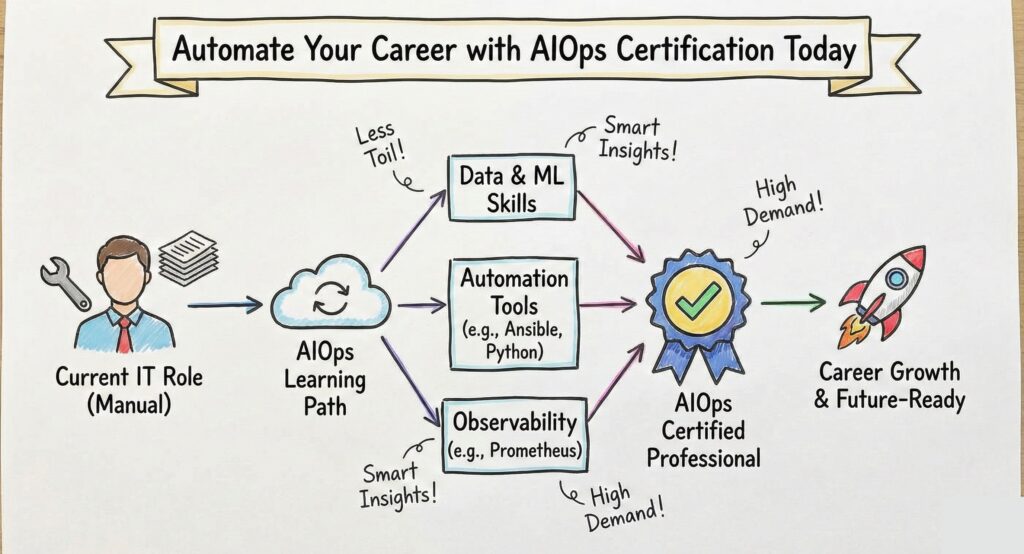
In today’s rapidly changing technology landscape, businesses depend heavily on their IT systems for smooth operations. When something goes wrong—whether it’s a slowdown, system failure, or downtime—IT teams need to act fast. AiOps (Artificial Intelligence for IT Operations) is a game-changing solution that helps solve these problems by applying AI (Artificial Intelligence) and ML (Machine Learning) to IT operations. The AiOps Certified Professional (AIOCP) certification equips professionals with the knowledge and skills to integrate AI and machine learning into IT operations. It enables teams to automate tasks, predict and prevent problems, and significantly improve system performance. This guide provides everything you need to know about the AIOCP certification, from the basics to the skills you’ll gain and how it can elevate your career.
What is AIOCP?
The AiOps Certified Professional (AIOCP) certification focuses on applying AI and ML techniques to IT operations. The certification program aims to equip professionals with the skills to use AI in areas like incident detection, event management, root cause analysis, and predictive maintenance.
The key benefit of AIOps is its ability to help organizations move from a reactive model (fixing problems after they happen) to a proactive one (identifying and solving issues before they arise). AIOps automates many traditional IT tasks, helping organizations stay ahead of potential problems and optimize their systems in real time.
Who Should Take AIOCP?
The AIOCP certification is ideal for professionals working in IT operations who want to gain expertise in using AI to improve their workflow. The following roles would benefit the most from this certification:
- DevOps Engineers: Those looking to improve the software development lifecycle with automation and AI.
- Site Reliability Engineers (SRE): Professionals focusing on system reliability, uptime, and performance.
- Platform Engineers: Engineers responsible for the infrastructure on which applications run.
- Cloud Engineers: Those working with cloud services who want to enhance monitoring and automation.
- Security Engineers: Professionals who want to integrate AI for real-time threat detection and response.
- Data Engineers: Engineers working with data who want to use AI to streamline data processes and optimize system performance.
- Engineering Managers: Managers who want to lead teams in implementing AIOps solutions for operational efficiency.
Whether you’re just starting or you have some experience, the AIOCP certification will help you build the foundation for integrating AI into IT operations.
Skills You’ll Gain
By taking the AIOCP certification, you’ll develop skills that are crucial in today’s IT landscape:
- Understanding AI and ML: Learn the basics of AI and machine learning, including how to apply them in IT operations.
- Master AIOps Tools: Gain practical knowledge of the tools used for monitoring and automating IT systems.
- Event Management: Learn how to automatically detect and manage events in real-time, reducing manual effort and downtime.
- Root Cause Analysis: Use AI to quickly identify and fix the root causes of system failures, improving recovery times.
- Predictive Analytics: Gain expertise in using AI to predict potential issues before they happen, helping to prevent failures.
- Data Integration: Understand how to integrate and manage large datasets and apply AI to analyze and optimize them.
- Real-Time Monitoring: Master AI-driven tools that monitor systems in real-time, automatically identifying anomalies or potential issues.
Real-World Projects You Should Be Able to Do
Upon completing the AIOCP certification, you will be able to implement and work on real-world projects that involve:
- Automating Incident Management: Set up systems that automatically detect and resolve incidents, reducing manual intervention.
- Implementing Predictive Maintenance: Use AI to predict when system components are likely to fail, allowing you to perform maintenance before failures occur.
- Automating Event Management: Configure AI-driven systems to categorize, prioritize, and manage events in real time.
- Integrating AI with IT Systems: Work on integrating AI solutions into existing IT infrastructures, improving overall system performance.
- Detecting Anomalies: Apply machine learning algorithms to detect unusual system behavior that may indicate a problem.
- Enhancing Security: Automate the detection of security threats and vulnerabilities, ensuring faster responses and proactive defense.
Preparation Plan
Proper preparation is key to successfully earning the AIOCP certification. Depending on how much time you have available, here’s a recommended study plan:
7–14 Days: Basic Understanding
- Day 1–3: Familiarize yourself with the basics of AI and machine learning concepts.
- Day 4–7: Understand the foundational principles of AIOps and how AI is applied in IT operations.
- Day 8–10: Explore the most widely used AIOps tools and their practical applications.
- Day 11–14: Learn about predictive maintenance and how AI can be used to monitor and optimize system performance.
30 Days: Comprehensive Preparation
- Week 1–2: Dive deeper into the AIOps tools you will be using, including configuration, integration, and monitoring.
- Week 3: Study advanced AI techniques like anomaly detection, root cause analysis, and predictive analytics.
- Week 4: Practice solving case studies and real-world scenarios to understand how AIOps is implemented in actual IT environments.
60 Days: Advanced Preparation
- Week 1–4: Focus on mastering advanced topics like machine learning algorithms and big data integration in AIOps.
- Week 5–6: Complete hands-on labs and projects that simulate real-world AIOps challenges.
- Week 7–8: Review your learning, practice case studies, and refine your knowledge in preparation for the exam.
Common Mistakes to Avoid
Here are some mistakes you should avoid while preparing for the AIOCP certification:
- Skipping the Fundamentals: A solid understanding of AI and machine learning is essential for AIOps. Don’t skip the basics, even if you’re eager to dive into the advanced topics.
- Focusing Only on Tools: While tools are crucial, understanding the theory and how to apply these tools effectively is just as important.
- Not Practicing Enough: AIOps requires hands-on experience. Try to implement what you learn in practical exercises and real-world scenarios.
- Rushing Through Case Studies: Case studies provide valuable insights into how AIOps works in the real world. Take the time to understand the details.
Best Next Certification After This
Once you’ve completed the AIOCP certification, you may want to further specialize with one of these certifications:
- Same Track: AiOps Mastery Certification (AIMC) – For those looking to master AIOps and become experts in AI-driven IT operations.
- Cross-Track: DevSecOps Certified Professional (DSOCP) – For those interested in integrating security with AIOps solutions.
- Leadership Track: Certified Cloud Architect (CCA) – Expand your knowledge of cloud technologies and how AIOps can be integrated with cloud environments.
Choose Your Path: 6 Learning Paths
The AIOCP certification is just one path in a vast and exciting world of IT operations. Here are some other tracks you can explore:
| Path | Focus |
|---|---|
| DevOps | Learn about automating IT processes, continuous integration, and improving software development workflows. |
| DevSecOps | Focus on integrating security practices at every stage of the software development lifecycle. |
| SRE | Learn to build scalable, reliable systems that can withstand high traffic and potential failures. |
| AIOps/MLOps | Master the use of AI and machine learning to automate and optimize IT operations. |
| DataOps | Explore how to integrate and automate data pipelines for improved agility and data management. |
| FinOps | Learn how to manage and optimize cloud costs with transparent financial operations. |
Role → Recommended Certifications
Based on your job role, here are the certifications that will help you advance in your career:
| Role | Recommended Certifications |
|---|---|
| DevOps Engineer | AIOCP, DevOps Certified Professional (DCP), SRE Certified Professional (SREC) |
| SRE | AIOCP, SRECP, Cloud Architect |
| Platform Engineer | AIOCP, DevOps Certified Architect (DCA) |
| Cloud Engineer | AIOCP, Cloud Certified Professional (CCP) |
| Security Engineer | AIOCP, DevSecOps Certified Professional (DSOCP) |
| Data Engineer | AIOCP, DataOps Certified Professional (DOCP) |
| FinOps Practitioner | AIOCP, FinOps Certified Practitioner (FOCP) |
| Engineering Manager | AIOCP, Leadership in DevOps, SRE Management Certification |
Top Training Institutions for AIOCP
The following institutions are known for providing high-quality AIOCP training:
1. DevOpsSchool
DevOpsSchool is a leading provider of DevOps, AIOps, and related certifications. They offer comprehensive training for AIOCP, focusing on practical knowledge and real-world scenarios. The training includes hands-on labs, expert guidance, and career support, ensuring students gain the skills needed to implement AIOps in IT environments.
2. Cotocus
Cotocus is known for its high-quality training programs in AIOps, DevOps, and machine learning. They offer specialized courses for AIOCP, providing in-depth knowledge of AI tools, predictive analytics, and real-time event management. Cotocus also offers customized training plans for organizations looking to scale AIOps capabilities.
3. ScmGalaxy
ScmGalaxy is a trusted name in IT training, offering comprehensive programs for DevOps and AIOps certifications, including AIOCP. Their training includes both theoretical concepts and practical applications, ensuring professionals are equipped with the tools and techniques needed to succeed in real-world IT operations.
4. BestDevOps
BestDevOps offers a wide range of certifications in DevOps and AIOps, including the AIOCP certification. They provide expert-led courses, industry-relevant materials, and hands-on practice to help professionals master AIOps tools and methodologies. Their training is designed for both beginners and experienced professionals.
5. DevSecOpsSchool
DevSecOpsSchool specializes in integrating security with AIOps and DevOps. Their certification programs, including AIOCP, teach how to incorporate security practices into AI-driven IT operations. With a focus on automation and real-time threat detection, their courses are ideal for security engineers and IT professionals looking to enhance system reliability and security.
6. SRESchool
SRESchool offers a targeted curriculum for Site Reliability Engineers (SREs), with a strong focus on AIOps to improve system uptime, reliability, and automation. Their AIOCP training combines the principles of AIOps with SRE practices, making it a perfect fit for professionals who want to manage scalable and resilient systems with AI tools.
7. AiOpsSchool
AiOpsSchool is dedicated to AIOps training and certifications. They provide in-depth courses that cover all aspects of AIOps, from tool usage to machine learning models and predictive analytics. AiOpsSchool helps professionals understand how to integrate AI into IT operations and take advantage of automation to boost operational efficiency.
8. DataOpsSchool
DataOpsSchool focuses on data-driven automation and AI integration for IT operations. Their AIOCP certification is ideal for data engineers and IT professionals looking to leverage AI to automate data workflows, enhance monitoring, and streamline system management. DataOpsSchool offers both theoretical knowledge and hands-on experience.
9. FinOpsSchool
FinOpsSchool blends financial operations with AIOps, offering training programs that teach professionals how to use AI and machine learning for cost optimization in cloud and IT environments. The AIOCP certification at FinOpsSchool prepares professionals to manage financial aspects of cloud infrastructure while ensuring system reliability and performance.
Frequently Asked Questions (FAQs) on AIOCP
1. What is the difficulty level of the AIOCP certification?
The AIOCP certification is considered an intermediate to advanced-level certification. It requires a solid understanding of IT operations, as well as some basic knowledge of AI and machine learning. If you are already familiar with IT processes or have experience in DevOps, the material will be more accessible. However, the certification is comprehensive, requiring hands-on practice with AIOps tools and techniques.
2. How much time should I dedicate to preparing for AIOCP?
Preparation time can vary depending on your current knowledge. Typically, it takes 30 to 60 days to prepare for AIOCP. If you have prior experience in IT operations and AI, you may be able to complete the certification in less time. For beginners, a more extended study period of around 60 days may be necessary to grasp the concepts fully.
3. Are there any prerequisites for AIOCP?
While there are no strict prerequisites, having a basic understanding of the following areas will help:
- IT Operations: Familiarity with basic IT systems, networks, and infrastructure.
- DevOps Practices: Knowledge of continuous integration, automation, and collaborative IT practices.
- Basic AI/ML Concepts: Understanding the fundamentals of artificial intelligence and machine learning.
If you lack some of this foundational knowledge, it’s a good idea to brush up on these topics before starting the certification.
4. What is the recommended learning sequence for AIOCP?
The learning sequence for AIOCP is designed to build your knowledge progressively:
- Start with AI and ML fundamentals: Understand the core concepts of AI and machine learning.
- Dive into AIOps principles: Learn what AIOps is, why it’s important, and how it transforms IT operations.
- Get hands-on with AIOps tools: Learn how to use AIOps tools for monitoring, automation, and predictive maintenance.
- Apply machine learning to IT operations: Explore real-time event management, anomaly detection, and predictive analytics.
- Work through real-world case studies: Apply your knowledge to real-world scenarios to understand how AIOps works in business environments.
5. How valuable is the AIOCP certification?
The AIOCP certification is highly valuable for IT professionals who want to be at the forefront of innovation in IT operations. With AIOps, organizations can automate tasks, reduce downtime, and improve system performance. This certification is particularly beneficial for roles like DevOps engineers, SREs, and platform engineers. As more companies adopt AI-driven solutions for IT, AIOCP-certified professionals will be in high demand.
6. What career outcomes can I expect from earning the AIOCP certification?
Earning the AIOCP certification can open several career paths in the IT industry, including:
- AIOps Engineer: Specialize in implementing AI-powered solutions to enhance IT operations.
- Site Reliability Engineer (SRE): Use AIOps to improve system reliability and uptime.
- IT Operations Manager: Lead teams to automate and optimize IT workflows with AI tools.
- Cloud Engineer: Integrate AIOps into cloud platforms to monitor, manage, and predict cloud service issues.
- Machine Learning Engineer: Work on AI models that optimize IT operations.
This certification can lead to better job security, promotions, and new career opportunities.
7. Is AIOCP recognized globally?
Yes, AIOCP is a globally recognized certification. As AIOps becomes more integrated into IT operations worldwide, professionals with AIOCP certification are increasingly sought after across different regions and industries. The certification is valued by companies that are looking to automate their IT operations and improve efficiency using AI.
8. How does AIOCP impact job performance?
Completing the AIOCP certification will enhance your ability to improve system reliability, optimize operational efficiency, and predict IT issues before they arise. You will be equipped with the skills to automate tasks such as incident detection, event management, and predictive maintenance—leading to reduced downtime, faster problem resolution, and improved IT system performance.
9. How can AIOCP benefit my organization?
For organizations, having AIOCP-certified professionals helps implement AI-driven solutions that can significantly improve operational efficiency, predict failures before they occur, and automate mundane tasks. This leads to cost savings, reduced downtime, and increased productivity. In short, AIOps enhances the overall IT system performance, which directly benefits the business.
10. Can AIOCP be completed online?
Yes, the AIOCP certification is available through online courses and self-paced learning programs. Many training providers offer online training and certification options, allowing you to complete the course remotely and at your own pace.
11. What resources do I need to prepare for AIOCP?
To successfully prepare for AIOCP, you will need:
- A solid study plan that covers all the topics in the syllabus.
- Hands-on practice with AIOps tools, either through labs or real-world environments.
- Reading materials such as books, online articles, and course notes that explain AIOps principles and practices.
- Online tutorials and videos for visual learners who need to see how AIOps tools work.
12. What are the common mistakes to avoid when preparing for AIOCP?
Here are some common mistakes candidates make when preparing for AIOCP:
- Skipping hands-on practice: AIOps involves practical application. Don’t just read; practice using the tools.
- Focusing too much on theory: While theory is important, real-world applications and tools are essential.
- Underestimating the time needed: Don’t rush through the material. Make sure to spend time mastering both the theory and practical aspects of AIOps.
- Not revising or reviewing: Always revisit and revise concepts to ensure you have a strong grasp on the material before taking the exam.
Frequently Asked Questions (FAQs) on AIOCP
- What is the difficulty level of AIOCP?
AIOCP is an intermediate-level certification that requires a foundational understanding of IT operations, AI, and DevOps. - How much time should I dedicate to preparing for AIOCP?
Typically, professionals should spend between 30 and 60 days preparing, depending on their background. - What are the prerequisites for AIOCP?
It’s helpful to have a basic understanding of IT operations, DevOps practices, and AI fundamentals. - What is the sequence of learning for AIOCP?
Start with the basics of AI and machine learning, then move on to AIOps tools and their applications in real-world scenarios. - How does AIOCP improve career prospects?
AIOCP equips you with the skills to use AI and machine learning to optimize IT operations, making you highly valuable to employers. - Is AIOCP recognized globally?
Yes, the AIOCP certification is widely recognized in the industry and is valuable in organizations globally. - Can I take AIOCP online?
Yes, AIOCP training is available online, allowing you to learn at your own pace. - How can I apply for AIOCP certification?
Visit the official certification page for details on the application process and available training options.
Testimonials
“I took the AIOCP certification to learn more about integrating AI into our IT operations. The course gave me hands-on experience with real-world tools, and now I can automate incident detection in our system!” – Rajesh Sharma, IT Operations Specialist
“As a DevOps engineer, the AIOCP certification helped me implement AI-driven solutions that dramatically improved our system’s efficiency. It’s a must for anyone serious about modern IT operations.” – Sonal Kumar, DevOps Engineer
Conclusion
The AiOps Certified Professional (AIOCP) certification is a powerful tool for anyone looking to enhance their skills in IT operations. Whether you are looking to automate workflows, predict potential issues, or improve system reliability using AI, AIOCP will provide the knowledge and expertise needed to succeed. Start your journey in AIOps today and take the first step toward transforming your career in IT operations.