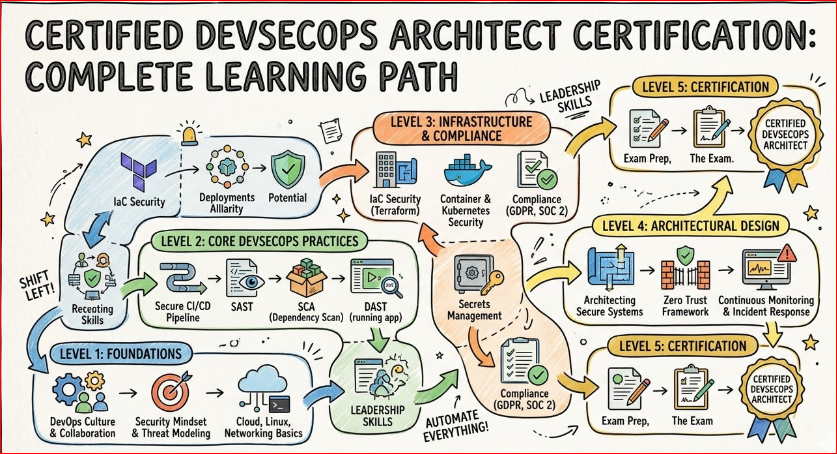
Development, operations, and security can no longer work in separate silos. They must come together with a solid architecture that keeps systems secure, scalable, and compliant from day one. The Certified DevSecOps Architect program from DevSecOpsSchool focuses exactly on this need. It helps engineers and leaders design secure-by-default DevOps ecosystems across code, pipelines, platforms, and cloud environments. In this guide, you will learn what this certification is, who should take it, what skills you gain, and how to prepare. You will also see learning paths, role-based recommendations, common mistakes, FAQs, and what to do after you become a Certified DevSecOps Architect.
What is Certified DevSecOps Architect?
Certified DevSecOps Architect is an advanced, architecture-focused certification for people who want to design, review, and guide secure DevOps environments end to end. It goes beyond tools and teaches you how to build a security-first blueprint for applications, CI/CD pipelines, cloud infrastructure, and containers.
The program from DevSecOpsSchool is designed for real-world use. It combines secure software design, automated security controls, compliance, risk management, and cultural change in DevOps teams.
Why Certified DevSecOps Architect Matters
Organizations today run on distributed systems, microservices, containers, and multi-cloud platforms. Attack surfaces are wide, and traditional “after-the-fact” security is no longer enough.
A DevSecOps Architect sits at the center of this ecosystem. This role designs security into every stage of the software lifecycle, from planning and coding to deployment and monitoring. As an architect, you help teams balance speed with safety, using automation, security-as-code, and clear guardrails that developers can follow without friction.
Key Skills Covered in Certified DevSecOps Architect
The Certified DevSecOps Architect program covers a wide range of architecture-level skills, including:
- Designing security-first CI/CD pipelines for hybrid and multi-cloud environments
- Applying Shift-Left security principles in design and development
- Implementing SAST, DAST, SCA, and dependency scanning across pipelines
- Architecting container and Kubernetes security (RBAC, network policies, admission controllers)
- Applying Infrastructure as Code and Compliance as Code patterns
- Building threat models, risk registers, and security metrics for leadership
- Designing logging, monitoring, and incident response architectures that support security and reliability
Mini-Guide: Certified DevSecOps Architect
What it is
Certified DevSecOps Architect proves that you can design and guide secure DevOps and cloud environments, not just operate tools. It shows you understand how to embed security into architecture, pipelines, and daily engineering practices.
Who should take it
- DevOps, SRE, and Platform engineers moving into security architecture roles
- Security engineers who want to work closely with DevOps and cloud teams
- Cloud and Infrastructure architects who must design secure CI/CD and platform patterns
- Engineering managers who lead security, DevOps, or reliability teams
Skills you’ll gain
- Designing secure CI/CD pipelines with built-in security gates
- Applying Shift-Left security in design, code review, and pipelines
- Architecting container, Kubernetes, and cloud security baselines
- Implementing security and compliance as code (policies, baselines, guardrails)
- Building and reviewing threat models for applications and platforms
- Creating monitoring, logging, and alerting setups that support detection and response
- Communicating security trade-offs and priorities to engineers and leaders
Real-world projects you should be able to do after it
- Design a secure CI/CD architecture for a microservices platform on a major cloud provider
- Define container and Kubernetes security policies for a production cluster
- Build a security blueprint for a new product: identity, access, encryption, logging, and compliance
- Create a DevSecOps roadmap for an organization, including tools, processes, and training
- Review an existing DevOps setup and propose a phased DevSecOps transformation
Preparation plan (7–14 days / 30 days / 60 days)
- 7–14 days (intensive track)
- Suitable for experienced DevOps, cloud, or security professionals already working hands-on.
- Focus on official curriculum, architecture diagrams, and case studies.
- Map your current systems to DevSecOps patterns and identify gaps.
- Solve scenario-based questions that test design choices and trade-offs.
- 30 days (standard track)
- Best for working engineers who can study a few hours per day.
- Week 1: DevSecOps basics, threats, and secure SDLC patterns.
- Week 2: CI/CD security, SAST/DAST/SCA, and secrets management.
- Week 3: Cloud, containers, and Kubernetes security architecture.
- Week 4: Governance, compliance, incident response, and mock tests.
- 60 days (deep-dive track)
- Ideal if you are new to security or architecture.
- Spend the first month strengthening DevOps, cloud, and basic security concepts.
- Spend the second month on full DevSecOps architecture patterns, labs, and practice designs.
- Build at least 2–3 mini reference architectures for different types of systems (e.g., monolith, microservices, data platform).
Common mistakes
- Focusing only on tools and not on architecture or processes
- Ignoring developer experience and creating “heavy” security gates
- Skipping fundamentals of cloud, networking, and identity before advanced topics
- Underestimating the time needed to review case studies and scenarios
- Not practicing how to explain design decisions in simple, business-friendly language
Best next certification after this
After Certified DevSecOps Architect, strong next options include:
- A deeper DevSecOps Practitioner or security engineering certification to enhance technical depth
- An SRE or Observability/Resilience certification to strengthen reliability and incident response skills
- A cloud security or architecture certification from a major cloud provider to deepen platform-specific expertise
Certification Table
Below is a table placing Certified DevSecOps Architect in a broader security and DevOps learning track context (example structure combining foundation, professional, and architect levels).
| Track | Level | Who it’s for | Prerequisites | Skills covered | Recommended order |
|---|---|---|---|---|---|
| DevSecOps | Foundation | Developers, DevOps beginners, junior engineers | Basic Linux, Git, CI/CD concepts | DevSecOps basics, SDLC overview, common threats, basic security tools, culture and collaboration | 1 (starter) |
| DevSecOps | Professional | Working DevOps, Cloud, Security engineers | DevOps experience, basic security understanding | Secure pipelines, SAST/DAST/SCA integration, secrets management, IaC security, vulnerability management | 2 (intermediate) |
| DevSecOps | Architect | Senior engineers, architects, managers | Strong DevOps and cloud background, security basics | Security architecture, threat modeling, multi-cloud design, compliance as code, leadership and strategy | 3 (advanced core) |
| SRE | Specialist | SREs, Platform and Reliability engineers | Linux, networking, observability basics | SLOs, SLIs, error budgets, incident response, reliability patterns | Parallel to 2–3 |
| AIOps/MLOps | Specialist | Data, ML, and platform engineers | DevOps basics, data and ML familiarity | ML pipeline security, AIOps, anomaly detection, predictive monitoring | After 3 |
| DataOps | Specialist | Data engineers, BI engineers | SQL, ETL basics, data platform experience | Secure data pipelines, data governance, quality, and compliance | After 2–3 |
| FinOps | Specialist | FinOps, Cloud, and Engineering managers | Cloud usage basics, finance awareness | Cost governance, budgeting, chargeback/showback, security and compliance-linked cost controls | Parallel to 3 |
Choose Your Path: 6 Learning Paths
This section shows how Certified DevSecOps Architect fits into different strategic learning paths.
1. DevOps Path
- Start with DevOps foundations and CI/CD basics.
- Move into secure pipelines and infrastructure automation.
- Use Certified DevSecOps Architect as your advanced security and architecture layer.
Example sequence:
DevOps Foundation → DevOps Professional → Certified DevSecOps Architect
2. DevSecOps Path
- Begin with DevSecOps fundamentals and secure SDLC.
- Learn how to integrate SAST, DAST, SCA, and compliance into CI/CD.
- Take Certified DevSecOps Architect as your core architect-level certification.
Example sequence:
DevSecOps Foundation → DevSecOps Professional → Certified DevSecOps Architect
3. SRE Path
- Build strong skills in reliability, SLOs, and incident management.
- Learn how security, reliability, and observability work together.
- Use Certified DevSecOps Architect to design secure, reliable platforms.
Example sequence:
SRE Foundation → SRE/Observability Specialist → Certified DevSecOps Architect
4. AIOps / MLOps Path
- Focus on ML pipelines, data workflows, and automation.
- Add security and compliance to data and ML platforms.
- Use Certified DevSecOps Architect to design secure DevSecOps and MLOps platforms.
Example sequence:
MLOps/DataOps Foundation → AIOps/MLOps Professional → Certified DevSecOps Architect
5. DataOps Path
- Start with DataOps basics: pipelines, quality, and governance.
- Integrate security around data access, encryption, and compliance.
- Apply DevSecOps architecture patterns to analytical and data platforms.
Example sequence:
DataOps Foundation → DataOps Professional → Certified DevSecOps Architect
6. FinOps Path
- Focus on cloud cost visibility, budgets, and showback/chargeback.
- Learn how cost, security, and governance tie together.
- Use Certified DevSecOps Architect to design secure, cost-aware architectures with guardrails.
Example sequence:
Cloud/FinOps Foundation → FinOps Practitioner → Certified DevSecOps Architect
Role → Recommended Certifications Mapping
Below is a high-level mapping of roles to recommended certification focus areas including Certified DevSecOps Architect.
| Role | Primary focus certifications | How Certified DevSecOps Architect fits |
|---|---|---|
| DevOps Engineer | DevOps Foundation, DevOps Professional, CI/CD-focused training | Becomes the advanced security and architecture layer for your pipelines |
| SRE | SRE/Observability certifications, Reliability engineering | Adds security architecture to your reliability and incident work |
| Platform Engineer | Cloud Architect, Kubernetes/Platform engineering certifications | Provides security-by-design patterns for platforms and clusters |
| Cloud Engineer | Cloud Associate/Professional, Infrastructure automation | Adds deep DevSecOps patterns to your cloud designs |
| Security Engineer | Application security, Cloud security, DevSecOps certifications | Becomes your bridge into DevOps, CI/CD, and architecture-level decisions |
| Data Engineer | DataOps, Data platform, ETL certifications | Guides secure data platform pipelines and DevSecOps-minded designs |
| FinOps Practitioner | FinOps, Cloud cost management certifications | Helps connect cost, governance, and security at the architecture level |
| Engineering Manager | Leadership, Cloud/DevOps, security basics | Gives you frameworks to guide DevSecOps strategy and team roadmaps |
List of Top Institutions for Certified DevSecOps Architect Training
DevOpsSchool
DevOpsSchool offers practical, hands-on training for Certified DevSecOps Architect and related DevOps, SRE, and cloud programs. Their focus is on real project scenarios and toolchains used in production environments. They often combine workshops, labs, and architectural reviews so learners can apply concepts quickly on the job.
Cotocus
Cotocus provides consulting-led training programs where architecture and implementation go hand in hand. For DevSecOps Architect tracks, they focus on design reviews, transformation roadmaps, and organization-level adoption patterns. This is especially useful if you want to align certification learning with your company’s long-term DevSecOps strategy.
ScmGalaxy
ScmGalaxy focuses on software configuration management, CI/CD, and DevOps toolchains, which are strong foundations for DevSecOps architectures. Their programs help participants understand how code, builds, artifacts, and releases fit into a broader secure pipeline design. This makes it easier to apply DevSecOps Architect patterns in real CI/CD setups.
BestDevOps
BestDevOps curates and promotes training, articles, and learning resources around DevOps, DevSecOps, and SRE. For aspiring DevSecOps Architects, it can serve as a central place to discover courses, webinars, and learning paths that keep you updated on industry practices and tools.
devsecopsschool.com
DevSecOpsSchool is the direct provider of the Certified DevSecOps Architect program. Their portfolio includes DevSecOps, application security, and related certifications built around secure SDLC, pipelines, and cloud-native security. The Architect-level course focuses on strategy, blueprints, and real-world implementation patterns across multiple environments.
sreschool.com
SRESchool specializes in SRE, reliability, and observability training. For DevSecOps Architects, this is valuable because secure architectures must also be reliable and observable. Programs from SRESchool help you design systems that are both secure and resilient, with strong monitoring, SLOs, and incident response.
aiopsschool.com
AIOpsSchool focuses on AI-driven operations, proactive monitoring, and intelligent automation. This complements DevSecOps architecture by showing how machine learning and automation can be used to detect anomalies, predict issues, and respond faster to security and reliability events.
dataopsschool.com
DataOpsSchool covers secure and reliable data pipelines, governance, and analytics environments. When you combine these skills with DevSecOps architecture, you can design data platforms that are secure, compliant, and ready for large-scale analytics and AI workloads.
finopsschool.com
FinOpsSchool focuses on cloud financial operations and cost governance. DevSecOps Architects benefit from this perspective by designing architectures that are secure, compliant, and cost-aware at the same time. This is especially important for managers who must justify investments and manage budgets.
Next Certifications to Take After Certified DevSecOps Architect
1. Same track (deepening DevSecOps)
- Choose an advanced DevSecOps or security engineering certification that goes deeper into specific topics such as secure coding, cloud security, or container security.
- Focus on advanced threat modeling, red-teaming, or supply chain security to increase your depth.
2. Cross-track (broadening your scope)
- SRE/Observability certifications to strengthen reliability, performance, and incident skills
- DataOps or MLOps certifications to apply DevSecOps patterns to data and ML platforms
- FinOps certifications to connect security, cost, and governance in cloud environments
3. Leadership (strategy and management)
- Architecture or enterprise-level security programs that focus on governance, risk, and compliance (GRC)
- Management and leadership-focused courses where you learn to build roadmaps, influence culture, and lead change programs in large organizations
FAQs on Certified DevSecOps Architect
- Is Certified DevSecOps Architect very difficult?
It is challenging but manageable for working engineers with solid DevOps and cloud basics. The exam and content focus more on scenarios and architecture decisions than on memorizing tool commands. - How much time do I need to prepare?
Most professionals need 30–60 days of part-time study, depending on their experience. If you already work in DevOps and security daily, an intensive 7–14 day plan can be enough with focused effort. - What are the prerequisites for Certified DevSecOps Architect?
You should be comfortable with DevOps concepts, cloud platforms, CI/CD pipelines, and basic application security. Some experience in architecture or technical leadership is very helpful but not mandatory. - Do I need coding experience for this certification?
You do not need to be a full-time developer, but you should understand how code moves through pipelines and where security checks fit. Basic scripting and reading code samples is useful. - Is this certification suitable for managers?
Yes, especially for engineering managers, security leads, and platform leaders who must guide DevSecOps strategy. It helps managers understand trade-offs, risks, and architecture patterns so they can make better decisions. - What kind of exam questions should I expect?
Expect scenario-based questions that test your ability to design, review, and improve DevSecOps architectures. You may see case studies about pipelines, cloud environments, or security incidents where you must choose the best pattern. - How does this certification help my career?
It positions you for architect-level roles in DevSecOps, security architecture, platform engineering, and cloud governance. It also strengthens your profile for leadership roles where strategy and security are important. - Is there hands-on content, or is it theory only?
Most modern DevSecOps Architect programs mix conceptual content with labs, case studies, and reference architectures. You will be expected to apply ideas to real or realistic systems. - Can I do this certification while working full-time?
Yes. The typical 30–60 day plan is designed for professionals who study in the evenings or weekends. The key is consistency and focusing on architecture thinking instead of tool-by-tool memorization. - Do I need previous DevSecOps certifications first?
Not always, but foundation or professional-level DevSecOps or security certifications will make the Architect-level program easier. If you are completely new to security, start with a foundation-level course first. - How does this compare to general cloud architect certifications?
Cloud architect certifications focus on broader cloud design, performance, and cost. Certified DevSecOps Architect adds a deep security and SDLC view, making you more focused on secure pipelines and engineering workflows. - Is Certified DevSecOps Architect relevant outside India?
Yes. DevSecOps patterns, cloud platforms, CI/CD tools, and security frameworks used in these programs are global. The skills are applicable in organizations worldwide. - What tools are typically covered or referenced?
You can expect to see scanners and platforms like SAST, DAST, SCA tools, secrets managers, and cloud security services across major providers. Exact tools vary, but the focus is on patterns that outlast specific products. - Will this help me move from hands-on engineer to architect?
Yes. The certification emphasizes design decisions, trade-offs, and communication, which are core architect skills. It can be a strong step when you want to shift from “doing” to “designing and guiding”.
FAQs Specifically on Certified DevSecOps Architect
- What is the main objective of Certified DevSecOps Architect?
The main objective is to prepare you to design secure-by-default DevOps and cloud environments, integrating security across SDLC, pipelines, and platforms. - Who is the ideal candidate for this certification?
Ideal candidates are mid to senior DevOps, SRE, security, cloud, and platform engineers who want to move into architecture or leadership roles. - How is the Certified DevSecOps Architect exam structured?
The exam is typically online, uses scenario and multiple-choice questions, and focuses on architecture decisions rather than pure theory. - What topics are most important in the exam?
Key topics include secure CI/CD design, threat modeling, container and cloud security architecture, compliance as code, and incident response design. - Does the program include case studies and real-world examples?
Yes, case studies and sample architectures are a core part of the learning journey so you can relate concepts to complex systems. - How can I practice for Certified DevSecOps Architect?
Practice by designing and reviewing sample architectures, creating security blueprints for your own systems, and solving scenario-based questions. - Can this certification help me switch from pure security to DevSecOps?
Yes. It gives you the DevOps and CI/CD perspective that pure security roles sometimes miss, making you more effective in cross-functional teams. - Is Certified DevSecOps Architect future-proof?
The underlying patterns of DevSecOps, cloud security, and architecture thinking are very stable, even as tools change. This makes the certification highly relevant for the long term.
Conclusion
Certified DevSecOps Architect is a powerful next step for engineers and managers who want to design secure, reliable, and scalable systems instead of treating security as a late add-on. It sits at the intersection of DevOps, security, cloud, and reliability, and helps you think like an architect who can guide teams and organizations through real transformation. If you are a DevOps, SRE, Platform, Security, Data, or Cloud professional looking to grow into architecture and leadership, this certification can become a central pillar of your career path. Start with a realistic study plan, practice real-world scenarios, and use this guide as your roadmap to becoming a Certified DevSecOps Architect.