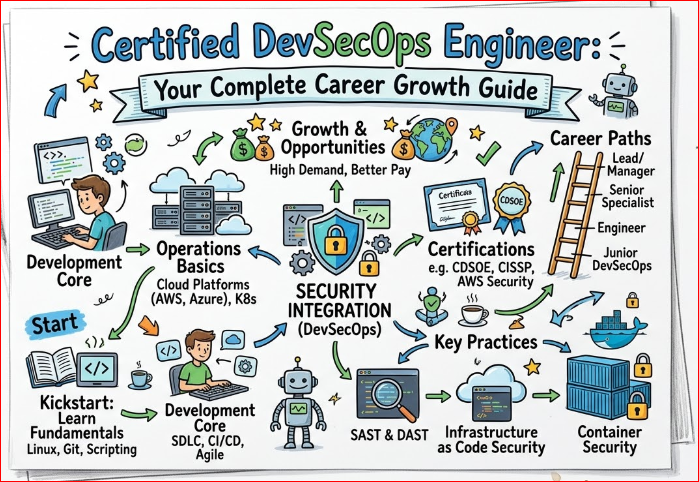
Modern software teams move fast, but security risks move even faster. When code, infrastructure, and services are changing every day, old security models no longer work. DevSecOps has emerged as a practical way to weave security into every part of the delivery lifecycle, from planning and coding to deployment and operations. Certified DevSecOps Engineer is a focused certification that helps working engineers and managers prove that they can build, ship, and run software securely at scale. This guide is written for software engineers, DevOps and platform teams, SREs, security engineers, and managers in India and across the world who want a clear, practical path into DevSecOps.
Key Certification Overview
What it is
Certified DevSecOps Engineer is a practitioner-level certification that confirms you can integrate security into modern DevOps environments. It covers secure SDLC practices, CI/CD security, container and cloud security, and security automation. The program is designed to be directly usable in real projects.
Who should take it
- DevOps engineers who want to strengthen their security skills
- Software engineers who want to design and ship secure applications
- Security engineers who want to work closely with DevOps and platform teams
- SREs and platform engineers responsible for production systems and reliability
- Cloud engineers managing infrastructure, services, and deployments
- Engineering managers and team leads who own delivery and risk together
Skills you will gain
- Understanding of DevSecOps principles, terminology, and culture
- Secure SDLC practices across planning, coding, testing, and release
- CI/CD security patterns, including static and dynamic scanning
- Dependency and container security fundamentals
- Secrets management and secure configuration practices
- Infrastructure as Code (IaC) security and policy enforcement
- Cloud security basics for common platforms and services
- Security monitoring, alerting, and incident basics for DevOps teams
Real‑world projects you should be able to do after it
- Build a CI/CD pipeline that includes code, dependency, and container scans
- Integrate secret management tools into applications and pipelines
- Apply security policies to IaC templates, Kubernetes manifests, and cloud resources
- Design a secure deployment workflow for microservices-based applications
- Implement basic hardening and access control for critical services
- Work with product, security, and operations teams to roll out security checks in stages
Preparation plan (7–14 days / 30 days / 60 days)
You can choose a preparation route based on your time and background.
7–14 days (fast track):
- Daily 3–4 hours of focused study and labs
- Day 1–3: DevSecOps fundamentals, SDLC security patterns
- Day 4–7: CI/CD security, scanning, secrets, and small pipeline project
- Day 8–14: Container, IaC, and cloud security basics; practice scenarios and review
30 days (balanced):
- Daily 1–2 hours of study and hands-on work
- Week 1: DevSecOps culture, SDLC, threat basics, and common patterns
- Week 2: CI/CD security, scanning tools, and secure pipeline design
- Week 3: Container, Kubernetes, and IaC security foundations
- Week 4: Cloud security, monitoring, a full end-to-end project, and exam-style practice
60 days (deep learning with work schedule):
- 3–5 hours per week with more time for practice
- First 4 weeks: Concepts, reading, and small lab exercises
- Final 4 weeks: Larger projects, pipeline designs, mock exercises, and evaluation
- Use this track if you are balancing a busy job and want to absorb steadily
Common mistakes
- Thinking DevSecOps is only about adding security tools, not changing workflows or culture
- Overloading pipelines with checks that slow teams down, without explaining business value
- Ignoring developer experience, making security feel like a barrier instead of support
- Focusing only on application security and forgetting infrastructure, cloud, and runtime risks
- Studying only theory and documentation while skipping hands-on labs and projects
- Treating DevSecOps as a one-time project instead of an ongoing capability
Best next certification after this
After completing Certified DevSecOps Engineer, good next steps are:
- Same track: An advanced DevSecOps or cloud-native security certification, focusing on containers, Kubernetes, and cloud platforms.
- Cross track: An SRE, cloud architect, or platform engineering certification to broaden reliability and infrastructure depth.
- Leadership: A program in security leadership, governance, or technical management to lead secure delivery at team or organization level.
Certification Table
Here is a structured view of the Certified DevSecOps Engineer certification in the context of career tracks.
| Track | Level | Who it’s for | Prerequisites | Skills covered | Recommended order |
|---|---|---|---|---|---|
| DevSecOps | Core / Practitioner | DevOps, cloud, platform, security engineers; managers | Basic Linux, Git, CI/CD, one language, cloud basics | DevSecOps principles, SDLC security, CI/CD security, container and IaC security, cloud security, monitoring | After basic DevOps or cloud experience, before deep security specializations |
This table helps you see where this certification fits into your overall learning journey.
Choose Your Path – 6 Learning Paths
DevSecOps does not live in isolation. It connects with several career tracks. Here is how it fits into six popular paths.
DevOps path
In the DevOps path, Certified DevSecOps Engineer acts as a security upgrade to your existing skills. You move from building pipelines and automation to building secure pipelines and automation. This makes you more valuable to teams that need both speed and safety.
DevSecOps path
In the DevSecOps path itself, this certification is a core foundation. It gives you a clear overview of how to apply security across repositories, pipelines, environments, and teams. After this, you can choose to specialize in cloud security, container security, or application security.
SRE path
For SREs, DevSecOps skills link reliability with security. Many incidents come from insecure configurations, poor access control, or unpatched services. By understanding DevSecOps practices, SREs can design systems that reduce both outages and security incidents.
AIOps/MLOps path
In AIOps and MLOps, automation and data pipelines are central. DevSecOps helps you secure pipelines that handle sensitive data, models, and infrastructure changes. You learn to add checks, controls, and monitoring that protect your automation and ML workflows.
DataOps path
DataOps professionals build and manage data pipelines, storage, and transformations. DevSecOps concepts help you treat data pipelines with the same care as application pipelines. You can add access controls, scanning, and policy checks to protect data and meet compliance needs.
FinOps path
FinOps practitioners focus on cloud cost, efficiency, and governance. DevSecOps brings in the security dimension, so guardrails, policies, and access rules support both cost control and risk reduction. This helps organizations run secure and cost-effective cloud operations.
Role → Recommended Certifications Mapping
This mapping shows how Certified DevSecOps Engineer fits common roles and what certification order makes sense.
| Role | How DevSecOps fits | Recommended certifications order |
|---|---|---|
| DevOps Engineer | Adds security depth to pipelines and automation | DevOps foundation → Certified DevSecOps Engineer → Cloud or container security specialist |
| SRE | Connects reliability, risk, and security | SRE fundamentals → Certified DevSecOps Engineer → Advanced reliability or resilience programs |
| Platform Engineer | Strengthens platform guardrails, policies, and secure defaults | Cloud/platform basics → Certified DevSecOps Engineer → Kubernetes and IaC security |
| Cloud Engineer | Helps secure cloud workloads, services, and deployment workflows | Cloud associate level → Certified DevSecOps Engineer → Cloud security specialization |
| Security Engineer | Brings security closer to delivery and engineering practice | Security foundation → Certified DevSecOps Engineer → Application or cloud-native security track |
| Data Engineer | Builds secure data pipelines and platforms | Data engineering basics → Certified DevSecOps Engineer → Data security/governance certification |
| FinOps Practitioner | Aligns security guardrails with cost-efficient cloud usage | Cloud and FinOps basics → Certified DevSecOps Engineer → Governance and policy programs |
| Engineering Manager | Guides teams to deliver quickly and safely | Engineering leadership basics → Certified DevSecOps Engineer → Security and risk leadership |
How Certified DevSecOps Engineer Supports Your Career
For engineers in India and global markets, DevSecOps is a strong differentiator. When recruiters compare profiles with similar DevOps or cloud skills, the ability to handle security often stands out. Certified DevSecOps Engineer signals that you understand how to secure modern systems, not just build them.
For managers and leaders, this certification gives a practical view of how to blend security with delivery. You can design roadmaps, review architectures, and discuss trade‑offs in a more confident way. It becomes easier to align engineering plans with compliance, risk, and business needs.
Top Institutions for Certified DevSecOps Engineer Training
The following institutions provide training and support that can help you prepare for Certified DevSecOps Engineer and related paths.
DevOpsSchool
DevOpsSchool offers hands-on DevOps and DevSecOps training with real project examples. Their courses typically cover CI/CD, cloud, containers, and security automation. You can expect a mix of concepts, tools, and labs aimed at working professionals.
Cotocus
Cotocus focuses on role‑based learning paths and career outcomes. Their programs often combine instructor guidance with practical labs and assignments. For DevSecOps, they help participants understand how to apply security practices across development and operations teams.
ScmGalaxy
ScmGalaxy provides training around version control, build systems, and CI/CD pipelines. With DevSecOps topics, they emphasize adding security checks into existing workflows. This can be useful if your organization already has pipelines and wants to introduce security gradually.
BestDevOps
BestDevOps curates learning content and training programs across the broader DevOps space. Their approach aims to simplify complex ideas so that working engineers can apply them quickly. DevSecOps programs here can give you structured, step‑by‑step learning paths.
devsecopsschool.com
devsecopsschool.com focuses directly on DevSecOps and secure delivery. Their training and certification programs cover secure SDLC, CI/CD security, infrastructure security, and more. This is a strong option if DevSecOps is your main track and long‑term focus.
sreschool.com
sreschool.com specializes in SRE and reliability engineering. When combined with DevSecOps, this helps professionals link reliability, performance, and security. It is well‑suited for people working on production systems and critical services.
aiopsschool.com
aiopsschool.com concentrates on AIOps, automation, and intelligent operations. DevSecOps knowledge, combined with AIOps, allows you to build systems that detect risks and anomalies earlier. This is helpful in environments with high complexity and constant change.
dataopsschool.com
dataopsschool.com focuses on DataOps and data engineering practices. Adding DevSecOps concepts to that knowledge helps secure data pipelines and processing platforms. This is important in organizations where data is central to products and decisions.
finopsschool.com
finopsschool.com provides training around cloud cost optimization and financial operations. Integrating DevSecOps into FinOps thinking helps you design secure and cost‑efficient architectures. It supports teams who must balance budgets, performance, and risk.
FAQs on Certified DevSecOps Engineer
1. How difficult is Certified DevSecOps Engineer?
The certification is moderate to challenging, depending on your DevOps and cloud background. The main challenge is the breadth of topics, not advanced theory. With steady practice and clear focus, most working professionals can handle it.
2. How much time should I plan for preparation?
Many engineers complete preparation in 30–60 days while working full‑time. If you already have strong DevOps experience, a focused 2–3 week plan is possible. The main success factor is consistent hands‑on practice.
3. Do I need a strong security background before attempting it?
You do not need to be a security specialist. Basic familiarity with vulnerabilities, authentication, authorization, and networking is enough to begin. The certification will guide you towards more structured, practical security skills.
4. What are the main prerequisites?
You should know Git, basic CI/CD concepts, one programming or scripting language, and core cloud ideas. Understanding containers and Kubernetes is helpful but not mandatory. The ability to learn tools quickly is more important than any single tool.
5. How does this certification help with career growth?
It shows that you can secure modern delivery pipelines and cloud environments. This is attractive for roles in DevOps, platform engineering, SRE, cloud engineering, and security. It can also support internal promotions and leadership discussions.
6. Is this certification relevant for managers?
Yes, managers gain enough depth to plan secure delivery processes, evaluate proposals, and guide teams. It helps them talk to both security and engineering in practical terms.
7. Can beginners attempt Certified DevSecOps Engineer?
Complete beginners will find it hard. It is better to first complete a basic DevOps or cloud foundation course. Once you are comfortable with pipelines and cloud basics, DevSecOps becomes much easier to understand.
8. What tools do I need to know?
You should be comfortable with at least one CI/CD platform, one code scanning tool, one dependency scanner, and basic container tools. You should also explore secrets management, IaC scanning, and cloud security tooling. The key is to understand patterns rather than memorize specific tools.
9. How should I organize my study plan?
Divide your plan into concepts, tools, and projects. Start with principles and patterns, then move into tools, then build at least one end‑to‑end project. Review regularly and keep notes of what you implement.
10. What projects should I complete before the exam?
Build a sample application with a pipeline that does code scanning, dependency scanning, container scanning, and basic infrastructure checks. Deploy to a cloud environment or Kubernetes and secure the main components. Document your assumptions and controls.
11. Is DevSecOps knowledge useful outside of pure DevOps roles?
Yes, it is useful for SREs, platform engineers, cloud engineers, data engineers, and even FinOps practitioners. Any role that touches production systems and cloud benefits from understanding security patterns.
12. What should I learn after finishing this certification?
You can deepen your skills in application security, cloud security, Kubernetes security, SRE, or platform engineering. Alternatively, you can move towards leadership and governance roles where you shape security strategy.
FAQs
1. What does the Certified DevSecOps Engineer role cover?
The Certified DevSecOps Engineer role focuses on joining development, operations, and security into one flow. It covers designing secure pipelines, automating security checks, and helping teams build safer applications and services.
2. Why should I choose the Certified DevSecOps Engineer certification?
You should choose it if you want to stay relevant in modern cloud and DevOps environments where security is critical. This certification shows employers that you can handle both delivery speed and security needs together.
3. What background is helpful before starting this certification?
It helps if you already know basic Linux, Git, CI/CD concepts, and at least one programming language. Some comfort with cloud platforms and basic security ideas also makes the learning journey smoother.
4. Is Certified DevSecOps Engineer suitable for developers?
Yes, it is very useful for developers who want to write secure code and understand how their changes move through pipelines. It helps them work better with operations and security teams and avoid common security mistakes in code.
5. Can SREs and platform engineers benefit from this certification?
SREs and platform engineers can strongly benefit because they handle production systems and pipelines every day. With this certification, they learn how to add guardrails and security checks to the platforms they maintain.
6. What are the main topics covered in Certified DevSecOps Engineer?
Main topics include secure SDLC, CI/CD security, static and dynamic testing tools, software composition analysis, container and Kubernetes security, secrets management, policy-as-code, and basic cloud security controls.
7. How does this certification change my day-to-day work?
After certification, your daily work includes looking at both features and risks. You will plan pipelines with security in mind, review configurations, help fix vulnerabilities, and support teams to adopt safer patterns.
8. What is a good way to prove my Certified DevSecOps Engineer skills?
A good way is to build small demo projects that use secure pipelines, scanning tools, and safe deployments. You can document these projects, share them with recruiters or managers, and talk through your design choices in interviews.
Next Certifications to Take
Once you complete Certified DevSecOps Engineer, you can decide your next move based on your goals.
- Same track: Choose advanced DevSecOps, cloud security, or container security certifications. These will deepen your skills in securing modern platforms.
- Cross track: Explore SRE, platform engineering, or cloud architect certifications. These broaden your understanding of reliability, design, and operations.
- Leadership: Consider programs that cover security leadership, governance, and technical strategy. These help you influence direction at team or organization level.
This three‑way branching gives you flexibility while still building on your DevSecOps foundation.
Conclusion
Certified DevSecOps Engineer is a practical way to align software delivery with modern security expectations. It gives engineers and managers a clear framework for building secure pipelines, infrastructure, and processes without sacrificing speed. Whether you are in DevOps, SRE, security, data, or cloud, this certification can become a central part of your growth plan. By following a structured preparation plan, building real projects, and connecting this certification with your role, you can turn DevSecOps into a long‑term career advantage. It helps you speak the language of engineering, security, and business at the same time, which is a rare and valuable combination.