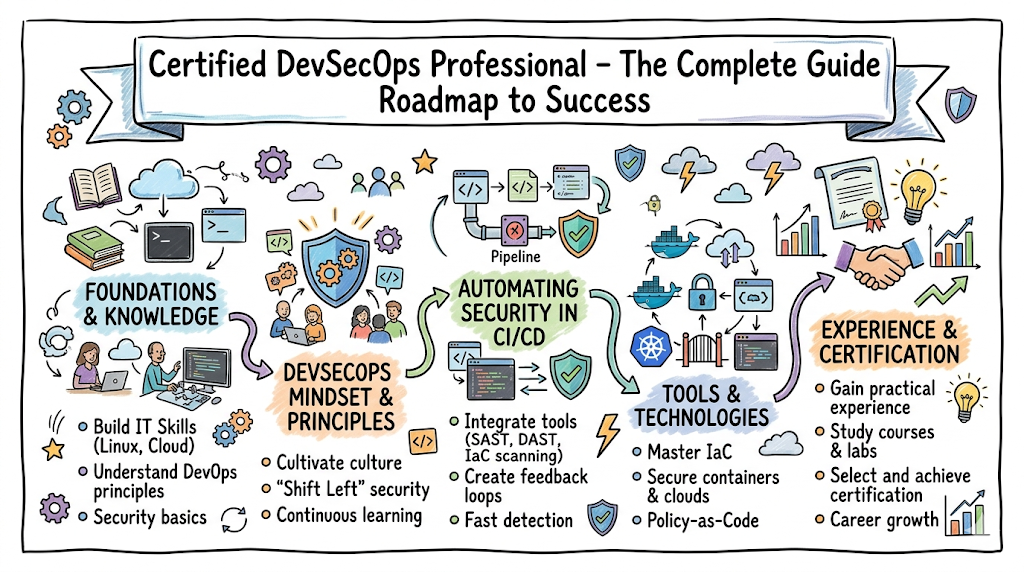
Introduction
The Certified DevSecOps Professional stands as a vital milestone for engineers who want to integrate security into the heart of the software delivery process. In the modern landscape, security can no longer exist as an isolated silo or a final checkpoint that happens just before a production release. As a senior mentor with over two decades of experience, I have observed that the most resilient systems are built by professionals who understand that security is a shared engineering responsibility. This guide is written to help you navigate the complexities of this field and determine how this specific certification can accelerate your career trajectory.
Choosing to pursue this credential through DevSecOpsSchool provides a structured and hands-on approach to mastering the tools and cultural shifts required for modern engineering. This blog is intended for software engineers, site reliability experts, and technical managers who need a clear, unbiased evaluation of the program’s value and real-world application. By the end of this guide, you will have a comprehensive understanding of the certification tracks, the preparation required, and the long-term impact on your professional growth. My goal is to empower you with the insights needed to make an informed decision about your learning path in the security-automation domain.
What is the Certified DevSecOps Professional?
The Certified DevSecOps Professional represents a specialized standard for engineers who are tasked with securing modern, automated software factories. It exists because traditional perimeter-based security is insufficient for cloud-native architectures where deployments happen multiple times a day. This certification proves that a professional possesses the technical depth to automate security gates within a continuous integration and continuous deployment (CI/CD) pipeline.
This program emphasizes real-world, production-focused learning over purely theoretical knowledge. It focuses on the actual implementation of tools and the configuration of security policies that protect code, containers, and cloud infrastructure. By aligning with modern engineering workflows, the certification ensures that participants can handle the velocity of high-performing development teams without compromising on the safety and integrity of the system.
In enterprise practices, the certification acts as a validation of an engineer’s ability to manage risk at scale. It covers the end-to-end lifecycle, from secure coding and dependency management to infrastructure auditing and secrets rotation. Ultimately, it represents a shift in mindset—moving from “policing” developers to “empowering” them with the automated tools they need to write and deploy secure software independently.
Who Should Pursue Certified DevSecOps Professional?
This certification is designed for software engineers who want to take full ownership of their code’s security posture and understand the underlying platforms they deploy to. Site Reliability Engineers (SREs) and platform specialists will find immense value here, as it provides the techniques needed to build resilient and compliant infrastructure. Security analysts who wish to move away from manual checklists and into the world of automation and scripting will also find this path highly beneficial.
The program is structured to cater to a wide range of experience levels. Beginners will find a clear roadmap that introduces them to the complex intersection of development, operations, and security. Experienced engineers can use the program to formalize their skills and stay updated on the latest cloud-native security standards. Technical leaders and engineering managers should pursue this to understand the strategic and cultural requirements for a successful DevSecOps transition within their organizations.
The relevance of the Certified DevSecOps Professional is particularly high in India’s growing tech hubs and among global capability centers (GCCs) worldwide. As companies in finance, healthcare, and e-commerce face stricter regulatory requirements, the demand for certified security engineers continues to soar. Whether you are looking to secure a promotion, pivot to a specialized role, or lead a digital transformation project, this certification provides the necessary technical foundation and professional recognition.
Why Certified DevSecOps Professional is Valuable and Beyond
The value of this certification lies in its focus on enduring engineering principles that remain relevant even as specific tools evolve. As organizations continue their journey into the cloud, the complexity of securing distributed systems increases, making automated security a non-negotiable requirement for business continuity. This program ensures that you stay relevant by teaching you the core logic of security automation, which is applicable across different technology stacks.
Enterprise adoption of DevSecOps is accelerating because it significantly reduces the cost of remediating security flaws. Professionals who can catch vulnerabilities early in the development lifecycle are viewed as high-value assets who protect both the company’s finances and its brand reputation. This role is one of the few specializations where the demand consistently outpaces the supply of qualified talent, leading to excellent job security and competitive compensation packages.
Investing time in this certification provides a strong return on career investment because it positions you at the critical intersection of three major domains. This “triple-threat” skill set—development, operations, and security—makes you eligible for senior-level positions such as Lead Security Engineer or DevSecOps Architect. It provides the technical depth required to lead high-stakes projects and ensures you are prepared for the next decade of engineering challenges where trust and safety are paramount.
Certified DevSecOps Professional Certification Overview
The program is delivered via the official course URL and is hosted on the DevSecOpsSchool website. It is designed to be a practical, lab-based certification that mirrors the challenges encountered in real-world production environments. The certification levels are structured to guide a professional from the foundational concepts of security culture to the advanced technical details of architectural design and governance.
The assessment approach is rigorous, focusing on the candidate’s ability to solve complex problems and configure industry-standard tools in a sandbox environment. Ownership of the certification resides with a community of experts who ensure the content is updated frequently to reflect current cyber threats and the evolution of the cloud-native ecosystem. This ensures that the skills you learn are not just current, but forward-looking.
Practically speaking, the program is divided into specific modules that cover different phases of the software delivery lifecycle. Each module includes hands-on labs where you will configure automated scanners, manage sensitive credentials, and audit infrastructure as code. By the end of the program, you will have a deep, practical understanding of how to build and maintain a secure software factory for any modern organization.
Certified DevSecOps Professional Certification Tracks & Levels
The certification is organized into three distinct levels: Foundation, Professional, and Advanced. The Foundation level is focused on establishing a common vocabulary and understanding of the DevSecOps philosophy and cultural pillars. It is the perfect starting point for those who are new to the field or for non-technical stakeholders who need to understand how security impacts the delivery timeline.
The Professional level is the core technical track, focusing on the hands-on implementation of security tools within the CI/CD pipeline. This is where engineers spend most of their time learning how to use specific software for vulnerability scanning, secret management, and container protection. It is designed for those who are actively building and maintaining software delivery systems and need to automate their security checks.
The Advanced level is for architects and senior leaders who are responsible for the overall security strategy and governance of an organization. This level focuses on complex topics such as Policy as Code at scale, advanced threat modeling, and regulatory compliance automation across multiple business units. These levels align with a natural career progression, allowing a professional to grow from a technical practitioner to a strategic leader in the space.
Complete Certified DevSecOps Professional Certification Table
| Track | Level | Who it’s for | Prerequisites | Skills Covered | Recommended Order |
| Core Security | Foundation | Junior Engineers, Managers | Basic IT Knowledge | DevSecOps Culture, Lifecycle | 1 |
| Engineering | Professional | DevOps & Security Engineers | CI/CD awareness | SAST, DAST, SCA, Vault | 2 |
| Governance | Advanced | Architects, Tech Leads | Professional level | OPA, Compliance as Code | 3 |
| Cloud Security | Professional | Cloud Engineers, SREs | Cloud basics (AWS/Azure) | IAM, VPC, Cloud Auditing | 2 |
| Container Sec | Professional | Platform Engineers | Docker/K8s basics | Image Signing, Admission | 2 |
Detailed Guide for Each Certified DevSecOps Professional Certification
Certified DevSecOps Professional – Foundation
What it is
This level validates a candidate’s understanding of the foundational principles of DevSecOps and the cultural evolution required to make it successful. It ensures that the professional understands the “shift-left” methodology and the shared responsibility model.
Who should take it
This is suitable for entry-level developers, project managers, and scrum masters who need to understand how security integrates with agile workflows. It is for anyone who needs to build a solid conceptual foundation before moving on to technical tools.
Skills you’ll gain
- Understanding the core pillars of the DevSecOps manifesto.
- Familiarity with the various stages of the secure delivery lifecycle.
- Identifying common security bottlenecks in traditional DevOps.
- Basic knowledge of compliance and governance principles.
Real-world projects you should be able to do
- Conduct a basic security audit of a software development process.
- Create a roadmap for introducing security into a standard DevOps team.
- Explain the return on investment for DevSecOps to non-technical leaders.
Preparation plan
- 7–14 days: Focus on the theoretical modules and historical evolution of DevOps.
- 30 days: Review industry case studies of successful security cultural shifts.
- 60 days: Not usually required for this foundational level of expertise.
Common mistakes
- Underestimating the importance of the cultural and organizational change topics.
- Treating the exam as a technical coding test rather than a conceptual one.
Best next certification after this
- Same-track option: Certified DevSecOps Professional.
- Cross-track option: SRE Foundation.
- Leadership option: Certified DevOps Leader.
Certified DevSecOps Professional – Professional
What it is
The Professional level is the core technical certification that proves an engineer’s ability to build and maintain secure automation pipelines. It confirms that you can use modern tools to find and fix vulnerabilities without manual intervention.
Who should take it
This is designed for active DevOps engineers, security analysts, and SREs who are responsible for production environments. It requires a practical comfort level with automation, scripting, and cloud-native infrastructure.
Skills you’ll gain
- Implementing Static Application Security Testing (SAST) in the pipeline.
- Automating Dynamic Application Security Testing (DAST) for web apps.
- Managing library risks through Software Composition Analysis (SCA).
- Configuring and managing centralized secrets using tools like Vault.
Real-world projects you should be able to do
- Build a fully automated pipeline with integrated security failure gates.
- Set up a container scanning system that blocks insecure images.
- Implement an automated secrets rotation workflow for a microservices app.
Preparation plan
- 7–14 days: Intensive lab-based practice with specific scanning tools.
- 30 days: Build a complete project including code, pipeline, and security checks.
- 60 days: Deep dive into the remediation of complex vulnerabilities and policy.
Common mistakes
- Focusing only on tool features while neglecting the integration logic.
- Failing to understand the developer’s experience when security is added.
Best next certification after this
- Same-track option: Certified DevSecOps Expert.
- Cross-track option: Certified Cloud Security Professional.
- Leadership option: DevSecOps Manager Certification.
Certified DevSecOps Professional – Advanced / Expert
What it is
This advanced credential validates the ability to design enterprise-wide security governance and high-level architectural patterns. It focuses on the orchestration of security policies and the management of complex risk profiles across an entire organization.
Who should take it
It is intended for senior architects, principal engineers, and aspiring security directors who lead multiple engineering teams. Candidates should have a strong background in both technical engineering and organizational strategy.
Skills you’ll gain
- Designing and implementing Policy as Code frameworks using OPA.
- Advanced threat modeling for complex, distributed cloud architectures.
- Automating continuous compliance for standards like SOC2 or GDPR.
- Developing custom security orchestration and automated response workflows.
Real-world projects you should be able to do
- Create a centralized policy engine that governs hundreds of cloud accounts.
- Lead a threat modeling session for a mission-critical enterprise product.
- Design an automated compliance auditing system for a regulated industry.
Preparation plan
- 7–14 days: Focus on high-level architectural patterns and security governance.
- 30 days: Practice writing complex Rego policies and infrastructure auditing.
- 60 days: Conduct mock architecture reviews and design remediation plans.
Common mistakes
- Over-engineering security policies to the point that they hinder development.
- Neglecting the business and financial implications of architectural choices.
Best next certification after this
- Same-track option: Specialized niche certifications like eBPF security.
- Cross-track option: FinOps Professional to manage security costs.
- Leadership option: Chief Information Security Officer (CISO) track.
Choose Your Learning Path
DevOps Path
The DevOps path focuses on the harmony between development and operations, where security acts as a critical quality gate. Professionals on this path use the certification to learn how to inject security into their existing automation without slowing down the release cycle. This involves mastering tool integration and ensuring that security alerts are actionable for the engineering team. It is the ideal route for those who want to be the ultimate generalists in a modern organization.
DevSecOps Path
The dedicated DevSecOps path is for those who want to become deep specialists in security automation and defense-in-depth. This route focuses heavily on vulnerability management, secure coding standards, and proactive threat hunting within the pipeline. You will learn to build the platforms that other developers use to ship code safely. It is a highly technical path that prepares you for roles like Security Automation Engineer or DevSecOps Architect.
SRE Path
For Site Reliability Engineers, security is fundamentally a part of system reliability; a compromised system is an unreliable one. This path emphasizes how to use DevSecOps principles to prevent security-related outages and data loss. You will learn to treat security incidents like any other operational failure, using post-mortems and automation to prevent recurrence. It is perfect for those who want to build resilient, self-healing platforms.
AIOps Path
The AIOps path explores the intersection of artificial intelligence and security operations, focusing on the future of automated defense. In this path, you will learn how to use machine learning to detect anomalies in logs and traffic that might signal a breach. The certification provides the foundational security knowledge needed to ensure your AI models are protected and properly governed. This is a cutting-edge route for engineers looking to lead.
MLOps Path
The MLOps path is designed for those securing the machine learning lifecycle, from data collection to model inference. Security in this domain involves protecting the integrity of training data and ensuring the models themselves are not poisoned. This certification helps you apply traditional DevSecOps automation to the unique challenges of the ML pipeline. It is a critical path for data-heavy organizations that are deploying AI models into production.
DataOps Path
DataOps is about the secure and rapid orchestration of data, and this path focuses on protecting the information that flows through your pipelines. You will learn about data encryption at rest and in transit, access control as code, and automated privacy masking. The certification ensures that as you move data faster, you are not increasing the risk of exposure. It is the go-to path for data engineers who must comply with global regulations.
FinOps Path
The FinOps path looks at the financial impact of security decisions and the cost of protecting cloud resources. This path teaches you how to balance the price of security tools and services with the risk they mitigate. You will learn how to identify expensive security misconfigurations that waste budget and how to optimize your security spend. It is a strategic path for those who want to bridge the gap between technical security and business finance.
Role → Recommended Certified DevSecOps Professional Certifications
| Role | Recommended Certifications |
| DevOps Engineer | Certified DevSecOps Professional, Container Security |
| SRE | Certified DevSecOps Professional, SRE Foundation |
| Platform Engineer | Certified DevSecOps Professional (Expert), K8s Security |
| Cloud Engineer | Cloud Security Track, Infrastructure as Code Security |
| Security Engineer | Certified DevSecOps Professional (All Levels), Threat Modeling |
| Data Engineer | DataOps Security, Certified DevSecOps Professional |
| FinOps Practitioner | DevSecOps Foundation, FinOps Certified Practitioner |
| Engineering Manager | DevSecOps Foundation, DevOps Leader |
Next Certifications to Take After Certified DevSecOps Professional
Same Track Progression
After mastering the professional level, the logical progression is to move toward the Expert or Advanced levels to solidify your architectural standing. This involves moving away from the “how-to” of individual tools and focusing on the broader strategy of security governance across an entire enterprise. You may also choose to dive into niche domains such as Advanced Kubernetes Security or Cloud-Specific Security for major providers. This path ensures you remain at the top of your technical field as a recognized authority.
Cross-Track Expansion
In the modern landscape, being a multi-disciplinary professional is a significant advantage. After securing your DevSecOps credentials, consider expanding into SRE to understand system resilience or FinOps to manage the business side of the cloud. This cross-training allows you to see the “big picture” of how security affects reliability and cost across the organization. It makes you a more versatile professional capable of leading complex, multi-million dollar digital transformation projects from start to finish.
Leadership & Management Track
For those who want to transition from an individual contributor to a leadership role, the management track is the next phase. This involves moving into certifications focused on engineering management, strategic planning, and organizational leadership. Your background in DevSecOps gives you the technical credibility to lead teams, while leadership training gives you the “soft skills” needed to manage people and stakeholders. This is the traditional path toward becoming a CTO, CISO, or VP of Engineering.
Training & Certification Support Providers for Certified DevSecOps Professional
DevOpsSchool is a globally recognized leader in technical training, focusing on the intersection of development, operations, and security. They offer an extensive range of hands-on courses designed to bridge the skills gap in the modern IT industry. Their curriculum is developed by veterans who bring decades of real-world experience, ensuring that students learn practical, production-ready skills. By combining expert-led instruction with comprehensive lab environments, they help engineers master complex automation tools. The organization is committed to providing an ecosystem of support that transforms learners into specialized experts. Whether you are an individual or part of a corporate team, they provide the resources needed to succeed in high-stakes environments.
Cotocus provides specialized technical training and consulting services with a deep focus on cloud-native technologies and infrastructure automation. They are known for their practical, lab-centric approach that allows engineers to “learn by doing” in a safe and structured environment. Their trainers are industry practitioners who offer unique insights into the architectural challenges faced by modern enterprises. Cotocus tailors its programs to meet the needs of diverse learners, from beginners to advanced architects. They are particularly favored by organizations looking to upskill their teams in containerization, security orchestration, and cloud governance. Their mission is to empower the next generation of engineers with the technical depth required for the future.
Scmgalaxy is one of the oldest and most respected community-driven platforms for software configuration management and DevOps education. They offer a vast repository of tutorials, videos, and documentation that support professionals throughout their career journey. Their DevSecOps programs are designed to be accessible yet rigorous, providing a clear roadmap for mastering automated security. The platform serves as a knowledge hub where professionals can collaborate, share best practices, and stay updated on industry trends. Scmgalaxy is an excellent choice for those who value community-led learning and continuous support. They bridge the gap between academic learning and industry application through their extensive library of resources and expert guidance.
BestDevOps is a dedicated training provider that prides itself on delivering high-quality, outcome-oriented education in the DevOps and security domains. They offer a curated selection of certifications designed to meet the highest industry standards for technical competency. Their training programs are known for being practical and intensive, with a heavy emphasis on real-world project simulations. BestDevOps instructors bring a wealth of practical experience, helping students overcome technical hurdles and master complex automation workflows. They provide a supportive learning environment that caters to both individual professionals and large-scale corporate teams. Their goal is to ensure every candidate is fully prepared for the demands of a production environment.
devsecopsschool.com is the authoritative portal for the Certified DevSecOps Professional program, offering a wide array of specialized courses and resources. The site serves as a central hub for DevSecOps best practices, tool guides, and certification paths. It is designed to cater to both individual learners and large enterprises looking to build a security-first culture. The certifications offered here are widely respected for their focus on practical, hands-on implementation. The site also provides extensive documentation and lab access to help students master the intricacies of security automation. For anyone looking for the most direct and official route to mastering DevSecOps, this is the primary starting point.
sreschool.com specializes in teaching the principles and practices of Site Reliability Engineering, with a strong focus on system resilience and security. They offer training that helps organizations improve the reliability of their platforms through automation and data-driven decision-making. Their curriculum covers everything from error budgets to automated incident response and security monitoring. By integrating security into the SRE framework, they provide a holistic view of what it takes to run high-performing production systems. The school is ideal for engineers who want to specialize in the operational aspects of modern cloud infrastructure. Their programs are recognized for their technical depth and practical application.
aiopsschool.com is dedicated to the emerging field of AIOps, providing training on how to use artificial intelligence and machine learning to transform IT operations. They offer certifications that teach professionals how to implement intelligent monitoring and automated security detection. Their programs are ideal for those looking to stay at the forefront of the next wave of technological innovation. The site provides a clear roadmap for integrating AI into traditional DevOps and security workflows to handle complexity at scale. The training is focused on practical applications, ensuring that students can build and govern AI-driven operational systems. It is an essential resource for forward-thinking engineering professionals.
dataopsschool.com focuses on the intersection of data engineering and operations, offering specialized training on building secure and scalable data pipelines. Their certifications are designed for data professionals who need to implement DevOps practices within their data workflows. They emphasize data encryption, access control as code, and automated privacy masking. This is a critical resource for organizations that need to move data faster while maintaining strict compliance with global regulations. The school provides a comprehensive learning path that covers the entire data lifecycle from ingestion to storage. It helps data engineers become critical assets in any data-driven enterprise.
finopsschool.com provides the necessary training to bridge the gap between engineering operations and financial management. They offer certifications that help professionals understand and optimize the costs associated with cloud infrastructure and security tools. Their curriculum provides practical strategies for cost allocation, budgeting, and implementing financial accountability within engineering teams. As cloud costs continue to be a top concern for businesses, the skills taught here are becoming increasingly valuable. The school provides a clear path for achieving financial transparency and efficiency in the cloud-native world. It is a strategic resource for anyone responsible for managing the business side of IT.
Frequently Asked Questions (General)
- How difficult is the Certified DevSecOps Professional exam?
The exam is considered moderately difficult because it is lab-based. It tests your ability to actually implement security configurations in a real environment rather than just answering multiple-choice questions.
- How long does it take to prepare for the certification?
Most professionals with a background in DevOps or SRE can prepare within 30 to 60 days of consistent study and lab practice. Beginners may need three to six months to build foundational skills.
- Are there any mandatory prerequisites?
While there are no strict official requirements, a basic understanding of Git, the Linux command line, and at least one CI/CD tool (like Jenkins or GitLab) is highly recommended for success.
- Is the certification globally recognized?
Yes, it is recognized by major technology firms, Global Capability Centers (GCCs), and enterprises worldwide as a valid measure of competency in security engineering.
- What is the return on investment (ROI)?
The ROI is significant, often leading to a 20-40% increase in salary and opening doors to high-demand roles such as DevSecOps Engineer or Security Architect.
- How often do I need to renew the certification?
Typically, the certification is valid for two to three years. After this period, you may need to participate in continuing education or take a renewal exam to stay current.
- Can I take the exam online?
Yes, the certification exams are delivered through a secure, proctored online platform, allowing you to take them from anywhere in the world.
- What specific tools are covered in the curriculum?
The program covers a wide array of tools including Jenkins, GitLab, SonarQube, Snyk, OWASP ZAP, HashiCorp Vault, and various container security platforms.
- Is there a community for certified professionals?
Yes, there is a large and active community of alumni and experts who provide ongoing support, networking opportunities, and knowledge sharing through forums and social platforms.
- Does the course include hands-on labs?
Yes, the program is heavily focused on practical labs. You will be provided with sandbox environments to practice tool integration and vulnerability remediation throughout the course.
- How does this differ from traditional security certifications?
Unlike traditional certifications that focus on auditing, policy, and theory, this is focused on engineering, automation, and the “Security as Code” approach.
- Is this certification suitable for non-technical managers?
Yes, the Foundation level is specifically designed to help managers and stakeholders understand the strategic importance and cultural shifts required for DevSecOps.
FAQs on Certified DevSecOps Professional
- Is the certification specific to one cloud provider like AWS?
No, the program is designed to be cloud-agnostic. It focuses on principles and open-source tools that are applicable across AWS, Azure, Google Cloud, and on-premises environments.
- Do I need to be an expert programmer to pass?
You do not need to be a senior developer, but you should be comfortable reading code and writing scripts (Bash or Python) for automation and configuration tasks.
- Does the certification cover Kubernetes security?
Yes, securing containerized workloads and Kubernetes clusters is a core component of the Professional and Advanced tracks, reflecting current industry demand.
- Is “Compliance as Code” included in the training?
Yes, you will learn how to turn manual regulatory requirements into automated tests that can run automatically on every build and deployment.
- What happens if I fail the exam on the first attempt?
Most training providers offer a retake option. It is recommended to review the exam feedback and spend more time in the labs before attempting the second time.
- Is there an emphasis on shift-left security?
Absolutely; the entire curriculum is built around the philosophy of identifying and fixing security issues as early as possible in the development lifecycle.
- Does the program cover secret management?
Yes, learning to use centralized secret management tools like HashiCorp Vault to secure credentials and API keys is a mandatory part of the Professional track.
- Are the lab environments accessible after the course ends?
This depends on the specific enrollment plan you choose, but most programs offer extended lab access to help you solidify your skills before taking the exam.
Conclusion
From a mentor’s perspective, I can tell you that the era of “security as an afterthought” is officially over. We are now in a world where the speed of deployment and the safety of the system must coexist. If you want to remain a high-value professional in the next decade, mastering the integration of security into engineering is not just an advantage—it is a necessity. This certification is one of the most practical and direct ways to achieve that mastery.
Approaching the Certified DevSecOps Professional program is an investment in your technical maturity. It forces you to move beyond the surface level of tools and understand the architectural patterns that make a system truly resilient. The hands-on nature of the labs ensures that you leave the program not just with a piece of paper, but with the confidence to handle high-stakes production security incidents.
My final advice to you is to approach this learning journey with a curious and proactive mindset. Don’t just follow the lab instructions; try to understand the logic of why a certain security gate is necessary. This certification will open doors to some of the most challenging and rewarding roles in the industry. It is a solid, strategic step for any engineer looking to lead in the age of automated, cloud-native infrastructure.