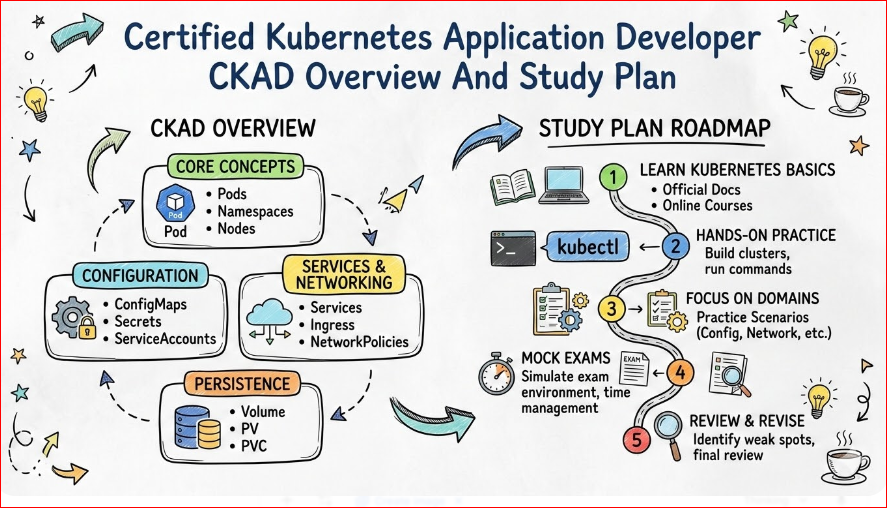
Introduction
In my years of watching the software landscape evolve, I have seen many technologies come and go. However, few have had the seismic impact of Kubernetes. It has fundamentally changed how we build, deploy, and manage applications. Today, Kubernetes is the undisputed operating system of the cloud. For a Software Engineer, knowing how to code is no longer enough. You need to know how your code lives and breathes in a containerized, orchestrated environment. I often speak with engineers and managers, both in India and globally, who know they need to master Kubernetes but don’t know where to start. They feel overwhelmed by the complexity. That is where the Certified Kubernetes Application Developer (CKAD) program comes in. This guide is meant to cut through the noise. It is drawn from long experience in architecture, operations, and security. It is designed to give you, whether you are an engineer or a manager, a clear roadmap to mastering application development on Kubernetes.
Why Kubernetes Certifications Matter Now
For a long time, I questioned the value of certain IT certifications. Many were just memory tests. But Cloud Native Computing Foundation (CNCF) certifications, provided in partnership with institutions like DevOpsSchool, are different. These are performance-based exams. You don’t answer multiple-choice questions. You sit in a live environment and solve real problems. If you possess the CKAD, it proves you can do the job.For the engineer, it represents verifiable proof of skill. In a competitive job market, this distinguishes you. For the manager, it provides a benchmark for hiring and training teams, ensuring everyone is speaking the same container orchestration language.
Core Kubernetes Certification Overview
| Track | Level | Who it’s for | Prerequisites | Skills covered | Recommended order |
| Application Development | Associate/Professional | Software Engineers, Developers, DevOps Engineers | Basic Linux and Docker knowledge | Designing, building, configuring, and exposing cloud-native apps in K8s. | First (for Developers) |
Deep Dive: Certified Kubernetes Application Developer (CKAD)
Let’s look closely at the CKAD. This is the certification I most often recommend for active developers and software engineers. It doesn’t ask you to build a cluster (that’s for the administrators). It asks you to use the cluster to run applications effectively.
What it is
The CKAD exam certifies that users can design, build, configure, and expose cloud-native applications for Kubernetes. It is a hands-on, command-line-based exam, not a written test.
Who should take it
This certification is designed for:
- Software Engineers and Application Developers.
- DevOps Engineers focused on CI/CD pipelines.
- System Architects looking to understand container deployment patterns.
Skills you’ll gain
Preparing for the CKAD forces you to master essential cloud-native skills:
- Defining Kubernetes Application Resources (Pods, Deployments, Services).
- Configuring applications using ConfigMaps, Secrets, and SecurityContexts.
- Implementing application health checks (Liveness and Readiness probes).
- Managing application log handling and debugging.
- Utilizing persistent volumes for stateful applications.
- Setting up network policies to secure application traffic.
- Troubleshooting application deployment failures in real-time.
Real-world projects you should be able to do after it
Once you have mastered the CKAD curriculum, you should be able to handle these real-world scenarios:
- Migrating a legacy monolithic application into microservices and deploying them on Kubernetes.
- Setting up a complete, zero-downtime deployment strategy using rolling updates.
- Creating a multi-container Pod (e.g., application container + logging sidecar).
- Exposing a microservice securely to the internet via an Ingress controller.
- Diagnosing why an application is crashing and fixing its configuration in a live cluster.
Preparation plan
Based on mentoring hundreds of engineers, here are three realistic timelines depending on your current workload.
- 7–14 days (The Bootcamp Path): Only for those with significant prior Docker and basic Kubernetes experience who can dedicate 8 hours a day. This is intense, focused purely on labs and simulation exams.
- 30 days (The Working Professional Path): This is the most common path. Commit 2 hours on weekdays and 4-5 hours on weekends. Focus on learning a domain, then doing the labs for that domain repeatedly.
- 60 days (The Beginner Path): If you are new to containers entirely. Spend the first 20 days mastering Linux basics and Docker, then move into the CKAD curriculum.
Common mistakes to avoid in the exam
I have seen brilliant engineers fail the CKAD, usually not because they didn’t know the material, but because of exam management.
- Running out of time: It is a race. You must be fast with
kubectl. - Not using aliases: Forget typing
kubectl get deployments. Usek get deploy. Set up aliases immediately. - Over-complicating: If the question asks for a basic Pod, don’t build a whole Deployment. Do exactly what is asked.
- Weak imperative commands: Don’t write YAML from scratch. Use
kubectl run --dry-run=client -o yaml > pod.yamland edit it. - Sticking on one tough question: If you are stuck for more than 5 minutes, flag it and move on. You can come back.
Best next certification after this
After CKAD, I highly recommend the Certified Kubernetes Administrator (CKA). While CKAD covers how to use the cluster, CKA covers how to build and maintain it. Having both makes you incredibly versatile.
Choose Your Path: Integrating Kubernetes into Your Career
Over the last two decades, I have seen roles blur. Kubernetes is not just for the “Ops” team anymore. Depending on your career aspiration, CKAD is the starting point for various specialized streams.
Here are 6 learning paths where CKAD is vital.
1. The DevOps Path
This is about modernizing the delivery pipeline.
- The Focus: CI/CD, automation, “Infrastructure as Code.”
- CKAD Role: You must understand how to package and deploy applications via Helm or Kustomize within Jenkins or GitLab CI pipelines. CKAD is fundamental here.
2. The DevSecOps Path
We are shifting security “left.” It has to be part of the development process.
- The Focus: Compliance, container scanning, network policies, IAM.
- CKAD Role: You learn to set SecurityContexts (preventing root access) and NetworkPolicies. You cannot secure a Kubernetes application if you don’t know how to develop one.
3. The SRE (Site Reliability Engineering) Path
This is treating operations as a software problem.
- The Focus: Reliability, scalability, monitoring, incident response.
- CKAD Role: SREs need CKAD skills to debug application failures quickly. They use this knowledge to set proper resource limits (CPU/Memory) to ensure cluster stability.
4. The AIOps/MLOps Path
Deploying Machine Learning models at scale.
- The Focus: Running complex data science workloads on GPUs within Kubernetes.
- CKAD Role: ML models are typically deployed as microservices. Understanding how to manage these Pods, utilize GPU resources, and scale them is critical for MLOps engineers.
5. The DataOps Path
Managing data pipelines and databases in a containerized world.
- The Focus: Persistent state, high availability for databases like PostgreSQL or Cassandra on Kubernetes.
- CKAD Role: You master PersistentVolumes, PersistentVolumeClaims, and StatefulSets. Managing state is the hardest part of Kubernetes, and CKAD lays the foundation.
6. The FinOps Path
The cloud can get expensive fast. This path is about cloud financial accountability.
- The Focus: Cost management, optimization, allocation.
- CKAD Role: While FinOps seems managerial, it requires technical insight. An engineer with CKAD knowledge can optimize resource requests/limits, preventing over-provisioning and saving significant cloud costs.
Role → Recommended Certifications Mapping
I often get asked by management in big IT firms about upskilling plans. Here is a simple mapping I suggest for typical engineering roles, moving from core skills to leadership.
| Current Role | Recommended Certifications Sequence | Why this sequence? |
| Software Engineer | CKAD -> CKA | First, learn to run your apps. Then, learn how the infrastructure works. |
| DevOps Engineer | CKAD -> CKA -> CKS | A complete toolkit. Develop, Administer, and Secure. |
| Platform Engineer | CKA -> CKAD -> CKS | Focus on building the internal platform first, then understanding the user (developer) perspective. |
| SRE | CKA -> CKAD | You need deep cluster knowledge (CKA) but also must understand application logic (CKAD) for debugging. |
| Security Engineer | CKA -> CKS -> CKAD | Need to know the admin side to secure the cluster, then special security focus (CKS). |
| Data Engineer | KCNA -> CKAD | Gain a cloud-native overview, then focus heavily on application deployment (where the data flows). |
| FinOps Practitioner | KCNA -> CKAD | Understand the terminology first (KCNA), then learn how resources are consumed technically. |
| Engineering Manager | KCNA -> CKAD | High-level understanding (KCNA) is essential. CKAD awareness helps in managing developer teams. |
Where to Get Training and Certification Help
While you can self-study, the hands-on nature of the CKAD makes expert-led training highly valuable. I have interacted with various institutions over the years, and many offer excellent, lab-focused programs.
Here are top institutions providing help in training cum certifications for CKAD:
- DevOpsSchool: This institution has a long-standing reputation in India for deep-dive technical training. Their instructors are usually industry practitioners, focusing heavily on hands-on labs that simulate the actual exam environment. They are excellent for both individual engineers and corporate upskilling.
- Cotocus: Known for their specialized consulting and training services. They approach training from an architectural perspective, making them a good choice if you are looking to understand not just how Kubernetes works, but how to design robust solutions with it.
- Scmgalaxy: A very reliable resource for DevOps and configuration management. They have extensive experience in the field, and their training programs often integrate real-world CI/CD scenarios, which is a big part of what a CKAD needs to know.
- BestDevOps: They focus strongly on current market trends. Their training materials are frequently updated to reflect the latest changes in the CNCF curriculum, ensuring you are not learning outdated concepts.
- devsecopsschool.com: If your ultimate goal is security, starting here is wise. Their CKAD training emphasizes the security aspects of application development early on, preparing you well for a future DevSecOps role.
- sreschool.com: For those on the SRE path. They teach CKAD with a focus on reliability, monitoring, and debugging, which are crucial skills for any reliability engineer managing containerized workloads.
- aiopsschool.com: Focused on the intersection of AI and Operations. If you are a developer looking to deploy AI models on Kubernetes, their approach to CKAD will be very relevant to your specific needs.
- dataopsschool.com: Ideal for data professionals. They cover the CKAD curriculum with a strong emphasis on managing stateful applications, persistent volumes, and database deployments on Kubernetes.
- finopsschool.com: For those blending finance with technology. Their CKAD awareness courses focus on how technical deployment choices affect cloud costs and resource optimization.
Next Certifications to Take
After you have achieved your CKAD, you have proved you can develop applications for the cloud. Where should you go next? Depending on your goals, I suggest three options.
Option 1: Same Track (Deepen your Kubernetes knowledge)
- Recommendation: Certified Kubernetes Administrator (CKA)
- Why: CKAD is about the application. CKA is about the cluster infrastructure itself. Having both makes you a “T-shaped” engineer. You understand the breadth of development and the depth of administration.
Option 2: Cross-Track (Broaden your skillset)
- Recommendation: HashiCorp Certified: Terraform Associate
- Why: Kubernetes manages containers; Terraform manages the underlying infrastructure (vms, networks) that Kubernetes runs on. The combination of Terraform and Kubernetes is the standard for modern platform engineering.
Option 3: Leadership/Strategic (Move towards management)
- Recommendation: AWS Certified Solutions Architect – Associate (or Azure/Google Cloud equivalent)
- Why: If you want to move into a team lead or cloud architect role, you need to understand the broader ecosystem surrounding Kubernetes—databases, messaging queues, and storage services offered by the cloud providers.
FAQs (Certified Kubernetes Application Developer – CKAD)
Over the years, mentoring engineers, these are the questions I hear most frequently.
1. How difficult is the CKAD exam compared to CKA?
In my opinion, they are equally difficult but focus on different areas. CKAD is faster. You have fewer questions but they require more active problem-solving around application YAML. CKA requires more knowledge of system administration, network setups, and cluster troubleshooting.
2. How much time is needed to prepare for CKAD if I am working full-time?
For most working engineers, 30 to 45 days is realistic. This allows time to understand the concepts and, more importantly, to practice the hands-on labs until you develop muscle memory for kubectl commands.
3. What are the prerequisites for CKAD?
You need to be comfortable with the Linux command line (managing files, basic piping) and have a fundamental understanding of Docker (images, containers, volumes). You don’t need prior Kubernetes experience, but it helps.
4. If I’m a Software Engineer, do I need CKA, or is CKAD enough?
CKAD is enough to prove you can write and deploy applications. However, in the real world, you will often need to debug issues that aren’t in your code, but in the cluster configuration. CKA gives you that visibility. I highly recommend both for long-term career growth.
5. Is the CKAD certification recognized globally?
Yes, absolutely. It is provided by the CNCF (Cloud Native Computing Foundation) in partnership with The Linux Foundation. It is recognized as the standard benchmark for Kubernetes skills globally, whether in India, the US, or Europe.
6. I’m a manager; do I really need a hands-on certification like CKAD?
I have met excellent managers who have taken it. It gives you true empathy for the technical challenges your team faces. It changes how you estimate timelines and hire. However, if you have no background in coding, start with the Kubernetes and Cloud Native Associate (KCNA) first.
7. How long is the CKAD certification valid?
It is valid for 3 years. After that, you must retake the exam to recertify. This keeps the certification relevant as Kubernetes evolves rapidly.
8. Is CKAD training required before the exam?
Training is not mandatory, but highly recommended. The exam is performance-based. Many people who know the theory fail because they aren’t used to the time pressure of the lab environment. Good training centers, like those mentioned above, provide lab environments that simulate this pressure.
9. Can I take the exam using a browser other than Chrome?
You should always check the official exam rules, as they can change. Historically, Google Chrome or Chromium-based browsers are preferred as the exam delivery system relies on specific extensions.
10. What happens if I fail the first time?
When you purchase the exam from The Linux Foundation, it typically includes one free retake. This should take some pressure off. If you fail, review your score report (it will tell you which areas you were weak in), practice those areas, and retake it within a few weeks.
11. Are the questions multiple choice?
No. It is 100% performance-based. You are given a terminal with a code editor and access to a live cluster, and you must solve tasks.
12. How has CKAD changed over the years?
CNCF updates the curriculum regularly. Recent changes have focused more on modern application practices, Helm charts, and Ingress resources, rather than older resource types. Always check the current curriculum before studying.
FAQs: Navigating CKAD Changes in 2026
1. Has the exam format changed in the latest version? The core performance-based format remains, but the environment is now more rigorous. You now solve roughly 17 to 20 tasks in a remote-desktop-style browser environment. One major shift is the increased focus on multi-cluster contexts; you must be extremely careful to ensure you are on the correct node for every single question.
2. What are the biggest technical additions to the curriculum? The 2025–2026 updates have integrated Helm and Kustomize more deeply. You aren’t just deploying YAML anymore; you are expected to know how to install, uninstall, and troubleshoot applications using Helm charts. Additionally, Custom Resource Definitions (CRDs) and API Deprecation management are now standard topics.
3. Is “Building Images” still part of the exam? Yes, and it is more common now. You may be asked to build a container image using Podman or Docker, tag it, and save it as an OCI-compliant tarball. This reflects the modern reality where a developer’s responsibility starts at the Dockerfile, not just the Kubernetes YAML.
4. How has the security section changed? Security is no longer “optional” for developers. The exam now heavily tests SecurityContexts (like running as a non-root user) and NetworkPolicies. A common 2026-era task involves troubleshooting why two microservices cannot communicate and fixing the label or policy blocking them.
5. Are there new networking topics like the Gateway API? While traditional Ingress is still the primary focus for CKAD, there is an increasing shift toward the Gateway API. You should at least understand the conceptual difference, though most practical tasks still revolve around Ingress controllers and Services.
6. Has the difficulty level increased? In my opinion, the exam has become more “applied.” Older versions focused on simple object creation. The current version often gives you a broken configuration that you must fix. This requires a deeper understanding of how components interact rather than just memorizing a specific command.
7. Is the passing score still the same? The passing score remains 66%. However, because the tasks are more complex and the environment can have a slight lag, the “perceived difficulty” is higher. You have to be faster with your kubectl aliases than ever before to finish all 17+ questions.
8. Can I still use the official documentation? Yes, you still have access to kubernetes.io/docs. However, the 2026 environment uses a strict virtual desktop. I suggest practicing searching the documentation within a restricted window so you aren’t fumbling with the UI on exam day.
Testimonials from the Field
I asked a few engineers I’ve mentored to share their thoughts on the CKAD journey.
“I was strictly a Java developer. The cloud was ‘someone else’s problem.’ CKAD forced me out of my comfort zone. It was hard to learn YAML and the command line, but it fundamentally changed how I write code now. I understand resource constraints and how to debug in production. I’ve since moved into a Lead Developer role.”
— Rajesh M., Senior Software Engineer (Bangalore, India)
“I thought I knew Kubernetes because I could use
kubectl get pods. The CKAD exam proved me wrong. I failed the first time because I ran out of time. The retake was a different story because I focused heavily on labs. It’s the most valuable certification I hold.”— Samantha L., DevOps Engineer (London, UK)
“From a manager’s perspective, having my team CKAD certified has standardized how we deploy apps. It cut down debugging time significantly because everyone speaks the same language. We no longer rely on one ‘K8s expert’ to fix everything.”
— Arun S., Engineering Manager (Mumbai, India)
Conclusion
The transition to cloud-native architecture is accelerating, not slowing down. Every company is becoming a software company, and almost all of them are looking to Kubernetes to manage that software. If you are a Software Engineer or an Application Developer, ignoring Kubernetes is the single greatest risk to your career relevance in the next decade. The CKAD is not just a certification; it is a declaration that you are ready for this new reality. It proves you have the practical, hands-on skills to build, deploy, and manage modern applications. It is challenging, but in my experience, the things most worth doing usually are.