Introduction
I have spent decades in this industry. I started when “deploying” meant physically carrying a hard drive to a server room. I watched us move to virtualization, then to the cloud, and then to containers. But in all that time, I haven’t seen a gap quite as expensive—or as dangerous—as the one between Data Science and Operations.We have all seen the scenario: A brilliant data scientist builds a model in a Jupyter Notebook. It has 98% accuracy. It predicts customer churn perfectly. Then, they hand it to an engineering team, and the project dies. Why? Because a notebook isn’t a product. It doesn’t scale. It doesn’t handle errors. It doesn’t secure data.This is where MLOps (Machine Learning Operations) steps in. It is not just a buzzword; it is the discipline of applying engineering rigor to the messy, probabilistic world of AI. Today, I am breaking down the MLOps Certified Professional (MLOCP). This isn’t just about passing an exam. It is about understanding the rigorous plumbing required to keep AI alive, reliable, and profitable in production.
The Landscape: DevOpsSchool Certification Ecosystem
Before we dive deep into MLOps specifically, you need to see where it fits. A good engineer knows the whole map, not just their corner of it. This table helps you understand the progression and how different tracks intersect.
Certification Tracks & Levels
| Track | Level | Who It’s For | Prerequisites | Skills Covered | Recommended Order |
|---|---|---|---|---|---|
| DevOps | Foundation | Freshers, Managers, QA | None | Linux, Basic Git, SDLC, Agile Culture | 1 |
| DevOps | Practitioner | Developers, Ops, SysAdmins | Foundation | CI/CD Pipelines, Docker, Jenkins, Ansible | 2 |
| DevOps | Master | Architects, Team Leads | Practitioner | Kubernetes, Cloud Architecture, Microservices | 3 |
| MLOps | Foundation | Data Scientists, Managers | Python Basics | ML Lifecycle, Basics of Model Training | 1 |
| MLOps | Certified Professional (MLOCP) | ML Eng, DevOps Eng | Linux, Python | Model Deployment, Drift Detection, Pipelines | 2 |
| MLOps | Master | Architects, CTOs | MLOCP | Scaled AI, Governance, Advanced Orchestration | 3 |
| SRE | Practitioner | SysAdmins, Ops | Linux | SLOs/SLIs, Error Budgets, Monitoring | 2 |
| DevSecOps | Practitioner | Security Eng | DevOps Fdn | SAST/DAST, Container Security, Compliance | 2 |
Deep Dive: MLOps Certified Professional (MLOCP)
What is it?
The MLOps Certified Professional (MLOCP) is a rigorous validation that you can do more than just train a model. It proves you can build the “factory” that builds the models. While data science focuses on the algorithm (the math), MLOCP focuses on the lifecycle (the engineering).
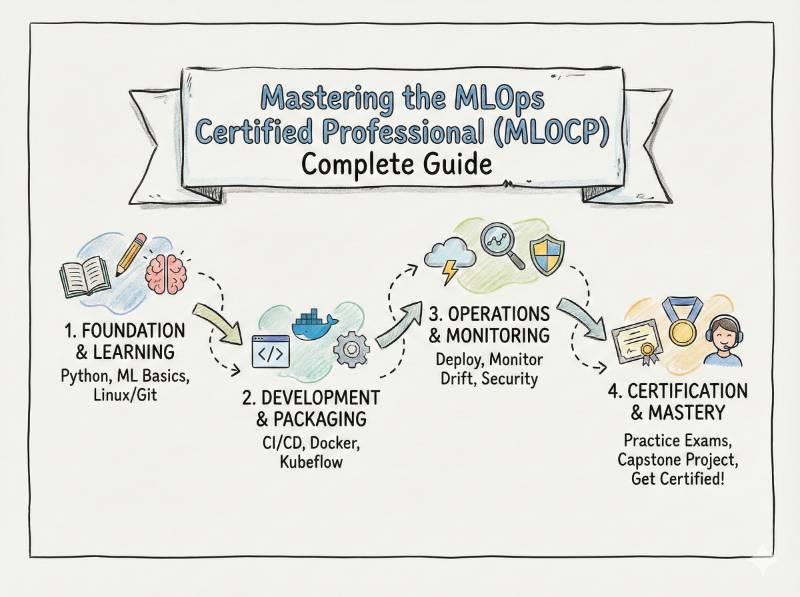
It covers the end-to-end journey: automating data ingestion, versioning massive datasets, creating reproducible training pipelines, managing model artifacts, and deploying scalable inference endpoints on Kubernetes. It transforms you from a coder into a systems architect for AI.
Who Should Take It?
- DevOps Engineers: You are tired of being asked to “just deploy this model” without understanding why it is crashing your pods. You need to understand the unique resource requirements (GPUs, memory) of ML workloads.
- Data Scientists: You want to stop relying on engineering teams to ship your work. You want the power to take your model from your laptop to a live API endpoint yourself.
- Software Engineers: You see the market shifting. You know that the highest-paying roles in the next decade will be in AI infrastructure, and you want to pivot your backend skills into MLOps.
- Platform Engineers: You are building the internal platforms that other teams use. To support AI teams effectively, you need to know how to build a “Golden Path” for model deployment.
Skills You Will Gain
- Advanced Containerization: You will learn how to package ML models with Docker. This isn’t just standard Dockerizing; it involves handling heavy dependencies like CUDA drivers for GPUs, massive model weights, and specific Python library versions to ensure reproducibility.
- Orchestration for ML: You will master deploying training jobs and inference services on Kubernetes. You will learn why standard Kubernetes deployments often fail for ML and how to use tools like Kubeflow or KServe to manage inference at scale.
- CI/CD for ML (CT/CD): You will move beyond standard CI/CD into “Continuous Training.” You will build pipelines (using Jenkins, GitLab CI, or Argo) that automatically retrain models when new data arrives, creating a self-improving system.
- Model Monitoring & Observability: You will learn that monitoring “uptime” isn’t enough. You will set up systems to detect Data Drift (when input data changes) and Concept Drift (when the model becomes outdated), using tools like Prometheus and Grafana.
- Experiment Tracking: You will learn to manage the chaos of research. Using tools like MLflow, you will track every hyperparameter, dataset version, and metric, ensuring that you can always reproduce a specific model version from six months ago.
Real-World Projects You Will Master
The certification is hands-on. By the time you are certified, you should be able to build these three systems from scratch:
- Build an End-to-End Automated Pipeline:
- The Scenario: A developer commits code.
- The System: This triggers a Jenkins job that pulls data, retrains the model, evaluates it against a test set, packages it into a Docker container, pushes it to a registry, and deploys it to a Kubernetes staging cluster—all without human intervention.
- Real-Time Drift Detection System:
- The Scenario: Your fraud detection model starts failing because scammers changed their tactics.
- The System: You build a monitoring layer that analyzes live traffic. When the statistical distribution of data shifts (drift), it triggers a critical alert in Slack and automatically spins up a retraining job on the latest data.
- A/B Testing & Canary Deployment Framework:
- The Scenario: You have a new, experimental model, but you aren’t sure if it’s better.
- The System: You configure a traffic splitter (using Istio or similar service mesh) that routes exactly 5% of live traffic to the “Challenger” model and 95% to the “Champion” model. You build a dashboard to compare their conversion rates in real-time.
Preparation Plan
- 7–14 Days (The Sprint):
- Target Audience: Senior DevOps Engineers.
- Focus: Skip the Linux/Docker basics. Focus strictly on the ML-specific toolchain: MLflow for tracking, DVC for data versioning, and Kubeflow/Airflow for pipeline orchestration. Spend 80% of your time in labs.
- 30 Days (The Standard):
- Target Audience: Software Engineers / Data Scientists.
- Week 1: Python automation and Linux advanced commands.
- Week 2: Docker deep dive and Kubernetes fundamentals (Pods, Services, Deployments).
- Week 3: MLOps specific tools (Jenkins for ML, Prometheus for metrics).
- Week 4: Capstone projects—building the pipelines described above.
- 60 Days (The Deep Dive):
- Target Audience: Freshers or Career Switchers.
- Strategy: Build everything from scratch. Do not use managed services (like AWS SageMaker) initially. Install Kubernetes manually. Install Jenkins manually. This “hard way” approach ensures you understand the underlying architecture before you abstract it away.
Common Mistakes
- Ignoring Data Versioning: Treating data like code is a fatal error. Code is small; data is huge. You cannot put 50GB CSV files in GitHub. You must learn DVC (Data Version Control) to manage datasets properly.
- Over-Engineering: Not every project needs a massive Kubernetes cluster. A common mistake is building a complex microservices architecture for a simple regression model that runs once a day. Learn to right-size your architecture.
- Forgetting Compliance & Security: In the real world, models use sensitive data (PII). A major failure mode is exposing model endpoints without authentication or logging. You must prioritize security (authentication, authorization, encryption) from day one.
Best Next Certification
After MLOCP, I strongly recommend the AIOps Certified Professional.
- Why? MLOps teaches you how to manage AI (deploying and maintaining models). AIOps teaches you how to use AI to manage your IT operations.
- The Logic: Once you know how to deploy models effectively, the logical next step is using those models to automate your own operations work—like incident response, log analysis, and self-healing infrastructure. It completes the circle: you build the AI, and then the AI helps you build better systems.
Choose Your Path
The industry is broad, and “DevOps” is now just an umbrella term. Here is how to find your specific lane based on what you love doing:
- The Builder (DevOps): You love the “plumbing.” You get satisfaction from automation, CI/CD pipelines, and making developer lives easier. You are the enabler of speed.
- The Guardian (DevSecOps): You are paranoid, in a good way. You believe security should be baked in, not bolted on. You enjoy finding vulnerabilities, automated scanning, and “breaking” things to fix them.
- The Reliability Expert (SRE): You obsess over uptime, latency, and graphs. You don’t just want it to work; you want it to work at scale, under pressure, at 3 AM. You manage “error budgets.”
- The AI Architect (AIOps/MLOps): You bridge the gap between complex algorithms and stable infrastructure. You are the translator between the data scientists (math) and the sysadmins (servers).
- The Data Wrangler (DataOps): You focus on the velocity and quality of data. You build the pipelines that feed the models. You ensure that data is clean, available, and governed.
- The Strategist (FinOps): You manage the cloud budget. In a world of auto-scaling clusters, costs can spiral. You ensure every dollar spent on cloud brings business value.
Role → Recommended Certifications Mapping
| Current Role | Recommended Certification | Why This Path? |
|---|---|---|
| DevOps Engineer | MLOps Certified Professional (MLOCP) | To expand your scope. Standard DevOps is becoming commoditized; MLOps is the premium, high-growth skill set that leverages your existing pipeline knowledge. |
| Site Reliability Engineer (SRE) | AIOps Certified Professional | To automate incident response. You want to move from reacting to outages to using AI to predict and prevent them before they impact users. |
| Platform Engineer | DevOps Master / CKA | You need deep architectural knowledge to build self-service platforms. The Master level helps you design the “Golden Path” for other developers. |
| Cloud Engineer | FinOps Certified Practitioner | To optimize the infrastructure you build. Cost optimization is a massive value-add for any cloud engineer in an era of sprawling cloud bills. |
| Security Engineer | DevSecOps Master | To own the entire security lifecycle. This moves you from just configuring firewalls to embedding security into the code and pipeline itself. |
| Data Engineer | DataOps Certified Professional | To formalize your pipeline skills. This helps you apply engineering rigor and modern orchestration tools (like Airflow) to data workflows. |
| FinOps Practitioner | Cloud Architect (AWS/Azure) | To understand what you are financing. You cannot optimize costs effectively if you don’t understand the underlying technical architecture. |
| Engineering Manager | DevOps Master | To gain a high-level architectural view. You need to understand the systems your cross-functional teams are building to lead them effectively. |
Top Training Institutions for MLOCP
When it comes to getting certified, you need mentors who have been in the trenches, not just theorists reading off slides. These institutions provide robust, practical support for the MLOCP:
DevOpsSchool
They are the pioneers of this certification. Their training is famously “lab-heavy,” meaning you spend 70% of your time typing commands and only 30% listening. They have a massive library of real-world scenarios that simulate actual production failures.
Cotocus
Cotocus is a consultancy first and a training provider second. This is a huge advantage because their instructors are active consultants working on Fortune 500 projects. They bring fresh, bleeding-edge case studies into the classroom.
Scmgalaxy
This is one of the oldest and largest communities for DevOps and SCM professionals. Their training is deeply rooted in configuration management and version control best practices, which is the foundation of good MLOps.
BestDevOps
If you prefer a modular approach, BestDevOps is excellent. They offer deep-dive micro-courses on specific tools (like just Jenkins or just Docker) alongside the full MLOCP track, allowing you to patch specific skill gaps.
devsecopsschool
Security in AI is critical. This institution specializes in the intersection of security and operations. If your industry is regulated (finance, healthcare), their security-focused take on MLOps is invaluable.
sreschool
Reliability is their religion. Their MLOps training focuses heavily on the “Day 2” operations—monitoring, alerting, incident response, and keeping models available under high load.
aiopsschool
They focus on the future of IT operations. Their training bridges the gap between MLOps (deploying AI) and AIOps (using AI for Ops), providing a holistic view of the intelligent enterprise.
dataopsschool
Great models need great data. Their curriculum focuses heavily on the “left side” of the pipeline—data engineering, ETL processes, and data quality checks—before moving into the model deployment phase.
finopsschool
Cloud bills for AI can be astronomical. Their training emphasizes cost-aware engineering, teaching you how to use Spot Instances, auto-scaling, and resource quotas to keep MLOps budgets in check.
Frequently Asked Questions (FAQs)
1. Is MLOps just DevOps for Data Science?
In a way, yes, but with added complexity. In DevOps, you manage code. In MLOps, you manage Code + Data + Model. The “Data” part changes constantly, making MLOps significantly more dynamic and prone to silent failures.
2. Do I need to be a math genius to take the MLOCP?
No. You need to understand how models work (inputs/outputs, training vs inference), but you don’t need to derive gradients by hand. Your job is operationalizing the code, not writing the algorithm. You are the stage manager, not the actor.
3. How long does the certification take?
Most working professionals can complete the preparation and project work in 4 to 6 weeks if they dedicate 5-10 hours of study per week. It is designed for working engineers.
4. What are the prerequisites?
You must be comfortable with the Linux command line (navigating, permissions, bash scripts) and have a basic reading knowledge of Python. Experience with Docker is a huge plus, but can be learned during the course.
5. Will this increase my salary?
Specialized skills pay more. MLOps engineers are currently rarer than standard DevOps engineers. In the current market, this specialization typically gives you significant leverage in salary negotiations.
6. Can I take this if I am a manager?
Yes, but be aware it is technical. You might find the “Master” level (more strategic) or “Foundation” level (more conceptual) more appropriate unless you still enjoy getting your hands dirty with code and configurations.
7. Is the exam multiple choice or practical?
The best certifications, including this one, lean heavily on practical assessments. You will likely need to demonstrate you can actually build a pipeline, deploy a container, and fix a broken build.
8. What is the difference between AIOps and MLOps?
MLOps is managing AI (deploying models to customers). AIOps is AI managing you (using AI to fix IT issues, analyze logs, and predict outages). They are opposites in terms of direction.
9. Do I need to know a specific cloud provider?
The concepts are universal. Whether you use AWS SageMaker, Azure ML, or Google Vertex AI, the underlying principles of drift, versioning, and automation remain the same. The certification focuses on these agnostic principles.
10. Why is “Model Drift” such a big deal in this course?
Because unlike standard software, ML models degrade without you touching them. If user behavior changes, the model fails. Catching this is the core responsibility of an MLOps engineer, and it requires a totally different monitoring stack.
11. Is coding required?
Yes. You will need to write YAML for Kubernetes, Python for DAGs (like in Airflow), and Bash scripts for automation. It is “glue code”—connecting systems together—rather than application development.
12. What happens if I fail the exam?
Do not panic. Review your weak areas—usually, it is the practical implementation of pipelines or security settings—and retake it. The hands-on labs are your best preparation; if you can do the labs, you can pass the exam.
FAQs on MLOps Certified Professional (MLOCP)
1. What is MLOps Certified Professional (MLOCP)?
MLOCP is a professional certification that validates your ability to design, deploy, automate, monitor, and manage machine learning models in production environments using DevOps principles.
2. Who should take the MLOCP certification?
This certification is ideal for DevOps Engineers, Machine Learning Engineers, Data Engineers, Software Engineers, Cloud Engineers, and Engineering Managers who work with ML systems in production.
3. How difficult is the MLOCP exam?
The exam is moderately challenging. It focuses more on practical understanding than theory. If you have hands-on experience with CI/CD, Docker, Kubernetes, cloud platforms, and ML lifecycle management, it becomes manageable.
4. How long does it take to prepare for MLOCP?
Preparation typically takes 30–60 days depending on your background. Professionals with DevOps or ML experience may prepare faster, while beginners may need more hands-on practice time.
5. What are the prerequisites for MLOCP?
There are no strict mandatory prerequisites, but basic knowledge of machine learning concepts, cloud platforms, containerization, and CI/CD pipelines is strongly recommended.
6. What career benefits does MLOCP provide?
MLOCP improves your profile for roles such as MLOps Engineer, ML Platform Engineer, Data Engineer, Cloud Engineer, and AI Infrastructure Specialist. It demonstrates that you can operationalize ML systems at scale.
7. Does MLOCP focus more on coding or operations?
MLOCP focuses more on operational excellence — automation, deployment, monitoring, scalability, reliability, and governance of ML models — rather than algorithm development.
8. What certification should I pursue after MLOCP?
After MLOCP, you can move to:
- Advanced MLOps or AIOps certifications (same track)
- DataOps or DevSecOps certifications (cross-track)
- DevOps Architect or Engineering Manager certifications (leadership path)
Next Certifications to Take
Once you have secured your MLOCP, do not stop learning. The field moves too fast. Here are three distinct directions you can take for your next milestone:
- Same Track (Deepen Expertise): MLOps Master. This focuses on governing AI at an enterprise scale, managing hundreds of models, and handling legal/compliance issues.
- Cross-Track (Broaden Skills): SRE Certified Professional. Learn to apply Site Reliability Engineering principles to your ML infrastructure to ensure 99.99% availability.
- Leadership (Move Up): DevOps Master. Step up to architecting entire organizational systems, managing budgets, and leading digital transformation efforts.
Conclusion
The MLOps Certified Professional (MLOCP) certification is a powerful step for engineers and managers who want to master the operational side of machine learning. As organizations move from experimentation to large-scale AI adoption, the real challenge is not building models — it is deploying, automating, scaling, and maintaining them reliably in production. MLOCP equips you with exactly these capabilities.
By earning this certification, you demonstrate that you understand CI/CD for ML, model versioning, containerization, cloud deployment, monitoring, and governance. More importantly, you show that you can bridge the gap between data science and DevOps — a skill that is in high demand globally. Whether you aim to grow as an MLOps Engineer, ML Platform Engineer, Cloud Specialist, or Engineering Leader, MLOCP strengthens your credibility and prepares you for real-world impact.