Intorduction
In the earlier days of my career, we used to treat servers like pets—we gave them names, fixed them when they were sick, and feared their eventual hardware failure. Today, the world has shifted to treating infrastructure like cattle: massive, automated, and replaceable. At the heart of this revolution is Kubernetes, the tool that turned “it works on my machine” into “it works everywhere at scale.” If you are an engineer or a manager looking to stay relevant, mastering Kubernetes is no longer a choice; it is a necessity. The Certified Kubernetes Administrator (CKA) is the gold standard that proves you don’t just know the theory, but you can actually get your hands dirty and manage production-grade clusters in real-world environments.
Why Kubernetes is the Foundation of Modern Tech
Kubernetes has effectively become the “operating system” of the cloud, providing a unified way to manage containers across any provider. Whether you are working in India or for a global firm, companies are rapidly moving away from monoliths toward microservices to gain speed and agility. These microservices need an orchestrator to handle scaling, networking, and self-healing, and Kubernetes is the undisputed leader in that space.
Getting CKA certified means you have the practical skills to keep these critical systems running without manual intervention. It’s a performance-based exam, which is why it carries so much weight in the industry today. You aren’t just clicking boxes or memorizing facts; you are solving live problems in a terminal, proving you can handle the pressure of a production outage.
Deep Dive: Certified Kubernetes Administrator (CKA)
What it is
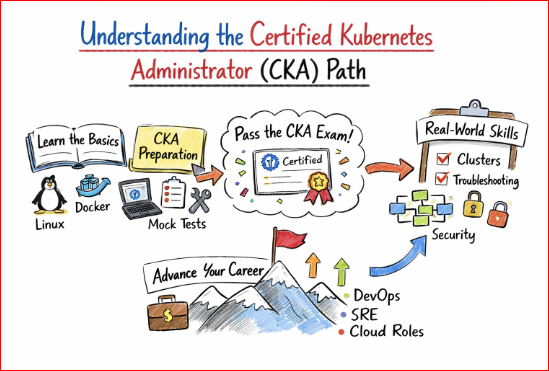
The CKA is a performance-based certification created by the Cloud Native Computing Foundation (CNCF) to verify that an individual can handle the duties of a Kubernetes administrator. It specifically focuses on the ability to install, configure, and manage production-ready clusters from the ground up. This certification ensures that you understand the core building blocks that keep modern applications stable, scalable, and highly available.
Who should take it
This certification is tailor-made for DevOps engineers, SREs, and System Administrators who are directly responsible for infrastructure and platform stability. It is also highly recommended for Software Engineers and Engineering Managers who want a deep, technical understanding of how their code is actually deployed and scaled. If your career path involves any form of cloud-native development or infrastructure management, this is your foundational step.
Skills you’ll gain
- Cluster Architecture & Setup: You will learn how the control plane components communicate with worker nodes and how to build a resilient cluster from scratch.
- Workload Management: You’ll master creating and managing Pods, Deployments, and DaemonSets, ensuring your applications are always running as intended.
- Advanced Networking: You will gain the skills to set up CNI plugins, manage internal and external traffic via Services, and configure Ingress controllers for secure access.
- Storage Solutions: You’ll learn to manage the lifecycle of data using Persistent Volumes (PV) and Claims (PVC), essential for running stateful applications like databases.
- Troubleshooting: You will develop a systematic approach to fixing clusters, from debugging node failures to resolving complex networking or security policy issues.
Real-world projects you should be able to do
- Build a High-Availability (HA) Cluster: You will be able to design and implement a Kubernetes cluster that can withstand the failure of multiple master or worker nodes.
- Zero-Downtime Upgrades: You’ll learn the process of upgrading a live production cluster’s version without interrupting the service for your end-users.
- Traffic Isolation: You can implement complex networking rules and Network Policies to ensure that sensitive microservices are isolated from the public internet.
- Production Debugging: You will have the confidence to dig into system logs, events, and metrics to identify and resolve performance bottlenecks in real-time.
- Resource Optimization: You’ll be able to implement resource quotas and limit ranges to prevent “noisy neighbors” from consuming all the cluster’s CPU and memory resources.
Preparation plan
- 7–14 days: This fast-track is only for those who are already using
kubectldaily in their professional lives. Spend this time mastering time management, getting used to the official documentation search, and running through practice labs to build muscle memory. - 30 days: This is the most effective path for most working engineers, allowing for a balanced mix of theory and practice. Spend the first two weeks on architecture and objects, and the final two weeks exclusively on hands-on labs and troubleshooting scenarios.
- 60 days: Highly recommended for beginners or those transitioning from traditional sysadmin roles. Use the first month to understand Linux networking, Docker, and YAML syntax, then spend the second month diving deep into the specific Kubernetes domains required for the exam.
Common mistakes
- Poor Time Management: Many candidates fail because they stay stuck on a single high-weight question for 20 minutes; knowing when to skip and return is vital.
- Namespace Errors: A very common mistake is creating the right resource but in the wrong namespace, which results in zero points for that specific task.
- Context Confusion: In the exam, you work across multiple clusters; forgetting to switch the context at the start of a question is a quick way to lose marks.
- Manual Typing Fatigue: Failing to use command-line aliases like
kforkubectlor not enabling shell autocompletion can slow you down significantly during the timed test.
Best next certification after this
Once you have mastered the administration side, the most natural progression is the Certified Kubernetes Security Specialist (CKS). While CKA teaches you how to build and run a cluster, CKS focuses exclusively on how to harden that environment against modern security threats and vulnerabilities. It’s the perfect way to round out your expertise and make yourself indispensable in a security-conscious market.
Certification Overview Table
| Track | Level | Who it’s for | Prerequisites | Skills covered | Recommended order |
| Infrastructure | Intermediate | DevOps, SRE, Admins | Basic Linux/YAML | Setup, Networking, Storage | First |
Choose Your Path: 6 Learning Journeys
Kubernetes is a versatile tool that adapts to different career focuses. Here is how I recommend approaching the technology based on your specific career goals:
1. The DevOps Path
Your focus here is on automation and the “Developer Experience.” You will spend your time integrating Kubernetes with CI/CD tools like Jenkins or GitLab, writing Helm charts to package applications, and ensuring that code flows from a git commit to a production pod with zero manual intervention. Your goal is to make the infrastructure invisible and seamless for the development teams.
2. The DevSecOps Path
In this journey, security is your primary metric of success. You will dive deep into Network Policies, Secrets management, and Role-Based Access Control (RBAC) to ensure a “least privilege” environment. Your work involves scanning container images for vulnerabilities before they are deployed and ensuring the cluster remains compliant with industry standards like CIS benchmarks.
3. The SRE Path
Reliability and observability are your North Stars. You care about the “Golden Signals”—latency, errors, traffic, and saturation—and you use Kubernetes to implement self-healing systems. You will master tools like Prometheus and Grafana to monitor cluster health and set up automated alerting to catch issues before the customer even notices.
4. The AIOps/MLOps Path
This path is about managing high-performance workloads for data science. You’ll learn how to handle GPU resources within Kubernetes and use specialized tools like Kubeflow to manage the entire machine learning lifecycle. Your challenge is ensuring that complex AI models have the massive computing power they need while maintaining the flexibility of a containerized environment.
5. The DataOps Path
Data is often the hardest thing to manage in containers because it is “heavy” and must persist. You’ll focus on StatefulSets and how to run massive databases like PostgreSQL or big data processing engines like Spark inside Kubernetes without data loss. You will become an expert in managing persistent storage layers and ensuring data consistency across cluster nodes.
6. The FinOps Path
As cloud costs continue to rise, the FinOps path is becoming increasingly critical for businesses. You will use Kubernetes resource limits and requests to ensure that every dollar spent on cloud CPU and memory is used efficiently. Your job is to provide the transparent data that helps the business understand where their money is going and how to optimize their cloud spend.
Role → Recommended Certifications Mapping
| Job Role | Recommended Certification Path | Primary Focus of this Path |
| DevOps Engineer | CKA → CKAD → CKS | Automation, App Deployment, and Security |
| SRE (Site Reliability Engineer) | CKA → Prometheus Certified Associate (PCA) → CKS | System Reliability, Monitoring, and Observability |
| Platform Engineer | CKA → HashiCorp Terraform Associate → CKS | Infrastructure as Code and Platform Building |
| Cloud Engineer | CKA → AWS / Azure / GCP Solutions Architect Professional | Cloud Architecture and Vendor Integration |
| Security Engineer | CKA → CKS → Certified Cloud Security Professional (CCSP) | Cluster Hardening and Broad Cloud Security |
| Data Engineer | CKA → Google Professional Data Engineer (or equivalent) | Stateful Workloads and Data Pipeline Management |
| FinOps Practitioner | CKA → FinOps Certified Practitioner | Technical Context and Cloud Cost Optimization |
| Engineering Manager | CKA → PMP or Agile Certifications | Technical Grounding and Team Governance |
Why Choose DevOpsSchool?
When you are looking to get certified, you need more than just a pre-recorded video course. DevOpsSchool offers a deep, hands-on experience led by industry veterans who have managed real-world clusters for years. They focus on the “why” as much as the “how,” providing a curriculum that is updated constantly to reflect the latest Kubernetes changes. Their goal is to make sure you don’t just pass the exam, but you also become a confident leader in your organization’s cloud-native journey.
Top Institutions for CKA Training
DevOpsSchool This platform is highly regarded for its immersive, hands-on approach to DevOps and Kubernetes training. They provide real-world project scenarios and dedicated mentorship from industry veterans. Their CKA program focuses heavily on live cluster troubleshooting, ensuring you are completely comfortable in the command-line environment before exam day.
Cotocus Cotocus is a consulting and training firm that helps enterprise teams transition to cloud-native systems. They provide practical, scenario-based Kubernetes training that mimics real work environments. Their teaching method does an excellent job of bridging the gap between traditional server management and modern container orchestration.
Scmgalaxy This is a massive, community-driven platform packed with helpful resources, tutorials, and guided courses. They excel at teaching Kubernetes alongside broader CI/CD and configuration management tools. It is a fantastic option for engineers who want strong community support and active forums while preparing for their CKA.
BestDevOps BestDevOps focuses on delivering streamlined, high-quality learning paths for busy working professionals. Their CKA training is direct, highly focused on the exam curriculum, and removes unnecessary theory. They help you build the exact command-line muscle memory you need to pass the time-pressured test.
devsecopsschool.com This institution focuses on the critical intersection of operations and security. While they teach the core CKA fundamentals, their curriculum strongly emphasizes secure cluster configurations and strict network policies. It is the perfect starting point for engineers who plan to tackle the security-focused CKS certification next.
sreschool.com Tailored specifically for Site Reliability Engineers, this platform focuses on maintaining high system availability. Their Kubernetes training highlights monitoring, logging, and self-healing mechanisms within a cluster. It is ideal for professionals who want to use their CKA skills to drastically improve application uptime and performance.
aiopsschool.com This school is aimed at engineers who manage infrastructure for artificial intelligence and machine learning projects. Their training covers standard CKA topics but also touches on scheduling heavy, compute-intensive workloads and managing hardware resources like GPUs. It is a great fit for those supporting data science teams.
dataopsschool.com Running stateful data workloads in containers brings unique challenges, and this platform focuses on exactly that. Their CKA preparation puts extra emphasis on managing Persistent Volumes, Storage Classes, and complex StatefulSets. It is highly recommended for database administrators and data engineers moving into the Kubernetes space.
finopsschool.com This platform connects cloud architecture directly with cost management and business value. Their Kubernetes training highlights how to properly configure resource quotas, limits, and namespace boundaries. It helps professionals understand how to pass the CKA while also keeping enterprise cloud costs firmly under control.
FAQs (General Value & Career)
- Is CKA hard? It is considered one of the most challenging IT exams because it is 100% lab-based; you must demonstrate actual skill rather than just memorization.
- How much time do I need? Most working professionals find that 40 to 60 hours of focused study, split between labs and theory, is the “sweet spot” for passing.
- Are there prerequisites? There are no official prerequisites, but I strongly advise being comfortable with the Linux command line and YAML formatting before you start.
- Is it better than other cloud certs? Cloud-specific certs teach you a single vendor’s tools; CKA teaches you the universal technology that runs on every major cloud provider.
- What is the passing score? You typically need a 66% to pass, but aim for 80% in your practice labs to account for the pressure of the actual exam.
- Can I retake it? Yes, most exam vouchers purchased through official channels include one free retake if you don’t succeed on your first attempt.
- Does it expire? The certification is valid for three years, which is a good thing as it ensures your skills remain current with the fast-evolving Kubernetes ecosystem.
- Will it increase my salary? In global markets, Kubernetes experts consistently command higher salaries because the demand for skilled orchestrators far outweighs the supply.
- Can I use notes during the exam? You cannot use personal notes, but you are allowed to access one browser tab with the official Kubernetes documentation for reference.
- Is CKAD or CKA better? CKA is broader and better for those managing the “plumbing” of the infrastructure, while CKAD is more focused on the developers building apps.
- Do managers need this? Even if they don’t do the hands-on work, this certification gives managers the technical grounding needed to plan realistic timelines and budgets.
- Is it recognized globally? Yes, the CKA is recognized by every major tech company in the world as the definitive proof of Kubernetes competency.
FAQs on Certified Kubernetes Administrator (CKA)
- What is the official URL for the course? You can find the full details and registration at Certified Kubernetes Administrator (CKA).
- Who is the provider for this training? The primary provider for this expert-led training and certification support is Devopsschool.
- What version of Kubernetes is the exam on? The exam usually aligns with the latest stable release or the version immediately preceding it, so check the CNCF site for the current version.
- Is the exam multiple choice? No, it is a performance-based exam where you are given a series of tasks to complete in a real command-line interface.
- How long is the exam duration? You have exactly 120 minutes (2 hours) to complete all the tasks, which makes time management your most important skill.
- What is the most important skill for the exam? Beyond technical knowledge, the ability to quickly find and copy-paste YAML templates from the official documentation is a life-saver.
- How is the exam proctored? It is taken online with a live proctor who monitors your screen, microphone, and webcam to ensure the integrity of the testing environment.
- When do I get my results? Results are usually processed within 24 hours, but it can sometimes take up to 36 hours for the final email to arrive in your inbox.
Testimonials
“I had been a System Admin for 10 years and felt like my career was plateauing. The CKA training at DevOpsSchool gave me the modern tools I needed to transition into a Senior DevOps role with a 40% salary hike. The hands-on labs were the most valuable part for me.”
— Arjun M.
“As an Engineering Manager, I wanted to lead my team by example. This guide helped me map out my journey, and passing the CKA allowed me to understand the technical roadblocks my engineers were facing during our massive cloud migration.”
— Sarah J.
“The instructors at Scmgalaxy and DevOpsSchool don’t just teach you how to pass a test; they teach you how to handle a production cluster failure on a Friday night. That real-world experience is what sets this training apart from the rest.”
— Vikram K.
Next Certifications to Take
- Same Track: Certified Kubernetes Security Specialist (CKS) – This is the logical next step for those who want to focus on hardening and cluster security.
- Cross-Track: HashiCorp Certified: Terraform Associate – This will help you master the “Infrastructure as Code” layer that sits underneath your Kubernetes clusters.
- Leadership: Google Professional Cloud Architect – This certification focuses on high-level system design and business strategy, perfect for those moving into architect roles.
Conclusion
The transition from traditional server management to a Kubernetes-native world is the most significant shift I’ve witnessed in my career. The CKA is more than just a certificate on your wall; it is your passport to this new reality. It gives you the confidence to know that you can manage the most complex orchestration system on the planet and lead your organization toward a more resilient, scalable future. Start your journey today. The tools are ready, the training is available, and the global market is waiting for experts who can speak the language of Kubernetes.