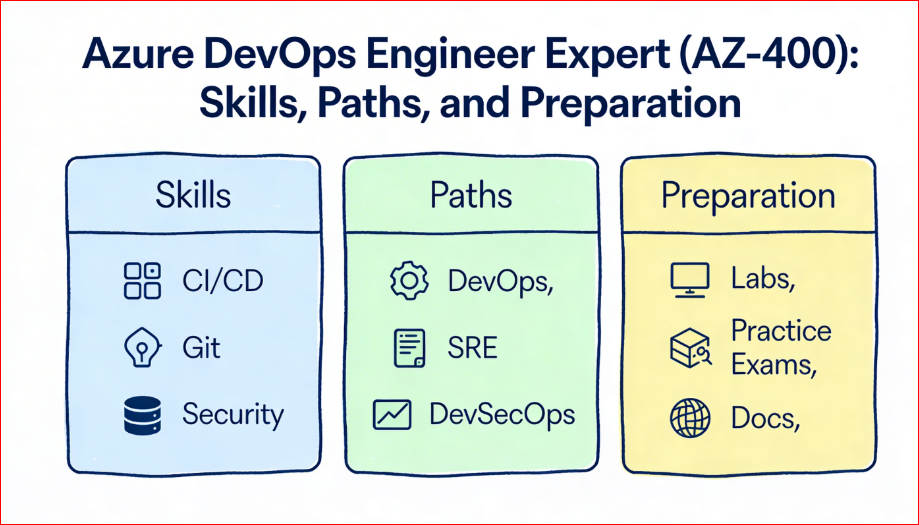
Introduction
If you are a software engineer, DevOps practitioner, or engineering manager looking to validate your cloud-native delivery skills on Microsoft Azure, the Azure DevOps Engineer Expert (AZ-400) is the certification that puts you in the top tier of the industry. It is recognized globally by enterprises, product companies, and consulting firms as proof that you can design and operate production-grade DevOps systems. In India alone, the demand for certified Azure DevOps professionals has grown rapidly as organizations modernize on Azure. This guide is your single, comprehensive reference — from understanding the certification to landing your next role.
What Is Azure DevOps Engineer Expert (AZ-400)?
The Microsoft Certified: DevOps Engineer Expert (AZ-400) is Microsoft’s highest-level credential for professionals who design and implement DevOps practices on the Azure platform. It validates your ability to work across the full software delivery lifecycle — from source control and CI/CD pipelines to security, compliance, infrastructure as code, and observability. Unlike associate-level certifications that test general cloud knowledge, AZ-400 expects you to demonstrate engineering depth in automated workflows, governance, and continuous improvement. It is the gold standard for anyone whose job revolves around building, shipping, and maintaining software on Azure at scale.
Certification at a Glance
| Field | Details |
|---|---|
| Track | Microsoft Azure — DevOps |
| Level | Expert |
| Who It’s For | DevOps Engineers, SREs, Platform Engineers, Cloud Engineers, Engineering Managers |
| Prerequisites | AZ-104 (Azure Administrator Associate) OR AZ-204 (Azure Developer Associate) |
| Skills Covered | CI/CD Pipelines, Source Control, Security & Compliance, IaC, Monitoring |
| Exam Duration | 150–180 minutes |
| No. of Questions | 40–60 |
| Passing Score | ~700 / 1000 |
| Recommended Order | AZ-104 or AZ-204 → AZ-400 |
Deep Dive: Azure DevOps Engineer Expert (AZ-400)
What It Is
AZ-400 is Microsoft’s expert-level certification for professionals who design, build, and manage end-to-end DevOps workflows using Azure DevOps and GitHub. It measures your ability to unify people, processes, and tools to enable continuous delivery at scale across complex enterprise environments. The exam covers the full delivery lifecycle — from the moment code is committed to the point it reaches production safely and reliably. Passing this exam earns you the Microsoft Certified: DevOps Engineer Expert badge, one of the most recognized and respected credentials in the global cloud market.
Who Should Take It
This certification is designed for professionals who are already operating in real Azure and GitHub environments, not beginners. It is highly relevant for DevOps Engineers building and maintaining CI/CD pipelines, SREs managing release reliability and platform health, and Platform Engineers designing internal developer platforms. Cloud Engineers who automate infrastructure deployments and Engineering Managers overseeing DevOps transformation programs at enterprise scale will also find this certification deeply valuable. Developers who want to expand their scope beyond writing code into the delivery and operations space are also strong candidates.
Skills You’ll Gain
- CI/CD pipeline design — Build, maintain, and optimize build and release pipelines using Azure Pipelines and GitHub Actions, which is the heaviest exam domain at 50–55% weight
- Source control strategy — Implement Git workflow, branch protection policies, pull request reviews, and code review automation
- Infrastructure as Code — Automate infrastructure provisioning using Terraform, Bicep, and ARM templates
- Security and compliance — Integrate shift-left security scanning, secret management via Azure Key Vault, and pipeline compliance gates
- Dependency management — Manage packages, libraries, and versioning using Azure Artifacts
- Instrumentation and monitoring — Design and implement monitoring solutions using Azure Monitor and Application Insights
- Container workflows — Build, store, and deploy container images using Azure Container Registry and Kubernetes
Real-World Projects You Should Be Able to Do After It
- Build and maintain a full CI/CD pipeline from code commit to production deployment using Azure Pipelines or GitHub Actions, including approvals, gates, and rollback strategies
- Implement branch protection strategies, pull request policies, and GitFlow or trunk-based development workflows in Azure Repos
- Automate infrastructure provisioning using Terraform or Bicep so environments are reproducible, version-controlled, and consistent across dev, staging, and production
- Set up secret management and pipeline security using Azure Key Vault, eliminating hardcoded credentials from all pipeline configurations
- Configure monitoring dashboards and alerts using Azure Monitor and Application Insights to provide real-time visibility into deployment health and application performance
- Implement shift-left security scanning in pipelines using tools like Microsoft Defender for DevOps to catch vulnerabilities before they reach production
- Manage container image builds and push workflows with Azure Container Registry, including versioning, tagging, and integration with Kubernetes deployments
Preparation Plan
7–14 Days — Fast Track for Experienced Professionals
This plan is designed for engineers who already have 2+ years of active Azure DevOps experience and hold AZ-104 or AZ-204. Spend the first two days reviewing the official exam skills outline to identify any gaps in your current knowledge. Days three through five should be focused entirely on the CI/CD pipeline domain, which carries over half the exam weight — practice real scenarios in Azure Pipelines and GitHub Actions. Days six through eleven should cover IaC, source control strategies, dependency management, security, and monitoring. Close out with two to three full-length mock tests and a targeted gap review on your weakest areas before exam day.
30 Days — Balanced Plan (Recommended for Most)
This is the most effective plan for working professionals who have some Azure familiarity but need structured preparation. Spend Week 1 on Azure DevOps fundamentals — repos, branching strategies, work items, and board configuration. Week 2 is your most critical week: go deep on Azure Pipelines YAML syntax, GitHub Actions workflows, multi-stage deployments, and pipeline triggers. Week 3 covers the IaC, security scanning, Key Vault integration, and artifact management domains. Finish Week 4 with monitoring, instrumentation, and at least three to four full mock exams to build confidence and time management.
60 Days — Thorough Plan for Career Changers
This plan is ideal for professionals transitioning into DevOps from development, testing, or infrastructure backgrounds. Spend the first month completing the AZ-104 or AZ-204 prerequisite content while building foundational Azure familiarity through the free Azure portal sandbox. This establishes the context AZ-400 assumes you already have. In Month 2, go through each AZ-400 domain systematically with hands-on labs on the Azure free tier — do not rely on video content alone; build real pipelines. Close the second month with structured mock exams, reviewing every wrong answer to understand root cause before booking the real exam.
Common Mistakes
- Skipping prerequisites — Attempting AZ-400 without AZ-104 or AZ-204 leaves major knowledge gaps in Azure resource management that the exam assumes as baseline
- Theory without hands-on practice — Watching videos and reading docs is not enough; you must build real pipelines in Azure DevOps and GitHub Actions to pass
- Underestimating the CI/CD domain — Many candidates spread study time equally across all domains, not realizing that pipelines alone cover 50–55% of the exam
- Ignoring GitHub Actions — The exam tests both Azure Pipelines and GitHub Actions workflows; neglecting one will cost you points
- Overlooking security and compliance — This domain has grown in exam weight with recent updates and is often where unprepared candidates lose marks
- Not reading the official Microsoft study guide — The skills outline on Microsoft Learn is the definitive source for what is in scope; ignoring it leads to studying the wrong things
- Booking the exam too early — Confidence from mock test scores on easy question banks can be misleading; always use scenario-based practice questions that mirror actual exam complexity
Best Next Certification After This
After earning AZ-400, the most strategic next steps depend on the direction you want your career to move.
- Same Track: Microsoft Certified Azure Solutions Architect Expert (AZ-305) — expands your scope from pipeline design to full Azure architecture
- Cross-Track: HashiCorp Terraform Associate or Certified Kubernetes Application Developer (CKAD) — adds multi-cloud IaC and container orchestration depth
- Leadership: ITIL 4 Strategic Leader or PMP — for Engineering Managers stepping into delivery governance and organizational transformation roles
Choose Your Path
Not every engineer follows the same route. AZ-400 is a core credential that feeds into six modern DevOps career paths, and knowing how it fits into each helps you plan smarter.
DevOps Path
AZ-400 is the definitive core certification for the DevOps career track. Start with AZ-104 to build Azure administration fundamentals, then complete AZ-204 for development context, and sit AZ-400 as your capstone expert credential. After AZ-400, AZ-305 extends your skills into full cloud architecture design, making you capable of both building pipelines and designing the infrastructure they deploy to. Adding Terraform Associate gives you multi-cloud IaC capability beyond Azure-specific tools.
DevSecOps Path
AZ-400 provides the pipeline security foundation that every DevSecOps role depends on — secret management, compliance gates, and shift-left security scanning are all covered in the exam. Build on this with SC-400 (Microsoft Information Protection) to cover data governance and information protection at the platform level. Supplement with dedicated DevSecOps certifications from DevSecOps School and CSSLP for secure software development lifecycle depth. This combination positions you as someone who can secure the entire delivery chain, not just the application layer.
SRE Path
AZ-400’s monitoring and instrumentation domain directly supports the SRE discipline of SLO implementation, error budgeting, and incident response automation. Combine the certification with the Linux Foundation Certified SRE (LFSRE) and hands-on Prometheus and Grafana observability skills to build a well-rounded SRE credential stack. Understanding how to instrument pipelines for reliability — not just functionality — is what separates DevOps engineers from true SREs. This path makes you effective both in preventing production failures and recovering from them systematically.
AIOps / MLOps Path
AZ-400 provides the CI/CD backbone that makes MLOps possible — automated model training pipelines, model versioning, and deployment workflows all follow the same CI/CD principles the exam tests. Layer DP-100 (Azure Data Scientist Associate) on top to add machine learning model building and experiment tracking capability. This combination allows you to design and operate end-to-end MLOps workflows where models are trained, tested, versioned, and deployed automatically. As AI adoption accelerates in Indian enterprises and globally, this path is one of the highest-demand specializations in the market.
DataOps Path
AZ-400 builds the pipeline discipline essential for DataOps — treating data pipelines the same way software pipelines are treated, with version control, automated testing, and continuous integration. Pair this certification with DP-203 (Azure Data Engineer Associate) to handle CI/CD for data workflows, including quality gates, automated testing of ETL pipelines, and data pipeline observability. This combination is increasingly sought after by organizations that want reliable, auditable, and automated data delivery rather than fragile manual processes. DataOps practitioners with AZ-400 can bridge the gap between data engineering and platform engineering teams effectively.
FinOps Path
Engineering Managers and Cloud Architects following FinOps practices benefit directly from AZ-400’s IaC and pipeline governance modules — automated provisioning with cost tagging, policy enforcement, and budget controls baked into pipelines. Combine AZ-400 with the FinOps Certified Practitioner (FOCP) to govern cloud cost in automated deployments and provide cost visibility across engineering teams. This path is especially relevant for Engineering Managers who need to demonstrate both technical credibility and financial accountability to leadership. As cloud spend grows in organizations, professionals who combine DevOps execution with FinOps governance become highly strategic.
Role → Recommended Certifications
| Role | Recommended Certifications |
|---|---|
| DevOps Engineer | AZ-104 → AZ-204 → AZ-400 → AZ-305 |
| SRE | AZ-104 → AZ-400 → LFSRE → Prometheus/Grafana |
| Platform Engineer | AZ-104 → AZ-400 → CKA → Terraform Associate |
| Cloud Engineer | AZ-900 → AZ-104 → AZ-400 → AZ-305 |
| Security Engineer | AZ-500 → AZ-400 → SC-400 → DevSecOps Practitioner |
| Data Engineer | DP-900 → DP-203 → AZ-400 (DataOps pipeline automation) |
| FinOps Practitioner | AZ-104 → AZ-400 → FOCP (FinOps Certified Practitioner) |
| Engineering Manager | AZ-900 → AZ-400 → AZ-305 → PMP / ITIL 4 |
Training Institutions That Can Help You Prepare
DevOpsSchool
DevOpsSchool is one of India’s and the world’s most comprehensive DevOps training and certification providers. They offer instructor-led, self-paced, and corporate training programs specifically aligned with AZ-400 and the broader Azure DevOps ecosystem. Their curriculum is built around real industry use cases, ensuring that learners gain both certification readiness and practical job-ready skills. For working professionals in India and globally, DevOpsSchool’s structured pathways from associate to expert level make progression predictable and measurable.
Cotocus
Cotocus provides hands-on DevOps and cloud training with a strong emphasis on project-based, outcome-oriented learning. Their AZ-400 preparation programs include live pipeline labs, scenario-based mock exams, and one-on-one mentorship sessions that bridge the gap between certification theory and actual job performance. Cotocus is particularly effective for professionals who learn best through building rather than reading, as the training prioritizes doing over watching. Their instructors bring direct enterprise experience into the classroom, making examples grounded and immediately applicable.
Scmgalaxy
Scmgalaxy specializes in SCM, DevOps tooling, and continuous delivery training with a strong legacy in the Indian DevOps training space. Their Azure DevOps content is particularly strong on Git workflow design, pipeline orchestration, and release strategy — all high-weight domains in the AZ-400 exam. They are a trusted name among working engineers in India who need focused, tool-specific training that complements theoretical exam preparation. Scmgalaxy’s community forums and peer-to-peer learning networks also provide ongoing support beyond formal training sessions.
BestDevOps
BestDevOps provides focused, structured training paths for DevOps certifications, including AZ-400, with content designed for both beginners entering the field and experienced professionals seeking certification. Their programs include curated study materials, community forums, and practice labs that help learners move from concept to certification confidently without information overload. The platform is particularly well-suited for self-paced learners who want to progress on their own schedule while still having access to structured guidance. Learners benefit from a community of peers going through the same certification journey, creating accountability and knowledge sharing.
DevSecOps School
For engineers on the DevSecOps path, DevSecOps School complements AZ-400 with dedicated security-focused content that covers pipeline hardening, compliance automation, and shift-left security practices in depth. Their training programs go beyond what AZ-400 covers in security by diving into threat modeling, security toolchain integration, and DevSecOps organizational practices. This makes their content essential for professionals who want AZ-400 to be the foundation of a dedicated DevSecOps specialization rather than just a general DevOps certification. Their instructors bring real-world red team and blue team perspectives that sharpen practical security skills alongside certification readiness.
SRE School
SRE School bridges the SRE and DevOps worlds, making it the ideal complement for professionals using AZ-400 as part of a Site Reliability Engineering career path. Their content on reliability engineering, observability design, SLO/SLA frameworks, and error budget management extends far beyond what the AZ-400 monitoring domain covers. For engineers transitioning from DevOps to SRE roles, SRE School provides the structural thinking and operational discipline that certifications alone cannot teach. Their programs are especially valuable for professionals at large-scale internet companies and banks where uptime and reliability are business-critical requirements.
AIOps School
AIOps School is the ideal partner for professionals combining AZ-400 with AI-driven IT operations, a rapidly growing discipline across enterprise technology teams. Their content on intelligent monitoring, anomaly detection, automated incident remediation, and AI-assisted pipeline optimization directly complements AZ-400’s instrumentation strategy domain. As organizations move toward self-healing infrastructure and intelligent alerting, professionals who hold AZ-400 and understand AIOps principles are uniquely positioned for senior platform and operations roles. AIOps School’s practical labs ensure that AI concepts are grounded in real operational tooling rather than staying purely theoretical.
DataOps School
DataOps School supports data engineers and analytics professionals who want to apply CI/CD principles to data pipelines, treating data delivery with the same rigor as software delivery. Combined with AZ-400 training, their courses help professionals build production-ready, version-controlled data workflows on Azure that include data quality gates, automated testing, and pipeline observability. This combination is increasingly demanded by organizations that want to eliminate manual, error-prone data processes and replace them with auditable, automated pipelines. DataOps School’s content on metadata management, data lineage, and pipeline monitoring fills the gaps that a pure DevOps certification does not address.
FinOps School
FinOps School prepares engineering and finance teams to optimize cloud spending and build financial accountability into cloud operations, a skill that pairs directly with AZ-400’s infrastructure governance capabilities. For AZ-400 professionals moving into FinOps roles or supporting FinOps initiatives, their programs on cloud cost modeling, tagging strategies, showback/chargeback frameworks, and budget governance create a highly strategic professional profile. Their training helps engineers understand that the pipelines and IaC templates they build have direct financial consequences — and that cost efficiency should be engineered, not hoped for. As cloud bills grow and CFOs demand accountability, FinOps School graduates with AZ-400 credentials are increasingly sought after in both enterprise IT and cloud consultancies.
FAQs — Azure DevOps Engineer Expert (AZ-400)
Q1. Is AZ-400 a difficult exam?
Yes, it is officially rated as an Expert-level exam by Microsoft, and it earns that classification. The CI/CD pipelines domain alone covers 50–55% of the total exam weight, which means theoretical knowledge without hands-on pipeline experience will almost certainly result in failure. Candidates who have passed consistently emphasize that real-world practice in Azure Pipelines and GitHub Actions is non-negotiable, not optional preparation. The exam uses scenario-based and case-study questions that require you to think through trade-offs, not just recall definitions.
Q2. How much time do I need to prepare?
Most candidates need 30–60 days of focused, structured preparation to feel genuinely ready for AZ-400. Experienced DevOps engineers who work with Azure Pipelines daily and hold the prerequisite certifications can often prepare in 2–3 weeks with concentrated effort. However, professionals transitioning from development or infrastructure backgrounds without active Azure DevOps experience should plan for 45–60 days to build the hands-on exposure the exam demands. Rushing preparation to meet a self-imposed deadline is one of the most common reasons for first-attempt failures.
Q3. What are the prerequisites?
You must hold either the Microsoft Certified: Azure Administrator Associate (AZ-104) or Microsoft Certified: Azure Developer Associate (AZ-204) before the Expert certification badge is formally awarded. Microsoft introduced this requirement to ensure that Expert-level candidates have foundational Azure knowledge in either administration or development before attempting an advanced delivery certification. You can technically sit the AZ-400 exam before completing the prerequisite, but the Expert certification will not appear on your transcript until the associate requirement is satisfied. For most professionals, completing AZ-104 first is the more logical path since it covers Azure infrastructure that pipelines deploy to.
Q4. Can I take AZ-400 without AZ-104 or AZ-204?
You can sit the AZ-400 exam without holding a prerequisite, but Microsoft will not issue the DevOps Engineer Expert certification until you also hold AZ-104 or AZ-204. This means taking AZ-400 first is possible but creates a frustrating situation where you pass an Expert exam but cannot claim the credential. It is far more efficient to complete the prerequisite certification first so that passing AZ-400 immediately rewards you with the Expert badge. Most training institutions recommend following the Microsoft-recommended sequence to avoid this certificate limbo.
Q5. What is the exam fee?
The standard exam fee is approximately USD 165, though pricing varies by country and region due to Microsoft’s regional pricing model. In India, the fee is significantly lower due to Purchasing Power Parity (PPP) pricing that Microsoft applies for many countries, making it more accessible for Indian professionals. Check the current fee at the time of registration as it is subject to periodic revision. Corporate clients who purchase Microsoft exam vouchers in bulk through enterprise agreements often access discounts that bring the per-exam cost down further.
Q6. How long is the AZ-400 certification valid?
Microsoft certifications are valid for one year from the date of earning. After the first year, you must pass a free annual renewal assessment on Microsoft Learn — an online, open-book assessment that is significantly shorter and less formal than the proctored exam. This renewal model means you never need to pay for a re-exam just to stay certified, as long as you complete the renewal assessment within the designated window. Missing the renewal window results in the certification expiring, requiring you to retake the full proctored exam to reinstate it.
Q7. What is the passing score?
The minimum passing score for AZ-400 is approximately 700 out of 1000. Microsoft uses a scaled scoring model, meaning the difficulty of the specific question set you receive is factored into the final score calculation. This is why two candidates answering different versions of the exam are assessed fairly against the same 700-point threshold. There is no partial credit for most question types, so accuracy and understanding — not guessing — is what gets you across the passing line.
Q8. What career outcomes can I expect after AZ-400?
Earning AZ-400 positions you for roles such as DevOps Engineer, Cloud Engineer, Platform Engineer, Senior SRE, and DevOps Lead in both enterprise IT and product companies. In India, certified professionals with relevant experience typically earn between ₹10 lakhs and ₹16.5 lakhs or significantly more depending on the employer, city, and total experience. Globally, Azure DevOps Engineers with this certification command salaries ranging from $120,000 to over $200,000 in the United States, United Kingdom, and APAC markets. Beyond salary, the credential opens consulting opportunities, contract roles, and internal promotion pathways that are often gated by certifications in large organizations.
Q9. What tools should I know before the exam?
Core tools include Azure DevOps, GitHub, Azure Pipelines, Terraform or Bicep for IaC, Azure Monitor, Application Insights, Azure Key Vault, and Docker basics with some Kubernetes familiarity. Being comfortable navigating the Azure portal and writing YAML pipeline syntax is especially important since many exam questions are scenario-based and expect you to recognize correct configurations. Understanding how these tools connect to each other — for example, how Key Vault integrates with pipeline variable groups — is more valuable than knowing any single tool in isolation.
Q10. Is AZ-400 valuable in India specifically?
Absolutely — and the demand is growing at a notable pace. As Indian enterprises across BFSI, retail, manufacturing, and IT services accelerate their Azure adoption, AZ-400-certified professionals are in high demand across Bengaluru, Pune, Hyderabad, Mumbai, and Delhi-NCR. Both captive centers of global MNCs and Indian product companies are actively seeking engineers who can not only work in Azure but prove they understand enterprise-grade delivery pipeline design. India’s growing cloud consulting export market also values this certification heavily since it demonstrates a globally recognized, vendor-verified level of expertise to international clients.
Q11. Can Engineering Managers benefit from AZ-400?
Yes — and often more than people expect. Engineering Managers who earn AZ-400 gain a structured, comprehensive understanding of pipeline design, IaC governance, DevSecOps controls, and monitoring strategy. This technical depth makes them significantly more effective in sprint planning, architecture reviews, hiring decisions, and cross-team coordination where DevOps principles are discussed. It also gives managers the credibility to push back on poor technical decisions and advocate for engineering excellence with data and structured reasoning. In many organizations, a manager holding an Expert-level DevOps certification commands higher authority in technical governance discussions than those without it.
Q12. What is the difference between AZ-400 and just doing Azure DevOps on the job?
On-the-job experience is valuable, but it is almost always siloed — you become expert in the parts of the pipeline your team owns and less familiar with everything else. AZ-400 forces you to learn the full delivery lifecycle — source control, build, release, security, dependency management, and monitoring — as a coherent, integrated system. The certification also provides a globally recognized, employer-verifiable proof of that knowledge, which informal experience cannot provide on a resume or in a job interview. Additionally, the structured preparation process for AZ-400 consistently teaches experienced practitioners things they had been doing suboptimally or had never been exposed to at all.
FAQs (8) — Azure DevOps Engineer Expert (AZ-400)
1) What is AZ-400 and what does it validate?
AZ-400 is the exam for the Microsoft Certified: DevOps Engineer Expert credential, focused on designing and implementing DevOps practices on Microsoft platforms. It validates end-to-end capability across source control, CI/CD, security/compliance, and observability/instrumentation—so you can build reliable delivery systems, not just run tools.
2) Who should take AZ-400?
It’s best for DevOps Engineers, SRE/Platform Engineers, and Cloud/Software Engineers who already work with pipelines and delivery workflows in real projects. It also fits engineering leads/managers who need to understand pipeline design, governance, and release reliability at a system level.
3) What are the prerequisites for the DevOps Engineer Expert certification?
To earn the DevOps Engineer Expert certification, Microsoft requires you to have either AZ-104 (Azure Administrator Associate) or AZ-204 (Azure Developer Associate) along with AZ-400. Many candidates follow AZ-104 → AZ-400 (ops-heavy) or AZ-204 → AZ-400 (dev-heavy) depending on their current role.
4) What skills/topics are heavily tested in AZ-400?
The biggest weight is on designing and implementing build and release pipelines (CI/CD), which is listed as 50–55% in the official study guide. Other measured areas include processes/communications, source control strategy, security & compliance, and instrumentation/monitoring strategy.
5) Do I need to know Azure Pipelines and GitHub Actions?
Yes—AZ-400 covers DevOps implementation using Microsoft’s ecosystem, which includes Azure DevOps and GitHub-based workflows. Expect scenario questions where you choose the right approach for automation, approvals/gates, secrets, and deployment strategies across these tools.
6) How long does it take to prepare for AZ-400?
If you already work daily with CI/CD on Azure and understand Azure fundamentals, preparation can be shorter because you’re mostly mapping real experience to the skills outline. If your exposure is limited (or you’re new to Azure DevOps/GitHub workflow design), plan more time so you can practice the pipeline-heavy domain properly.
7) Is AZ-400 more theory or hands-on?
The exam is strongly scenario-driven, so “tool definitions” aren’t enough—you need to understand how to design and troubleshoot delivery systems in realistic constraints (security, reliability, approvals, and governance). The official skills outline is a good checklist for building hands-on labs (repos, pipelines, artifacts, Key Vault integration, monitoring).
8) What should I do after AZ-400?
If you want to expand beyond delivery into architecture, the next logical Microsoft step is to grow into broader solution design responsibilities after proving DevOps expertise. If you want deeper operational excellence, double down on monitoring/instrumentation and reliability practices because AZ-400 explicitly tests instrumentation strategy as part of the blueprint.
Testimonials
“I had been working with Azure Pipelines for two years but never had a structured way to validate it. AZ-400 changed that. The preparation process alone taught me things about IaC and compliance I had been missing. Within three months of certifying, I was leading pipeline architecture for a pan-India retail client.”
— Senior DevOps Engineer, IT Services Company, Bengaluru
“As an Engineering Manager, I wasn’t sure if AZ-400 was for me. But the exam gave me the exact vocabulary and technical depth to have better conversations with my team and leadership. It legitimized my role in technical decisions — I went from following DevOps conversations to leading them.”
— Engineering Manager, FinTech Startup, Mumbai
“I came from a development background and was transitioning to DevOps. AZ-400 gave me a clear roadmap — every topic felt connected to real work, not just abstract concepts. DevOpsSchool’s hands-on labs were a game changer. I passed on my first attempt and received a job offer within six weeks.”
— Software Engineer transitioning to DevOps, Hyderabad
“I took AZ-400 after completing my AZ-104. The jump in knowledge and confidence was massive — it forced me to understand not just what tools do, but how to design systems with them. It directly helped me land a Platform Engineer role at a global bank’s India operations center, and the salary uplift was significant.”
— Platform Engineer, Global Bank India Operations, Pune
Conclusion
The Azure DevOps Engineer Expert (AZ-400) is not just a certification — it is a career accelerator that validates your ability to operate at the top tier of cloud-native software delivery. It proves to employers, clients, and peers that you can design, build, secure, and monitor enterprise-grade DevOps pipelines on one of the world’s most widely adopted cloud platforms. Whether you are a hands-on engineer, a team lead, or a manager driving DevOps transformation in your organization, AZ-400 gives you the credibility, the structure, and the depth to take your career measurably forward. The path is clear: earn your prerequisite, build your hands-on lab experience, choose a training partner that fits your style, and prepare systematically. With focused effort and the right resources from institutions like DevOpsSchool, Cotocus, Scmgalaxy, and BestDevOps, this certification is well within your reach regardless of your current starting point. Take the first step today — because in today’s cloud-first world, certified expertise is not optional for those who want to lead.