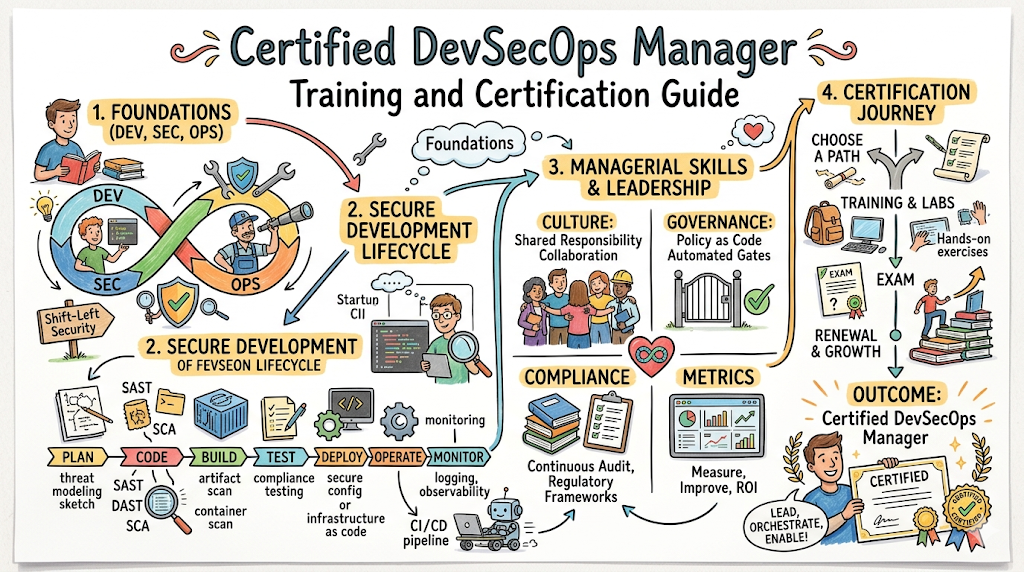
Software is changing very fast. Teams release new features weekly or even daily. At the same time, security, compliance, and privacy are becoming more important than ever. The Certified DevSecOps Manager program from DevSecOpsSchool helps you become the person who leads both speed and security together. It is designed for working engineers, technical leads, and managers in India and across the world.
Deep Dive: Certified DevSecOps Manager
What it is
The Certified DevSecOps Manager program is a structured training and certification focused on DevSecOps strategy, governance, and leadership. It prepares you to lead secure software delivery across development, operations, and security teams in cloud and on-prem environments.
Who should take it
This certification is ideal for:
- DevOps engineers, SREs, and platform engineers who want to move into security leadership.
- Security engineers who want to understand CI/CD, cloud, and DevOps ways of working.
- Cloud engineers who manage large-scale platforms and must embed security.
- Engineering managers and team leads who own delivery, risk, and compliance.
- Product and program managers involved in secure delivery programs.
Skills you’ll gain
You will gain skills in:
- DevSecOps leadership models and organizational structures.
- Designing governance frameworks and security policies across CI/CD.
- Mapping compliance frameworks (ISO, SOC 2, HIPAA, GDPR, PCI-DSS, NIST) to pipelines.
- Building cross-functional DevSecOps teams and practices.
- Selecting and orchestrating security tools in CI/CD (SAST, DAST, SCA, secrets, container security).
- Designing DevSecOps maturity roadmaps, KPIs, and dashboards.
- Leading incident response and post-incident learning.
- Managing cloud and infrastructure risk across AWS, Azure, and GCP.
Real-world projects you should be able to do after it
After completing this certification, you should be able to:
- Design a DevSecOps transformation plan for a product, BU, or entire organization.
- Build a DevSecOps governance model with policies, approvals, and automated checks.
- Implement a policy-as-code approach that blocks non-compliant builds in CI/CD.
- Create a DevSecOps KPI dashboard (e.g., MTTR, vulnerability closure rate, policy compliance).
- Lead a cross-team initiative to integrate security tools into existing pipelines.
- Set up incident response workflows and run effective post-incident reviews.
Preparation plan (7–14 days / 30 days / 60 days)
7–14 days (fast track for experienced professionals)
- Focus on official syllabus, governance concepts, and case studies.
- Study 3–4 hours per day, with strong focus on scenario-based thinking.
- Revise compliance frameworks and DevSecOps maturity models.
30 days (typical for working engineers and managers)
- Week 1: Refresh DevOps, CI/CD, and basic security concepts.
- Week 2: Study DevSecOps governance, compliance, and cloud risk topics.
- Week 3: Deep dive into metrics, maturity, and incident response.
- Week 4: Solve practice questions, create your own DevSecOps roadmap, and revise.
60 days (foundation + leadership)
- First 30 days: Build hands-on understanding of DevOps, pipelines, and common security tools.
- Next 30 days: Focus on leadership, strategy, frameworks, and organizational design.
- Use the full duration to connect every topic to your real or target organization.
Common mistakes
Avoid these common mistakes:
- Treating it as a pure technical exam, ignoring leadership and governance.
- Focusing only on tools, not on process and culture.
- Not mapping concepts to your current or target company context.
- Ignoring compliance and risk topics because they feel “less technical”.
- Memorizing definitions instead of practicing scenarios and trade-offs.
Best next certification after this
After this certification, the best next options are:
- Same track (DevSecOps / security leadership)
- A higher-level security architecture or DevSecOps transformation program that covers enterprise-scale governance and zero-trust models.
- Cross-track (cloud / DevOps / SRE)
- A cloud architect, SRE, or advanced DevOps certification that deepens knowledge of large-scale systems and reliability.
- Leadership
- A broad engineering leadership, product, or program management certification that strengthens your ability to manage multi-team initiatives.
Certification Snapshot Table
| Track | Level | Who it’s for | Prerequisites | Skills covered | Recommended order |
|---|---|---|---|---|---|
| DevSecOps | Manager / Master | DevOps/SRE/Platform/Security Engineers, Tech Leads, Managers | 3+ years in DevOps/SRE/Security/Cloud, CI/CD experience, basic security & compliance awareness | DevSecOps leadership, governance, compliance mapping, policy-as-code, cross-team collaboration, KPIs, incident response, cloud risk | After core DevOps/Cloud/Security engineer-level certifications |
| DevOps | Associate | New or early-career engineers learning modern delivery | Basic IT knowledge, scripting or programming fundamentals | CI/CD basics, source control, scripting, containers, build and release pipelines | 1st DevOps step before any specialization |
| DevOps | Professional / Expert | Experienced DevOps and platform engineers | 2+ years in DevOps or system administration, CI/CD and cloud exposure | Advanced CI/CD, infrastructure as code, cloud strategy, observability, scaling delivery pipelines | After DevOps Associate, before DevSecOps Manager or SRE/Architect tracks |
| DevSecOps | Engineer / Professional | Security-minded DevOps/SRE/Cloud engineers | DevOps foundation, basic AppSec knowledge, exposure to security tools | Integrating SAST/DAST/SCA, secrets management, container security, secure SDLC, pipeline security automation | After DevOps Professional, before or alongside DevSecOps Manager |
| SRE | Specialist / Professional | Reliability engineers, SREs, Ops/DevOps moving into reliability roles | Programming skills, Linux, networking, CI/CD familiarity | SLIs/SLOs, error budgets, incident response, capacity planning, production readiness, observability | After DevOps foundation; can precede or run parallel to DevSecOps Manager |
| AIOps/MLOps | Specialist | ML/Data leads, platform engineers working with ML and intelligent ops | Python, cloud ML services, CI/CD knowledge | Model lifecycle, ML deployment, monitoring & drift, AIOps signals, automation of operations using AI/ML | After DevOps/DataOps fundamentals; before or after DevSecOps Manager for AI/ML-heavy environments |
| DataOps | Specialist | Data engineers, data architects, analytics platform owners | SQL, data engineering basics, ETL/ELT familiarity | Data pipeline design, data quality, lineage, collaboration, DataOps practices | After data engineering or BI experience; complements DevSecOps Manager for data platforms |
| FinOps | Specialist | Cloud managers, FinOps practitioners, cost-focused platform leaders | Cloud usage experience, basic finance/cost concepts | Cloud cost allocation, optimization, budgeting, chargeback/showback, governance | After cloud fundamentals; pairs well with DevSecOps Manager for cost + security governance |
Choose Your Path: 6 Learning Paths
DevSecOps management touches many areas. Here is how the certification fits into six popular learning paths for software engineers.
1. DevOps Path
- Start with a DevOps foundation: version control, CI/CD, automation, and cloud basics.
- Add infrastructure as code, containers, and orchestration.
- Learn observability and basic SRE practices.
- Take Certified DevSecOps Manager to add security leadership and governance to your DevOps profile.
2. DevSecOps Path
- Begin with basic application security and secure coding practices.
- Learn to integrate SAST, DAST, SCA, and secrets management into CI/CD.
- Move into more advanced DevSecOps engineer trainings.
- Take Certified DevSecOps Manager to lead DevSecOps programs, not just implement tools.
3. SRE Path
- Start with SRE principles, SLIs, SLOs, and error budgets.
- Learn incident management, on-call practices, and observability.
- Understand where security and reliability intersect (e.g., secure incident response).
- Take Certified DevSecOps Manager to drive both reliability and security at the platform level.
4. AIOps/MLOps Path
- Build a base in data pipelines, ML workflows, and model deployment.
- Learn MLOps practices for monitoring and governance of models.
- Understand security, access control, and compliance for ML and data platforms.
- Take Certified DevSecOps Manager to secure AI/ML systems and align them with enterprise security.
5. DataOps Path
- Start with data engineering and ETL/ELT pipelines.
- Add DataOps, focusing on data quality, lineage, and collaboration.
- Learn data security and privacy regulations for data systems.
- Take Certified DevSecOps Manager to lead secure data delivery and regulatory compliance.
6. FinOps Path
- Learn cloud cost management, budgeting, and chargeback/showback.
- Understand how cost choices affect architecture, security, and risk.
- Work with engineering and finance on governance.
- Take Certified DevSecOps Manager to connect cost, risk, and security decisions for leadership.
Role → Recommended Certifications
| Role | How Certified DevSecOps Manager fits | Suggested high-level sequence |
|---|---|---|
| DevOps Engineer | Adds security governance and leadership on top of automation and CI/CD | DevOps foundation → Cloud/Containers → DevSecOps Engineer → Certified DevSecOps Manager |
| SRE | Extends reliability focus with security, risk, and compliance ownership | SRE/Observability foundation → Incident/On-call → Certified DevSecOps Manager |
| Platform Engineer | Connects platform design with security, policy, and governance | Cloud/Platform/Kubernetes → Security basics → Certified DevSecOps Manager |
| Cloud Engineer | Brings structured security leadership into cloud migration and operations | Cloud Associate/Architect → Cloud Security → Certified DevSecOps Manager |
| Security Engineer | Moves from deep technical security to DevSecOps strategy and leadership | AppSec/Cloud Security → DevSecOps Engineer → Certified DevSecOps Manager |
| Data Engineer | Adds governance and security to data platforms and pipelines | Data Engineering → Data Security/Compliance → Certified DevSecOps Manager |
| FinOps Practitioner | Aligns cost optimization with security, risk, and compliance governance | FinOps fundamentals → Cloud Governance → Certified DevSecOps Manager |
| Engineering Manager | Provides a structured framework to lead secure delivery across multiple teams | Leadership/PM basics → DevOps/Cloud Fundamentals → Certified DevSecOps Manager |
Next Certifications to Take (Same Track, Cross-Track, Leadership)
Based on general software engineering certification trends for DevOps, cloud, and security-focused professionals, the next steps after Certified DevSecOps Manager can be:
1. Same Track: Deepen DevSecOps and Security Leadership
- Advanced DevSecOps or security architecture programs that cover microservices security, zero-trust, and large-scale governance.
- Specialized certifications in cloud security (AWS/Azure/GCP security) to deepen your platform security skills.
2. Cross-Track: Strengthen Adjacent Technical Areas
- DevOps / SRE master-level certifications to improve your skills in reliability, scalability, and automation.
- Cloud architect certifications to design secure, large-scale cloud architectures.
3. Leadership: Broader Engineering and Program Leadership
- Certifications that focus on engineering management, program management, or product leadership.
- These help you manage bigger portfolios, budgets, and multi-team DevSecOps programs.
(Above guidance is aligned to common “top certifications for software engineers” patterns, adapted to fit a DevSecOps manager’s path.)
Top Institutions for Training and Certification Support
These institutions can support your preparation for Certified DevSecOps Manager and related learning paths.
DevOpsSchool
DevOpsSchool provides structured training across DevOps, DevSecOps, SRE, and cloud, with hands-on labs and real-world case studies. It is a strong choice if you want integrated learning that connects tools, processes, and leadership topics.
Cotocus
Cotocus focuses on training and consulting for DevOps and cloud transformation. It often combines workshops with implementation support, which helps if you plan to apply DevSecOps Manager concepts directly in your organization.
Scmgalaxy
Scmgalaxy offers training on DevOps, SCM, CI/CD, and related tooling, which forms the technical base for DevSecOps. It is a good option to strengthen your pipeline and automation skills before or alongside this certification.
BestDevOps
BestDevOps is a knowledge hub that shares content, news, and programs related to DevOps and DevSecOps. It helps you stay updated with evolving practices that support your long-term DevSecOps leadership journey.
devsecopsschool.com
DevSecOpsSchool is the official provider for Certified DevSecOps Manager. It offers targeted training, leadership-focused curriculum, governance playbooks, and certification support.
sreschool.com
SRESchool focuses on Site Reliability Engineering and observability. Pairing SRE skills with DevSecOps Manager prepares you to own both reliability and security at scale.
aiopsschool.com
AIOpsSchool provides training in AIOps and MLOps, covering intelligent operations and ML lifecycle. Combined with DevSecOps Manager skills, it helps you secure complex, automated, and AI-driven environments.
dataopsschool.com
DataOpsSchool trains professionals in DataOps, data pipelines, and analytics delivery. Together with DevSecOps Manager, it helps you handle data security, governance, and regulatory needs in data-heavy systems.
finopsschool.com
FinOpsSchool focuses on cloud cost management and FinOps practices. When you add DevSecOps Manager skills, you can align cost, security, reliability, and risk into one leadership perspective.
FAQs – Difficulty, Time, Prerequisites, Value, Career
1. Is Certified DevSecOps Manager a difficult certification?
It is challenging but achievable for working engineers and managers with experience in DevOps, security, or cloud. The difficulty comes from scenario-based thinking and leadership topics, not from low-level tool commands.
2. How much time do I need to prepare?
Most professionals need 30–60 days with 1–2 hours of study per day. Those already working in DevSecOps or security leadership can prepare faster, in 7–14 focused days.
3. What are the prerequisites?
You should have:
- A few years of experience in DevOps, security, SRE, or cloud.
- Familiarity with CI/CD pipelines and common DevOps tools.
- Basic understanding of security or compliance frameworks.
4. In what sequence should I take related certifications?
A good sequence is: core DevOps or cloud certification → security/DevSecOps engineer-level training → Certified DevSecOps Manager → advanced architecture or leadership programs. This keeps your foundation strong while you grow into leadership.
5. What is the real value of this certification?
The main value is that you learn how to lead DevSecOps, not just configure tools. You become better at making decisions, designing governance, and explaining security trade-offs to business leaders.
6. What kind of career outcomes can I expect?
You can move towards roles like DevSecOps Manager, Secure Delivery Program Manager, Platform Security Manager, Cloud Governance Lead, or DevSecOps Consultant. It can also strengthen your profile for senior DevOps, SRE, or engineering management positions.
7. Is this certification useful for managers who do not code daily?
Yes. The focus is on strategy, governance, and culture, not on writing code. However, a basic understanding of technical topics helps you talk effectively with engineering teams.
8. Is this suitable for freshers?
No, it is not ideal for complete beginners. Freshers should first build experience in DevOps, cloud, or security before aiming for DevSecOps Manager.
9. Does it cover compliance and audits?
Yes, the program covers mapping DevSecOps practices to frameworks like ISO 27001, SOC 2, HIPAA, GDPR, and PCI-DSS, as described in the official agenda. It also covers audit readiness and reporting.
10. How does it help if I already work as a Security Engineer?
It helps you move from individual contributor work (finding and fixing vulnerabilities) to leading DevSecOps programs across teams. You learn how to influence processes, culture, and leadership decisions.
11. How does it help if I am an Engineering Manager?
You get a structured way to manage security within your existing delivery processes. This includes roadmaps, governance models, and metrics that you can present to senior leadership.
12. Will this certification stay relevant as tools change?
Yes, because it focuses on principles, frameworks, and leadership patterns that last longer than specific tools. As tools evolve, you can still apply the same governance, risk, and culture approaches.
FAQs – Specifically on Certified DevSecOps Manager
1. What is the main goal of the Certified DevSecOps Manager program?
The main goal is to prepare you to lead DevSecOps adoption across teams, with clear governance, metrics, and culture change.
2. Does the program only cover one cloud platform?
No, it covers cloud risk and governance concepts that apply across AWS, Azure, and GCP, not just one platform.
3. How much of the course is about tools?
Tools are covered at a conceptual level (how to select and integrate them), but the focus is on strategy and leadership, not deep tool commands.
4. How are classes usually delivered?
The official program offers instructor-led training, templates, and mentoring, plus lifetime access to materials.
5. Are there real-world examples in the training?
Yes, the agenda and learning objectives indicate case studies and practical frameworks for real organizations.
6. How do I make the most of this certification?
Apply every topic to your current organization: design sample policies, roadmaps, and dashboards even before the exam.
7. Can I combine this with other tracks like DataOps or FinOps?
Yes, and it is recommended. DevSecOps leadership becomes even stronger when you understand data and cost governance as well.
8. Who recognizes this certification?
It is offered by DevSecOpsSchool, a specialized provider focused on DevSecOps leadership and training.
Conclusion
The Certified DevSecOps Manager program is designed for engineers and managers who want to lead secure software delivery, not just participate in it. It gives you a clear structure for handling governance, compliance, culture, and cloud risk in modern DevOps environments.
If you already work with DevOps, SRE, cloud, or security and you feel responsible for both speed and safety, this certification can become a key milestone in your career. It helps you speak the language of developers, security teams, and business leaders at the same time, and turn DevSecOps from a buzzword into a practical, long-term advantage for your organization.