Introduction
The Certified AIOps Architect is a professional designation designed for engineers who want to master the intersection of artificial intelligence and IT operations. This guide is written for software engineers, systems administrators, and technical leads who need to navigate the transition from traditional monitoring to intelligent, automated observability. As infrastructure grows in complexity, manual intervention is no longer sustainable, making AIOps a critical skill set in the modern cloud-native ecosystem. By following this guide, professionals can understand the core competencies required to design and implement self-healing systems. Aiopsschool provides the framework and resources necessary to move from a reactive operational state to a proactive, data-driven architecture.
What is the Certified AIOps Architect?
The Certified AIOps Architect represents a shift in how enterprises manage large-scale distributed systems by applying machine learning to operational data. It exists to bridge the gap between data science and systems engineering, ensuring that automation is driven by actual insights rather than static thresholds. This certification focuses on the practical application of AI models to detect anomalies, correlate events, and automate incident response in production environments. It aligns with modern engineering workflows by emphasizing the importance of high-quality telemetry and the deployment of intelligent agents within the CI/CD pipeline.
Who Should Pursue Certified AIOps Architect?
This certification is ideal for senior DevOps engineers, Site Reliability Engineers (SREs), and Cloud Architects who manage high-traffic applications. Security professionals and data engineers will also find value in learning how to apply AI to threat detection and data pipeline monitoring. In the Indian market, where large-scale digital transformation is prevalent, this certification helps engineers stand out in competitive hiring environments. Even engineering managers can benefit from this track to better understand the ROI of investing in intelligent automation for their technical teams.
Why Certified AIOps Architect is Valuable in Modern Engineering
The demand for AIOps expertise is surging as enterprises struggle with “alert fatigue” and the sheer volume of data generated by microservices. Holding this certification ensures that a professional can architect solutions that reduce Mean Time to Repair (MTTR) and improve system reliability through predictive analytics. It offers long-term career longevity because the principles of data-driven operations remain relevant even as specific cloud providers or tools change. Investing time in this certification provides a significant return by positioning the individual as a leader in the next evolution of platform engineering.
Certified AIOps Architect Certification Overview
The program is delivered via the official course page and hosted on the main website for the school. It follows a rigorous assessment approach that includes both theoretical knowledge and hands-on practical labs to ensure real-world readiness. The certification ownership lies with industry experts who have designed the curriculum to reflect current enterprise challenges in scaling AI within operations. Candidates are expected to demonstrate proficiency in data collection, model selection, and the integration of AI outputs into existing incident management workflows.
Certified AIOps Architect Certification Tracks & Levels
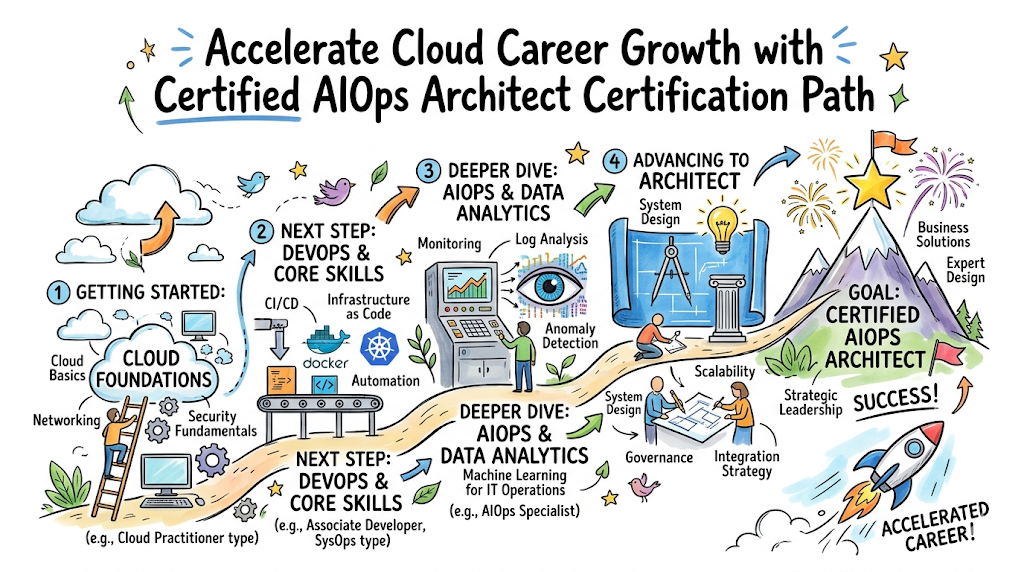
The certification is structured across three primary levels: Foundation, Professional, and Advanced to cater to different career stages. The Foundation level introduces the core concepts of machine learning in operations, while the Professional level focuses on implementing specific AIOps tools and platforms. The Advanced or Architect level is reserved for those who can design end-to-end intelligent systems that span across multiple cloud environments and legacy stacks. These levels allow a professional to progressively build their expertise while maintaining a clear path for salary and title growth.
Complete Certified AIOps Architect Certification Table
| Track | Level | Who it’s for | Prerequisites | Skills Covered | Recommended Order |
| Operations | Foundation | Junior DevOps/SRE | Basic Linux & Cloud | Data ingestion, Log analysis | 1 |
| Implementation | Professional | Senior Engineers | Python, Foundation Cert | ML Model Deployment, NLP | 2 |
| Architecture | Advanced | Principal Engineers | Professional Cert, 5+ yrs Exp | System Design, Self-healing | 3 |
| FinOps AI | Specialist | Cloud Economists | Basic FinOps knowledge | Predictive Billing, Unit Costs | Optional |
| Security AI | Specialist | DevSecOps | Security Fundamentals | Threat hunting, Pattern recognition | Optional |
Detailed Guide for Each Certified AIOps Architect Certification
Certified AIOps Architect – Foundation Level
What it is
This certification validates a candidate’s understanding of basic AIOps terminology, the data lifecycle, and the difference between traditional and intelligent monitoring. It serves as the entry point for anyone looking to transition into data-driven operations.
Who should take it
It is suitable for junior engineers, helpdesk leads, or system administrators who are currently managing monitoring tools and want to understand how AI can improve their daily tasks.
Skills you’ll gain
- Understanding telemetry data types (Metrics, Logs, Traces).
- Basic knowledge of anomaly detection algorithms.
- Ability to identify noise in alerting systems.
- Knowledge of AIOps tool landscapes.
Real-world projects you should be able to do
- Configure a basic dashboard that identifies outliers in CPU usage.
- Set up a log aggregation pipeline that flags frequent error patterns.
- Document a workflow for transitioning from threshold-based alerts to dynamic alerts.
Preparation plan
- 7–14 days: Focus on terminology, reading whitepapers on AIOps, and understanding the core pillars of observability.
- 30 days: Complete online lab modules related to ELK stack or Prometheus to see how data is collected and visualized.
- 60 days: Not typically required for Foundation unless the candidate is completely new to IT operations.
Common mistakes
- Overcomplicating the math behind machine learning instead of focusing on operational utility.
- Ignoring the importance of data quality before applying AI models.
Best next certification after this
- Same-track: Professional AIOps Engineer.
- Cross-track: SRE Foundation.
- Leadership: ITIL 4 Specialist.
Certified AIOps Architect – Professional Level
What it is
This level confirms the ability to deploy and manage AIOps platforms in a production environment. It moves beyond theory and into the actual implementation of machine learning models for operational excellence.
Who should take it
Middle-to-senior level engineers who are responsible for the uptime of large-scale applications and need to reduce the operational burden on their teams.
Skills you’ll gain
- Deploying ML models using containers and Kubernetes.
- Integrating AI insights into Slack, Jira, or PagerDuty.
- Tuning algorithms to reduce false positives in noisy environments.
- Implementing automated remediation scripts based on AI triggers.
Real-world projects you should be able to do
- Build an automated incident response system that restarts services based on predicted failure.
- Implement a correlation engine that groups 1,000 alerts into 5 actionable incidents.
- Design a custom dashboard for stakeholders showing the reduction in MTTR.
Preparation plan
- 7–14 days: Review Python for data science and brush up on API integrations.
- 30 days: Build a lab environment using tools like Moogsoft, BigPanda, or open-source equivalents.
- 60 days: Deep dive into specific case studies and practice complex troubleshooting scenarios provided in the course.
Common mistakes
- Failing to account for the “black box” nature of some AI models which makes troubleshooting difficult.
- Not setting up a feedback loop for the AI to learn from human corrections.
Best next certification after this
- Same-track: Certified AIOps Architect (Advanced).
- Cross-track: Kubernetes Administrator (CKA).
- Leadership: Engineering Manager Professional.
Certified AIOps Architect – Advanced/Architect Level
What it is
The pinnacle of the program, this certification proves the candidate can design a holistic AIOps strategy for an entire enterprise. It focuses on governance, cost, and cross-departmental integration.
Who should take it
Principal engineers, Chief Architects, and technical directors who oversee multiple teams and need to set the technical direction for the organization’s infrastructure.
Skills you’ll gain
- Designing multi-cloud AIOps architectures.
- Creating governance frameworks for AI in operations.
- Calculating ROI and business value for AIOps initiatives.
- Leading organizational change toward a data-driven culture.
Real-world projects you should be able to do
- Create a 3-year roadmap for migrating a legacy NOC to a modern AIOps-driven SOC.
- Architect a global event-driven automation framework that spans AWS, Azure, and On-prem.
- Conduct a tool evaluation and gap analysis for a Fortune 500 company.
Preparation plan
- 7–14 days: Review enterprise architecture patterns and high-level system design.
- 30 days: Focus on the financial and leadership aspects of AIOps implementation.
- 60 days: Complete a comprehensive capstone project that addresses a real-world enterprise scaling problem.
Common mistakes
- Focusing too much on technology and not enough on the cultural shifts required for AIOps.
- Underestimating the cost of data storage and processing for long-term AI training.
Best next certification after this
- Same-track: Continued professional development in specific AI niches.
- Cross-track: FinOps Certified Practitioner.
- Leadership: CTO Academy or Executive Management programs.
Choose Your Learning Path
DevOps Path
The DevOps path focuses on integrating AI into the CI/CD pipeline to predict deployment failures before they reach production. Engineers on this path learn how to use AIOps to analyze build logs and test results for patterns that indicate future instability. This ensures that the “Continuous” part of DevOps is actually stable and reliable. By automating the feedback loop, DevOps engineers can focus on feature delivery rather than fixing broken pipelines.
DevSecOps Path
In this path, the focus is on “AI for Security Operations” (AISecOps), where machine learning is used to identify unauthorized access patterns or data exfiltration. Professionals learn to correlate security logs with performance metrics to find hidden vulnerabilities that traditional scanners might miss. This path is essential for organizations that need to maintain high security standards without slowing down the development process. It turns security from a gatekeeper into an automated, intelligent observer.
SRE Path
The SRE path is perhaps the most natural fit for AIOps, as it focuses on maintaining Service Level Objectives (SLOs) through intelligent automation. SREs learn to use AI to manage error budgets and trigger automated failovers when a service starts trending toward a breach. This path emphasizes the reduction of “toil” by letting machines handle the repetitive task of incident triage. It allows SRE teams to scale their impact without linearly increasing their headcount.
AIOps Path
This dedicated path focuses purely on the architecture of intelligent operational systems from the ground up. It covers the deep technical details of data engineering for operations, ensuring that the telemetry pipeline is robust and scalable. Professionals learn how to select the right algorithms for different operational use cases, such as forecasting capacity or detecting seasonal anomalies. This is the specialized track for those who want to be “AIOps Engineers” as their primary role.
MLOps Path
The MLOps path is distinct because it focuses on the operational health of the machine learning models themselves. It ensures that the models used for AIOps are not drifting and are providing accurate predictions over time. Engineers learn about model versioning, automated retraining, and the infrastructure required to serve ML models at scale. This path is critical for ensuring that the “AI” in AIOps remains trustworthy and effective.
DataOps Path
DataOps focuses on the quality and flow of data that feeds the AIOps engine, ensuring that the “garbage in, garbage out” problem is avoided. This path teaches engineers how to build resilient data pipelines that can handle the massive throughput of system logs and metrics. It emphasizes data governance, observability of the data itself, and the orchestration of complex data workflows. Without strong DataOps, an AIOps initiative will likely fail due to inconsistent or missing information.
FinOps Path
The FinOps path uses AI to predict cloud spending and identify waste in real-time, which is becoming a top priority for CFOs. Engineers learn how to correlate resource usage with billing data to provide accurate unit-cost analysis for every microservice. AIOps in this context helps in automated rightsizing and purchasing of reserved instances based on predicted demand. It transforms cloud cost management from a monthly spreadsheet task into a real-time automated optimization.
Role → Recommended Certified AIOps Architect Certifications
| Role | Recommended Certifications |
| DevOps Engineer | AIOps Foundation, Professional AIOps |
| SRE | Professional AIOps, AIOps Architect |
| Platform Engineer | AIOps Architect, DataOps Specialist |
| Cloud Engineer | AIOps Foundation, FinOps AI |
| Security Engineer | Security AI Specialist, Professional AIOps |
| Data Engineer | DataOps Specialist, MLOps Specialist |
| FinOps Practitioner | FinOps AI Specialist |
| Engineering Manager | AIOps Foundation, AIOps Architect |
Next Certifications to Take After Certified AIOps Architect
Same Track Progression
Once you have achieved the Architect level, the next step is to stay updated with specific vendor-neutral advanced courses in Deep Learning or Neural Networks. You might also consider specialized certifications in Generative AI for Operations to explore how LLMs can assist in writing remediation scripts. Deep specialization involves becoming a subject matter expert in one specific area, such as predictive maintenance for hardware or network-specific AIOps.
Cross-Track Expansion
If you have mastered AIOps, expanding into FinOps or DevSecOps provides a well-rounded profile that makes you indispensable to any organization. Learning how to apply your AI knowledge to cost optimization or threat hunting creates a unique “T-shaped” skill set. Many professionals also look toward Kubernetes certifications like CKA or CKS, as AIOps is heavily reliant on container orchestration in modern environments.
Leadership & Management Track
For those looking to move away from hands-on keyboard work, a transition into technical product management or engineering leadership is a logical step. Certifications in Agile leadership or MBA programs for technology professionals can complement your technical architect background. Understanding the business side of AI, such as ethics, compliance, and budgeting, is essential for anyone aiming for a VP of Infrastructure or CTO role.
Training & Certification Support Providers for Certified AIOps Architect
DevOpsSchool
DevOpsSchool is a major player in the technical training space, providing a wide array of courses that cover everything from basic automation to complex system architecture. They focus on delivering instructor-led sessions that are highly interactive, allowing students to ask questions and solve real-world problems in real-time. Their curriculum is often updated to reflect the latest tools in the market, ensuring that learners are not stuck with outdated information. With a strong presence in India and globally, they provide the community support and certification prep needed to succeed in the AIOps journey. Their trainers are usually industry veterans who bring a wealth of practical knowledge to every class session they conduct.
Cotocus
Cotocus specializes in providing high-end technical consulting and training services with a focus on emerging technologies like AIOps and cloud-native computing. They are known for their intensive bootcamps which are designed to take an engineer from zero to expert in a very short amount of period. Their approach is very much hands-on, emphasizing that the best way to learn is by doing and breaking things in a controlled environment. They often work with corporate clients to upskill entire teams, making them a great choice for enterprise-level AIOps transitions. Their training materials are comprehensive and include a mix of video content, written guides, and practical lab exercises.
Scmgalaxy
Scmgalaxy has built a massive community of software configuration management and DevOps professionals over the years, making it a go-to resource for learning. They provide a vast library of free tutorials, blogs, and videos that serve as a great supplement to any formal certification program. Their focus is on the entire software delivery lifecycle, which helps AIOps candidates understand where AI fits into the broader picture of development. They offer specialized workshops that dive deep into specific tools, helping engineers master the “how-to” of AIOps implementation. Their community forums are active, providing a place for professionals to network and share their own experiences and challenges.
BestDevOps
BestDevOps is a boutique training provider that prides itself on the quality and depth of its technical content rather than the volume of courses. They focus on providing personalized mentorship, which is particularly useful for senior engineers aiming for the Architect level of certification. Their courses are designed to be challenging, pushing students to think critically about system design and long-term maintainability. They often include modules on the “soft skills” of engineering, such as how to present an AIOps strategy to a board of directors. For those who prefer a more tailored and high-touch learning experience, this provider is an excellent choice for AIOps mastery.
devsecopsschool.com
This platform is the primary destination for engineers who want to specialize in the intersection of security and automation. They provide deep-dive courses into how AI can be used to protect the software supply chain and detect threats in real-time within production environments. Their trainers focus on practical security implementations, teaching students how to build automated security gates that don’t hinder the speed of development. As security becomes a top concern for every enterprise, the skills learned here are a perfect complement to an AIOps certification. They offer both self-paced and instructor-led options to accommodate the busy schedules of working security professionals.
sreschool.com
Sreschool focuses on the principles of Site Reliability Engineering, teaching the methodologies that keep the world’s largest websites running smoothly. Their curriculum is heavily influenced by the practices developed at companies like Google and Netflix, emphasizing scalability and reliability. They offer specific tracks on observability and incident management, which are core components of the AIOps certification journey. By learning at this school, engineers gain a deep understanding of how to manage service level objectives and error budgets using data. It is an essential resource for anyone who wants to ensure that their AIOps implementation actually leads to better system availability.
As the primary host for the AIOps certifications, this site is the most direct source of information and training for aspiring architects. They provide the official curriculum, exam guides, and practice tests specifically designed for the Certified AIOps Architect designation. Their focus is exclusively on the niche of AI in operations, ensuring that the content is not diluted by other general DevOps topics. The platform provides a structured path from foundation to advanced levels, making it easy for learners to track their progress. For anyone serious about this specific certification, this is the first and most important place to start their educational journey.
dataopsschool.com
Dataopsschool addresses the critical need for better data management within the operations and development lifecycle. They teach engineers how to treat operational data as a first-class citizen, ensuring it is clean, accessible, and actionable for AI models. Their courses cover data engineering, pipeline orchestration, and the ethical use of data in an enterprise setting. Since AIOps is entirely dependent on the quality of data it receives, this school provides the foundational knowledge required to make AI successful. Their training is highly relevant for those who want to specialize in the backend infrastructure that powers intelligent monitoring and alerting systems.
finopsschool.com
Finopsschool is dedicated to the growing field of cloud financial management, teaching engineers how to balance performance with cost. They provide training on how to use AI and machine learning to predict cloud spend and identify opportunities for automated savings. This is a critical skill for modern architects who are responsible for the “bottom line” as much as they are for technical uptime. Their courses explain the cultural shift required to get finance and engineering teams working together toward a common goal. For AIOps professionals, this school offers the specialized knowledge needed to prove the financial ROI of their automation projects.
Frequently Asked Questions (General)
- How difficult is the certification for someone with no ML background?The Foundation level is designed for beginners, but the Professional and Architect levels require a solid understanding of IT operations. You do not need to be a data scientist, but you must be comfortable with data concepts and basic Python.
- How long does it take to complete the entire track?A dedicated professional can complete the Foundation level in a month, while the full journey to Architect usually takes 6 to 12 months of consistent study.
- What are the prerequisites for the Architect level?You generally need to hold the Professional level certification and have at least five years of experience in DevOps, SRE, or systems engineering roles.
- Is there a practical exam involved?Yes, the higher levels usually involve a hands-on lab or a project where you must demonstrate your ability to configure AIOps tools.
- How does this certification impact my salary?Professionals with AIOps skills often see a 20% to 35% increase in compensation compared to traditional DevOps roles due to the high demand and specialized nature of the work.
- Can I take the exam online?Yes, most of the certifications offered are available through an online proctored format, allowing you to take them from anywhere in the world.
- Does the certification expire?Most certifications in this field are valid for two to three years, after which you must renew by passing an update exam or earning continuing education credits.
- Are there any free resources to start with?Yes, websites like Scmgalaxy and various community blogs offer free tutorials that can help you understand the basics before you commit to a paid program.
- What tools will I learn to use?You will gain exposure to a mix of open-source tools like Prometheus, ELK, and Grafana, as well as enterprise platforms like Splunk, Dynatrace, or New Relic.
- Is this certification recognized globally?Yes, the principles of AIOps are universal, and the certification is recognized by major tech hubs in India, the US, Europe, and beyond.
- Do I need to know how to code?A basic understanding of scripting, especially Python and Bash, is highly recommended as you will need to automate responses and integrate different systems.
- What is the return on investment for this certification?The ROI is high because it transforms you from a “maintainer” to an “architect,” allowing you to lead high-value digital transformation projects.
FAQs on Certified AIOps Architect
- What makes the Certified AIOps Architect different from a standard DevOps cert?While DevOps focus on the “how” of delivery, this certification focuses on the “intelligence” of operations. It teaches you how to use data and machine learning to make decisions, rather than just following manual scripts. It is a more advanced specialization that deals with the complexity of modern, large-scale systems.
- Is this certification focused on a specific tool?No, it is designed to be vendor-neutral. It teaches the underlying principles of data ingestion, model selection, and event correlation that can be applied to any tool, whether it is an open-source stack or a proprietary enterprise platform. This makes your skills more portable across different companies.
- How does the certification handle the concept of “Self-Healing” systems?The curriculum places a heavy emphasis on closed-loop automation. You will learn how to architect systems that not only detect an issue through AI but also trigger a predefined, automated script to resolve it without human intervention. This is a core competency of the Architect level.
- Will this help me in an SRE role?Absolutely. SRE is all about using software engineering to solve operations problems. AIOps provides the “brains” for that software, allowing SREs to manage much larger environments with higher reliability and less manual work, which is the ultimate goal of the SRE philosophy.
- What is the role of Big Data in this certification?The certification covers how to manage the “Three Vs” of data—Volume, Velocity, and Variety—as they pertain to system logs and metrics. You will learn how to build data pipelines that can feed ML models in real-time without causing latency in the production environment.
- How is “Alert Fatigue” addressed in the training?One of the primary goals of the program is to teach event correlation and noise reduction. You will learn techniques to group related alerts into a single root-cause incident, significantly reducing the number of notifications that on-call engineers receive.
- Does the course cover the ethics of AI in operations?Yes, the Architect level includes discussions on the transparency and explainability of AI models. It is important for an architect to understand why an AI made a certain decision, especially when that decision affects the availability of a critical business service.
- Is there a community for certified individuals?Yes, once certified, you gain access to a network of professionals who are leading AIOps initiatives globally. This community is a great resource for sharing best practices, finding job opportunities, and staying updated on the latest industry trends and tool updates.
Final Thoughts
If you are looking for a way to future-proof your career in infrastructure, the Certified AIOps Architect is one of the most solid investments you can make. The industry is moving away from manual “firefighting” and toward a model where engineers design systems that watch themselves. This certification gives you the theoretical foundation and the practical “battle-tested” skills to be at the forefront of that movement. It is not just about adding another badge to your profile; it is about changing your mindset from a reactive administrator to a proactive architect. While the learning curve can be steep, the ability to manage complex, global-scale systems with confidence is a reward that pays off for years to come. Focus on the data, embrace the automation, and let the machines do the heavy lifting so you can focus on building the next generation of technology.