Introduction
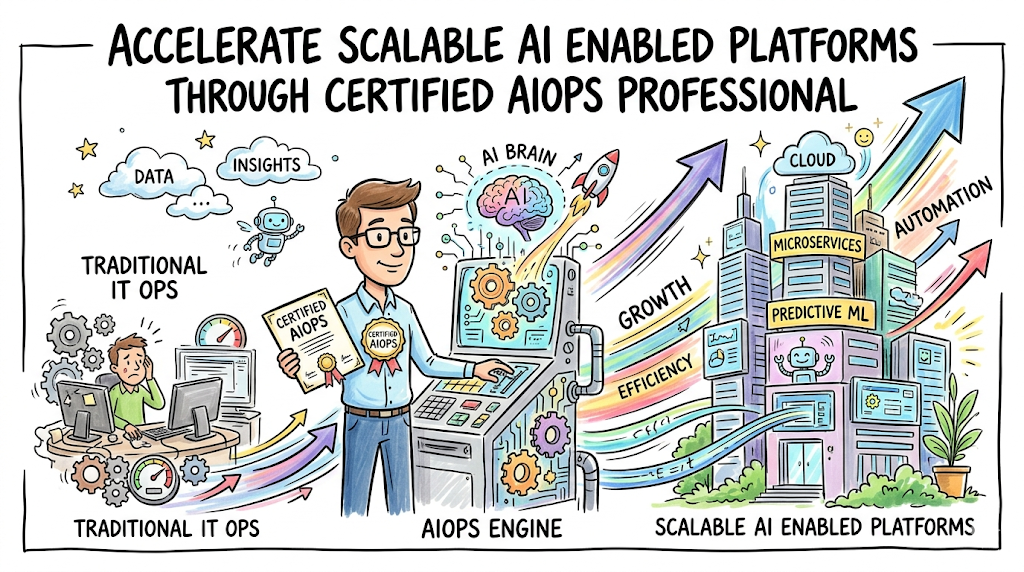
The Certified AIOps Professional is a specialized credential designed for engineers and managers who want to lead the shift from manual operations to autonomous, AI-driven systems. This guide is built for professionals who realize that traditional monitoring is no longer enough for complex, distributed cloud environments. By learning how to integrate machine learning and big data into the operational lifecycle, you can reduce alert fatigue and solve problems before they impact users.
In the modern landscape of DevOps, cloud-native architecture, and platform engineering, the ability to automate insights is a critical career advantage. This guide provides an honest look at how this certification helps you navigate the changing demands of enterprise technology. It serves as a roadmap for professionals to evaluate the curriculum against their own career goals. Whether you are an SRE or a Data Scientist, Aiopsschool offers the structured path needed to bridge the gap between operations and artificial intelligence.
What is the Certified AIOps Professional?
The Certified AIOps Professional represents a high level of operational excellence by combining data science with system administration. It exists because modern infrastructure generates more data than human operators can process in real time, leading to slow response times and missed issues. This certification validates your ability to apply algorithmic solutions to operational problems, moving beyond basic scripts to intelligent, self-healing systems.
The program emphasizes real-world, production-focused learning, ensuring that candidates can handle massive datasets generated by logs, metrics, and traces. It aligns with modern engineering workflows by teaching professionals how to integrate AI models directly into the monitoring and deployment stacks. For enterprises, this means shifting from reactive troubleshooting to proactive anomaly detection and automated incident response. This focus on practical application makes it a standout choice for those looking to improve system reliability at scale.
Who Should Pursue Certified AIOps Professional?
This certification is designed for a wide range of professionals, but it is especially beneficial for SREs and DevOps engineers who manage large cloud environments. Cloud architects and platform engineers will find the curriculum essential for designing resilient systems that use predictive analytics to stay healthy. Additionally, data professionals looking to transition into operational roles will gain the necessary context to apply their skills effectively in a production setting.
While experienced engineers can use this to formalize their knowledge, beginners can use it as a rigorous entry point into the world of intelligent automation. Engineering managers and technical leaders also benefit from this track, as it provides the strategic framework needed to lead AIOps initiatives. The demand is global, with significant growth in India and other major tech hubs where digital transformation is a top priority. It is the right choice for anyone who wants to stay ahead of the curve in high-scale infrastructure management.
Why Certified AIOps Professional is Valuable Today and Beyond
The value of this certification lies in its focus on longevity and enterprise adoption, as companies move away from simple, threshold-based alerting systems. As systems become more complex and change more rapidly, the demand for professionals who can manage “noise” through machine learning continues to grow. This credential ensures that your skillset remains relevant even as specific monitoring tools change or are replaced over time.
Investing time in this certification offers a high return on career growth, as AIOps is a core part of the next generation of IT operations. It helps professionals move into high-impact roles where they can drive cost savings and improve system uptime for global companies. By mastering the principles of algorithmic operations, you position yourself as a strategic asset capable of solving the most difficult scalability challenges. It is a long-term investment in your ability to manage the future of cloud-native infrastructure.
Certified AIOps Professional Certification Overview
The program is delivered via the official course URL provided above and is hosted on the Aiopsschool platform. The certification is structured into logical levels that progress from foundational concepts to advanced architectural patterns for large enterprises. It uses a practical assessment approach, requiring candidates to demonstrate their ability to implement AIOps strategies in simulated production environments.
The ownership of the curriculum ensures that the content is updated frequently to reflect changes in AI technologies and operational best practices. The structure is designed for working professionals, offering a blend of theoretical knowledge and hands-on lab work that fits into a busy schedule. This ensures that when you complete the program, you have a portfolio of work that proves your capability to handle real-world challenges. It is a comprehensive path that takes you from understanding the basics to mastering advanced automation.
Certified AIOps Professional Certification Tracks & Levels
The certification is divided into Foundation, Professional, and Advanced levels to cater to different stages of a professional career. The Foundation level introduces the core concepts of data ingestion, noise reduction, and basic algorithmic patterns used in operations. The Professional level dives deeper into model selection, anomaly detection, and integrating AI with existing ITSM and DevOps tools for automated response.
Advanced levels allow for specialization in tracks like AIOps for FinOps or AIOps for DevSecOps, focusing on niche operational requirements and security. These levels align with career progression, helping a junior engineer move toward a Lead SRE or Principal Architect role. By following these tracks, professionals can build a specialized profile that is highly attractive to top-tier technology firms and global enterprises. Each level builds on the last, ensuring a steady growth in technical depth and strategic thinking.
Complete Certified AIOps Professional Certification Table
| Track | Level | Who it’s for | Prerequisites | Skills Covered | Recommended Order |
|---|---|---|---|---|---|
| Core AIOps | Foundation | Beginners, Junior SREs | Basic Linux & Python | Data collection, Intro to ML | Step 1 |
| Core AIOps | Professional | DevOps Engineers, SREs | Foundation Level | Anomaly detection, Event correlation | Step 2 |
| Engineering | Expert | Senior Architects, Leads | Professional Level | Custom model building, Automation | Step 3 |
| Specialization | Security | DevSecOps Engineers | Professional Level | Threat detection, Pattern matching | Optional |
| Specialization | Financial | FinOps Practitioners | Professional Level | Cost prediction, Budget forecasting | Optional |
Export to Sheets
Detailed Guide for Each Certified AIOps Professional Certification
Certified AIOps Professional – Foundation Level
What it is
This certification validates a candidate’s understanding of the basic components of an AIOps ecosystem. It covers the core terminology, the data pipeline stages, and the fundamental differences between traditional monitoring and AI-driven operations.
Who should take it
This is suitable for junior engineers, fresh graduates, or managers who need a high-level technical understanding of AIOps. It is an ideal starting point for anyone new to machine learning in the context of infrastructure management.
Skills you’ll gain
- Understanding structured and unstructured data sources.
- Knowledge of the AIOps maturity model for enterprises.
- Ability to identify use cases for intelligent automation.
- Familiarity with basic data ingestion and storage tools.
Real-world projects you should be able to do
- Setting up a basic data pipeline from application logs to a central dashboard.
- Configuring a simple threshold-based alerting system that identifies outliers in metrics.
- Creating a report on operational inefficiencies that can be solved by AI.
Preparation plan
Explain 7–14 days: Focus on learning the vocabulary and the AIOps lifecycle stages. Explain 30 days: Complete all foundational modules and practice with sample data ingestion labs. Explain 60 days: Not required for this level if the candidate has a basic technical background.
Common mistakes
- Ignoring the data quality aspect and focusing only on the automation tools.
- Underestimating the importance of domain knowledge in operations.
Best next certification after this
Same-track option: Certified AIOps Professional – Professional Level
Cross-track option: Certified SRE Professional
Leadership option: IT Management Foundation
Certified AIOps Professional – Professional Level
What it is
This is the core certification that validates an engineer’s ability to implement and manage AIOps solutions. It focuses on the practical application of machine learning to solve real-world production incidents and reduce alert noise.
Who should take it
This is designed for experienced DevOps engineers, SREs, and Platform engineers with several years of experience. It is for those who are responsible for the reliability and performance of enterprise systems.
Skills you’ll gain
- Implementing event correlation and root cause analysis.
- Building predictive models for capacity planning and resource scaling.
- Automating incident response using AI-driven triggers and scripts.
- Managing model drift in operational environments over time.
Real-world projects you should be able to do
- Deploying an event correlation engine that reduces alert volume by 50 percent.
- Building an anomaly detection system for a distributed microservices architecture.
- Automating the remediation of common disk space or memory issues using AI.
Preparation plan
Explain 7–14 days: Review core ML concepts and data preprocessing techniques for logs. Explain 30 days: Work through the hands-on labs focusing on correlation and anomaly detection. Explain 60 days: Conduct a full mock implementation of an AIOps platform on a cloud provider.
Common mistakes
- Focusing too much on the algorithm and not enough on the business outcome.
- Failing to integrate the AIOps tool with existing communication channels like Slack.
Best next certification after this
Same-track option: Certified AIOps Professional – Expert
Cross-track option: Certified MLOps Professional
Leadership option: AIOps Strategy for Technical Leaders
Choose Your Learning Path
DevOps Path
Engineers on the DevOps path should focus on integrating AIOps into the CI/CD pipeline to improve deployment success rates. By using AI to analyze build logs and test results, you can predict failures before they reach production. This path emphasizes the “Shift Left” philosophy, where AI helps developers catch performance regressions during the coding phase. Mastery of this path leads to more stable releases and faster feedback loops for the entire development team.
DevSecOps Path
In this path, the focus shifts to using AIOps for security telemetry and threat hunting in real time. You will learn how to apply pattern matching and anomaly detection to identify unauthorized access or data exfiltration attempts. AI helps in correlating security events across layers of the stack that human analysts might miss. This path is essential for professionals working in highly regulated industries like finance or healthcare where security is paramount.
SRE Path
The SRE path is perhaps the most natural fit for AIOps, focusing on maintaining Service Level Objectives (SLOs) through automation. You will learn to use predictive analytics to prevent outages by identifying early warning signs in system metrics. This path emphasizes reducing “toil” by automating the repetitive tasks of incident investigation and remediation. It is the definitive route for those aiming to manage massive-scale distributed systems with high reliability.
AIOps Path
This dedicated path focuses on the pure architecture of AI-driven operations platforms and data pipelines. It is for the specialist who wants to master the entire lifecycle of operational data, from ingestion to intelligent action. You will study various AI models, including supervised and unsupervised learning, specifically tailored for time-series infrastructure data. This path prepares you to be the primary architect of an organization’s internal AIOps capabilities and strategies.
MLOps Path
The MLOps path is for those who want to manage the lifecycle of the AI models themselves within the operational environment. You will focus on model deployment, monitoring for drift, and ensuring that the AI providing the insights is itself reliable and accurate. This path bridges the gap between the data science team and the infrastructure team, ensuring models are production-ready. It is a critical role as AI becomes embedded in every part of the software stack.
FinOps Path
The FinOps path uses AIOps to bring intelligence to cloud financial management and cost optimization. You will learn to build models that predict cloud spend and identify waste across multiple providers automatically. AIOps helps in identifying the root cause of “billing spikes” and can suggest or implement automated resizing of resources. This path is increasingly valuable as enterprises struggle to control their expanding cloud budgets in a multi-cloud world.
Role → Recommended Certified AIOps Professional Certifications
| Role | Recommended Certifications |
|---|---|
| DevOps Engineer | Foundation, Professional |
| SRE | Professional, Expert |
| Platform Engineer | Professional, Expert |
| Cloud Engineer | Foundation, Professional |
| Security Engineer | Professional, Security Specialization |
| Data Engineer | Professional, DataOps Path |
| FinOps Practitioner | Foundation, FinOps Specialization |
| Engineering Manager | Foundation, Leadership Track |
Next Certifications to Take After Certified AIOps Professional
Same Track Progression
Once you have mastered the Professional level, the natural progression is to move toward the Expert level or specific specializations. Deep specialization involves mastering the nuances of different AI architectures, such as Generative AI for automated code remediation. You should also look for advanced courses in distributed systems and high-scale data engineering to complement your AI skills. This ensures you remain the top technical authority on AIOps within your organization and the broader industry.
Cross-Track Expansion
Broadening your skills into adjacent fields like MLOps or FinOps can make you a more versatile professional. Understanding how to manage the lifecycle of machine learning models provides a deeper context for the AIOps tools you use daily. Similarly, adding FinOps knowledge allows you to link operational performance directly to business value and cost savings. This cross-pollination of skills is what defines a top-tier engineer in the modern era who understands both technology and business.
Leadership & Management Track
For those looking to move into management, the next step is focusing on technical leadership and organizational strategy. This involves learning how to build teams, manage budgets, and drive cultural changes toward autonomous operations. You should look for certifications that focus on the “People” and “Process” parts of the operational triad. Understanding how to communicate the ROI of complex technical projects to non-technical stakeholders is the key to moving into executive leadership roles.
Training & Certification Support Providers for Certified AIOps Professional
DevOpsSchool
DevOpsSchool is a major provider of technical training that focuses heavily on the practical aspects of modern engineering. They offer a structured environment for learning AIOps by providing access to experienced mentors and comprehensive lab environments for students. Their curriculum is designed to take a professional from the basics of automation to advanced AI implementation in production. With a strong presence in India, they cater to thousands of engineers looking to upgrade their skills for global roles. The training is delivered through a mix of live sessions and recorded content to ensure flexibility for working professionals. They focus on real-world outcomes rather than just passing an exam.
Cotocus
Cotocus specializes in high-end consulting and training for cloud-native technologies and intelligent automation systems. They are known for their deep dive into architectural patterns and their ability to explain complex AI concepts in a simplified manner. Their approach to AIOps training involves real-world case studies that help students understand the logic behind the technology. Cotocus provides a personalized learning experience, ensuring that each candidate can meet their specific career objectives through guided mentorship. They are highly regarded for their expert-led workshops and hands-on guidance on enterprise-level projects. Their training helps bridge the gap between theory and actual implementation.
Scmgalaxy
Scmgalaxy is a community-driven platform that has been a cornerstone of the DevOps and SRE learning ecosystem for many years. They provide a wealth of resources, including blogs, tutorials, and certification paths for AIOps enthusiasts and professionals. Their training programs are focused on the tools and technologies that drive modern IT operations in the cloud. Scmgalaxy is particularly helpful for professionals who prefer a collaborative learning environment and community support during their journey. They offer practical insights into the industry’s best practices and emerging trends in automation and AI. It is an excellent place to stay updated on new tools.
BestDevOps
BestDevOps offers a curated learning experience for engineers who want to stay at the cutting edge of infrastructure management. Their AIOps certification support is designed to be concise and highly relevant to current market demands and job roles. They focus on the most popular tools in the AIOps space, ensuring that students gain skills that are immediately applicable in their current jobs. The platform is known for its high-quality study materials and practice exams that mirror the actual certification process closely. It is a great choice for those looking for a balanced approach to theory and hands-on practice. Their goal is to create job-ready professionals.
devsecopsschool.com
This platform is the go-to resource for professionals who want to integrate security into their operational workflows using AI. Their AIOps training includes specific modules on how AI can be used to detect and mitigate security threats in real time. They emphasize the importance of “Security as Code” and how machine learning can automate complex compliance checks. By focusing on the intersection of AI and security, they provide a unique value proposition for modern cloud engineers. Their courses are designed by industry veterans who have managed security at scale for global organizations. It is perfect for those in sensitive industries.
sreschool.com
Sreschool.com is dedicated to the discipline of Site Reliability Engineering and how it evolves with the introduction of artificial intelligence. Their curriculum is deeply rooted in SRE handbooks while adding the modern layer of AIOps for intelligent automation. They teach students how to manage error budgets and incident response using advanced algorithmic tools. The training focuses on reliability, scalability, and the reduction of manual toil through smart, automated solutions. It is an essential platform for anyone serious about becoming a high-level SRE in an AI-driven world. They focus on the core metrics that define system success.
Aiopsschool.com is the primary hosting site and content creator for the Certified AIOps Professional program itself. They offer the most direct and comprehensive path to mastering AI in operations, with a curriculum built by actual practitioners. Their platform features state-of-the-art virtual labs where students can practice on real datasets from simulated production environments. They provide a clear roadmap from foundation to expert levels, ensuring a continuous learning journey for every professional. Being the source of the certification, their training is perfectly aligned with the exam requirements and the latest industry needs. It is the home of AIOps expertise.
dataopsschool.com
Dataopsschool.com focuses on the crucial data layer that powers every successful AIOps initiative in an enterprise. They provide training on how to build resilient data pipelines and ensure data quality for machine learning models. Their courses cover everything from data ingestion to real-time stream processing and proper data governance. This platform is ideal for those who want to specialize in the “Data” part of the AIOps lifecycle. They help engineers understand how to treat data as a first-class citizen in the operational ecosystem. Without clean data, AIOps cannot succeed, and they teach you how to fix that.
finopsschool.com
Finopsschool.com addresses the financial side of cloud operations, teaching how AI can be used to optimize cloud spending. Their training programs show how to use AIOps to predict costs and automate the identification of underutilized cloud resources. They bridge the gap between engineering, finance, and business teams, providing a holistic view of cloud economics. As companies look to maximize their cloud ROI, the skills taught here are becoming increasingly critical for senior engineers. Their certification path is a must for anyone involved in cloud cost management and strategic planning. They focus on saving money through intelligence.
Frequently Asked Questions (General)
- How difficult is the Certified AIOps Professional exam?
The difficulty is moderate to high, depending on your existing background in both operations and basic data science.
- What are the primary prerequisites for this certification?
A solid understanding of Linux servers, at least one scripting language like Python, and experience with monitoring tools is required.
- How long does it take to prepare for the Professional level?
Most working professionals find that 30 to 60 days of consistent study is sufficient to pass the exam and the labs.
- Is there a practical component to the assessment?
Yes, the certification includes lab-based exercises where you must solve real operational problems using AI techniques and tools.
- Does this certification expire after a certain period?
Typically, certifications in this fast-moving field are valid for two to three years, after which recertification is highly recommended.
- Can I take this certification if I do not have a data science degree?
Absolutely; the program is designed to teach engineers the specific AI skills they need for operations without a full degree.
- How does this help my salary prospects in the market?
AIOps specialists often command higher salaries than traditional DevOps engineers due to the specialized and high-impact nature of the skill.
- Is the exam conducted online or at a physical center?
The exam is generally available online through a proctored platform, making it accessible to a global audience of professionals.
- What kind of tools will I learn to use during the course?
You will learn the principles behind tools like ELK, Prometheus, and various ML libraries, rather than just one specific vendor tool.
- Is there a community for certified professionals to join?
Yes, Aiopsschool maintains a community where certified professionals can network, share insights, and find new career opportunities.
- Can a manager benefit from this technical certification?
Yes, managers gain the technical depth needed to make informed decisions about AIOps tool sets and team structure for their organization.
- How does AIOps differ from standard automation scripts?
Automation follows pre-defined rules, while AIOps uses machine learning to adapt and make decisions based on evolving data patterns.
FAQs on Certified AIOps Professional
- What makes this specific certification unique compared to other vendor-specific badges?
This program focuses on the core principles and architectural patterns of AIOps rather than just teaching you how to use one product. This vendor-neutral approach ensures your skills are portable across different platforms and companies throughout your career.
- How much Python knowledge is actually required to be successful?
You should be comfortable reading and writing scripts to manipulate data and call APIs for different tools. You do not need to be a software developer, but you should understand basic data structures and how to use common libraries.
- Is the India-specific job market ready for AIOps professionals?
Yes, large Indian IT firms and global captive centers in India are aggressively hiring for these roles to manage their massive scale. AIOps is seen as a key way for these companies to improve their service delivery margins and reliability.
- Will I learn how to build my own machine learning models from scratch?
The course teaches you how to select and implement existing models for operational data needs. While you will learn to tune them, the focus is on practical application rather than pure theoretical model development for academic purposes.
- How does this certification address the issue of “Black Box” AI?
The curriculum emphasizes “Explainable AI,” ensuring that engineers understand why a model made a specific decision. This is critical for building trust with operations teams who need to understand the root cause before taking action.
- Can I skip the Foundation level and go straight to Professional?
If you have significant experience in both DevOps and basic machine learning, you may be able to jump to the Professional level. However, the Foundation level is recommended to ensure you understand the specific framework used in this program.
- Does the program cover cloud-specific AIOps tools like AWS SageMaker?
It covers how to use cloud-native AI services as part of a broader AIOps strategy, but it remains focused on the operational logic. This allows you to apply the concepts regardless of which cloud provider your company currently uses.
- What is the success rate for the certification among candidates?
The success rate is high for those who complete all the hands-on labs and follow the recommended preparation plan provided. The focus of the program is on ensuring you have the actual skills to perform the job in a real-world setting.
Final Thoughts
From a mentor’s perspective, the decision to pursue the Certified AIOps Professional should be based on your long-term career goals. If you are satisfied with manual troubleshooting and basic scripting, this might be more than you need at this moment. However, if you see the industry moving toward autonomous systems—and it certainly is—then this certification is a strategic investment in yourself. It provides the structured knowledge that is very hard to gain through fragmented online tutorials or trial and error.
The reality of modern engineering is that the volume of data will only increase as we move forward. Professionals who can harness that data using AI will be the ones leading teams and designing the systems of the future. This certification does not just give you a badge; it gives you a framework for thinking about operations as a data science problem. If you are looking to future-proof your career and tackle the most interesting challenges in technology today, this path is well worth the effort.