Introduction
Mastering the Certified Site Reliability Architect Professional Career , Navigating the complexities of modern digital infrastructure requires more than just basic coding or operations skills. The Certified Site Reliability Architect is a specialized framework designed to transform how engineers perceive and manage system health. This guide serves as a strategic roadmap for those ready to lead high-stakes technical environments with confidence. By engaging with the programs offered at Sreschool, professionals can bridge the gap between legacy maintenance and future-proof engineering. This journey is about moving beyond reactive firefighting toward a proactive, architecture-first mindset that ensures global-scale reliability.
What is the Certified Site Reliability Architect?
The Certified Site Reliability Architect is a professional validation that signifies a deep mastery of creating resilient, self-healing systems. It is not merely a badge of technical knowledge but a testament to an engineer’s ability to balance innovation with stability. This role exists to address the growing complexity of distributed systems where manual intervention is no longer a viable long-term strategy. It focuses on the intersection of software engineering and systems operations, ensuring that reliability is baked into the design phase.
This curriculum is built on the reality of production environments rather than academic theory. It represents a paradigm shift in how organizations view uptime and performance, treating operational challenges as software problems. By aligning with modern enterprise workflows, the certification prepares architects to handle the pressures of massive scale and rapid deployment. It serves as a benchmark for excellence in the cloud-native era, providing a common language for reliability across various industries.
Who Should Pursue Certified Site Reliability Architect?
This path is specifically tailored for mid-to-senior level engineers who are currently operating in DevOps, SRE, or Cloud Architecture roles. It is highly beneficial for those who find themselves responsible for the stability of mission-critical applications and want to formalize their expertise. Junior engineers who have a strong foundation in Linux and cloud services can also use this as a definitive roadmap for their career progression. It provides the technical depth required to move from a generalist role to a specialized architectural position.
Furthermore, engineering managers and technical leads should pursue this certification to better understand the metrics that drive successful SRE teams. It is equally relevant for professionals in India and other global tech markets where the demand for high-availability systems is skyrocketing. Whether you are working in finance, healthcare, or e-commerce, the principles taught in this program are universal. It is designed for those who want to be the primary decision-makers in an organization’s infrastructure strategy.
Why Certified Site Reliability Architect is Valuable
In a landscape where technology stacks change almost monthly, the core principles of reliability remain constant. The Certified Site Reliability Architect provides professionals with a durable skillset that transcends specific tools or vendors. This longevity is what makes the credential so valuable; it proves that an architect understands the “why” behind the “how.” As enterprises continue their migration to the cloud, the need for architects who can prevent costly outages is becoming a top priority for hiring managers.
The return on investment for this certification is realized through accelerated career growth and increased influence within the engineering department. It empowers professionals to lead digital transformation efforts with a focus on sustainable growth rather than just rapid expansion. By mastering the art of error budgets and observability, architects can help their organizations innovate faster while maintaining customer trust. This certification is a strategic asset for staying relevant in a competitive job market where specialized architectural skills are at a premium.
Certified Site Reliability Architect Certification Overview
The Certified Site Reliability Architect program is a comprehensive educational journey hosted on Sreschool and delivered via the official course URL. It is structured to provide a logical progression from fundamental concepts to advanced system design. The program uses a practical assessment approach, requiring candidates to solve real-world problems in simulated production environments. This ensures that every certified professional is ready to tackle the actual challenges faced by modern engineering teams.
The ownership of the curriculum is held by industry experts who have managed some of the world’s most complex infrastructure. This practical ownership ensures the course content remains aligned with the latest industry standards and enterprise needs. The structure is designed to be flexible, allowing working professionals to progress at their own pace while maintaining high standards of learning. It is more than a test; it is a professional development ecosystem that supports long-term career success.
Certified Site Reliability Architect Certification Tracks & Levels
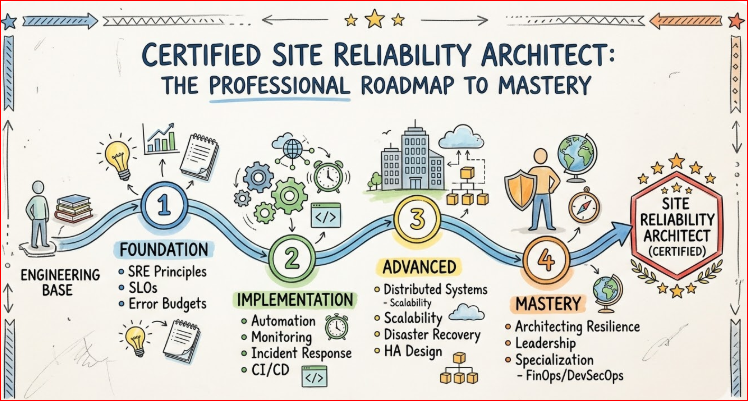
The certification is organized into clear tiers to facilitate meaningful career development. The Foundation level is the entry point, focusing on the core vocabulary and basic concepts of site reliability engineering. The Professional level shifts the focus toward implementation, covering the automation and monitoring tools that drive reliable systems. Finally, the Advanced level is for those who wish to design and oversee the entire infrastructure of a global enterprise.
These tracks are designed to align with the different stages of an engineer’s professional journey. Specializations are also available for those who want to apply SRE principles to niche areas like security or data operations. This modular approach allows for a personalized learning path that can be adjusted as your career goals evolve. Each level builds upon the previous one, ensuring a comprehensive and deep understanding of how to maintain system health at scale.
Complete Certified Site Reliability Architect Certification Table
| Track | Level | Who it’s for | Prerequisites | Skills Covered | Recommended Order |
| Core Track | Foundation | Aspiring SREs | Basic IT Knowledge | SLIs, SLOs, SRE Culture | Level 1 |
| Implementation | Professional | DevOps Engineers | Foundation Level | Automation, Incident Response | Level 2 |
| Strategic | Advanced | Senior Architects | Professional Level | Scalability, Disaster Recovery | Level 3 |
| Leadership | Expert | Tech Leads | Advanced Level | Culture, Strategy, Mentorship | Level 4 |
Detailed Guide for Each Certified Site Reliability Architect Certification
Certified Site Reliability Architect – Foundation Level
What it is
This entry-level certification confirms that a professional understands the fundamental philosophy of SRE and the critical difference between availability and reliability.
Who should take it
It is designed for junior engineers, developers, and traditional system administrators who are looking to pivot into the world of site reliability.
Skills you’ll gain
- Understanding the core pillars of SRE as defined by industry leaders.
- Ability to identify and define Service Level Indicators (SLIs).
- Knowledge of how to calculate and use Error Budgets.
- Basics of identifying and eliminating operational toil.
Real-world projects you should be able to do
- Creating a basic reliability dashboard for a sample application.
- Writing a simple service level objective for a web service.
- Documenting an incident and participating in a blameless post-mortem.
Preparation plan
- 7–14 days: Focus on the SRE handbook and foundational definitions.
- 30 days: Use sandbox environments to practice setting up monitoring alerts.
- 60 days: Implement basic SLOs on a non-production system at work.
Common mistakes
- Focusing only on the technical tools while ignoring the cultural mindset of SRE.
- Setting overly aggressive SLOs that the system cannot realistically meet.
Best next certification after this
- Same-track option: SRE Professional
- Cross-track option: DevOps Associate
- Leadership option: Team Lead Certification
Certified Site Reliability Architect – Professional Level
What it is
The Professional level validates your ability to implement technical solutions that enhance system uptime and performance through automated workflows.
Who should take it
This is for active SREs and DevOps practitioners who have significant experience in production and want to prove their technical implementation skills.
Skills you’ll gain
- Developing advanced monitoring and alerting strategies using modern tools.
- Implementing automated remediation for common system failures.
- Managing complex infrastructure as code using industry-standard frameworks.
- Mastering the art of distributed tracing and log aggregation.
Real-world projects you should be able to do
- Building a fully automated CI/CD pipeline with integrated health checks.
- Implementing an auto-scaling group that reacts to specific reliability metrics.
- Setting up a centralized logging system for a microservices cluster.
Preparation plan
- 7–14 days: Deep dive into specific cloud provider reliability features.
- 30 days: Build and break several lab environments to test automation scripts.
- 60 days: Refine existing monitoring systems in your current role to reduce noise.
Common mistakes
- Creating “flapping” alerts that lead to alert fatigue in the operations team.
- Automating a broken process without fixing the underlying issues first.
Best next certification after this
- Same-track option: Advanced Site Reliability Architect
- Cross-track option: DevSecOps Engineer
- Leadership option: SRE Manager
Certified Site Reliability Architect – Advanced Level
What it is
The Advanced level is the ultimate validation of an architect’s ability to design, build, and maintain world-class resilient infrastructure.
Who should take it
This is intended for senior technical leaders and principal architects who are responsible for the high-level design of enterprise platforms.
Skills you’ll gain
- Architecting global-scale, multi-region cloud infrastructures.
- Designing and executing chaos engineering experiments to find hidden risks.
- Creating long-term reliability strategies that align with business growth.
- Implementing advanced cost-optimization without sacrificing performance.
Real-world projects you should be able to do
- Designing a disaster recovery plan that guarantees minimal data loss.
- Leading a company-wide initiative to adopt chaos engineering practices.
- Creating an architectural blueprint for a highly available database cluster.
Preparation plan
- 7–14 days: Analyze case studies of major system failures from global companies.
- 30 days: Develop a comprehensive architectural review for a complex system.
- 60 days: Conduct a pilot chaos engineering experiment on a production-like environment.
Common mistakes
- Over-complicating the architecture with redundant systems that increase cost.
- Neglecting the communication aspect of managing large-scale infrastructure changes.
Best next certification after this
- Same-track option: Elite Fellowship in Architecture
- Cross-track option: FinOps Architect
- Leadership option: Chief Architect or CTO
Choose Your Learning Path
DevOps Path
The DevOps path is centered on the integration of software development and operations to shorten the development lifecycle. It focuses on using SRE principles to make deployment pipelines more predictable and reliable. This is the ideal path for those who want to excel at delivering software at high velocity without compromising on quality.
DevSecOps Path
In the DevSecOps path, the focus is on integrating security directly into the reliability engineering workflow. Professionals learn how to automate security protocols so that they do not slow down the development process. This path is critical for ensuring that systems are not only available but also highly secure against modern cyber threats.
SRE Path
The SRE path is the core journey for those dedicated to the science of reliability and the engineering of uptime. It involves a deep dive into monitoring, incident management, and automation to create stable systems. This path is for engineers who are passionate about performance tuning and building resilient distributed systems.
AIOps Path
The AIOps path focuses on the application of artificial intelligence to IT operations to enhance system observability. Professionals learn how to use machine learning to predict potential outages and automate the root cause analysis process. This path is essential for managing the massive data volumes generated by modern cloud-native environments.
MLOps Path
The MLOps path applies site reliability principles specifically to the lifecycle of machine learning models in production. It ensures that data science projects are scalable, reliable, and continuously monitored for performance degradation. This path bridges the gap between data science and traditional infrastructure engineering.
DataOps Path
DataOps is a path designed for those who manage large-scale data pipelines and want to ensure high data quality and availability. It uses SRE techniques to manage data flows and prevent downtime in critical analytics platforms. This path is vital for organizations that depend on real-time data for business decisions.
FinOps Path
The FinOps path combines technical architecture with financial management to optimize cloud spending while maintaining reliability. Architects learn how to design systems that are cost-aware and how to balance infrastructure investment with uptime requirements. This path is increasingly important for managing the economic impact of cloud migrations.
Role → Recommended Certified Site Reliability Architect Certifications
| Role | Recommended Certifications |
| DevOps Engineer | SRE Foundation, SRE Professional |
| SRE | SRE Professional, Certified Site Reliability Architect |
| Platform Engineer | SRE Professional, Certified Site Reliability Architect |
| Cloud Architect | SRE Foundation, Advanced SRE Architect |
| Security Lead | SRE Foundation, DevSecOps Practitioner |
| Data Architect | SRE Foundation, DataOps Specialist |
| Cloud FinOps Lead | SRE Foundation, FinOps Architect |
| Engineering Director | SRE Foundation, SRE Leadership |
Next Certifications to Take After Certified Site Reliability Architect
Same Track Progression
After reaching the architect level, you can further specialize by focusing on niche technologies like Kubernetes-specific reliability or serverless architecture. This keeps your skills sharp and ensures you are a master of the tools most commonly used in the industry today. Deepening your expertise in these areas allows you to lead the most technical and complex projects within your company.
Cross-Track Expansion
Expansion into adjacent fields like security or finance provides a more holistic view of the technology landscape. By adding a DevSecOps or FinOps certification to your portfolio, you become a versatile leader who can address multiple business needs simultaneously. This cross-track expansion is the key to becoming a senior leader who can influence broad organizational strategies.
Leadership & Management Track
For those interested in the human side of engineering, the leadership track provides the skills needed to manage and scale high-performing SRE teams. This involves learning how to foster a blameless culture, manage departmental budgets, and align engineering goals with business outcomes. It is the definitive path for those who want to transition from individual contributor to executive leadership.
Training & Certification Support Providers for Certified Site Reliability Architect
DevOpsSchool
DevOpsSchool stands out as a leading training provider with a massive global community of learners and professionals. They offer a deep and immersive curriculum that is built on decades of collective industry experience. What makes DevOpsSchool unique is their commitment to providing long-term support to their students, ensuring that the learning continues well after the course is finished. Their training modules are highly interactive, focusing on the real-world application of SRE and DevOps principles in enterprise settings. Students benefit from access to high-quality labs and project-based assessments that reflect the actual challenges of the job. By choosing DevOpsSchool, you are joining a network of experts who are dedicated to mutual growth and technical excellence.
Cotocus
Cotocus is a specialized training organization that focuses on empowering enterprise teams with modern infrastructure skills. They provide highly customized training solutions that are tailored to the specific needs and technology stacks of their clients. Their instructors are seasoned practitioners who bring a wealth of practical knowledge to every training session. Cotocus emphasizes the importance of hands-on experience, ensuring that every learner can confidently manage complex cloud environments. Their programs are designed to be intensive and high-impact, making them ideal for companies looking to upskill their workforce quickly. For individuals, Cotocus offers a rigorous learning environment that challenges them to think critically about system architecture and reliability.
Scmgalaxy
Scmgalaxy is a prominent name in the DevOps and SRE space, known for its extensive repository of technical resources and expert training. They provide a unique blend of theoretical knowledge and practical training that covers the entire software delivery pipeline. Their courses are designed to be accessible to everyone, from beginners to advanced architects, ensuring a smooth learning curve. Scmgalaxy also hosts a vibrant community where professionals can share insights, troubleshoot problems, and collaborate on projects. This community-driven approach ensures that their training content remains relevant and up-to-date with the latest industry trends. For those looking for a comprehensive and well-supported learning journey, Scmgalaxy is an excellent choice.
BestDevOps
BestDevOps focuses on delivering high-quality, practical training for engineers who want to master the art of automated infrastructure. Their curriculum is designed to help professionals gain a deep understanding of the tools and methodologies that drive modern software delivery. They prioritize results-oriented learning, with a heavy emphasis on achieving measurable skill improvements through structured labs. BestDevOps provides a disciplined and focused training environment that is perfect for those preparing for advanced architectural certifications. Their instructors are experts in the field, providing valuable insights into how to handle the pressures of high-stakes production environments. Choosing BestDevOps means committing to a high standard of technical proficiency and operational excellence.
devsecopsschool.com
This platform is the go-to resource for professionals who want to master the integration of security into the site reliability lifecycle. They offer specialized courses that teach how to build “security-first” infrastructure without sacrificing speed or reliability. Their training covers everything from automated security testing to managing compliance as code in the cloud. By training with devsecopsschool.com, engineers learn how to proactively identify and mitigate security risks before they become incidents. This specialized knowledge is increasingly valuable as organizations face more sophisticated cyber threats. For an architect, understanding the security implications of their design is no longer optional; it is a fundamental requirement for building trusted systems.
sreschool.com
Sreschool.com is an educational platform dedicated exclusively to the discipline of Site Reliability Engineering. They provide a concentrated and deep learning experience that is unmatched in its focus on the core principles of reliability. Their courses are built around the practical implementation of the Google SRE framework, making them highly relevant for engineers in any industry. Sreschool.com offers a wealth of case studies and practical scenarios that help students understand the real-world impact of their architectural decisions. Their commitment to the SRE niche ensures that learners get the most relevant and highest-quality information available. It is the ideal training ground for anyone who wants to become a recognized expert in system uptime and performance.
aiopsschool.com
Aiopsschool.com is at the forefront of the modern infrastructure movement, focusing on the intersection of artificial intelligence and operations. They provide training that prepares engineers for the future of automated system management using machine learning. Their curriculum covers advanced topics like predictive analytics, anomaly detection, and automated root cause analysis. By training with aiopsschool.com, professionals learn how to manage hyper-scale environments that are too complex for human monitoring alone. This forward-looking education is vital for architects who want to lead the next generation of digital transformation projects. It provides a unique competitive advantage in a market that is increasingly moving toward AI-driven automation and self-healing systems.
dataopsschool.com
Dataopsschool.com provides specialized training for managing the reliability of complex data ecosystems. They bridge the gap between traditional SRE and the world of big data, teaching how to ensure data flows are consistent and available. Their courses are essential for data engineers and architects who want to apply rigorous engineering standards to their data pipelines. They focus on reducing the operational overhead of managing massive data sets while maintaining high levels of data quality. Dataopsschool.com helps professionals understand the unique reliability challenges of data-intensive applications. As businesses become more dependent on data-driven insights, the skills learned here will be critical for the architects of the future.
finopsschool.com
Finopsschool.com addresses the critical need for financial literacy among cloud architects and engineering leaders. They offer training that teaches how to manage the cost of cloud infrastructure as a first-class engineering metric. Their curriculum covers cloud unit economics, budgeting, and the collaborative cultural shifts needed for successful FinOps. For a Certified Site Reliability Architect, the ability to design cost-efficient systems is a major differentiator. Finopsschool.com provides the frameworks needed to balance the cost of redundancy with the business value of uptime. This specialized training ensures that architects can make data-driven decisions that are both technically sound and financially responsible for their organizations.
Frequently Asked Questions (General)
1. What is the primary focus of the Certified Site Reliability Architect program?
The program focuses on the technical and strategic design of resilient, high-availability systems. It teaches engineers how to use software engineering practices to manage infrastructure and ensure consistent system performance. The ultimate goal is to move beyond manual operations to automated, reliable architecture.
2. How does this certification help in a job search?
It serves as a powerful validation of your skills for recruiters and hiring managers who are looking for high-level SRE talent. Having this credential shows that you have mastered both the technical and architectural aspects of reliability. It often opens doors to more senior roles and higher compensation packages.
3. Do I need a computer science degree to take these exams?
While a degree is helpful, it is not a strict requirement. The certification is based on practical skills and industry experience. If you have a strong understanding of systems and cloud infrastructure, you can succeed in the program through dedicated study and hands-on practice.
4. What is the difference between the Professional and Advanced levels?
The Professional level focuses on the implementation of SRE tools and automation in production. The Advanced level moves up to the architectural layer, focusing on the strategic design of entire platforms and global-scale resilience. One is about doing the work, while the other is about designing the system.
5. How often is the course material updated?
The material is updated regularly to reflect the latest changes in the technology landscape and cloud provider features. This ensures that the information remains relevant and that certified professionals are always at the leading edge of the industry. The curriculum stays aligned with enterprise needs.
6. Is the certification exam proctored?
Yes, the exams are typically proctored online to ensure the integrity of the certification. This allows professionals to take the test from the comfort of their home or office while maintaining high standards of assessment. You will need a reliable internet connection and a webcam.
7. How can I renew my certification after it expires?
Renewal usually involves proving continued professional growth through further education or by demonstrating active work in the field of SRE. Some tracks may require you to take a shorter recertification exam to ensure your knowledge of the latest tools and practices is current.
8. Can I skip the Foundation level if I have experience?
While it is possible for highly experienced professionals, it is generally recommended to start with the Foundation level to ensure you have a complete grasp of the specific SRE vocabulary. This provides a strong base for the more complex technical challenges found in the higher levels.
9. What tools are most important for this certification?
The most important tools include Kubernetes for orchestration, Terraform for infrastructure as code, and Prometheus or Grafana for monitoring. However, the certification emphasizes the principles of how to use these tools effectively rather than just the tools themselves.
10. Is there a community for certified architects?
Yes, there is a vibrant global community of professionals who have gone through the program. This community provides a platform for networking, sharing best practices, and staying updated on new trends in the field of site reliability and architecture.
11. Are the exams focused more on theory or practice?
The exams are heavily weighted toward practical, scenario-based questions. You will be asked how to solve specific architectural and operational problems that occur in real production environments. This ensures that the certification has real-world value for employers.
12. How does SRE relate to platform engineering?
SRE is often the operational framework used within platform engineering to ensure that the platform itself is reliable and scalable. Many platform engineers use SRE principles to build self-service tools that allow developers to manage their own service reliability effectively.
FAQs on Certified Site Reliability Architect
1. How does this certification address multi-cloud reliability strategies?
The program teaches architectural patterns that are vendor-neutral, allowing you to design reliable systems across different cloud providers. You will learn how to leverage the unique features of AWS, Azure, and GCP while maintaining a consistent reliability strategy. This flexibility is key for modern enterprise architects.
2. What is the focus on “toil” in the advanced architectural track?
In the advanced track, toil is viewed as a strategic risk to innovation. You will learn how to design architectures that inherently minimize manual, repetitive work through high levels of automation. This allows engineering teams to focus on building new features rather than just maintaining the existing system.
3. How are error budgets used in the architectural design phase?
The certification teaches you how to use error budgets as a design constraint. You will learn to balance the need for new features with the remaining reliability “capital” in your budget. This data-driven approach helps architects make objective decisions about when to slow down or speed up deployments.
4. What kind of observability techniques are taught?
You will move beyond simple monitoring to advanced observability, including distributed tracing and structured logging. The program teaches you how to design systems that are “observable by design,” making it easier to troubleshoot complex issues in distributed microservices environments. This is a core skill for any architect.
5. Is chaos engineering a mandatory part of the advanced curriculum?
Yes, chaos engineering is considered a critical practice for verifying architectural resilience. You will learn how to design safe experiments that inject failure into the system to confirm that your redundancy and failover mechanisms work as intended. It is a proactive way to build trust in your system.
6. How does the program help with post-mortem culture?
The certification provides a framework for conducting blameless post-mortems that focus on systemic improvements rather than human error. You will learn how to turn every outage into a learning opportunity that leads to a stronger, more resilient architecture. This cultural shift is vital for long-term SRE success.
7. What is the relationship between this certification and financial optimization?
The program integrates FinOps principles to ensure that your reliability designs are also cost-effective. You will learn to analyze the cost-to-reliability ratio, helping you justify infrastructure investments to business stakeholders. This makes you a more effective architect by aligning technical goals with financial realities.
8. How does the program prepare you for large-scale incident command?
The certification teaches the Incident Command System (ICS) for managing major outages. You will learn how to organize a team during a crisis, communicate effectively with stakeholders, and lead a structured recovery process. This leadership skill is essential for senior architects who must remain calm under pressure.
Conclusion
Looking back at the trajectory of the tech industry, the shift toward reliability engineering is one of the most significant changes we have seen. For the individual engineer, the Certified Site Reliability Architect is not just another certificate; it is a fundamental shift in professional identity. It moves you from being someone who “runs” systems to someone who “designs” the future of digital stability. The investment in this program pays for itself through the clarity and confidence it brings to your daily work.
If you are an engineer who thrives on solving complex puzzles and who takes pride in building things that last, then this path is absolutely worth it. It provides the structure and the community needed to reach the highest levels of technical leadership. As systems become more complex and the cost of failure rises, the role of the reliability architect will only become more central to the success of every modern business. Take the leap and start your journey toward mastering this critical discipline today.