Introduction
Data has become the strategic currency of modern organizations, yet delivering reliable, trustworthy data at speed remains one of the hardest challenges facing engineering teams today. Broken pipelines that fail silently, data quality issues that erode stakeholder trust, manual processes that bottleneck delivery, and compliance gaps that expose regulatory risk—these problems plague data teams across industries. DataOps emerges as the solution by applying proven Agile, DevOps, and lean manufacturing principles to the data lifecycle, treating data pipelines as production software that demands the same rigor: version control, automated testing, continuous integration and deployment, systematic monitoring, and built-in governance. The DataOps Certified Professional (DOCP) program from DevOpsSchool is designed to transform this mindset into practical capability, validating your hands-on skills in building automated, observable, quality-gated, and governed data pipelines using industry-standard tools like Airflow, Kafka, Great Expectations, Terraform, and Kubernetes. Whether you’re a data engineer tired of being paged at 3 AM for pipeline failures, a DevOps engineer expanding into data platform reliability, an analytics engineer wanting to professionalize dbt workflows, or a manager seeking predictable data delivery and measurable outcomes, DOCP equips you with the automation, quality, observability, and governance practices that separate fragile data workflows from production-grade data products that stakeholders can trust.
What is DataOps?
DataOps is a collaborative data management practice that improves communication, integration, and automation of data flows between data producers and data consumers. It treats data pipelines like software products—complete with version control, automated testing, continuous integration/deployment, monitoring, and governance. The core goal is to reduce cycle time and improve data quality by eliminating manual handoffs, automating repetitive tasks, and catching errors early through systematic testing. DataOps addresses common pain points like slow time-to-insight, brittle pipelines that break silently, lack of trust in dashboards, and compliance gaps.
Core DataOps Principles
Automation first: Automate data ingestion, transformation, quality checks, deployment, and monitoring to eliminate manual errors and increase throughput.
CI/CD for data: Automate pipeline deployment with version control, automated testing, and staged rollouts (dev → test → prod) to catch issues before they reach production.
Quality by design: Embed data quality tests at every pipeline stage—ingestion, transformation, and delivery—so bad data never reaches downstream consumers.
Monitoring and observability: Instrument pipelines with logging, metrics, and alerts so you detect failures quickly and understand system behavior in production.
Governance and compliance: Bake in access controls, audit trails, data lineage, and policy enforcement from day one.
DOCP Certification Overview
What it is
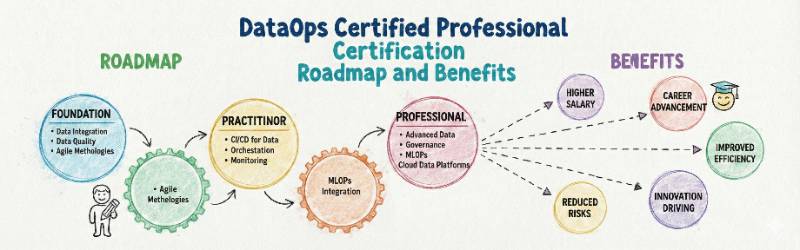
DataOps Certified Professional (DOCP) is a hands-on certification from DevOpsSchool that validates practical capability in DataOps principles, tools, and automated data pipeline management. The program emphasizes real-world projects, tool-based execution, and production-readiness across the full data delivery lifecycle with approximately 60 hours of training content.
Who should take it
Data Engineers who build and maintain data pipelines and want to move from ad-hoc scripting to production-grade automation with quality gates, observability, and repeatable deployment.
DevOps and Cloud Engineers who increasingly support data platforms alongside application delivery and need to understand data-specific challenges like schema evolution, data quality, and lineage tracking.
Analytics Engineers who transform raw data into analytics-ready datasets (often using tools like dbt) and need to integrate quality checks, version control, and CI/CD practices into transformation workflows.
Site Reliability Engineers (SREs) responsible for uptime and SLA compliance of data platforms—learning DataOps equips you to define SLIs/SLOs for data freshness and quality, not just system availability.
Engineering Managers and Technical Leads who own outcomes like time-to-insight, stakeholder trust in analytics, and compliance posture, and need to set standards for predictable data delivery.
Skills you’ll gain
- DataOps foundations and agile/lean ways of working in data delivery
- Pipeline orchestration using Airflow, Prefect, Dagster, and cloud-native workflow engines
- Data integration patterns for batch and streaming (Kafka, NiFi, StreamSets, CDC tools)
- CI/CD automation for data pipelines with version control, automated testing, and staged deployment
- Data quality frameworks like Great Expectations and Soda for automated validation
- Monitoring, observability, and alerting for pipeline health and data quality metrics
- Infrastructure-as-code using Docker, Kubernetes, and Terraform for reproducible environments
- Security, governance, and compliance practices including RBAC, lineage, and audit logging
Real-world projects you should be able to do after DOCP
- Build end-to-end automated data pipelines that ingest, transform, validate quality, and deliver data to warehouses with CI/CD deployment
- Implement production-grade orchestration workflows with failure recovery, automatic retries, and monitoring dashboards
- Add data quality gates using Great Expectations or Soda that block bad data from reaching downstream systems
- Design governed data delivery flows with lineage tracking, role-based access control, and audit logging
- Build streaming data pipelines with real-time quality checks using Kafka and Spark
- Set up multi-environment data platforms (dev/test/prod) using infrastructure-as-code
Preparation plan
7–14 days (fast-track for experienced practitioners)
- Days 1–2: Review DataOps principles, understand how it differs from DevOps, and map concepts to your current work
- Days 3–6: Build your first end-to-end pipeline (extract, transform, load) with version control and automation
- Days 7–10: Add quality checks, monitoring dashboards, and observability instrumentation
- Days 11–14: Practice failure scenarios, implement governance controls, and write troubleshooting runbooks
30 days (balanced for working engineers)
- Week 1: Master DataOps foundations and set up lab environment with Docker, Airflow, and databases
- Week 2: Build multiple pipelines covering batch and streaming patterns with orchestration
- Week 3: Implement CI/CD pipelines with automated testing, quality gates, and documentation
- Week 4: Add comprehensive monitoring, governance controls, and complete a capstone project
60 days (deep for managers or career transitions)
- Month 1: Build portfolio of 3+ working pipelines with full CI/CD, quality gates, and documentation
- Month 2: Add enterprise capabilities like advanced observability, governance at scale, cost optimization, and create reusable templates for your team
Common mistakes
- Treating DataOps as “just ETL tooling” instead of a holistic delivery system with quality, observability, and governance
- Skipping monitoring and alerting until late, which increases time-to-detect and time-to-recover
- Not automating quality checks, leading to silent failures that damage stakeholder trust
- Overbuilding architecture before proving value; start small and iterate
- Not version-controlling pipeline code from the start
- Forgetting about idempotency, making backfills and failure recovery dangerous
Best next certification after DOCP
Same track (DataOps specialization): Advance into streaming reliability at scale, metadata and lineage management, governance automation, or DataOps for ML.
Cross-track (SRE): Add Site Reliability Engineering if production reliability, uptime SLAs, and on-call maturity are gaps.
Cross-track (DevSecOps): Add DevSecOps if governance, compliance, and security controls dominate in regulated industries.
Leadership (FinOps): Add FinOps if cloud cost management, budget accountability, and unit economics are strategic priorities.
Certification Tracks Table
| Track | Certification (Level) | Who it’s for | Prerequisites | Skills covered | Recommended order |
|---|---|---|---|---|---|
| DataOps | DataOps Certified Professional (DOCP) (Professional) | Data engineers, analytics engineers, DevOps/cloud engineers supporting data platforms; managers/architects | Basic data engineering or DevOps knowledge recommended | DataOps principles; pipeline orchestration (Airflow, Dagster); data integration (Kafka, NiFi, StreamSets); CI/CD for data; monitoring/observability; data quality/testing (Great Expectations, Soda); IaC (Docker, Kubernetes, Terraform); governance | 1 |
| DevOps | DevOps Certified Professional (DCP) | Platform engineers, DevOps engineers, SREs; managers modernizing delivery | Development or operations fundamentals; Linux/Git helpful | CI/CD pipelines; automation scripting; containerization; orchestration; infrastructure-as-code; monitoring | After DOCP for broader platform delivery |
| DevSecOps | DevSecOps Certified Professional (DSCP) | Security engineers, compliance teams, platform teams | Security basics; SDLC and DevOps familiarity | Secure CI/CD; vulnerability scanning; secrets management; policy-as-code; compliance automation | After DOCP for governance focus |
| SRE | Site Reliability Engineering Certified Professional (SRECP) | SRE teams, operations engineers; on-call engineers | Monitoring basics; Linux fundamentals | SLOs/SLIs/error budgets; incident response; reliability engineering; observability; toil reduction | After DOCP for reliability focus |
| AIOps/MLOps | AIOps/MLOps Certified Professional | ML engineers, data scientists, platform teams | Python and data fundamentals; model training basics | ML pipeline automation; experiment tracking; model registry; feature stores; model monitoring | After DOCP for ML/AI deployment |
| FinOps | FinOps Certified Professional (FCP) | Cloud cost owners, finance teams, managers, architects | Cloud billing awareness; basic cloud fundamentals | Cloud cost governance; optimization; chargeback/showback; budgeting | After DOCP for cost governance |
Choose Your Path
DataOps Path
Pick this if you own data delivery end-to-end—from ingestion and transformation to quality validation and governed access—and your stakeholders are analysts, data scientists, and business users consuming analytics. DOCP is the most direct fit, teaching the full toolkit for production-grade data delivery.
DevOps Path
Pick this if your goal is consistent release automation across platforms and teams, and you want DataOps to fit into a broader CI/CD culture. DOCP helps because it treats data pipelines as production software that needs predictable delivery.
DevSecOps Path
Pick this if regulated data, audit needs, and policy-driven controls are constant concerns. DOCP’s emphasis on governance and compliance aligns with how DevSecOps teams think about guardrails.
SRE Path
Pick this if you are on call for data platforms and your problem is reliability: broken pipelines, missed SLAs, data freshness failures, and alert fatigue. DOCP highlights observability and monitoring practices that support this reliability mindset.
AIOps/MLOps Path
Pick this if the destination is AI/ML in production, where reproducibility and reliable feature pipelines decide whether models succeed. DOCP’s automation, testing, and monitoring themes are directly relevant to ML operations.
FinOps Path
Pick this if your organization wants cost transparency and control across cloud data platforms. While DOCP is not a cost certification, the operational discipline it promotes makes cost governance easier to implement.
Role → Recommended Certifications
| Role | Recommended Certifications | Rationale |
|---|---|---|
| Data Engineer | Primary: DOCP Secondary: SRE Optional: DevOps | DOCP is the direct match for pipeline builders. SRE adds production reliability practices. DevOps broadens platform skills. |
| Analytics Engineer | Primary: DOCP Secondary: DevOps Optional: FinOps | DOCP covers CI/CD and quality for dbt workflows. DevOps reinforces version control. FinOps optimizes query costs. |
| DevOps Engineer | Primary: DOCP (if supporting data) Secondary: DevOps Certified Optional: Kubernetes/Terraform | DOCP teaches data-specific challenges. Pair with general DevOps for cross-functional skills. |
| Site Reliability Engineer | Primary: DOCP Secondary: SRE Certified Optional: Kubernetes CKA | DOCP helps understand pipeline failures. SRE formalizes SLI/SLO thinking. |
| Platform Engineer | Primary: DOCP Secondary: DevOps + SRE Optional: K8s + Terraform | DOCP covers data platform patterns. DevOps and SRE cover broader automation. |
| Cloud Engineer | Primary: DOCP Secondary: Cloud-specific certs Optional: FinOps | DOCP operationalizes cloud data services. Vendor certs add depth. FinOps adds cost control. |
| Security Engineer | Primary: DOCP Secondary: DevSecOps Certified Optional: CISSP | DOCP provides data governance context. DevSecOps adds security automation. |
| Data Scientist | Primary: DOCP Secondary: MLOps certification Optional: Kubernetes | DOCP builds reliable feature pipelines. MLOps covers model deployment. |
| FinOps Practitioner | Primary: DOCP Secondary: FinOps Certified Optional: Cloud cost certs | DOCP provides technical context. FinOps teaches cost optimization. |
| Engineering Manager | Primary: DOCP Secondary: Choose based on needs Optional: Leadership training | DOCP gives hands-on understanding to coach teams. Add domain-specific certs based on gaps. |
Next Certifications to Take
Option 1: Same Track (DataOps Specialization)
Deepen DataOps expertise by specializing in streaming reliability at scale (Kafka Streams, Flink), advanced governance and metadata management (data catalogs, lineage), DataOps for ML (feature stores, training pipelines), or vendor-specific platforms (Databricks, Snowflake, AWS Data Analytics).
Option 2: Cross-Track (SRE or DevSecOps)
Add SRE if production reliability is your biggest gap—learn SLIs/SLOs, error budgets, incident response, and on-call best practices. Add DevSecOps if you operate in regulated industries requiring security automation, policy-as-code, and compliance controls.
Option 3: Leadership (FinOps)
Add FinOps Certified Professional if cloud cost is strategic—learn cost visibility, optimization techniques, chargeback/showback models, and financial governance. This prepares you for senior roles balancing technical delivery with financial outcomes.
Training and Certification Support Institutions
DevOpsSchool is the primary provider and official certifying body for DOCP, offering multiple training formats including self-paced video courses, live online instructor-led batches, one-to-one mentoring, and corporate bootcamps. All hands-on demos run on AWS cloud with step-by-step lab guides, real-time projects, and interview preparation support.
Cotocus focuses on corporate training and customized learning programs tailored to specific organizational needs. Their training emphasizes hands-on projects, orchestration/automation coverage (Airflow, Kubernetes), and interview preparation for DataOps roles.
Scmgalaxy offers DataOps training with emphasis on hands-on labs, sandbox environments, and practical implementation. Known for extensive lab catalogs and real-world scenario practice that complement formal certification training.
BestDevOps provides live, instructor-led online training with certification support, featuring expert trainers, long-form videos, projects, and assessment support. Certification is issued by DevOpsSchool with emphasis on career readiness.
devsecopsschool publishes deep-dive content connecting DataOps with security controls, governance, and secure pipeline implementation. Valuable for stronger compliance automation coverage and transition to DevSecOps certification.
sreschool focuses on Site Reliability Engineering training with emphasis on reliability, observability, SLO/SLI frameworks, and incident response. Strong complement to DOCP for operating data pipelines as production services.
aiopsschool covers AIOps and MLOps, teaching model deployment, feature engineering pipelines, and production ML monitoring. Complements DOCP when connecting data pipelines to ML/AI workflows.
dataopsschool publishes DOCP-oriented educational content, certification explainers, and career guides. Useful as supporting knowledge base and revision resource alongside official DOCP program.
finopsschool specializes in FinOps principles, cloud cost optimization, and financial governance for data platforms. Relevant after DOCP when cost visibility and budget accountability become priorities.
FAQs on DataOps Certified Professional (DOCP)
1. Is DOCP hard for working engineers?
DOCP is manageable if you have basic data engineering or DevOps knowledge, which is the recommended prerequisite. The hands-on format with AWS cloud demos and step-by-step labs helps bridge knowledge gaps.
2. How long does preparation typically take?
DevOpsSchool offers ~60 hours of training content. Fast-track preparation takes 7–14 days for experienced practitioners, balanced preparation takes 30 days for working engineers (1–2 hours daily), and deep preparation takes 60 days for career transitions or managers seeking mastery.
3. Do I need to be a Data Engineer to start?
No, but understanding either data engineering basics or DevOps basics is recommended. The program is designed for data engineers, DevOps/cloud engineers, analytics engineers, SREs, and managers.
4. What kind of hands-on work should I expect?
DevOpsSchool executes demos on AWS cloud and provides step-by-step lab guides. You can practice using AWS Free Tier or local VMs, and you’ll receive a real-time scenario-based project after training.
5. What tools should I be comfortable with?
The program covers orchestration (Airflow, Dagster), integration (Kafka, StreamSets, NiFi), quality testing (Great Expectations, Soda), and infrastructure-as-code (Docker, Kubernetes, Terraform).
6. Is this useful for managers?
Yes—DataOps focuses on predictable delivery and change management of data artifacts, which aligns with managerial KPIs like cycle time, quality, and stakeholder trust.
7. What are typical career outcomes after DOCP?
DOCP positions you for roles like Data Engineer, Analytics Engineer, Data Platform Engineer, DataOps Lead, and advancement into specialized areas like streaming pipelines or ML feature engineering.
8. What system setup do I need?
Windows/Mac/Linux with at least 2GB RAM and 20GB storage. Common Linux distributions like Ubuntu, CentOS, Redhat, or Fedora are supported.
9. Can I learn without attending every live session?
Yes, DevOpsSchool provides presentations, notes, and recordings in their LMS. You can attend missed sessions in another batch and have lifetime access to learning materials.
10. Is classroom training available?
Yes, classroom training is available in major Indian cities like Bangalore, Hyderabad, Chennai, and Delhi.
11. What’s the biggest reason people fail to benefit from DataOps training?
Staying stuck in manual steps instead of embracing automation. DataOps reduces slow, error-prone development by applying lean/Agile/DevOps principles and new tools.
12. How should I sequence certifications?
Start with DOCP if your work touches data pipelines. Then add SRE for reliability, DevSecOps for governance/security, DevOps for broader automation, or FinOps for cost governance depending on your gaps.
Testimonials
Abhinav Gupta, Pune
“The training was very useful and interactive. Rajesh helped develop the confidence of all participants.”
Indrayani, India
“Rajesh is a very good trainer. We really liked the hands-on examples covered during this training program.”
Sumit Kulkarni, Software Engineer
“Very well organized training. The content and delivery were very helpful.”
Vinayakumar, Project Manager, Bangalore
“Thanks for the excellent training. It was good, and I appreciate the knowledge shared throughout the program.”
Conclusion
If your organization depends on dashboards, ML features, operational analytics, or governed datasets, DataOps is no longer optional—it is the delivery discipline that makes data trustworthy and repeatable. DOCP is designed to build that discipline through practical pipeline automation, quality gates, observability, and governance skills that map to real production work. The certification validates your ability to build end-to-end automated pipelines, implement quality checks that prevent bad data from propagating, monitor data freshness and pipeline health, and apply governance controls for enterprise environments. Whether you’re looking to advance as a Data Engineer, transition into data platform reliability as an SRE, expand your DevOps skills to include data delivery, or lead DataOps transformations as a manager, DOCP provides the foundational capabilities that modern data teams require. Start your DataOps journey today and transform how your organization delivers data.