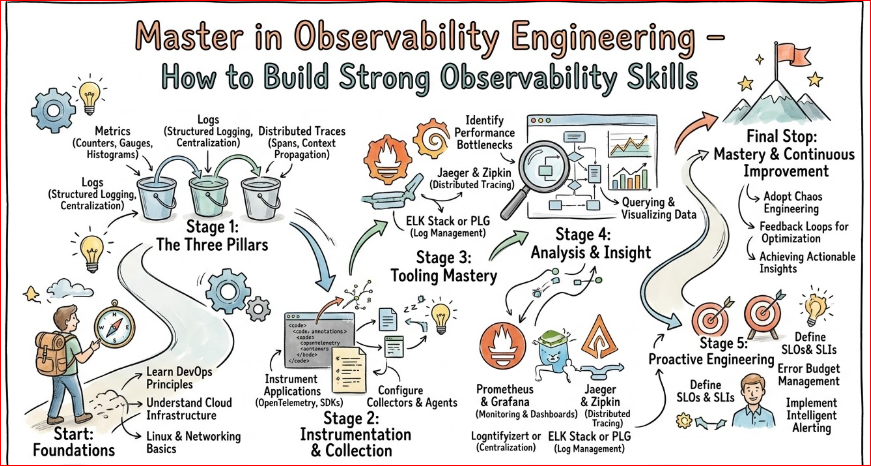
They break in surprising ways, often at the worst possible time. Observability is the skill that helps you see what is happening inside these systems so you can fix problems fast and keep users happy. The Master in Observability Engineering (MOE) certification is designed for professionals who want to build, run, and improve highly reliable systems using data-driven insights. It turns you from someone who “checks dashboards” into someone who can design complete observability strategies for products, platforms, and organisations. This guide will help you understand what MOE is, who it is for, what skills you will gain, and how it fits into different career paths such as DevOps, SRE, DevSecOps, AIOps/MLOps, DataOps, and FinOps.
Why Observability Matters Today
- Users expect fast and reliable experiences on web, mobile, and APIs.
- Systems spread across microservices, multiple clouds, containers, and serverless.
- Old-style monitoring with static checks is not enough; you need rich, queryable telemetry to answer new questions quickly.
Observability helps you:
- Detect issues before customers complain.
- Understand the root cause of complex failures.
- Optimize performance and cost with real data.
- Support modern practices like SRE, chaos engineering, and continuous delivery.
MOE Certification: Key Outcomes
After completing MOE, you should be able to:
- Design observability architectures for microservices, monoliths, and hybrid systems.
- Work with metrics, logs, traces, events, and profiles in a structured way.
- Use OpenTelemetry and major observability platforms to instrument applications and infrastructure.
- Build dashboards and alerts that reflect user experience and business SLIs/SLOs, not just server health.
- Lead incident response and post-incident reviews using data and timelines.
Master in Observability Engineering (MOE) Certification Overview
Mini-Sections for Master in Observability Engineering (MOE)
What it is
Master in Observability Engineering (MOE) is a master-level certification focused on designing and running observability for complex, cloud-native and hybrid systems. It teaches you how to collect, analyze, and use telemetry data to keep systems reliable, fast, and cost-effective.
Who should take it
- DevOps engineers managing CI/CD and production releases.
- SREs responsible for uptime, SLOs, and incident response.
- Platform and cloud engineers building shared platforms and internal developer platforms.
- Security engineers who want deep visibility into runtime behaviour.
- Data engineers and AIOps/MLOps practitioners working with telemetry and operational data.
- Engineering managers leading reliability, platform, or infrastructure teams.
Skills you’ll gain
- Observability fundamentals: metrics, logs, traces, events, and correlations.
- Observability architecture design for microservices, monoliths, and hybrid systems.
- Instrumentation using OpenTelemetry and cloud-native tools.
- Building useful dashboards and alert rules aligned with SLIs/SLOs.
- Incident detection, triage, root-cause analysis, and post-incident review.
- Performance analysis and capacity insights using telemetry data.
- Using observability data for AIOps, anomaly detection, and automation.
Real-world projects you should be able to do after it
- Design and implement an observability stack for a microservices-based product using metrics, logs, and traces.
- Build an end-to-end tracing pipeline using OpenTelemetry and a backend like Jaeger or a commercial platform.
- Create unified health dashboards for product, platform, and business KPIs in one place.
- Set up SLO-based alerting to reduce noise and focus on real user impact.
- Run performance audits that show how to cut latency and errors using data from traces and metrics.
- Integrate observability into CI/CD pipelines to catch issues earlier in the lifecycle.
Preparation plan
You can adjust your plan based on your background and time. Here is a simple structure.
7–14 day fast-track plan
- Day 1–3: Learn observability basics (metrics, logs, traces, SLI/SLO concepts) and review monitoring vs observability.
- Day 4–6: Study OpenTelemetry, basic instrumentation, and a simple observability stack on one cloud.
- Day 7–10: Practice with 2–3 hands-on labs: set up dashboards, alerts, and tracing flows for a sample app.
- Day 11–14: Revise concepts, attempt mock scenarios, and review case studies around outages and incident response.
30 day standard plan
- Week 1: Fundamentals of observability, telemetry types, and architecture patterns.
- Week 2: Deep dive into tools: OpenTelemetry, common backends, cloud-native monitoring (CloudWatch, Azure Monitor, etc.).
- Week 3: Build full observability for a sample system: logs, metrics, traces, dashboards, alerts, runbooks.
- Week 4: Focus on incident response, SLO design, AIOps basics, and practice exam-style questions and labs.
60 day working-professional plan
- Week 1–2: Learn and apply observability basics to your current environment.
- Week 3–4: Gradually introduce tracing, structured logging, and SLO-based alerts in your team’s systems.
- Week 5–6: Implement at least one end-to-end observability case study in your workplace or lab and use it as your portfolio.
- Week 7–8: Revision, mock projects, mentoring sessions, and final certification preparation using official course material.
Common mistakes
- Treating observability as “just monitoring” and focusing only on dashboards instead of instrumenting code and services properly.
- Overloading systems with telemetry without a clear plan for what questions need to be answered.
- Ignoring traces and only using metrics and logs, which hides cross-service problems.
- Setting alerts on low-level metrics only, rather than on user-centric SLIs and SLOs.
- Not integrating observability into CI/CD and relying only on production dashboards.
- Using multiple tools without a clear architecture, leading to data silos and confusion.
Best next certification after this
- Same track: AIOps-focused certification or advanced observability/telemetry program to use AI and automation on telemetry data.
- Cross-track: DevSecOps or cloud security certification to apply observability to security use cases and threat detection.
- Leadership: SRE or engineering leadership program focused on reliability, incident management, and data-driven decision-making.
Choose Your Path: 6 Learning Paths
Observability supports many roles and tracks. Here are six paths where MOE fits naturally.
1. DevOps Path
In the DevOps path, observability helps you ship faster with confidence. You focus on integrating telemetry into CI/CD, feature releases, and runtime automation.
You use MOE skills to design pipelines that automatically collect deployment metrics, error rates, and performance data for each release. This allows you to roll forward or roll back based on facts, not guesswork.
2. DevSecOps Path
DevSecOps uses observability data to detect security anomalies and misuse patterns. Logs, traces, and metrics give you insight into suspicious requests, privilege escalations, and unusual traffic patterns.
With MOE, you can design observability pipelines that feed both reliability and security tools, helping teams respond faster to threats and reduce blind spots in complex environments.
3. SRE Path
SRE teams rely heavily on observability for SLOs, error budgets, incident response, and postmortems. MOE gives SREs stronger skills for defining SLIs, designing dashboards, and automating responses.
You learn how to shift from reactive firefighting to proactive reliability engineering, using telemetry to predict and prevent outages instead of just fixing them.
4. AIOps/MLOps Path
For AIOps and MLOps, observability data is the fuel. Metrics and logs feed anomaly detection, correlation engines, and automated remediation workflows.
MOE helps you understand which telemetry to collect, how to label it, and how to use it to train models that predict incidents, capacity needs, or performance issues.
5. DataOps Path
DataOps teams manage data pipelines, ETL/ELT processes, and analytics platforms. Observability here means tracking freshness, quality, and reliability of data flows.
With MOE, you can instrument pipelines to track job success rates, data delays, and schema changes so that downstream users and dashboards stay trusted and reliable.
6. FinOps Path
FinOps teams care about the cost and value of cloud resources. Observability connects performance, reliability, and cost.
MOE skills help you create views where cost, utilization, and user experience appear together. This lets teams decide where to save money, where to invest more, and how to avoid expensive reliability issues.
Role → Recommended Certifications Mapping
This section maps common roles to MOE and related recommended certifications. MOE is central for anyone who owns reliability, platforms, or large-scale systems.
Next Certifications to Take After MOE
After completing MOE, you should not stop learning. Observability touches many domains. Here are three directions.
Same track: Deepen observability and AIOps
- Advanced observability or AIOps programs focused on anomaly detection, automated remediation, and ML-driven insights.
- Vendor-specific certifications for observability platforms (if your organisation uses a specific tool).
Cross-track: Broaden into DevSecOps or SRE
- DevSecOps certifications to use observability for security visibility and compliance.
- SRE certifications to deepen incident management, SLO design, and error budget practices.
Leadership track: Move into engineering leadership
- Reliability leadership, platform leadership, or engineering management programs that focus on leading teams using data and observability.
- These help you translate telemetry insights into business and product decisions.
Top Institutions for Training + Certification Support in MOE
DevOpsSchool
DevOpsSchool is the official provider of the Master in Observability Engineering (MOE) certification. It offers structured training, hands-on labs, mentoring, and exam preparation for engineers and managers across the globe. The programs are designed to be practical and aligned with real-world production environments.
Cotocus
Cotocus provides specialised training and consulting in DevOps, SRE, and observability for enterprises and individuals. It focuses on project-based learning and helps professionals apply observability practices directly in their current roles.
ScmGalaxy
ScmGalaxy runs workshops and courses on DevOps, CI/CD, cloud, and observability topics. Their programs are known for strong tooling coverage, lab-heavy sessions, and practical exposure to real-world use cases.
BestDevOps
BestDevOps focuses on curated learning paths and community-driven content around DevOps, SRE, and observability. It supports learners with articles, learning paths, and resources that often align with programs like MOE.
devsecopsschool.com
devsecopsschool.com delivers training on DevSecOps and security-focused engineering practices. For MOE learners, it helps connect observability and security, using logs, metrics, and traces as key inputs to detection and response.
sreschool.com
sreschool.com focuses on Site Reliability Engineering skills such as SLOs, error budgets, incident response, and reliability culture. Combined with MOE, it helps SREs build strong observability systems that support reliability goals.
aiopsschool.com
aiopsschool.com offers programs around AIOps and automation for operations. It complements MOE by teaching how to use observability data in automation, anomaly detection, and ML-driven decision-making.
dataopsschool.com
dataopsschool.com focuses on DataOps principles, data pipelines, and analytics reliability. It supports MOE learners who work with data platforms and want to instrument and observe data workflows end to end.
finopsschool.com
finopsschool.com provides training on FinOps and cloud cost management. Combined with MOE, it enables professionals to connect reliability, performance, and cost through observability dashboards and metrics.
FAQs on Master in Observability Engineering (MOE)
1. What is the Master in Observability Engineering (MOE) certification?
MOE is a master-level certification that teaches you how to design and run observability for modern systems using metrics, logs, traces, and SLOs. It focuses on both tools and practices needed for real production environments.
2. How difficult is the MOE certification?
The difficulty is moderate to high, depending on your background. If you already know DevOps or cloud basics, the course is challenging but manageable with hands-on practice and structured study.
3. How much time do I need to prepare?
Many working professionals can prepare in 30–60 days with consistent study and labs. If you are already working with monitoring tools, you might move faster using a 7–14 day intensive plan.
4. What are the prerequisites for MOE?
You should know basic Linux, cloud concepts, and CI/CD, plus have some exposure to logging or monitoring tools. Coding expertise is helpful but not mandatory, as the focus is on system design and telemetry usage.
5. Do I need prior SRE or DevOps experience?
Prior SRE or DevOps experience is not strictly required but is very helpful. Many learners come from DevOps, SRE, cloud, or development roles and use MOE to formalise and deepen their observability skills.
6. Is MOE useful for managers?
Yes. Engineering managers, platform leads, and reliability leaders benefit from MOE because it teaches how to read observability data, make decisions, and guide teams using clear SLOs and telemetry.
7. What career roles can I target after MOE?
You can target roles such as Observability Engineer, SRE, DevOps Engineer, Platform Engineer, Cloud Operations Lead, and Reliability-focused Engineering Manager.
8. How does MOE differ from a general DevOps certification?
A general DevOps certification covers many topics at a broad level, while MOE focuses deeply on observability, telemetry design, and reliability data. It is ideal as a specialised add-on after basic DevOps training.
9. In what order should I take MOE compared to other certifications?
Most professionals take a foundational DevOps or cloud certification first, then pursue MOE as a master-level specialisation. After MOE, they often move to AIOps, SRE, or leadership programs.
10. What real-world skills will I be able to show?
You will be able to design observability architectures, implement tracing, build dashboards, define SLOs, and lead incident investigations using telemetry data. These skills are directly visible in interviews and on the job.
11. Is MOE relevant for non-cloud environments?
Yes. While many examples use cloud and containers, observability principles apply to on-premise, hybrid, and legacy systems as well. The key idea is to collect and use telemetry, no matter where the system runs.
12. How does MOE help with long-term career growth?
Observability is becoming a core skill for all modern engineering teams. With MOE, you position yourself as someone who can lead reliability, performance, and data-driven engineering across DevOps, SRE, and platform roles.
FAQs on Master in Observability Engineering (MOE)
1. What is Master in Observability Engineering (MOE)?
Master in Observability Engineering (MOE) is a master-level certification that teaches you how to see what is happening inside your systems using data like logs, metrics, and traces. It helps you design and use observability to keep applications fast, reliable, and easy to troubleshoot.
2. Who should do the MOE certification?
MOE is ideal for DevOps engineers, SREs, platform and cloud engineers, security engineers, data engineers, FinOps practitioners, and engineering managers. Anyone responsible for uptime, performance, cost, or operations of modern systems can benefit from this certification.
3. What skills will I learn in MOE?
You will learn observability basics (metrics, logs, traces, events), how to design observability for microservices and cloud systems, and how to use tools like OpenTelemetry and observability platforms. You also learn to build dashboards, define SLOs, design alerts, and run better incident response using real data.
4. Do I need strong coding skills for MOE?
Strong coding skills are helpful but not mandatory. You should be comfortable reading basic code snippets and configuration files, but the main focus of MOE is on system design, telemetry, and practical usage of observability tools, not on advanced programming.
5. How long does it take to prepare for MOE?
If you already know DevOps or cloud basics, you can prepare in about 30–60 days with regular study and hands-on practice. If you are very experienced with monitoring and logging, you may be able to follow an intensive 7–14 day plan with focused labs.
6. What are the prerequisites for MOE?
You should know basic Linux commands, cloud concepts (like VMs, containers, and managed services), and CI/CD fundamentals. Some prior exposure to monitoring or logging tools is useful, but you do not need to be an expert before starting.
7. How will MOE help my career?
MOE can help you move into or grow within roles like Observability Engineer, SRE, DevOps Engineer, Platform Engineer, or Reliability-focused Manager. It makes you the person who can design and lead observability and reliability efforts, which are highly valued in modern engineering teams.
8. Is MOE only for cloud-native companies?
No. While many examples use cloud and microservices, the concepts apply to on-premise, hybrid, and legacy systems as well. Any organisation that wants better visibility into its systems and faster incident resolution can benefit from people trained in MOE.
Conclusion
Master in Observability Engineering (MOE) is one of the most powerful certifications for engineers and managers who want to build reliable, observable, and data-driven systems. It helps you move beyond basic monitoring into a world where you can ask any question about your system and get an answer from telemetry. Whether you work in DevOps, SRE, platform, security, data, or FinOps, observability is now a core skill. By investing in MOE and following the learning paths in this guide, you build a long-term career foundation that fits the future of engineering and operations.