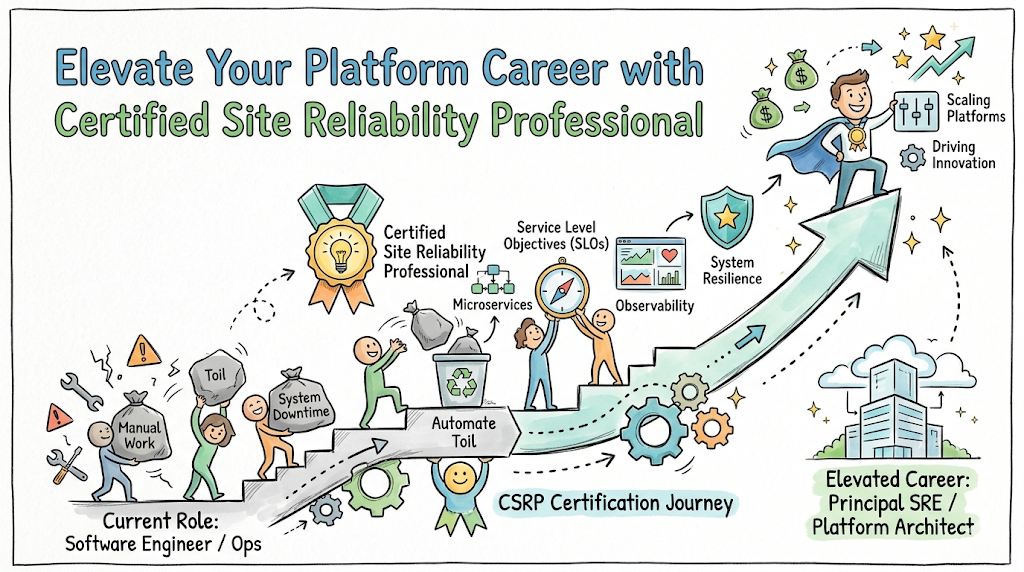
The transition from traditional systems administration to modern reliability engineering represents a significant shift in how we manage production environments. As organizations move toward cloud-native architectures, the demand for professionals who can balance feature velocity with system stability has never been higher. This guide is designed for engineers and technical leaders who want to validate their expertise through the Certified Site Reliability Professional program hosted at Sreschool.
Whether you are a software developer looking to understand production nuances or a DevOps engineer aiming for a specialized reliability role, this roadmap provides the clarity needed to navigate the certification landscape. We will examine the core competencies, the preparation required, and how this specific credential fits into a long-term career strategy. By the end of this guide, you will have a comprehensive understanding of how to leverage this certification to advance your standing in the global engineering community.
What is the Certified Site Reliability Professional?
The Certified Site Reliability Professional is a comprehensive validation framework designed to bridge the gap between theoretical DevOps concepts and the rigorous demands of high-scale production systems. Unlike traditional academic certifications, this program focuses heavily on the application of SRE principles such as Service Level Objectives (SLOs), error budgets, and toil reduction. It exists to provide a standardized benchmark for what it means to be a “reliability engineer” in an era where downtime carries massive financial and reputational risks.
This certification represents a commitment to the “Google-born” philosophy of treating operations as a software engineering problem. It aligns with modern engineering workflows by emphasizing automation over manual intervention and data-driven decision-making over “gut feelings.” For enterprises, this certification serves as a trust signal that an engineer can not only build systems but also maintain them under extreme pressure. It is a practitioner-focused credential that requires candidates to demonstrate proficiency in handling distributed systems, observability, and incident response.
Who Should Pursue Certified Site Reliability Professional?
Software engineers who find themselves increasingly responsible for the stability of their code will find immense value in this certification. It is particularly beneficial for DevOps practitioners who want to move beyond basic CI/CD pipelines and delve into the complexities of system telemetry and high availability. Platform engineers and cloud architects also stand to gain, as the principles of reliability are foundational to building resilient infrastructure that supports multiple development teams.
Beyond individual contributors, technical leads and engineering managers should pursue the Certified Site Reliability Professional to better understand how to structure their teams and manage technical debt. In the context of the Indian market, where the technology sector is shifting from service-based models to product-centric engineering, this certification is a powerful differentiator. Globally, it caters to any professional involved in the lifecycle of a digital product, including security and data roles that require stable pipelines to function effectively.
Why Certified Site Reliability Professional is Valuable in 2026 and Beyond
The demand for reliability expertise is not tied to a single tool or cloud provider, ensuring the longevity of this credential. As organizations adopt microservices and serverless architectures, the complexity of systems increases exponentially, making the role of the reliability professional indispensable. This certification helps professionals stay relevant by focusing on core principles that survive the rise and fall of specific software versions or popular framework trends.
Investing time in the Certified Site Reliability Professional offers a high return on investment because it addresses the most critical pain point in the industry: system uptime. Companies are willing to pay a premium for engineers who can prevent outages or minimize their impact when they occur. By mastering the art of reliability, you move from being a cost center to a value-driven asset that protects the company’s bottom line, ensuring your career remains robust regardless of economic fluctuations.
Certified Site Reliability Professional Certification Overview
The Certified Site Reliability Professional program is delivered via Certified Site Reliability Professional and is hosted on the Sreschool platform. The program is structured to accommodate various stages of professional growth, utilizing a multi-level assessment approach that combines conceptual knowledge with practical scenarios. It is owned and curated by industry veterans who understand the nuances of production environments, ensuring the content remains fresh and aligned with enterprise standards.
The assessment structure is designed to be rigorous yet fair, focusing on the ability to solve real-world reliability challenges rather than just memorizing definitions. Candidates are evaluated on their understanding of the SRE stack, their ability to design observable systems, and their proficiency in post-incident analysis. This structured approach ensures that the certification is not just a badge but a reflection of an engineer’s actual capability to manage complex, distributed production workloads effectively.
Certified Site Reliability Professional Certification Tracks & Levels
The certification is divided into three primary levels to mirror the standard career progression of an engineer. The Foundation level serves as the entry point, focusing on core definitions and the philosophy of SRE. The Professional level dives deeper into implementation, requiring candidates to show they can manage error budgets and design automated responses to system failures. Finally, the Advanced level is reserved for those who architect large-scale reliability strategies across multiple teams or organizations.
Specialization tracks are also available to allow professionals to align their certification with their specific domain. For instance, an engineer can focus on the SRE track to master infrastructure reliability, or a financial analyst could lean toward the FinOps track to understand the cost implications of high availability. This tiered and tracked system allows for a logical career progression, moving from a generalist understanding to specialized, high-impact leadership roles within the engineering organization.
Complete Certified Site Reliability Professional Certification Table
| Track | Level | Who it’s for | Prerequisites | Skills Covered | Recommended Order |
| Core SRE | Foundation | Junior Engineers, Students | Basic Linux/Cloud knowledge | SRE Tenets, SLOs, SLIs, Toil | 1 |
| Core SRE | Professional | SREs, DevOps Engineers | 2+ years Ops experience | Observability, Incident Management | 2 |
| Core SRE | Advanced | Architects, Sr. Leads | 5+ years SRE experience | Distributed Systems, Scalability | 3 |
| Platform | Professional | Platform Engineers | K8s & Cloud experience | Internal Developer Platforms | 2 |
| Operations | Foundation | Managers, Non-Technical | Basic IT awareness | Culture of Reliability, MTTR | 1 |
Detailed Guide for Each Certified Site Reliability Professional Certification
Certified Site Reliability Professional – Foundation
What it is
This certification validates a candidate’s understanding of the fundamental principles that govern Site Reliability Engineering. it serves as a baseline to ensure that all members of a technical team speak the same language regarding reliability and performance.
Who should take it
This is ideal for junior software engineers, fresh graduates, or system administrators who are new to the SRE philosophy. It is also suitable for project managers who need to understand why their teams are prioritizing “reliability” over “new features.”
Skills you’ll gain
- Understanding the difference between SLA, SLO, and SLI.
- Identifying and measuring “Toil” in daily operations.
- Basic understanding of the “Error Budget” concept.
- Familiarity with the SRE engagement model.
Real-world projects you should be able to do
- Define a basic Service Level Objective for a web application.
- Calculate the available error budget for a monthly release cycle.
- Identify manual tasks that can be targeted for automation.
Preparation plan
- 7 days: Review the core SRE handbook and memorize key definitions of SLIs and SLOs.
- 30 days: Practice identifying SLIs for a sample application and take multiple mock assessments.
- 60 days: Deep dive into the history of SRE and participate in community forums to discuss real-world toil reduction.
Common mistakes
- Confusing SLAs (legal) with SLOs (technical).
- Underestimating the cultural shift required for SRE.
- Focusing only on tools rather than the underlying philosophy.
Best next certification after this
- Same-track option: Certified Site Reliability Professional – Professional
- Cross-track option: Certified DevSecOps Professional
- Leadership option: Engineering Management Foundation
Certified Site Reliability Professional – Professional
What it is
This level validates the ability to implement SRE practices in a production environment. It proves that the engineer can manage incidents, build observability dashboards, and automate complex operational workflows.
Who should take it
This is for mid-level engineers with at least two years of experience in DevOps or operations. Candidates should be comfortable with cloud environments and have a working knowledge of at least one programming language.
Skills you’ll gain
- Designing and implementing comprehensive observability stacks.
- Managing incident response and conducting blameless post-mortems.
- Implementing “Infrastructure as Code” with a focus on reliability.
- Developing automated self-healing systems.
Real-world projects you should be able to do
- Build a Prometheus/Grafana dashboard that reflects real-time SLO health.
- Lead an incident response team during a simulated production outage.
- Create a CI/CD pipeline that automatically rolls back based on failed health checks.
Preparation plan
- 7 days: Focus on incident management protocols and post-mortem templates.
- 30 days: Set up a lab environment with monitoring tools and practice responding to synthetic failures.
- 60 days: Study distributed systems patterns and implement a complex automation script for system recovery.
Common mistakes
- Creating too many alerts, leading to alert fatigue.
- Failing to document the “why” behind an automated fix.
- Ignoring the human elements of incident response.
Best next certification after this
- Same-track option: Certified Site Reliability Professional – Advanced
- Cross-track option: Certified DataOps Professional
- Leadership option: Technical Lead Certification
Certified Site Reliability Professional – Advanced
What it is
The Advanced certification is a master-level credential for those who design the reliability strategy for entire organizations. It focuses on high-level architecture, global scalability, and long-term systems evolution.
Who should take it
Senior SREs, Staff Engineers, and Architects who have spent years managing large-scale distributed systems. These individuals are responsible for the reliability of multiple interconnected services.
Skills you’ll gain
- Architecting for multi-region and multi-cloud resilience.
- Capacity planning and performance engineering at scale.
- Designing organizational reliability policies and governance.
- Advanced chaos engineering and disaster recovery orchestration.
Real-world projects you should be able to do
- Design a disaster recovery plan that meets a 4-hour RTO for a global platform.
- Implement a chaos engineering experiment that tests cascading failures in microservices.
- Develop a custom internal tool to automate capacity forecasting.
Preparation plan
- 7 days: Review high-level architecture patterns and case studies of major outages.
- 30 days: Conduct deep-dive sessions on distributed consensus and database reliability.
- 60 days: Architect a full-scale reliability roadmap for a hypothetical enterprise and seek peer review.
Common mistakes
- Designing over-engineered solutions for simple problems.
- Losing sight of the business cost of extreme reliability.
- Failing to mentor junior engineers in reliability practices.
Best next certification after this
- Same-track option: Principal SRE Fellowship
- Cross-track option: Certified AIOps Professional
- Leadership option: CTO / VPE Leadership Track
Choose Your Learning Path
DevOps Path
The DevOps path focuses on the integration of development and operations with a heavy emphasis on automation and speed. In this journey, the Certified Site Reliability Professional serves as the “guardrail” that ensures speed does not compromise stability. You will learn to integrate automated testing and deployment with reliability metrics. This path is ideal for those who want to build the machines that build the software.
DevSecOps Path
The DevSecOps path layers security into the reliability lifecycle. Here, a Certified Site Reliability Professional learns that a vulnerable system is an unreliable system. You will focus on automating security checks and ensuring that incident response includes security breach protocols. This path is essential for organizations in regulated industries like finance or healthcare where uptime and data integrity are equally critical.
SRE Path
This is the pure-play path for reliability specialists. It follows the traditional Google model of SRE, focusing intensely on the software engineering aspects of operations. You will spend your time writing code to manage infrastructure, analyzing system performance, and reducing toil. This is the most direct path for those who want to become Site Reliability Engineers in top-tier product companies.
AIOps Path
The AIOps path is for engineers looking to leverage machine learning to enhance system reliability. By combining Certified Site Reliability Professional principles with AI, you will learn to predict outages before they happen using anomaly detection. This path focuses on the “Predictive” side of SRE, using data science to manage the overwhelming amount of telemetry generated by modern systems.
MLOps Path
The MLOps path addresses the specific reliability needs of machine learning pipelines. Unlike standard software, ML models require monitoring for data drift and training performance. A Certified Site Reliability Professional in this path ensures that the infrastructure supporting AI models is as robust as the models themselves. It is a specialized niche for those working at the intersection of data science and production engineering.
DataOps Path
DataOps is focused on the reliability of data pipelines and delivery. In this path, you apply SRE concepts like SLOs to data quality and pipeline latency. A Certified Site Reliability Professional here ensures that the “data factory” never stops running. It is perfect for engineers who manage large-scale data warehouses, streaming platforms, and ETL processes that the business relies on for decision-making.
FinOps Path
The FinOps path connects reliability with cloud financial management. It explores the reality that “infinite reliability” is infinitely expensive. You will learn to balance the cost of cloud resources with the required level of system uptime. This path is becoming vital as companies look to optimize their cloud spend without sacrificing the performance or stability of their applications.
Role → Recommended Certified Site Reliability Professional Certifications
| Role | Recommended Certifications |
| DevOps Engineer | Certified Site Reliability Professional (Foundation + Professional) |
| SRE | Certified Site Reliability Professional (All Levels) |
| Platform Engineer | Certified Site Reliability Professional (Professional) |
| Cloud Engineer | Certified Site Reliability Professional (Foundation + Professional) |
| Security Engineer | Certified Site Reliability Professional (Foundation) |
| Data Engineer | Certified Site Reliability Professional (Professional) |
| FinOps Practitioner | Certified Site Reliability Professional (Foundation) |
| Engineering Manager | Certified Site Reliability Professional (Foundation) |
Next Certifications to Take After Certified Site Reliability Professional
Same Track Progression
Once you have mastered the Foundation level, the natural progression is to the Professional and eventually the Advanced levels. This deep specialization allows you to become a Subject Matter Expert (SME) in reliability engineering. As you move up, the focus shifts from manual tasks to architectural decisions and cultural leadership. This progression ensures you remain the go-to person for solving the most difficult production challenges in your organization.
Cross-Track Expansion
If you have reached a comfortable level in SRE, broadening your skills into DevSecOps or DataOps is a strategic move. Reliability does not exist in a vacuum; it is heavily influenced by how data flows and how secure the environment is. By expanding cross-track, you become a multi-dimensional engineer who can address reliability from multiple angles. This makes you more versatile and valuable in smaller organizations or specialized task forces.
Leadership & Management Track
For those who want to move away from day-to-day coding and into people management, the transition to a leadership track is recommended. You can leverage your reliability expertise to become a better Engineering Manager or VP of Engineering. Understanding the trade-offs between feature development and stability allows you to lead teams more effectively. This track focuses on strategic planning, budgeting, and building a culture of excellence across the engineering department.
Training & Certification Support Providers for Certified Site Reliability Professional
DevOpsSchool
DevOpsSchool has established itself as a premier destination for technical training, offering a robust curriculum that covers the entire spectrum of modern engineering. With over 15 years in the industry, they provide deep-dive sessions into SRE practices that align perfectly with the Certified Site Reliability Professional standards. Their trainers are often working professionals who bring real-world scenarios into the classroom, ensuring that students learn how to handle actual production outages. They offer a blend of self-paced learning and instructor-led bootcamps, making them a flexible choice for working professionals. Their extensive lab environments allow for hands-on practice, which is crucial for passing the professional levels of the certification.
Cotocus
Cotocus is known for its boutique approach to technical consulting and training, focusing heavily on cloud-native technologies and infrastructure automation. They offer specialized modules that support the Certified Site Reliability Professional journey by emphasizing the integration of SRE with Kubernetes and multi-cloud environments. Their curriculum is designed to be highly practical, moving quickly from theory to implementation. For engineers looking for a mentor-driven experience, Cotocus provides a personalized touch that helps in understanding complex distributed systems concepts. Their strong background in corporate training makes them an excellent choice for teams looking to upskill together. They focus on the “how-to” of reliability, ensuring that every student leaves with a functional skill set.
Scmgalaxy
Scmgalaxy is a massive community-driven platform that has been a cornerstone for DevOps and SRE knowledge for over a decade. They provide an extensive library of tutorials, blog posts, and webinars that specifically support candidates preparing for the Certified Site Reliability Professional exam. Their strength lies in their massive repository of technical content which covers everything from basic shell scripting to complex monitoring configurations. By providing a platform where engineers can share their experiences, Scmgalaxy offers a unique “peer-to-peer” learning environment. For candidates who prefer a self-study approach supplemented by community support, this provider is an invaluable resource. They bridge the gap between official documentation and practical, everyday engineering tasks.
BestDevOps
BestDevOps focuses on delivering high-impact training that is specifically tailored to career advancement in the SRE and DevOps space. Their support for the Certified Site Reliability Professional program includes dedicated career coaching and resume building alongside technical training. They understand the market demand and ensure that their students are not just certified, but also “job-ready.” Their curriculum is streamlined to focus on the most in-demand tools and methodologies used by top-tier product companies. With a focus on mock interviews and real-world project simulations, BestDevOps helps candidates gain the confidence needed to excel in high-pressure technical roles. They are a great choice for those looking for a clear path from certification to employment.
devsecopsschool.com
DevSecOpsSchool is the leading authority on integrating security into the modern software development lifecycle. Their support for the Certified Site Reliability Professional program emphasizes the “Security” aspect of reliability, teaching students that a system cannot be reliable if it is not secure. They offer specialized tracks that show how to automate security audits and implement real-time threat detection as part of the SRE observability stack. Their courses are essential for professionals working in high-security environments who need to balance reliability with strict compliance requirements. By providing a security-first perspective on operations, they help engineers build more resilient and trustworthy systems. Their labs include security breach simulations that are vital for advanced SRE training.
sreschool.com
As the primary host for the Certified Site Reliability Professional, Sreschool.com offers the most direct and aligned training available. Their curriculum is built from the ground up to match the certification’s core competencies, ensuring no gaps in knowledge. They provide a comprehensive learning management system that tracks progress across Foundation, Professional, and Advanced levels. The content is curated by the same experts who designed the certification, offering unique insights into the assessment criteria. Sreschool.com is the ideal starting point for anyone serious about this specific credential, providing official study guides, practice exams, and interactive lab environments. Their focus is 100% on the art and science of Site Reliability Engineering.
aiopsschool.com
AIOpsSchool is at the forefront of the next generation of operations, focusing on the intersection of artificial intelligence and system reliability. They support the Certified Site Reliability Professional by providing the advanced skills needed to automate complex decision-making processes. Their training covers anomaly detection, automated root cause analysis, and predictive maintenance. For engineers who want to move beyond manual scripts and into the world of “intelligent” operations, AIOpsSchool provides the necessary mathematical and technical foundation. Their courses help SREs handle the “data deluge” of modern telemetry by using ML models to filter noise from actual signals. This provider is essential for those aiming for the AIOps specialization track.
dataopsschool.com
DataOpsSchool provides specialized support for engineers who manage the reliability of data-intensive applications. Their contribution to the Certified Site Reliability Professional ecosystem focuses on applying SRE principles to data pipelines, warehouses, and real-time processing engines. They teach students how to define SLOs for data freshness, quality, and availability. In an era where data is the lifeblood of the enterprise, their training ensures that the data infrastructure is as reliable as the application code. Their curriculum covers tools like Kafka, Spark, and various NoSQL databases from an operational excellence perspective. This is the go-to provider for SREs who find themselves working increasingly with data engineering teams.
finopsschool.com
FinOpsSchool addresses the critical need for financial accountability in the cloud, supporting the Certified Site Reliability Professional by teaching “cost-aware” reliability. Their training focuses on the cultural and technical shift needed to manage cloud spend as a first-class engineering metric. They show how reliability decisions, such as multi-region redundancy, directly impact the company’s bottom line. By providing the tools to calculate the “cost of downtime” versus the “cost of reliability,” they help SREs make better business-aligned decisions. Their curriculum is essential for senior engineers and managers who are responsible for large-scale cloud budgets. FinOpsSchool bridges the gap between the finance department and the engineering team.
Frequently Asked Questions (General)
- How difficult is the Certified Site Reliability Professional exam?
The difficulty depends on the level, with the Foundation level being accessible to most, while the Advanced level requires deep architectural knowledge and experience.
- How much time does it take to prepare for the certification?
Preparation can range from 30 days for the Foundation level to 90 days or more for the Advanced level, depending on your prior experience.
- Are there any prerequisites for taking the Foundation exam?
There are no formal prerequisites, but a basic understanding of Linux, cloud computing, and software development is highly recommended.
- Is this certification recognized globally?
Yes, the principles covered are based on industry-standard SRE practices used by major technology companies worldwide, making it globally relevant.
- Does the certification expire?
Most professional certifications in this field require renewal or continuing education every two to three years to ensure your skills stay current.
- How does this differ from a standard DevOps certification?
While DevOps focuses on the entire lifecycle, SRE focuses specifically on the “operations” part through the lens of a software engineer.
- Can I take the exam online?
Yes, the Certified Site Reliability Professional is typically delivered via an online proctored environment for maximum accessibility.
- What is the format of the exam?
The exam usually consists of a mix of multiple-choice questions, scenario-based problems, and practical lab assessments in higher levels.
- Is there a community for certified professionals?
Yes, Sreschool and other providers often host forums and alumni groups where professionals can network and share production insights.
- What is the return on investment for this certification?
Professionals often see a significant increase in salary and job opportunities, as SRE is one of the highest-paid roles in the tech industry.
- Can I jump straight to the Advanced level?
It is generally recommended to follow the sequence, but candidates with significant documented experience may sometimes bypass the Foundation level.
- Does the course cover specific tools like Terraform or Kubernetes?
While it focuses on principles, it uses industry-standard tools for practical labs and examples to ensure real-world applicability.
FAQs on Certified Site Reliability Professional
- Why should I choose Certified Site Reliability Professional over other SRE certs?
This certification is uniquely practitioner-focused, emphasizing the day-to-day realities of production rather than just high-level theory or a single vendor’s tools.
- Does this certification help in the Indian job market?
Absolutely, as Indian tech firms shift from IT services to product engineering, the demand for certified SREs has skyrocketed in cities like Bangalore and Pune.
- What are the core pillars covered in the syllabus?
The syllabus is built around the core SRE pillars: SLOs/SLIs, Error Budgets, Toil Reduction, Monitoring/Observability, and Incident Response.
- How are the practical labs structured?
The labs simulate real production environments where you must diagnose issues, fix broken pipelines, or set up monitoring for a failing service.
- Is coding a requirement for this certification?
For the Professional and Advanced levels, a working knowledge of Python, Go, or specialized scripting is essential to demonstrate automation skills.
- Can managers benefit from this technical certification?
Yes, the Foundation level is specifically designed to help managers understand SRE culture and how to support their teams’ reliability goals.
- How often is the course content updated?
The content is reviewed annually by a committee of industry experts to ensure it reflects the latest shifts in cloud-native and reliability engineering.
- Does this certification cover Chaos Engineering?
Yes, especially at the Professional and Advanced levels, where testing system resilience through controlled failure injection is a key competency.
Conclusion
As a mentor who has watched the industry evolve from physical server rooms to global cloud deployments, I can tell you that the fundamental challenge hasn’t changed: how do we keep things running while we change them? The Certified Site Reliability Professional is not just another line on your resume; it is a rigorous training ground that forces you to think like a systems architect. It moves you away from the “break-fix” mentality and toward a proactive, engineering-led approach to operations.
If you are looking for a “quick win” or a simple badge, this might not be for you. However, if you are committed to mastering the craft of production engineering, the investment is absolutely worth it. The clarity you gain in defining reliability and the confidence you build through the practical labs will stay with you long after the exam is over. In a field that is constantly changing, these principles are your North Star.