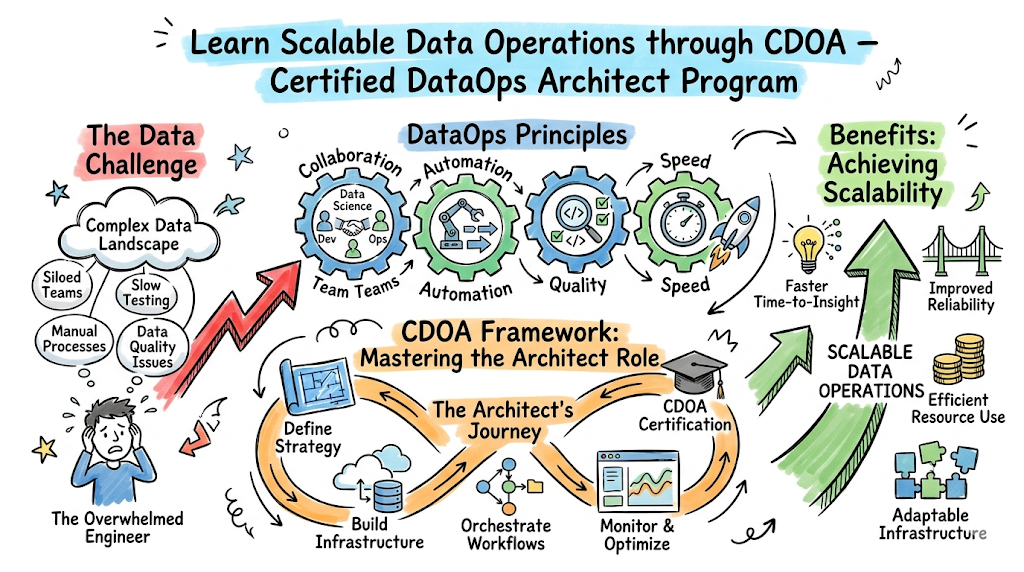
The digital landscape is moving toward a data-first approach where speed and reliability are non-negotiable. This guide on the CDOA – Certified DataOps Architect is designed for professionals who want to bridge the gap between data engineering and operational excellence. At Dataopsschool, the focus is on providing a clear roadmap for engineers to master the complexities of data pipelines. By following this guide, platform managers and software engineers can understand how to implement lean and agile practices within their data ecosystems. Navigating this certification helps you make informed career decisions that align with global technology trends and enterprise needs.
What is the CDOA – Certified DataOps Architect?
The CDOA – Certified DataOps Architect is a professional designation that focuses on the intersection of data engineering, automated delivery, and quality assurance. Unlike theoretical programs, this certification emphasizes the practical application of DataOps principles to solve real-world production bottlenecks. It represents a shift from traditional, siloed data management to a collaborative framework that ensures high-quality data is delivered continuously. By earning this credential, architects prove they can design systems that support rapid experimentation while maintaining strict governance and operational stability in complex environments.
Who Should Pursue CDOA – Certified DataOps Architect?
This certification is tailored for a wide range of professionals, from software engineers and SREs to dedicated data architects and cloud practitioners. It is particularly beneficial for those in India and the global market who are tasked with scaling data infrastructure or managing large-scale analytics platforms. Beginners with a strong foundation in IT will find a structured path to specialize, while experienced managers can gain the technical depth needed to lead modern engineering teams. Data security professionals and platform engineers will also find the curriculum highly relevant to their daily tasks of securing and optimizing data flows.
Why CDOA – Certified DataOps Architect is Valuable in the Future
The demand for DataOps expertise is growing rapidly as enterprises realize that data is only as good as the speed and accuracy with which it is delivered. Longevity in an engineering career today requires staying ahead of tool-specific changes and mastering the underlying methodologies that govern data lifecycle management. This certification ensures that professionals remain relevant by focusing on architectural patterns and automated workflows that persist even as individual technologies evolve. Investing time in this program offers a significant return by positioning you as a specialist who can reduce cycle times and improve data reliability for major organizations.
CDOA – Certified DataOps Architect Certification Overview
The program is delivered via the official course platform and is hosted on the main Dataopsschool website. This certification structure is designed to be practical, focusing on hands-on assessments rather than just multiple-choice questions. It provides clear ownership over different domains of data operations, ensuring that candidates understand the full stack of modern data architecture. The program is broken down into logical levels that allow learners to progress at their own pace while gaining industry-recognized validation for their technical skills.
CDOA – Certified DataOps Architect Certification Tracks & Levels
The certification is structured into three primary levels: Foundation, Professional, and Advanced. The Foundation level introduces the core concepts of DataOps, while the Professional level deepens the focus on automation and pipeline management. The Advanced or Architect level is designed for those who wish to lead large-scale digital transformations and design enterprise-grade data platforms. These levels align with career progression from junior roles to senior leadership, allowing specialists in DevOps, SRE, or FinOps to find a track that complements their existing technical expertise.
Complete CDOA – Certified DataOps Architect Certification Table
| Track | Level | Who it’s for | Prerequisites | Skills Covered | Recommended Order |
| Core DataOps | Foundation | Junior Engineers | Basic IT Knowledge | DataOps Principles, Agile | 1st |
| Implementation | Professional | Mid-level Engineers | Foundation Level | Automation, CI/CD for Data | 2nd |
| Architecture | Advanced | Senior Architects | Professional Level | Enterprise Design, Governance | 3rd |
| Operations | Professional | SRE / DevOps | Experience in Ops | Monitoring, Data Quality | 2nd |
| Leadership | Advanced | Managers / Leads | Industry Experience | Strategy, Team Alignment | 3rd |
Detailed Guide for Each CDOA – Certified DataOps Architect Certification
CDOA – Certified DataOps Architect – Foundation
What it is
This level validates a candidate’s understanding of basic DataOps terminology and the cultural shifts required for successful implementation. It serves as the entry point for anyone new to the discipline of automated data management.
Who should take it
It is suitable for entry-level developers, data analysts, and project managers who need to understand how data teams collaborate effectively. It is the ideal starting point for those looking to pivot into a specialized data role.
Skills you’ll gain
- Understanding the DataOps Manifesto and its core values.
- Ability to map data flows and identify common bottlenecks.
- Knowledge of version control for data and configuration.
- Awareness of testing frameworks within data pipelines.
Real-world projects you should be able to do
- Creating a basic automated workflow for a small data set.
- Setting up a collaborative environment for data and dev teams.
Preparation plan
- 7–14 days: Focus on vocabulary, core principles, and the history of DataOps.
- 30 days: Engage with community forums and review basic documentation.
- 60 days: Conduct practice assessments and review case studies.
Common mistakes
- Ignoring the cultural aspect of DataOps in favor of only learning tools.
- Overcomplicating the initial workflow setup.
Best next certification after this
- Same-track option: CDOA Professional
- Cross-track option: Certified Kubernetes Administrator (CKA)
- Leadership option: Project Management Professional (PMP)
CDOA – Certified DataOps Architect – Professional
What it is
This certification validates the ability to implement and manage automated data pipelines using industry-standard tools and methodologies. It proves that you can handle the technical complexities of production data environments.
Who should take it
Mid-level software engineers, data engineers, and SREs who are responsible for the daily operation and automation of data systems should pursue this level. It requires a solid grasp of technical implementation.
Skills you’ll gain
- Building and scaling CI/CD pipelines specifically for data.
- Implementing automated data quality checks and validation.
- Managing infrastructure as code (IaC) for data platforms.
- Monitoring and observability for complex data flows.
Real-world projects you should be able to do
- Deploying a fully automated pipeline that triggers on data changes.
- Implementing a monitoring dashboard for data health and latency.
Preparation plan
- 7–14 days: Deep dive into CI/CD tools and automation scripts.
- 30 days: Hands-on lab work focusing on pipeline failure scenarios.
- 60 days: Full-scale project implementation and architectural review.
Common mistakes
- Failing to account for data privacy and security during automation.
- Neglecting the documentation of automated processes.
Best next certification after this
- Same-track option: CDOA Advanced Architect
- Cross-track option: Azure Data Engineer Associate
- Leadership option: Certified Scrum Master (CSM)
CDOA – Certified DataOps Architect – Advanced Architect
What it is
The Advanced level validates the mastery of enterprise-scale data architecture and the ability to lead organizational change. It focuses on high-level strategy, governance, and complex system design.
Who should take it
Senior engineers, principal architects, and technical leaders who are responsible for the overall data strategy of an organization. This is for those who design the systems that others build and maintain.
Skills you’ll gain
- Designing multi-cloud and hybrid data architectures.
- Establishing enterprise-wide data governance and compliance.
- Strategic planning for data scalability and cost optimization.
- Leading cross-functional teams in DataOps transformation.
Real-world projects you should be able to do
- Designing a global data architecture that meets strict regulatory standards.
- Orchestrating a full-scale migration from legacy systems to a DataOps model.
Preparation plan
- 7–14 days: Reviewing enterprise architecture patterns and frameworks.
- 30 days: Case study analysis of large-scale DataOps failures and successes.
- 60 days: Designing a mock enterprise architecture and defending the choices.
Common mistakes
- Focusing too much on a single vendor’s ecosystem.
- Underestimating the complexity of legacy system integration.
Best next certification after this
- Same-track option: Specialized Data Security tracks
- Cross-track option: AWS Solutions Architect Professional
- Leadership option: MBA or executive leadership programs
Choose Your Learning Path
DevOps Path
The DevOps path focuses on integrating data workflows into the existing software delivery lifecycle. Professionals on this path will learn how to apply familiar DevOps tools like Jenkins, GitLab, or GitHub Actions to data-centric tasks. The goal is to treat data as code, ensuring that every change is tracked, tested, and deployed with the same rigor as an application update. This path is essential for teams looking to break down the walls between their data scientists and their operations staff.
DevSecOps Path
The DevSecOps path emphasizes the “Security by Design” principle within the data ecosystem. It involves integrating security scanners, encryption protocols, and access control checks directly into the data pipelines. Engineers will learn how to automate compliance auditing and ensure that sensitive information is protected throughout its entire journey. This is critical for organizations operating in highly regulated industries where data leaks can be catastrophic.
SRE Path
The SRE path focuses on the reliability and scalability of data platforms. Professionals here apply Site Reliability Engineering principles—such as Error Budgets and SLIs/SLOs—specifically to data availability and performance. You will learn how to build self-healing systems that can recover from data pipeline failures without manual intervention. This path ensures that the “ops” in DataOps is handled with the precision and automation required for modern high-traffic environments.
AIOps Path
The AIOps path leverages artificial intelligence to enhance IT operations and data management. It involves using machine learning models to analyze logs, predict potential system failures, and automate incident response. Professionals will focus on how to integrate AI tools into the monitoring stack to filter through the noise of modern distributed systems. This specialization is becoming vital for managing the sheer volume of telemetry data generated by cloud-native applications.
MLOps Path
The MLOps path is dedicated to the lifecycle management of machine learning models. It covers the transition from an experimental model in a notebook to a production-ready service that can scale. This includes versioning models, managing training datasets, and monitoring model drift in real-time. By following this path, you ensure that machine learning projects provide consistent value and can be updated frequently without breaking existing production services.
DataOps Path
The pure DataOps path is for those who want to specialize entirely in the orchestration of data value chains. It covers the end-to-end process from data ingestion and transformation to delivery and analytics. Professionals will master the art of lean manufacturing applied to data, focusing on reducing cycle times and increasing quality. This path is the core of the CDOA program and is designed for those who want to be the primary architects of a data-driven culture.
FinOps Path
The FinOps path addresses the financial accountability and cost management aspects of cloud-based data systems. Engineers and managers learn how to monitor cloud spending, optimize resource allocation, and forecast the costs of large-scale data processing. This ensures that the technical benefits of a DataOps approach do not lead to uncontrolled cloud bills. It is a crucial path for anyone responsible for the budget and fiscal efficiency of a modern technical department.
Role → Recommended CDOA – Certified DataOps Architect Certifications
| Role | Recommended Certifications |
| DevOps Engineer | CDOA Professional, CDOA Foundation |
| SRE | CDOA Professional, SRE Specialized Track |
| Platform Engineer | CDOA Architect, CDOA Professional |
| Cloud Engineer | CDOA Foundation, CDOA Professional |
| Security Engineer | CDOA Professional (Security Focus) |
| Data Engineer | CDOA Foundation, CDOA Professional |
| FinOps Practitioner | CDOA Foundation, FinOps Specialized Track |
| Engineering Manager | CDOA Foundation, CDOA Architect |
Next Certifications to Take After CDOA – Certified DataOps Architect
Same Track Progression
Deepening your specialization within the DataOps domain involves pursuing advanced workshops and mastery-level projects. You might choose to focus on specific architectural patterns like Data Mesh or Data Fabric, which build upon the core principles of the Architect level. This progression ensures that you stay at the forefront of the discipline as it matures. Continuous learning through specialized vendor-neutral certifications can help maintain your status as a top-tier industry expert.
Cross-Track Expansion
Broadening your skill set often means moving into adjacent fields like Kubernetes management, cloud-native security, or advanced cloud architecture. For instance, a DataOps Architect might pursue a CKA or a Security certification to better understand the underlying platform where their data pipelines run. This cross-pollination of skills makes you a more versatile engineer who can bridge the gap between infrastructure and data. It provides a holistic view that is highly valued in senior leadership roles.
Leadership & Management Track
Transitioning into leadership requires a shift from technical execution to strategic alignment and team development. Certifications in project management, agile leadership, or executive technology management are logical next steps after reaching the Advanced level. These programs help you develop the soft skills needed to manage large teams, handle budgets, and communicate technical value to non-technical stakeholders. It prepares you for roles such as Head of Engineering or Chief Data Officer.
Training & Certification Support Providers for CDOA – Certified DataOps Architect
DevOpsSchool is a leading provider of technical training that focuses heavily on practical, hands-on learning for modern engineering roles. They offer a wide range of courses that cover everything from basic automation to complex cloud orchestration. Their programs are designed by industry experts who bring real-world scenarios into the classroom, ensuring that students are prepared for actual job tasks. With a strong presence in India and a growing global community, they provide the resources and mentorship needed to succeed in competitive technology markets.
Cotocus specializes in providing high-end consulting and training services for enterprise-level digital transformations. They focus on niche technologies and advanced architectural patterns that help organizations scale their technical capabilities. Their training approach is deeply integrated with current industry practices, making them a preferred choice for senior professionals looking to upskill. By offering tailored learning paths and expert guidance, they ensure that every learner can achieve their specific career goals within the DataOps and DevOps ecosystems.
Scmgalaxy serves as a comprehensive resource hub and training center for configuration management and automated delivery. They have built a vast repository of technical content, tutorials, and community forums that support engineers at every stage of their career. Their training programs emphasize the importance of version control and continuous integration, which are foundational to any DataOps strategy. The platform is widely respected for its commitment to open-source tools and its ability to simplify complex technical concepts for a broad audience.
BestDevOps is dedicated to curating the best learning experiences for professionals who want to master the art of modern software delivery. They aggregate top-tier training content and provide structured roadmaps for certifications across various technical tracks. Their focus is on quality and relevance, ensuring that the skills taught are exactly what top employers are looking for. By providing a curated approach to education, they help engineers cut through the noise and focus on the most impactful learning opportunities available.
Devsecopsschool.com is a specialized platform that focuses on the integration of security into the modern DevOps lifecycle. They provide in-depth training on automated security testing, compliance as code, and secure infrastructure design. Their curriculum is designed for those who want to become specialists in protecting data and applications without slowing down the development process. As security becomes a top priority for global enterprises, the skills taught here are increasingly essential for every modern technical professional.
Sreschool.com offers dedicated training and resources for the growing field of Site Reliability Engineering. They focus on the practical application of SRE principles like error budgets, incident management, and automated toil reduction. Their programs are designed to help engineers transition from traditional operations roles to highly automated SRE positions. By providing a clear framework for building reliable systems, they help organizations maintain high availability and performance even as their infrastructure grows in complexity.
Aiopsschool.com is at the forefront of training for artificial intelligence in IT operations. They provide courses that teach engineers how to leverage machine learning and data analytics to improve system monitoring and incident response. Their curriculum covers the latest AI tools and techniques that help reduce the manual effort required to manage large-scale distributed systems. This training is vital for those looking to modernize their operations stack and stay ahead of the curve in an increasingly AI-driven technology world.
Dataopsschool.com is the primary source for education and certification in the discipline of DataOps. They provide the official curriculum and assessments for the CDOA program, ensuring that learners have access to the most accurate and up-to-date information. Their focus is entirely on the intersection of data engineering and operational excellence, making them the leading authority in this niche field. By offering a structured path to certification, they help professionals validate their skills and advance their careers in the data domain.
Finopsschool.com addresses the critical need for financial management in the cloud-native era. They provide training that helps engineers and finance professionals collaborate on cloud spending and resource optimization. Their courses cover the lifecycle of FinOps, from initial visibility and allocation to continuous optimization and forecasting. This education is essential for ensuring that the technical flexibility of the cloud does not lead to financial inefficiency, making it a key component of any comprehensive engineering strategy.
Frequently Asked Questions (General)
- How difficult is the CDOA certification for a beginner?The Foundation level is designed to be accessible for those with basic IT knowledge, though a conceptual understanding of data is helpful.
- How much time does it take to prepare for the Professional level?Most professionals find that 30 to 60 days of consistent study and hands-on practice is sufficient to master the material.
- Are there any specific prerequisites for the Advanced Architect level?Yes, you generally need to have completed the Professional level or have significant verifiable industry experience in data architecture.
- What is the return on investment for this certification?The ROI is high, as it qualifies you for specialized roles that often command higher salaries and provide greater job security.
- Is there a specific sequence I should follow for the certifications?We recommend starting with the Foundation level and progressing through Professional and Architect to ensure a solid understanding of the concepts.
- Does this certification focus on specific tools like AWS or Azure?While it covers how to use these platforms, the focus is on vendor-neutral principles and architectural patterns that apply to any environment.
- Can I take the exam online, or do I need to visit a center?The program is designed for modern professionals and is typically delivered through an online platform for maximum accessibility.
- Is the CDOA certification recognized globally?Yes, the standards and practices taught in the program align with global industry requirements and are recognized by major tech firms.
- How does DataOps differ from standard DevOps in this program?DataOps specifically addresses the unique challenges of data gravity, quality, and governance that are not always covered in standard DevOps.
- What kind of support is available during the learning process?Learners have access to community forums, official documentation, and support from various training providers like DevOpsSchool.
- Do I need to know how to code to pass the CDOA exams?A basic understanding of scripting and automation is required for the Professional level, while the Architect level focuses more on design logic.
- How often does the certification need to be renewed?The certification typically remains valid for a few years, after which you may need to complete a refresher course to stay current.
FAQs on CDOA – Certified DataOps Architect
- What are the key differences between the levels?The levels range from conceptual understanding to technical implementation and finally to enterprise-wide strategic design and organizational leadership.
- Are hands-on labs required for the Architect exam?Yes, the exam often includes practical scenarios where you must design a solution for a specific data architecture problem.
- Is there a focus on data security in this track?Security is integrated into every level, ensuring that data architects prioritize protection and compliance throughout the entire data lifecycle.
- How does this certification help with career progression in India?India’s tech sector is rapidly adopting DataOps, and this credential sets you apart as a specialist in a high-demand, high-growth field.
- What is the passing score for the certification exams?Passing scores vary by level but generally require a demonstration of both theoretical knowledge and practical application skills.
- Can I skip the Foundation level if I have experience?While possible, it is recommended to review the Foundation materials to ensure you are aligned with the specific terminology used in the program.
- Are there group discounts for enterprise training?Many training providers like Cotocus offer specialized packages for teams and organizations looking to upskill their entire engineering department.
- What is the best way to stay updated after getting certified?Engaging with the DataOps community through forums and attending industry webinars is the best way to maintain your edge.
Final Thoughts: Is CDOA – Certified DataOps Architect Worth It?
When considering whether to pursue the CDOA – Certified DataOps Architect certification, it is important to look beyond the title and evaluate the practical skills it offers. In a world where data complexity is increasing, the ability to automate and secure data pipelines is an invaluable asset. This certification provides a structured and professional way to validate those skills without the noise of marketing hype. For the serious engineer or manager, it represents a commitment to excellence and a clear path toward a more impactful career. If you are looking to lead in the next wave of technical transformation, investing in this architectural path is a sound and logical decision.