You run a quantum circuit. The math looks perfect. Yet the answer comes out wrong, and you cannot tell why.
Most of the time, decoherence is the quiet culprit. Your qubits lose their fragile quantum state before the job ends. The result turns into noise. Decoherence is not a rare bug. It is the main wall between today’s machines and truly useful quantum computing.
Teams at QuantumOpsSchool.com teach this topic first, because every other quantum operations skill depends on it.
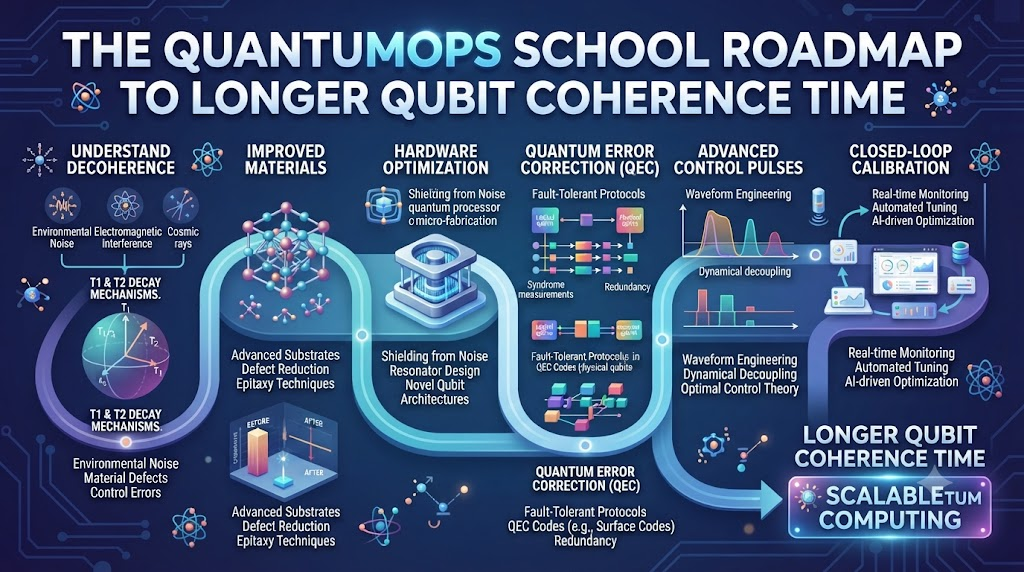
In this guide, you will learn what decoherence is and why it happens. You will also learn how to manage it. We use plain words and short steps. No physics degree is needed. You will get ten case stories, ten common mistakes, and a ten-step roadmap you can start this week.
What Is Decoherence? The Short Answer
Decoherence is the loss of quantum behavior in a qubit. It happens when the qubit interacts with its surroundings. The qubit stops acting like a delicate quantum object. It starts acting like a plain on-or-off bit with random errors.
A qubit can hold a blend of 0 and 1 at the same time. Scientists call this a superposition. The blend is useful, but it is fragile. Heat, stray signals, or a tiny vibration can disturb it.
Once disturbed, the blend fades. The information leaks into the environment. You cannot get it back.
Engineers also use the word “coherence” for the healthy state. Longer coherence means your qubit stays useful for more time. That extra time lets you run more steps in your circuit.
Why Qubits Are So Fragile
A normal bit is tough. It sits at 0 or 1, and small noise rarely flips it. A qubit works differently. It relies on phase. Phase is the timing relationship inside the blend of 0 and 1.
Noise can nudge that phase. A small nudge today becomes a big error after a hundred steps. That is why quantum machines feel so touchy.
Entanglement adds more risk. When two qubits link up, one disturbed qubit can spoil the whole group. So bigger machines need even more care.
Picture a spinning coin on a table. It spins well for a few seconds. Then friction slows it, and it falls flat. Decoherence is the friction. Your job is to keep the coin spinning long enough to finish the work.
The Main Causes of Decoherence
Several enemies attack your qubits at once. Let’s meet them.
Heat and Thermal Noise
Heat makes atoms jiggle, and that jiggle disturbs qubits. Superconducting machines sit in a dilution refrigerator at about 10 to 20 millikelvin. That is colder than outer space. Even then, a few stray bits of heat can cause trouble.
Electromagnetic Noise
Radio waves, power lines, and cables all carry stray signals. Your own control wires also bring noise into the fridge. So labs use filters and metal shielding to block it.
Material Defects
Chips are not perfect. Tiny flaws on the surface can trap energy and steal it from the qubit. Cleaner fabrication reduces this problem.
Control Errors and Crosstalk
Your own pulses cause errors too. A pulse that is slightly off in timing or strength leaves the qubit in the wrong state. Also, a pulse aimed at one qubit can leak into its neighbor. We call that crosstalk.
Cosmic Rays and Radiation
High-energy particles can hit a chip and disturb many qubits at once. Researchers have seen these events in superconducting chips. Some labs now study shielding and even underground sites.
T1 and T2: The Two Clocks You Must Know
Every quantum team tracks two numbers. They tell you how fast a qubit fades.
T1 is the energy relaxation time. It measures how long a qubit stays in the 1 state before it falls back to 0. Think of a battery that slowly leaks charge.
T2 is the dephasing time. It measures how long the phase stays steady. Think of a clock that slowly drifts out of time.
T2 can never be longer than twice T1. So T2 is often the number that limits you.
Here is a simple rule. Compare your coherence time to your gate time. Say each gate takes 50 nanoseconds, and T2 is 100 microseconds. You get about 2,000 gate steps before the signal fades. Real results land lower, because other errors add up. Still, this ratio gives you a quick feel for your budget.
Coherence Time Across Different Qubit Types
Each hardware type fades at a different speed. Here are rough, typical ranges from published research. Real numbers change by device, so always check your own data.
| Qubit Type | Typical Coherence Time | Gate Speed | Main Strength | Main Weakness |
|---|---|---|---|---|
| Superconducting | Tens to hundreds of microseconds | Very fast (nanoseconds) | Fast gates, chip-style builds | Needs extreme cold, material noise |
| Trapped ion | Seconds or longer in labs | Slower (microseconds) | Very long coherence, high accuracy | Slow gates, hard to scale |
| Neutral atom | Up to seconds with special methods | Medium | Large arrays are easier to build | Atom loss, slower cycles |
| Silicon spin | Milliseconds to seconds | Fast to medium | Fits chip factory methods | Tiny signals, tricky wiring |
| Photonic | Photons do not fade with time, but they get lost | Very fast | Many parts work at room temperature | Photon loss, hard to link |
Longer coherence does not always mean a better machine. Speed matters too. A fast qubit with a short life can do as much as a slow qubit with a long life. What counts is the ratio of coherence time to gate time.
How Decoherence Hurts Your Algorithms
Every gate takes time. Every moment of waiting lets noise creep in. So deeper circuits suffer most.
Imagine passing a message down a long chain of friends. Each friend adds a small mistake. After 100 friends, the message is a mess. Quantum circuits work the same way.
This is why many near-term algorithms use short circuits. It is also why qubit count alone is a weak score. A chip with 100 noisy qubits may do less than a chip with 20 clean ones.
Errors also grow as you add qubits. More qubits mean more gates and more neighbors that can disturb each other. So you must watch quality, not only quantity.
Fix 1: Hardware-Level Protection
The strongest fix starts with the machine itself.
Cold helps. Labs use dilution refrigerators to cool chips. Less heat means less jiggle.
Shielding helps. Layers of metal block stray fields, and special filters stop noise on control wires.
Better materials help. Teams now use cleaner metals and smoother surfaces. The transmon design came about largely to cut one kind of noise.
Isolation helps too. Engineers mount fridges on vibration dampers and keep noisy pumps away from the chip.
This layer costs a lot and changes slowly. Most operations teams cannot redesign a chip. But you can track the lab environment, and that leads to the next layer.
Fix 2: Control-Level Tricks
You can fight noise with smart control signals.
Dynamical Decoupling
You send quick pulses to a qubit while it waits. These pulses flip the qubit again and again. The flips cancel slow noise. Think of a rotisserie. Turning the food keeps the heat from hitting one side only. Spin echo is the simplest version, and it can raise effective T2 a lot.
Smarter Pulses
Pulse shaping makes your signals smoother and cleaner. Good shapes cut leaks to neighbor qubits. Teams use methods such as DRAG pulses for this job.
Regular Calibration
Qubits drift. T1 can change from morning to night. So you must re-tune often. Many teams run quick checks every few hours and full tune-ups each day.
Fix 3: Software-Level Help
You can also manage noise in code. We call this error mitigation. It does not remove noise. It reduces the effect on your final answer.
First, pick better qubits. Not all qubits on a chip are equal. Choose the ones with the best T1, T2, and gate scores today.
Next, compile smart. A good compiler cuts gate count and circuit depth. Fewer gates leave less time for noise.
Then, correct readout. Measurement errors are common. You can measure known states and use that data to fix your results.
You can also try zero-noise extrapolation. You run the same circuit at a few higher noise levels. Then you estimate the answer at zero noise.
Mitigation has a price. It needs extra runs, and the cost often grows fast with circuit size.
Fix 4: Quantum Error Correction
Error correction is the long-term cure. It spreads one logical qubit across many physical qubits. Then it checks for errors again and again and fixes them as they appear.
The idea sounds simple, but it needs many qubits. Estimates often reach hundreds or thousands of physical qubits per logical qubit. The exact number depends on how noisy your hardware is.
There is good news. In 2024, Google reported results where a larger error-correcting code cut errors instead of adding more. That was a key milestone. It showed the approach can work once physical qubits are good enough.
So decoherence is not a wall you cannot climb. It is a cost you pay down, layer by layer.
Comparing Your Four Options
| Method | What It Does | Cost | Best For | Main Limit |
|---|---|---|---|---|
| Hardware protection | Lowers noise at the source | Very high | Chip makers and lab builders | Slow to change |
| Dynamical decoupling | Cancels slow noise while qubits wait | Low | Idle qubits and long waits | Does not fix gate errors |
| Error mitigation | Cleans up the final answer | Medium | Today’s short circuits | Extra runs grow fast |
| Error correction | Finds and fixes errors live | Very high | Future large machines | Needs many qubits |
Notice the pattern. You can mix these layers. Most real teams use all four, and they start with the cheap ones first.
Real-World Stories: When Quantum Jobs Crash Because of Decoherence
These are common scenarios that quantum teams report. We kept the details general.
- The Morning Drift: A team ran a test at 9 a.m. and got great results. The same job failed at 3 p.m. because T1 on two key qubits had dropped. They now check calibration data before every big run.
- The Poor Thermal Contact: After fridge maintenance, qubits looked fine alone but failed in pairs. A loose thermal contact on one line caused extra heat. Fixing the contact restored normal results.
- The Noisy Neighbor: Two qubits side by side kept spoiling each other’s gates. The team moved the circuit to a pair that sat far apart. Errors dropped at once.
- The Cosmic Ray Burst: Many qubits failed at the same moment, then recovered. The team flagged the event and threw out those shots. Their final data came out clean.
- The Deep Circuit Trap: A student wrote a very deep circuit, and the output looked random. A better compiler cut the depth by almost half. The expected pattern then appeared.
- The Pump Vibration: A new pump near the lab raised noise on the chip. Engineers moved the pump and added vibration dampers. Coherence times rose again.
- The Wrong Qubit Pick: The default mapping chose a qubit with a weak T2. The team picked qubits by fresh scores instead. Their success rate jumped.
- The Idle Time Problem: Some qubits waited while others finished measurements. That wait cost them their phase. Adding dynamical decoupling pulses raised the final score.
- The Missing Filter: One control line had no noise filter. Stray signals kept dephasing a qubit. A simple filter lifted its T2.
- The Skipped Calibration: A team skipped full calibration to save time. Errors built up all week. The lost debug time was far longer than the time they saved.
Metrics to Track Every Day
Good teams treat coherence like server health. You watch it daily, and you act on trends.
| Metric | What It Tells You | How Often to Check | Warning Sign |
|---|---|---|---|
| T1 | How fast energy leaks | Daily | Big drop from your baseline |
| T2 | How steady the phase stays | Daily | Sudden drop or wild swings |
| Single-qubit gate error | Pulse quality | Daily | Rising trend |
| Two-qubit gate error | Link quality | Daily | Jump on one pair |
| Readout error | Measurement quality | Daily | Error above baseline |
| Fridge temperature | Heat level | Constantly | Any unplanned rise |
Keep a simple log. A trend line tells you more than a single number. So record values at the same times each day.
Common Mistakes and Pitfalls
- Trusting qubit count alone. A big number hides weak qubits. Check T1, T2, and gate error before you pick a machine.
- Using old calibration data. Qubits drift within hours. Pull fresh data before each run.
- Ignoring idle time. Waiting qubits still lose phase. Add dynamical decoupling or shorten the waits.
- Writing very deep circuits. Each extra layer adds noise. Simplify, compile well, and test small first.
- Picking qubits by number. Qubit 0 is not special. Choose by current quality scores.
- Watching only T1. T2 often limits you more. Track both clocks.
- Skipping readout checks. Measurement errors fool you easily. Calibrate readout and correct your counts.
- Over-trusting mitigation. It can hide problems or add bias. Test it on circuits with known answers.
- Not logging the environment. You cannot link a failure to a cause without data. Log temperature, time, firmware, and vibration events.
- Changing many things at once. You will not know what helped. Change one thing per test.
Step-by-Step Implementation Roadmap
- Set your goal. Decide what you want to run. Write down the circuit depth you need.
- Collect baseline numbers. Record T1, T2, gate errors, and readout errors. These numbers become your yardstick.
- Start a daily log. Note the date, time, device, and key metrics. Add lab events such as maintenance.
- Choose your best qubits. Rank qubits by current scores. Map your circuit to the top group.
- Shrink your circuit. Use a good compiler. Remove gates that do not change the answer.
- Add dynamical decoupling. Place it on idle qubits. Test with and without it, and compare.
- Fix readout errors. Measure known states. Use the data to correct your counts.
- Test on known answers. Run simple circuits where you already know the result. Confirm your setup works before real jobs.
- Add error mitigation. Use it only where needed. Track the extra cost in runs and time.
- Review every week. Check trends, update your baseline, and start learning error correction basics.
FAQs
1. What is decoherence in simple words?
Decoherence is when a qubit loses its quantum state because it interacts with its surroundings. The qubit stops holding a useful blend of 0 and 1. It starts acting like a normal bit with random errors. Heat, noise, and flaws all cause it.
2. What causes decoherence in quantum computers?
Many things cause it. The main causes are heat, stray electromagnetic signals, tiny material defects, control pulse errors, crosstalk between qubits, and radiation such as cosmic rays. Most machines face several of these at once, so teams fight noise on many fronts.
3. What is the difference between T1 and T2?
T1 measures how long a qubit holds its energy before it falls from 1 to 0. T2 measures how long its phase stays steady. T2 cannot exceed twice T1. In practice, T2 often limits how deep your circuit can go.
4. How long do qubits stay coherent?
It depends on the hardware. Superconducting qubits typically last tens to hundreds of microseconds. Trapped ions can last seconds or longer in labs. Silicon spin and neutral atom qubits fall in between. Always compare coherence time to gate time, not alone.
5. Can we stop decoherence completely?
No. You cannot remove it, because no qubit is fully isolated. But you can slow it with cold temperatures, shielding, and better materials. You can also reduce its effects with control tricks, software methods, and error correction.
6. How does decoherence affect quantum algorithms?
It adds errors as your circuit runs. Deeper circuits face more noise, so the final answer gets less reliable. Past a certain depth, results look random. That is why short circuits and clean qubits matter so much today.
7. What is dynamical decoupling?
It is a method that sends quick pulses to a waiting qubit. The pulses flip the qubit again and again. These flips cancel slow noise that would otherwise ruin the phase. It costs little and works well on idle qubits.
8. What is the difference between error mitigation and error correction?
Error mitigation cleans up your final answer using extra runs and math. It does not fix the qubits. Error correction spreads one logical qubit across many physical qubits and fixes errors live. Mitigation helps today. Correction is the long-term goal.
9. Why do quantum computers need to be so cold?
Heat makes atoms jiggle, and that jiggle disturbs qubits. Superconducting chips work at about 10 to 20 millikelvin to cut this noise. Cold temperatures also let their circuits behave in a quantum way. Other qubit types use different cooling methods.
10. How can a beginner start managing decoherence?
Start by reading your device’s T1, T2, and error data each day. Pick your best qubits, keep circuits short, and add dynamical decoupling to idle spots. Test on known answers. Then log your results and watch for trends.
Final Recommendation and Next Steps
Decoherence will never vanish. But you can manage it with simple habits. Start with the cheap layers: fresh data, smart qubit picks, shorter circuits, and idle-time protection.
Next, build a daily log. It turns a mystery into a pattern. After two weeks, you will spot drift, noisy hours, and weak qubits before they ruin a run.
Then add mitigation tools one at a time. Test each on a known answer. If a tool does not help, drop it. Honest testing beats clever tricks.
Finally, keep learning. Error correction is moving from theory to real experiments. Teams that understand decoherence today will be ready when large, fault-tolerant machines arrive. Take the ten-step roadmap above, pick step one, and start today.