Introduction
When you picture a quantum computer today, you probably imagine a massive, golden chandelier hanging inside a freezing cold laboratory. Most of the big technology companies are fighting to build the coldest machines on Earth, cooling their metal processors to temperatures that are actually colder than deep space. They do this because the tiny particles carrying quantum information are incredibly fragile. Any stray heat or background noise will destroy the calculations instantly, causing the computer to fail. But what if we do not need to freeze anything at all to achieve this incredible computing power?
A few brilliant engineers and scientists are taking a completely different approach by looking up at the light. Instead of using freezing metal and electricity to build these machines, they are designing processors that use tiny particles of light to do the math. If you want to learn more about the broader ecosystem of these incredible machines and the industry behind them, you can visit Quantumopsschool to explore. Right now, though, we are going to focus entirely on how these light-based hardware systems operate on a physical level.
This new approach is known as photonic quantum computing, and it promises to solve some of the biggest physical problems holding back the technology industry today. In this comprehensive guide, we are going to explore exactly how this works from the ground up. You do not need a degree in advanced physics to understand it. By the end of this article, you will know exactly what a photonic quantum computer is, why using light changes everything, and how lasers and glass are being used to build the future of technology.
Why Use Light to Build a Computer?
To understand why anyone would want to use light to build a computer, we first need to understand what light actually is. If you take a bright beam of light and break it down into its absolute smallest possible piece, you get a “photon.” A photon is simply a tiny, invisible particle of light. It has no physical mass, and it travels at the fastest speed allowed by the laws of physics: the speed of light. Because photons are so incredibly fast and weightless, they are the perfect messengers for carrying information from one place to another.
In fact, you are already using photons to read this article right now. The entire global internet runs on fiber optic cables. These cables are essentially long glass tubes buried underground and stretched under the oceans. Lasers shoot rapid pulses of light through these tubes to send emails, stream videos, and load websites around the world. Because light does not easily interact with its physical surroundings, a photon can travel for hundreds of miles through a glass cable without losing the information it carries. Photonic quantum computing takes this exact same proven concept and applies it to complex quantum math.
In standard quantum computers, the tiny bits of data are called qubits. In traditional designs, these qubits are made from artificial atoms or special electronic circuits. These physical parts are painfully sensitive. If they bump into each other, feel a tiny magnetic field, or experience a slight change in room temperature, the computer crashes and the data is lost. Photons, on the other hand, do not care about heat. They also mostly ignore each other. Two beams of light can cross right through one another without crashing or changing direction, making them incredibly stable.
This stability makes the photon a nearly perfect vehicle for delicate quantum information. You can pack thousands of photons into a tiny space, send them flying through a physical processor, and trust that they will hold onto their data securely. Using light means we can use the exact same principles that power the modern fiber-optic internet to build a machine capable of solving mathematical puzzles that would take a normal computer millions of years to crack.
How a Photonic Quantum Computer Actually Works
Now that we know why light is so incredibly useful, let us look at the physical machine itself. Instead of a giant freezing chandelier, a photonic quantum computer looks much more like a standard server you would find in any office data center. However, the processor inside that server is a microscopic maze of glass and silicon.
Firing the Photons
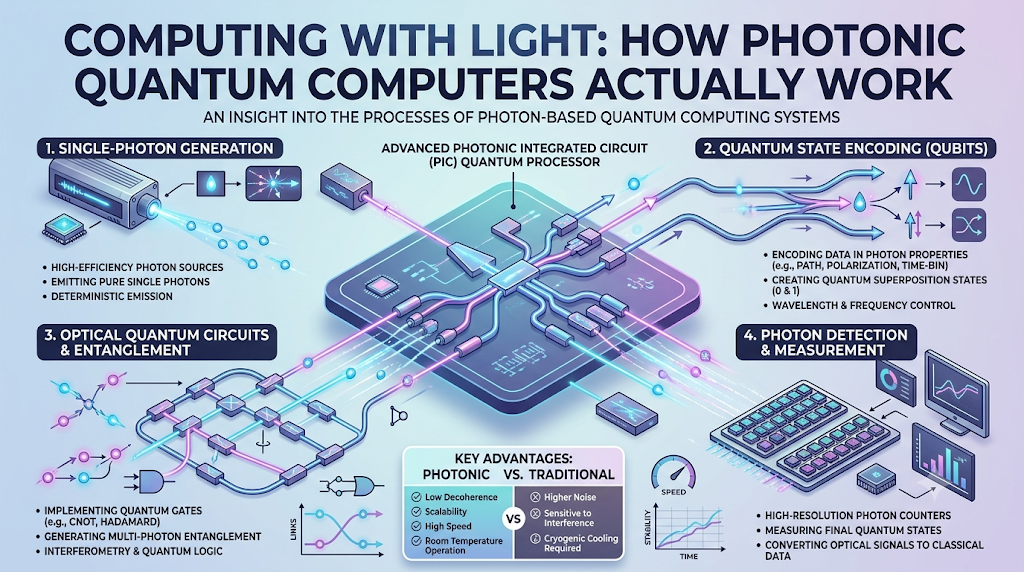
Everything in this machine starts with a very special kind of laser. This is not the type of laser pointer you use during a presentation or to play with a pet. This industrial laser is designed to shoot out exactly one single photon at a time. Getting a laser to release just one single particle of light on command is incredibly difficult, but it is the critical starting line for the computer.
These individual photons are fired into thin channels that act like microscopic fiber optic cables. These tiny glass-like channels are printed directly onto a small computer chip. Each individual photon that gets fired into these channels carries a piece of quantum data, acting as a single, light-based qubit.
The Microscopic Maze of Mirrors
Once the single photons are successfully inside the computer chip, they enter the actual processor. You can think of this processor as an extremely complex, microscopic obstacle course or a maze. The pathways are made of tiny silicon structures, optical splitters, and programmable mirrors. As a photon travels forward through this maze, it constantly hits these microscopic intersections.
Depending on how the engineers have tuned the mirrors, the photon might go left, go right, or—thanks to the strange and wonderful rules of quantum physics—it might actually go both ways at the exact same time. When you want the computer to solve a specific problem, you are basically rearranging the walls of this maze. You adjust the physical splitters and pathways so that when the photons travel through, they interact with the maze in a pattern that represents your complex mathematical equation.
Because photons travel at the speed of light, they do not take long to complete the course. They zoom through this entire microscopic obstacle course, bouncing off mirrors and traveling through splitters, in a tiny fraction of a second. The way they navigate the maze is the actual mathematical calculation happening in real-time.
Reading the Final Light Signal
After the photons have navigated the entire maze, they finally reach the finish line. At the very end of the silicon chip, there are highly sensitive light detectors. These detectors act like the eyes of the computer. They catch the photons exactly as they exit the maze and record precisely where they landed and when they arrived.
The pattern of light hitting these detectors at the finish line is the final answer to the math problem. By simply counting the photons at the exit and recording their final positions, engineers can read the results of calculations that are far too complex for normal supercomputers to ever handle.
Comparing Photonic Qubits vs. Superconducting Qubits
To truly appreciate how different this light-based approach is, we need to compare it to the current industry standard. Most major tech companies today are building “superconducting” quantum computers, which use electricity and freezing cold metals. Here is how the two technologies stack up against each other:
| Feature | Photonic (Light-Based) Computer | Superconducting (Cold Metal) Computer |
|---|---|---|
| Operating Temperature | Room Temperature | Absolute Zero (Colder than deep space) |
| What Carries the Data | Photons (Tiny particles of light) | Electrons (Electrical current) |
| The Biggest Manufacturing Challenge | Creating single photons perfectly on demand | Keeping the machine perfectly cold and quiet |
As you can clearly see from the comparison table, these two methods are entirely different worlds. Superconducting computers rely on electrons flowing through special metals. The main problem is that electrons are easily disturbed by their environment. Any tiny amount of environmental heat will create thermal “noise” that immediately ruins the calculation. This is precisely why those computers must be kept at absolute zero using massive refrigeration systems.
Photonic computers, on the other hand, rely entirely on particles of light, which do not feel environmental heat in the same way. The challenge with building a light-based machine is not keeping it cold, but rather creating the light perfectly in the first place and keeping it physically contained within the tiny glass pathways of the chip.
The Massive “Room Temperature” Advantage
The simple fact that photonic computers can operate at room temperature changes absolutely everything about how we might use them in the real world. Right now, building a superconducting quantum computer requires an enormous machine called a dilution refrigerator. These refrigerators are massive, highly complex, and cost millions of dollars just to purchase and run. They require rare cooling gases, specialized plumbing, and constant, daily maintenance by trained technicians.
Because of this extreme cooling requirement, you cannot simply put a normal quantum computer in a regular office building or a standard data center. You usually have to build a custom facility just to house the refrigerator itself. This makes the technology very exclusive and very expensive, severely limiting who gets to use it, who can buy it, and where it can be physically installed.
Photonic quantum computers completely remove this massive physical barrier. Because light does not need to be frozen to maintain its delicate quantum state, you can run a photonic chip at normal room temperature. You could theoretically hold the active quantum processor in the palm of your hand without wearing a winter coat or protective gloves.
This means that in the near future, these light-based processors could be placed right next to standard computer servers in normal commercial data centers. Companies will save millions of dollars on energy and cooling costs alone. It also means the computers can be made much smaller. Without a giant refrigerator taking up an entire room, a powerful quantum computer could eventually be the size of a standard desktop tower, making the technology far more accessible to businesses, hospitals, and researchers everywhere.
The Biggest Hurdles in Trapping Light
While running at room temperature sounds absolutely perfect, photonic computing is not without its own massive challenges. If building one were easy, every technology company in the world would be doing it. The truth is, light is very hard to control at a microscopic level, and scientists are still trying to figure out how to completely master it.
The first major hurdle is generating the photons. For this kind of computer to work properly, you need a light source that produces exactly one single photon at a time, over and over again, perfectly on cue. If the laser accidentally shoots two photons instead of one, or misses a beat and shoots zero photons, the entire math equation will be wrong at the finish line. Building a laser that acts like a perfect gumball machine, dispensing exactly one identical photon every single time you ask for it, is an incredibly difficult engineering problem.
The second massive problem is keeping the light trapped safely inside the microscopic maze. While photons do not care about room temperature, they are very prone to simply escaping. As the light travels through the tiny glass-like pathways and hits the microscopic programmable mirrors, there is always a small chance that a photon will just bounce the wrong way and leak entirely out of the silicon chip.
When a photon leaks out and disappears into the room, the data it was carrying is lost forever. In the industry, this is known as “photon loss.” If too many photons get lost in the maze before reaching the finish line, the computer simply cannot finish the calculation. Engineers are constantly testing new manufacturing techniques and materials to build better, tighter pathways that can trap the light securely from the starting line all the way to the finish line without dropping any precious data along the way.
Conclusion
Building a computer entirely out of light sounds like science fiction, but it is a reality happening right now in laboratories all over the world. By stepping away from the freezing cold temperatures and delicate metals of early quantum designs, scientists are discovering a brand new path forward. Photonic quantum computers take the exact same brilliant concept that powers our global fiber-optic internet—sending data safely through light—and apply it to the most complex math problems known to humanity.
There are certainly still many hurdles to overcome, from generating perfect single particles of light to ensuring they never leak out of their microscopic glass mazes. However, the promise of a room-temperature quantum computer is simply too powerful to ignore. As engineers continue to refine the lasers, the silicon chips, and the optical detectors, the dream of having a compact, light-powered supercomputer sitting inside a standard data center is slowly becoming a reality. The future of computing might not be freezing cold after all; it might just be built entirely on light.
FAQs
1. What is a photonic quantum computer?
It is an advanced type of computer that uses tiny particles of light to process and solve complex mathematical equations, rather than using electricity.
2. What exactly is a photon?
A photon is the smallest possible particle of light. It is invisible, has no physical weight, and travels at the speed of light.
3. Do photonic quantum computers need to be frozen?
No, unlike other quantum computers, photonic computers can operate at normal room temperature because light is not easily affected by environmental heat.
4. Why do normal quantum computers need to be so cold?
Normal quantum computers use metal and electricity, and any heat creates “noise” that destroys their delicate calculations, so they must be kept colder than deep space.
5. How does a photon actually do math?
Photons are fired through a microscopic maze of mirrors on a computer chip; the way they navigate this maze and reach the exit provides the answer to the mathematical problem.
6. How fast do photonic quantum computers operate?
Because the data is carried by physical light, the information travels through the computer processor at the speed of light, making the actual processing time incredibly short.
7. What happens if a photon gets lost in the computer?
If a photon leaks out of the microscopic maze, the data it was carrying is destroyed, which is one of the biggest challenges engineers are currently trying to fix.
8. What is a qubit?
A qubit is the basic unit of information in quantum computing, similar to a “bit” in a normal computer. In a photonic computer, a single photon acts as a single qubit.
9. Can I buy a photonic quantum computer today?
Not yet. They are still in the experimental and developmental stages in laboratories, but they are getting closer to commercial reality.
10. How will photonic computers change the future?
Because they operate at room temperature, they will make quantum computing much cheaper, smaller, and easier to install in normal data centers across the world.