Introduction
Modern cloud platforms run smoothly because we build solid pipelines to test, deploy, and monitor our code. Quantum processors now need that exact same operational discipline to deliver steady results.
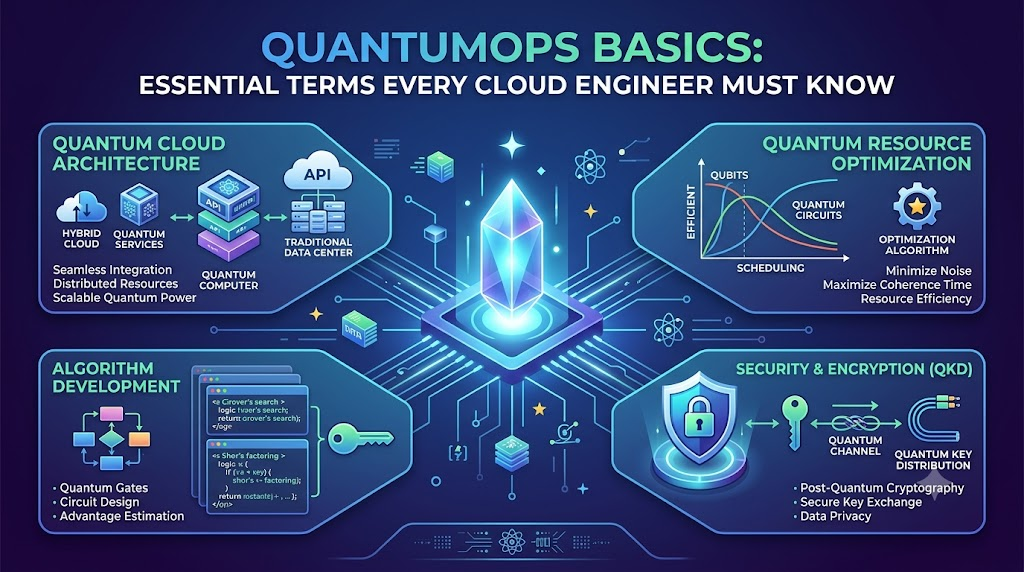
QuantumOps brings familiar DevOps ideas to quantum systems. It unites ordinary cloud servers with quantum hardware so your business workflows run without friction.
If you want a dedicated place to learn these concepts step by step, QuantumOpsSchool.com provides hands-on learning resources built directly for cloud engineers, developers, and tech teams.
In this guide, you will explore the primary pillars of quantum operations, review essential terminology in plain English, and learn how to build your very first hybrid pipeline.
Simple Definition & Basics
QuantumOps is the practice of building, running, and monitoring hybrid software pipelines that link classical cloud servers with quantum processors. It ensures your quantum jobs run smoothly, stay within budget, and return clean data.
Standard operations setups cannot handle quantum chips by themselves. Quantum hardware experiences heat shifts, magnetic noise, and quick state decay, requiring specialized monitoring tools that traditional cloud dashboards simply do not have.
6 Core Pillars of Quantum Operations
1. Hybrid Job Scheduling
- Smart Resource Routing: Your pipeline decides which tasks run on standard virtual machines and which go to quantum chips.
- Queue Management: It monitors vendor wait times to send urgent jobs to the fastest open hardware.
- Automatic Retries: If a quantum processor goes offline, the scheduler moves the job to a backup device.
2. Circuit Optimization
- Step Reduction: Operational tools compress quantum instructions to make them run faster.
- Hardware Matching: The pipeline rewrites instructions so they fit the exact chip layout.
- Resource Conservation: Shorter run times save money and lower the chance of signal errors.
3. QPU Calibration Tracking
- Daily Drift Monitoring: Engineers record how physical chips respond to changing lab temperatures.
- Error Rate Tracking: Automation alerts you when a chip passes safe error boundaries.
- Health Scoring: Real-time metrics tell your dispatch script if a processor is ready for production work.
4. Error Mitigation
- Noise Filtering: Mathematical routines clean up raw output before sending it back to your app.
- Baseline Zeroing: The setup runs test samples to measure background static.
- Result Sharpening: Software filters separate real signals from random machine noise.
5. Cloud Access Pipelines
- Identity Management: Secure tokens keep track of who accesses expensive quantum hardware.
- Vendor Agnostic APIs: Universal connectors let you switch quantum cloud vendors without rewriting code.
- Continuous Integration: Automated tests run code on simulators before pushing jobs to real hardware.
6. Resource Cost Monitoring
- Per-Shot Budgeting: Alerts fire when your team nears its planned run limits.
- Usage Tagging: Finance teams see which project ran which quantum circuit.
- Idle Time Elimination: Workflows batch tasks together to make every second on the hardware count.
Core Terminology For QuantumOps Beginners
Qubit (Quantum Bit)
A normal computer bit is like a light switch that is either on or off, representing a 0 or a 1. A qubit is like a spinning coin that can represent multiple states at once until you stop it and look at it.
This special trait lets a group of qubits test many combinations at the exact same moment.
QPU (Quantum Processing Unit)
A CPU runs your operating system, and a GPU handles graphics and machine learning. A QPU is the physical chip built specifically to run quantum calculations.
You can think of the QPU as a specialized coprocessor that your cloud server calls only when it faces a heavy math challenge.
Decoherence & Noise
Decoherence happens when a qubit loses its fragile quantum state and turns into a normal bit. Noise is the environmental disturbance that causes this loss, such as heat, tiny vibrations, or stray radio signals.
Imagine trying to balance a pencil on its sharp tip while someone bumps the desk; the bump is the noise, and the pencil falling over is decoherence.
Quantum Circuit & Gates
A quantum circuit is a sequence of instructions arranged step by step across time. Quantum gates are the individual commands within that circuit that manipulate the qubits.
Think of a circuit as a musical sheet, where the lines are qubits and the notes are gates guiding the performance from start to finish.
Hybrid Classical-Quantum Workflow
Most modern quantum programs do not run completely on a quantum chip. Instead, a classical cloud server manages the data, sends a hard loop of math to the QPU, gets the answer, and refines the next step.
It operates like a chief chef in a busy kitchen who hands one tricky pastry task to a specialist baker while managing the rest of the meal.
Quantum Transpilation
Your team writes quantum instructions in a high-level language, but the physical chip might not have physical wires connecting every qubit. Transpilation rewrites your code so it runs perfectly on that specific chip layout.
It acts like an editor who adapts a script to match the exact number of actors and stage doors available in a local theater.
Shot Count & Sampling
Because quantum hardware deals with probabilities, running a circuit once does not give you a final answer. You run the same circuit many times—each run is called a “shot”—to build a clear statistical picture.
Think of it like rolling a pair of dice a thousand times to confirm how often you land on seven.
QuantumOpsSchool.com Guide to Learning QuantumOps
You do not need access to million-dollar hardware in a physics laboratory to begin practicing quantum operations. Cloud providers offer free simulators that mimic quantum chips on top of ordinary virtual servers.
Start by installing an open-source quantum development kit on your local computer or cloud shell. Write a basic two-qubit script, send it to a local simulator, and inspect the resulting output table.
Next, build a lightweight automation script that checks the status of your simulated job. Practice capturing output logs, measuring execution time, and catching connection timeouts.
Finally, practice setting up basic alerts. Trigger a notification if your simulated circuit uses too many steps or if your error rates drift too high.
Real-World Applications
- Logistics Route Planning: Shipping networks run hybrid loops to find the best delivery paths across thousands of trucks, cutting fuel costs.
- Materials Discovery: Chemical manufacturers use QPUs to model molecular bonds, speeding up the creation of lighter batteries.
- Financial Risk Models: Trading firms analyze market swings by testing complex scenarios faster than classical server clusters can.
- Clean Energy Optimization: Power grid teams test load distributions to route wind and solar energy into cities with minimal power loss.
Comparison Table
| Feature | Classical DevOps | QuantumOps |
| Compute Unit | Transistor, CPU, GPU | Qubit, QPU |
| Error Nature | Rare bit flips, software bugs | Physical noise, quick decoherence |
| Execution Model | Deterministic or direct code | Probabilistic, statistical samples |
| Pipeline Output | Exact pass/fail test results | Probability distributions from shots |
| Main Operational Goal | Continuous delivery and uptime | Error reduction and QPU cost management |
Why Learning QuantumOps Terms Matters
Understanding these terms gives software engineers and system administrators an early advantage as quantum services enter main cloud platforms.
When you speak the language of quantum operations, you can design better cloud pipelines, choose the right mix of servers, and prevent costly run mistakes.
Tech leads also gain the clarity needed to evaluate quantum cloud vendors without getting lost in academic jargon.
Common Beginner Stumbling Blocks & How to Fix Them
- Expecting a Single Exact Answer: Beginners often assume a run produces one definitive number.Fix: Remember that quantum runs are statistical; always review the aggregated results across your total shot count.
- Ignoring Hardware Queue Latency: Sending a job to a live QPU can involve long wait times in vendor queues.Fix: Use cloud simulators for unit testing and save physical QPU runs for final validation checks.
- Overlooking Circuit Depth: Beginners write deep circuits that take too long to run, causing the qubits to decay mid-job.Fix: Run your code through a transpiler tool first to verify your circuit steps stay short and clean.
5 Easy Steps to Build Your First Hybrid Quantum Pipeline
- Set Up an Open-Source SDK: Install a widely supported quantum development toolkit in your local developer environment.
- Draft a Simple Circuit: Write a simple script with two qubits and a single measurement gate.
- Run on a Local Simulator: Execute the circuit across 1,000 shots on your local machine to verify the math works.
- Wrap in an Automation Script: Create a simple pipeline file that runs the code automatically on every new commit.
- Parse and Store the Metrics: Write the shot distribution and run duration to a local dashboard or text log for review.
Emerging Career Paths in Quantum Operations
- Quantum Operations Engineer: Manages everyday pipelines connecting traditional servers to physical quantum hardware.
- Hybrid Cloud Architect: Designs safe, fast networks that distribute tasks between classical clusters and quantum devices.
- Quantum Systems Administrator: Monitors hardware calibration data, manages cloud credentials, and tracks team run times.
- Quantum Software Tester: Tests quantum scripts across various simulators to catch layout issues before production runs.
- Quantum Pipeline Specialist: Streamlines circuit transpilation steps to lower cloud expenses and improve output fidelity.
Future Trends in Quantum Operations
- Fault-Tolerant Quantum Hardware: Systems will bundle many physical qubits into error-free logical qubits, simplifying operations.
- Automated Circuit Compilation: Modern pipelines will optimize circuit depth on the fly without manual tuning.
- Serverless Quantum Jobs: Developers will send tasks into the cloud without managing specific device connections or queue states.
- Integrated Observability Dashboards: Standard monitoring suites will display QPU calibration metrics alongside CPU server health.
Common Myths Debunked
- Myth 1: Quantum computers will replace all normal servers.Reality: Quantum chips act as specialized accelerators; standard servers will always handle databases, web pages, and file systems.
- Myth 2: You must hold an advanced physics degree to work in QuantumOps.Reality: Operations teams focus on networking, scripting, queue handling, and monitoring rather than raw hardware physics.
- Myth 3: Quantum software runs entirely without errors.Reality: Today’s quantum hardware is sensitive to noise, making error mitigation an essential operational task.
- Myth 4: Quantum computers give immediate answers to every problem.Reality: Quantum machines excel at specific mathematical problems, but they require repeated shots to build statistical answers.
Frequently Asked Questions
1. What is the main goal of QuantumOps?
The main goal is to build reliable software pipelines that connect standard cloud servers to quantum hardware. It ensures that quantum workloads run efficiently, return valid data, and remain cost-effective.
2. How does a QPU differ from a standard CPU?
A CPU handles everyday calculations sequentially using normal binary bits. A QPU uses quantum properties to evaluate complex mathematical relationships all at once.
3. What does decoherence mean in daily operations?
Decoherence is the loss of quantum information caused by heat, noise, or physical interference. In operations, it means your job failed or produced scrambled output because the qubits decayed too early.
4. Why do we need to specify a shot count?
Quantum circuits produce answers based on probabilities rather than single numbers. Running multiple shots provides enough samples to reveal the true statistical answer.
5. Can I practice QuantumOps without paying for real quantum hardware?
Yes, you can run all your early tests on free cloud simulators. Simulators run on ordinary servers and mimic quantum behavior without hardware costs.
6. What is the role of transpilation in a deployment pipeline?
Transpilation rewrites your high-level code to match the physical wiring and gate capabilities of a specific chip. It ensures your circuit runs smoothly on the target hardware.
7. Is QuantumOps only useful for large enterprises?
Small teams and research labs use these methods to keep their cloud bills under control. Anyone running quantum experiments benefits from structured pipelines and monitoring.
8. What programming languages are common in QuantumOps?
Python is the standard language for writing quantum scripts and operational pipelines. Bash, YAML, and container scripts are also widely used to automate workflows.
9. How do operations teams monitor quantum hardware health?
Teams monitor calibration logs, background noise levels, and gate error rates published by quantum cloud vendors. These metrics show whether a chip is ready for reliable execution.
10. What is a hybrid classical-quantum workflow?
It is a setup where classical cloud servers and quantum chips work together as a team. The classical system prepares the data, the quantum chip runs the intensive math, and the classical system interprets the results.
Every major leap in computing requires practical, steady engineers who know how to keep systems running smoothly. As quantum hardware continues to mature, teams that understand how to manage, monitor, and optimize these unique workflows will lead the next phase of cloud computing. Exploring the learning guides on QuantumOpsSchool.com is a great way to build your practical skills and stay ahead in modern operations.