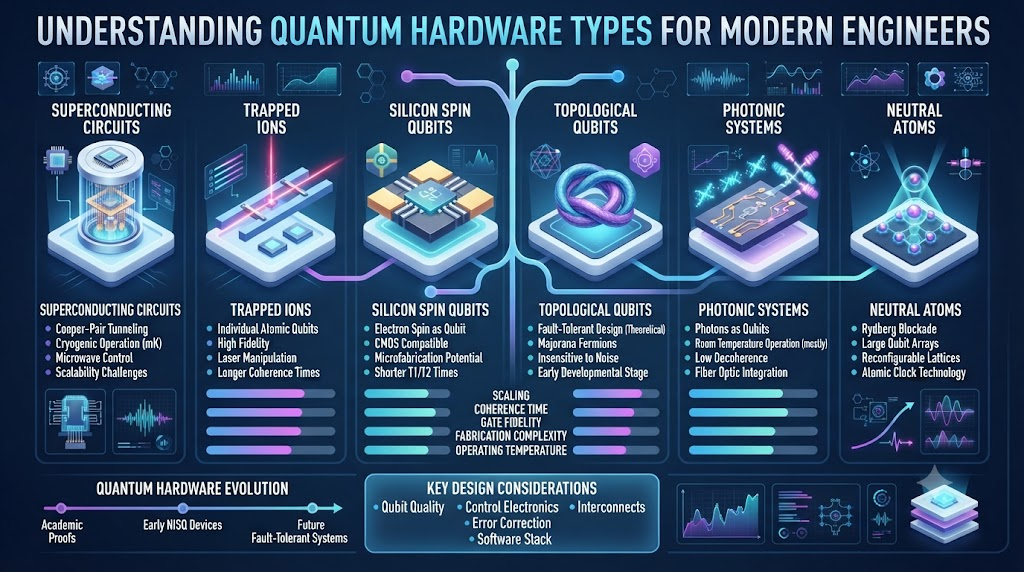
Quantum computing is changing how we solve hard problems. But building or using quantum machines is not simple. Different hardware types use completely different physics. Choosing the right platform can make or break your project.
That is why learning about these technologies is so important. When you look at different systems, you find unique strengths and weaknesses. Some systems run fast but need extreme cooling. Other systems run at room temperature but struggle with scaling.
If you want to master these architectures, you can check out expert resources at QuantumOpsSchool to guide your learning path. Understanding these physical differences helps you match your software to the right processor. Let us look at what makes each hardware type unique.
What Makes Quantum Hardware Different?
Classical computers use bits that are either zero or one. Quantum computers use qubits. Qubits can be both zero and one at the same time. This property is called superposition.
It lets quantum processors test many solutions at once. But qubits are extremely fragile. Tiny changes in temperature can destroy their state. This is why hardware design is so difficult.
Engineers use different physical systems to build qubits. Each system has its own way of holding data. Some trap charged atoms using electric fields. Others use tiny circuits made of superconducting metals.
Superconducting Qubits Explained
Superconducting circuits are the most popular hardware type today. Companies like IBM and Google use them. These qubits are made of metal loops chilled to near absolute zero.
At these super-low temperatures, electricity flows without resistance. This lets engineers control the qubits using microwaves. The main benefit is fast gate speed. Operations happen in billionths of a second.
However, keeping things cold requires massive dilution refrigerators. These fridges are expensive and bulky. Also, superconducting qubits have short coherence times. They lose their quantum state very quickly.
Trapped-Ion Qubit Architecture
Trapped-ion systems use charged atoms called ions. Lasers hold these ions in place inside a vacuum chamber. This isolation protects them from outside noise.
Because the ions are natural atoms, they are all identical. You do not get manufacturing defects like you do with chips. This gives trapped-ion systems very high fidelity. Errors happen much less often.
The downside is speed. Moving ions and firing lasers takes much longer than microwave pulses. Scaling up the number of ions in a single trap is also very tough.
Photonic Qubit Systems
Photonic systems use particles of light instead of atoms or circuits. Light travels through optical fibers and glass chips. Photons do not interact easily with their environment.
This means photonic hardware can often run at room temperature. You do not need giant cooling systems. You can also network multiple processors together easily using fiber optics.
Yet, photons are hard to control. They pass right through each other without interacting. Building two-qubit gates requires complex optical setups and lots of physical space.
Neutral Atom and Silicon Spin Qubits
Neutral atom systems use lasers to hold uncharged atoms in a grid. You can pack hundreds of qubits into a small space. This makes scaling much easier.
Silicon spin qubits use single electrons trapped in silicon chips. They look a lot like normal computer chips. Manufacturers can use existing semiconductor factories to build them.
Both technologies are newer than superconducting systems. They show great promise for the future. But they still face hurdles in error correction and control stability.
Comparative Analysis of Quantum Hardware
| Hardware Type | Operating Temperature | Gate Speed | Scalability Challenge |
| Superconducting | Near Absolute Zero | Very Fast | Cryogenic wiring limits |
| Trapped-Ion | Room Temp / Vacuum | Slow | Ion transport and lasers |
| Photonic | Room Temperature | Fast | Photon interaction complexity |
| Neutral Atom | Vacuum Chamber | Moderate | Atom loss during reordering |
Real-World Scenarios and Case Studies
- Case 1: Superconducting Chip Cooling Failure. A lab lost power to their dilution refrigerator. The temperature rose above absolute zero, instantly destroying the superposition of fifty qubits and ruining a week-long simulation.
- Case 2: Trapped-Ion Laser Drift. A research team noticed rising error rates during an overnight run. They found that a cooling laser had drifted by a tiny fraction of a millimeter, missing the target ion chain.
- Case 3: Photonic Routing Bottleneck. An optical quantum network suffered severe signal loss over long fiber spans. Engineers had to install custom single-photon amplifiers to maintain data integrity across nodes.
- Case 4: Silicon Spin Manufacturing Flaw. A commercial foundry produced a batch of silicon spin chips with microscopic impurities. These impurities trapped stray magnetic charges and scrambled the qubit states.
- Case 5: Neutral Atom Array Loss. During a high-speed rearrangement of neutral atoms using optical tweezers, a laser pulse flickered, causing three atoms to escape the trap and aborting the calculation.
- Case 6: Superconducting Crosstalk Issue. A dense grid of superconducting qubits experienced unintended electromagnetic coupling. Signals meant for qubit one accidentally triggered changes in qubit ten.
- Case 7: Cryogenic Wiring Bottleneck. A team hit a physical limit trying to route coaxial control cables into a cryostat. The sheer number of wires created too much heat load on the refrigeration system.
- Case 8: Ion Heating in Micro-Traps. High electric field noise near the microfabricated surface of an ion trap caused the trapped ions to shake violently, shortening their storage time.
- Case 9: Single-Photon Detector Saturation. A high-intensity photonic experiment flooded the avalanche photodiodes, causing them to miss subsequent photon arrivals and corrupting the output data distribution.
- Case 10: Hybrid Integration Challenge. A research group tried to link a superconducting processor with a photonic communication link. Converting microwave states to optical photons caused massive conversion losses.
Common Mistakes and Pitfalls
- Mistake 1: Ignoring Environmental Noise. Practitioners often design algorithms without accounting for hardware noise. Solution: Always run your quantum circuits through a noise simulator before deploying them to real hardware.
- Mistake 2: Assuming All Qubits Are Equal. Beginners treat every qubit as having identical performance. Solution: Check the calibration map of the specific processor and route your critical gates to the highest-fidelity qubits.
- Mistake 3: Overlooking Coherence Time Limits. Writing circuits that take longer than the qubit’s lifespan. Solution: Optimize your gate depth and use compiler passes to shorten execution times.
- Mistake 4: Choosing Hardware Solely on Qubit Count. Picking a machine just because it has a high headline number. Solution: Focus on quantum volume, gate fidelity, and connectivity rather than raw qubit counts.
- Mistake 5: Neglecting Calibration Drift Schedules. Running long jobs across calibration cycles. Solution: Split your workload into smaller batches and re-query hardware calibration metrics between runs.
- Mistake 6: Writing Hardware-Agnostic Code Blindly. Assuming code written for ion traps will run efficiently on superconducting grids. Solution: Tailor your transpilation settings to match the native gate set of your target architecture.
- Mistake 7: Underestimating Readout Errors. Failing to correct for measurement bias at the end of a circuit. Solution: Apply measurement error mitigation matrices to clean up your final probability distributions.
- Mistake 8: Mismanaging Classical Compute Bottlenecks. Letting classical control computers lag behind fast quantum gate speeds. Solution: Upgrade your feedback control electronics to handle real-time feed-forward operations.
- Mistake 9: Skipping Thermal Management Checks. Overlooking thermal loads inside cryogenic systems. Solution: Audit your control line wiring and attenuate high-frequency signals properly before they reach the cold stage.
- Mistake 10: Overcomplicating Error Correction Too Early. Trying to implement full fault-tolerant schemes on noisy intermediate-scale hardware. Solution: Start with error mitigation techniques and lighter mitigation protocols before scaling to full error correction.
Step-by-Step Implementation Roadmap
- Define your project’s specific computational requirements and target problem domain.
- Evaluate available hardware architectures against your problem’s connectivity needs.
- Set up your development environment using cloud-based quantum software development kits.
- Write a simple baseline circuit and test it using local noise simulators.
- Transpile your circuit to match the native gate set of your chosen hardware vendor.
- Submit a small test job to the hardware backend to check error rates and queue times.
- Implement error mitigation strategies like measurement mitigation and zero-noise extrapolation.
- Scale up your circuit depth gradually while monitoring fidelity degradation.
- Analyze your output results against classical benchmarks to verify correctness.
- Refine your algorithm and deploy automated batch execution pipelines for production runs.
Final Recommendation and Next Steps
Start small by picking one hardware architecture for your initial testing phase. Run basic test circuits on cloud-backed simulators before booking real hardware time. Track your error rates closely and adjust your compilation settings as you learn. Keep building your practical skills by testing different algorithms across various processor types.
Frequently Asked Questions
1. What is the main difference between superconducting and trapped-ion qubits?
Superconducting qubits use artificial circuits chilled to extreme cold, while trapped-ion qubits use real charged atoms held by lasers.
2. Why do superconducting processors need massive refrigerators?
They must stay near absolute zero so electrical resistance drops to zero and thermal noise does not ruin the fragile qubit states.
3. Are photonic qubits better because they run at room temperature?
They avoid heavy cooling systems, but photons are very hard to control and require complex optical setups to make two-qubit gates work.
4. How do neutral atom systems achieve high scalability?
They use optical tweezers and lasers to pack hundreds of uncharged atoms into tight, neat grids without complex wiring.
5. What does gate fidelity mean in quantum hardware?
Gate fidelity measures how accurately a quantum operation is performed without introducing errors into the system.
6. Can I run the exact same code on different quantum hardware types?
You must transpile your code because different hardware architectures use unique native gate sets and physical connectivity layouts.
7. What is coherence time?
Coherence time is how long a qubit can maintain its quantum superposition before environmental noise destroys its state.
8. Why is qubit connectivity important?
Connectivity determines which qubits can interact directly, which affects how many swap operations your circuit needs to run.
9. What is the best hardware type for beginners?
Cloud-accessible superconducting processors are currently the most documented and easiest for beginners to test.
10. How can I learn more about quantum hardware design?
You can explore structured technical resources and guided tutorials online to deepen your understanding of these systems.