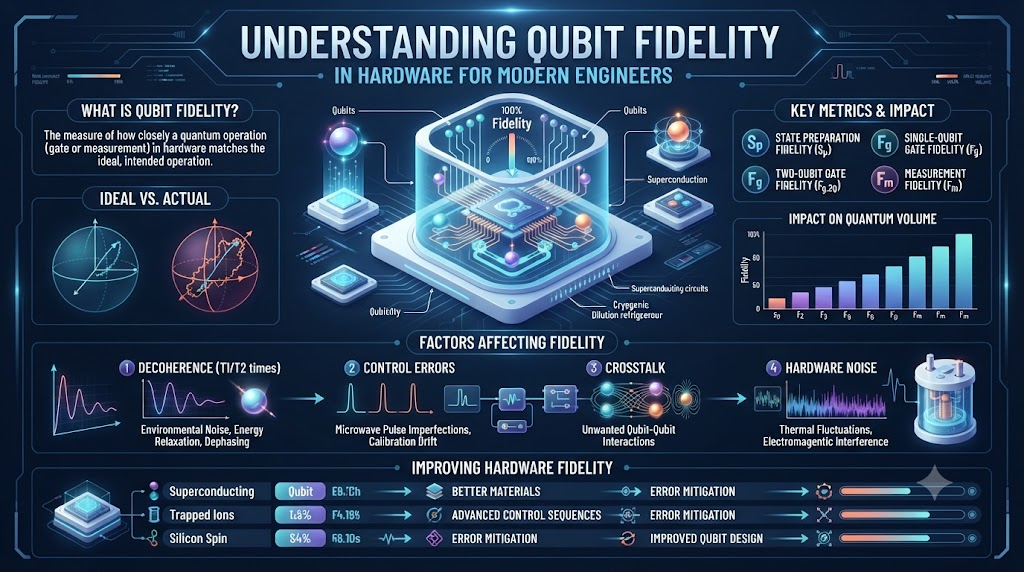
Your quantum computer just failed halfway through a multi-step calculation. You look at the logs and see a mess of random output errors. The root cause is almost always poor qubit fidelity. When qubits lose their fragile states, your data turns into noise. Engineers face this frustrating problem every single day when running circuits on real hardware. If you want to master the art of tracking and fixing these hardware errors, you can explore expert resources at QuantumOpsSchool to build your engineering skills. Qubit fidelity measures how accurately a quantum processor performs its basic steps. High fidelity means fewer errors and more reliable results. Low fidelity means your calculations get washed out by background noise before they finish. Understanding how hardware physical layers affect fidelity is your first step toward building stable quantum programs. Let us break down how fidelity works, why chips fail, and how you can measure processor performance like a seasoned reliability expert.
What Is Qubit Fidelity and Why It Matters
Fidelity is a score that tells you how close your physical quantum operation is to the ideal mathematical goal. A score of one means absolute perfection. A score of zero means total failure. Most real hardware sits somewhere in between.
When you run a quantum circuit, you stack dozens of small operations together. Each operation introduces a tiny bit of error. These small errors pile up fast. If your base fidelity is too low, your final answer becomes completely useless.
You need to track fidelity metrics before sending expensive jobs to cloud hardware. Think of fidelity as the health score of your processor. High fidelity lets you run longer, deeper circuits without losing your data. Low fidelity forces you to keep your code short and simple.
The Physics Behind Qubit Decoherence
Qubits are extremely sensitive to their environment. Any tiny change in temperature or magnetic fields can ruin their state. This loss of information is known as decoherence.
Decoherence happens because qubits interact with the outside world. The universe constantly measures the qubit, forcing it to pick a normal zero or one state. When this happens, your superposition vanishes.
Engineers fight decoherence by isolating the processor from outside noise. They use heavy shielding and extreme vacuum chambers. Yet, stray radiation and material defects still cause trouble. Controlling decoherence is the biggest challenge in quantum hardware design today.
Single-Qubit Gate Fidelity Explained
Single-qubit gates change the state of one individual qubit. You use them to rotate the qubit or flip its phase. These gates are usually much easier to control than multi-qubit gates.
Modern superconducting and trapped-ion systems achieve very high single-qubit fidelity. Scores often reach ninety-nine point nine percent or higher. This means out of a thousand operations, only one fails.
Even with high scores, errors still happen during long runs. You must design your software to use fewer gates whenever possible. Optimizing your circuit layout saves your data from unnecessary wear and tear.
Two-Qubit Gates and Their Error Rates
Two-qubit gates let two qubits talk to each other. They create entanglement, which gives quantum computers their raw power. But building these gates is very difficult.
Because two qubits must interact, they also pick up more outside noise. Their fidelity is always lower than single-qubit gates. Typical two-qubit error rates sit around one to two percent.
This error rate acts as a hard limit on your program length. If you run fifty two-qubit gates in a row, your chance of success drops close to zero. Hardware makers work hard every day to push these error rates down.
Readout Errors and Measurement Fidelity
At the end of your circuit, you must read the final state of your qubits. This process is called measurement. Just like running gates, reading data is never one hundred percent accurate.
Detectors can misinterpret a zero as a one due to electrical noise. This creates measurement errors in your final output. You must measure these readout error rates before trusting your results.
Engineers use calibration matrices to clean up measurement data. They run test patterns to see how often the detector makes mistakes. Then they apply math to correct the final probability distribution.
How Temperature Changes Impact Hardware Stability
Temperature plays a massive role in quantum hardware performance. Superconducting chips need extreme cold to function properly. They sit inside refrigerators cooled to near absolute zero.
If the temperature rises by even a tiny fraction of a degree, thermal energy enters the system. This extra heat knocks qubits out of their fragile states. Your fidelity drops instantly, and your job fails.
Reliability teams monitor cryostat temperatures around the clock. They use automated alarms to catch cooling system drops before data gets corrupted. Keeping the hardware cold is a non-stop engineering battle.
Electromagnetic Noise and Crosstalk Challenges
Modern quantum chips pack dozens or hundreds of qubits into a tight space. Controlling them requires complex wiring and microwave pulses. This density creates a major problem called crosstalk.
Crosstalk happens when a signal meant for one qubit leaks into a neighbor. The neighboring qubit changes state by accident. Your clean math gets scrambled by unwanted electromagnetic interference.
Hardware designers use careful shielding and microwave filtering to block this leakage. They also space out control lines to keep signals clean. Managing crosstalk is vital for scaling up processor sizes.
Benchmarking Tools for Quantum Processors
You cannot improve what you do not measure. Engineers use special testing protocols to check hardware health. Randomized benchmarking is one of the most popular methods.
Randomized benchmarking runs random sequences of gates of varying lengths. By checking how output accuracy drops as length increases, you get a clear error rate per gate. This cuts out measurement bias.
Cloud providers publish these benchmark scores on their dashboards. You should check these numbers before submitting your production workloads. Choosing the cleanest backend saves you time and compute credits.
Error Mitigation Versus Error Correction
Quantum error correction uses many physical qubits to build one perfect logical qubit. This protects data from hardware noise. But it requires thousands of physical qubits, which we do not have yet.
Until full error correction is ready, engineers use error mitigation. Error mitigation uses smart software tricks to reduce noise effects. You run circuits multiple times with slight changes and extrapolate the zero-noise result.
Error mitigation lets you squeeze better results out of noisy hardware today. It bridges the gap between raw physical errors and fault-tolerant computing. Mastering these software techniques is a core skill for modern developers.
Choosing Hardware Based on Fidelity Metrics
Not all quantum processors are built the same way. Some chips have high single-qubit fidelity but poor connectivity. Others have great connectivity but lower gate accuracy.
You must match your algorithm needs to the right hardware profile. If your code uses heavy entanglement, pick a machine with top-tier two-qubit fidelity. If your code is simple, raw speed might matter more.
Always test your code across multiple backends to compare results. Looking at real hardware metrics helps you make smart architectural choices. Data-driven decisions lead to successful quantum projects.
Comparative Analysis of Quantum Hardware Fidelity
| Hardware Architecture | Single-Qubit Fidelity | Two-Qubit Fidelity | Primary Error Source |
| Superconducting Circuits | High (99.9%) | Moderate (98.5%) | Thermal noise and crosstalk |
| Trapped-Ion Systems | Very High (99.99%) | Good (99.0%) | Laser drift and heating |
| Photonic Processors | Moderate (98.0%) | Low (95.0%) | Photon loss and routing |
| Neutral Atom Arrays | High (99.9%) | Good (99.1%) | Atom loss during transport |
Real-World Scenarios and Case Studies
- Case 1: Cryostat Thermal Spike. A laboratory refrigerator suffered a minor valve leak during a weekend run. The temperature rose slightly, destroying qubit coherence and ruining a massive optimization job.
- Case 2: Microwave Control Line Leakage. An engineering team noticed unexpected bit-flips on qubit twelve. They found that a nearby control line was broadcasting stray microwave signals into the chip core.
- Case 3: Ion Trap Laser Power Drift. A trapped-ion processor showed rising error rates over twelve hours. Technicians discovered that the cooling laser had lost power due to thermal expansion in the optical table.
- Case 4: Readout Detector Saturation. A high-intensity measurement pulse flooded the readout resonators. The detectors missed subsequent photon arrivals, corrupting the final output statistics completely.
- Case 5: Substrate Manufacturing Flaw. A commercial foundry produced a silicon chip with microscopic surface defects. These defects trapped stray magnetic charges and degraded overall gate fidelity.
- Case 6: Crosstalk During Parallel Gates. Running two entangling gates at the same time caused electromagnetic interference between adjacent qubits. The output fidelity dropped by five percent.
- Case 7: Calibration Schedule Mismatch. A user ran a long batch job across a daily hardware calibration reset. The new calibration parameters shifted the gate voltages, rendering the second half of the job invalid.
- Case 8: Optical Fiber Coupling Loss. A photonic quantum network suffered heavy signal attenuation over long fiber links. Engineers had to install custom single-photon amplifiers to maintain fidelity.
- Case 9: Stray Magnetic Field Interference. Unshielded lab equipment switched on nearby and generated a magnetic pulse. The pulse shifted the energy levels of superconducting qubits and aborted the calculation.
- Case 10: Compiler Mapping Inefficiency. A software compiler mapped logical qubits to distant physical qubits on a sparse chip. The extra swap gates introduced too many errors and ruined the final result.
Common Mistakes and Pitfalls
- Mistake 1: Ignoring Daily Calibration Shifts. Assuming hardware error rates stay the same all day long. Solution: Check updated calibration metrics and re-fetch backend parameters before every major job submission.
- Mistake 2: Writing Overly Deep Circuits. Stacking too many gates into a single unmitigated run. Solution: Break your code into smaller modular chunks and optimize gate depth using compiler passes.
- Mistake 3: Blindly Trusting Headline Qubit Counts. Picking a backend just because it has the highest number of qubits. Solution: Evaluate quantum volume, gate fidelity, and connectivity graphs instead of raw counts.
- Mistake 4: Skipping Noise Simulation Steps. Deploying new code directly to real hardware without testing. Solution: Always run your quantum circuits through a local noise simulator to catch obvious error bottlenecks.
- Mistake 5: Neglecting Readout Error Mitigation. Trusting raw measurement output without correcting detector bias. Solution: Apply measurement error mitigation matrices to clean up your final probability distributions.
- Mistake 6: Ignoring Architectural Constraints. Writing hardware-agnostic code that ignores native gate sets. Solution: Tailor your transpilation settings to match the specific physical layout of your target backend.
- Mistake 7: Overlooking Thermal Load Limits. Packing too many active control lines into a cryogenic fridge. Solution: Audit your wiring density and attenuate high-frequency signals properly before they reach the cold stage.
- Mistake 8: Mismanaging Classical Feed-Forward Time. Letting classical control computers lag behind fast quantum gate speeds. Solution: Upgrade your hardware controller electronics to handle real-time feedback loops.
- Mistake 9: Failing to Track Fidelity Trends. Not keeping historical logs of backend performance over time. Solution: Build automated logging tools to track error rate changes across different hardware vendors.
- Mistake 10: Forgetting to Apply Error Mitigation. Running circuits on noisy hardware without software correction tricks. Solution: Use zero-noise extrapolation and probabilistic error cancellation to improve output reliability.
Step-by-Step Implementation Roadmap
- Define your project’s specific computational goals and acceptable error thresholds.
- Review public hardware provider dashboards to find backends with the highest fidelity scores.
- Set up your local development environment using standard quantum software development kits.
- Write a baseline circuit and test its logic using a local noise-free simulator.
- Introduce realistic noise models to your simulator to test how fidelity drops.
- Transpile your circuit to match the native gate set and connectivity map of your chosen hardware.
- Submit a small pilot job to the live quantum processor to check queue times and error rates.
- Apply software-based error mitigation techniques to clean up your pilot output data.
- Scale up your circuit depth gradually while monitoring fidelity degradation metrics.
- Deploy automated execution scripts for production workloads and set up health alerts.
Frequently Asked Questions
1. What does qubit fidelity actually measure?
Qubit fidelity measures how closely a physical quantum operation matches the ideal mathematical goal on a scale from zero to one.
2. Why are two-qubit gate error rates higher than single-qubit rates?
Two-qubit gates require qubits to interact with each other, which exposes them to more environmental noise and crosstalk.
3. How does temperature affect superconducting qubit fidelity?
Extra thermal energy knocks fragile qubits out of their superposition states, destroying data and causing calculation failures.
4. What is quantum decoherence?
Decoherence is the process where a qubit loses its quantum state because it interacts with outside environmental noise.
5. Why do we need error mitigation if we have error correction?
Full fault-tolerant error correction needs thousands of physical qubits, so error mitigation helps us get clean results on today’s noisy hardware.
6. How often do quantum hardware calibration metrics change?
Calibration metrics often shift daily or even multiple times a day as hardware components drift and are re-tuned.
7. What is randomized benchmarking?
Randomized benchmarking is a testing protocol used to measure average gate error rates without interference from measurement bias.
8. Can I run the same circuit on different hardware architectures?
You must transpile your code for each specific backend because different architectures use unique native gate sets.
9. What causes readout errors at the end of a circuit?
Electrical noise in detectors can misinterpret qubit states, causing measurements to record zeros as ones or vice versa.
10. How can I choose the best backend for my project?
Compare quantum volume, gate fidelity scores, and qubit connectivity maps to find the hardware that matches your workload.
Final Recommendation and Next Steps
Start your journey by auditing the fidelity metrics of your preferred cloud quantum provider. Run small test circuits on low-error backends before scaling up your workload complexity. Track your error rates closely and adjust your compilation settings as hardware updates roll out. Keep building your practical engineering skills by testing different error mitigation strategies across various processor types.