Introduction
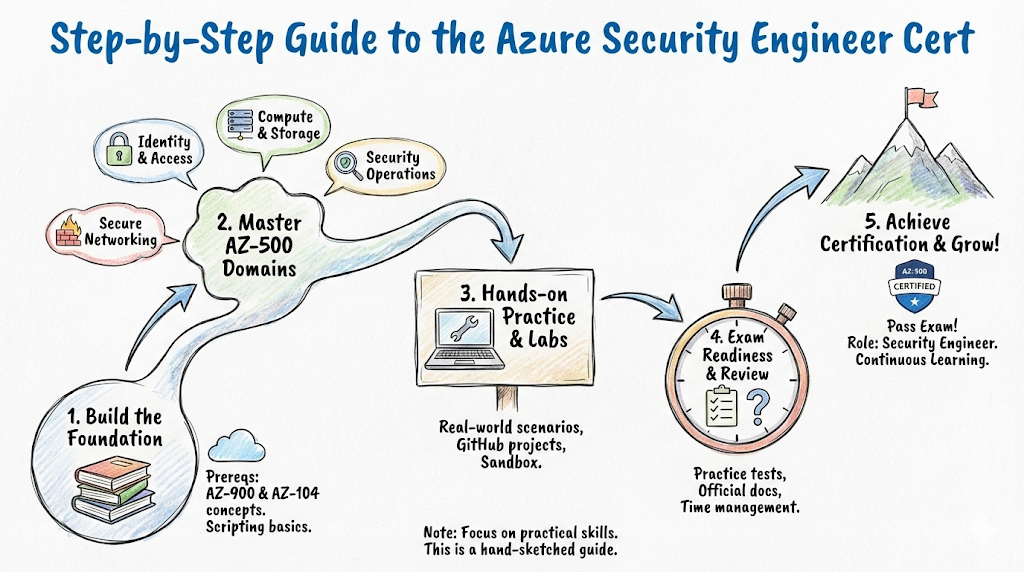
The Azure Security Engineer Associate (AZ-500) certification is a critical milestone for any professional looking to master the art of cloud defense in an increasingly complex digital landscape. Rather than focusing solely on administrative tasks, this program challenges you to adopt a “Security First” mindset, validating your ability to implement robust identity management, platform protection, and advanced threat detection across the entire Microsoft Azure ecosystem. Whether you are a Software Engineer looking to secure your applications, a DevOps practitioner automating compliance, or a Manager overseeing a secure digital transformation, the AZ-500 provides the technical depth and professional authority required to safeguard global enterprise environments. Mastering this track ensures you can move beyond theoretical knowledge to effectively design, implement, and maintain the high-level security controls that modern organizations depend on to survive and thrive.
Azure Certification Landscape
Before diving deep, let’s look at where this fits in the broader Microsoft ecosystem.
| Track | Level | Who it’s for | Prerequisites | Skills Covered | Recommended Order |
| Security | Associate | Engineers, Admins, Architects | AZ-900 (Recommended) | Identity, Networking, Apps, Data | After AZ-104 |
Deep Dive: Azure Security Engineer Associate (AZ-500)
What it is
The AZ-500 is a high-level associate certification that validates your ability to implement, monitor, and maintain security behaviors in Azure. It covers four major pillars: Managing Identity and Access, Implementing Platform Protection, Securing Data and Applications, and Managing Security Operations.
Who should take it
- DevOps & SREs: Those who need to automate security within the pipeline.
- Cloud Administrators: Professionals responsible for the day-to-day health of cloud resources.
- Software Engineers: Developers who want to ensure their apps are born secure.
- Engineering Managers: Leaders who need to understand the risk profile of their cloud infrastructure.
Skills you’ll gain
- Identity Governance: Mastering Microsoft Entra ID (Azure AD), Privileged Identity Management (PIM), and Conditional Access.
- Infrastructure Defense: Deploying Azure Firewall, Web Application Firewall (WAF), and Network Security Groups (NSGs).
- Threat Detection: Setting up Microsoft Defender for Cloud and Microsoft Sentinel to catch attackers in real-time.
- Encryption Mastery: Managing Key Vaults, disk encryption, and database security protocols.
Real-world projects you should be able to do
- Zero-Trust Networking: Build a hub-and-spoke network where no traffic is trusted by default, using Azure Firewall to inspect every packet.
- Automated Compliance: Write Azure Policies that automatically delete any resource created without encryption or proper tagging.
- Secure App Service: Deploy a web application that has no public IP address and is only accessible through a secure VPN or Front Door.
- Log Analytics Mastery: Create a custom dashboard in Microsoft Sentinel that alerts the team the moment a “Root” user logs in from an unknown country.
Detailed Preparation Plans
14-Day “Sprint” (For Experienced Pros)
- Days 1–3: Focus on Identity. Review Entra ID, PIM, and RBAC vs. ABAC.
- Days 4–7: Platform Protection. Configure VNets, NSGs, and Azure Firewall in a sandbox.
- Days 8–11: Operations & Data. Practice using Defender for Cloud and Sentinel. Review Key Vault and Storage security.
- Days 12–14: Final Polish. Take 3 full-length practice exams. Focus on time management.
30-Day “Standard” (Recommended for Engineers)
- Week 1: Identity & Access. Learn how to manage users, groups, and external identities safely.
- Week 2: Network Security. Deep dive into VNet peering, Service Endpoints, and Private Links.
- Week 3: Compute, Storage, & Apps. Secure VMs, Containers (AKS), and SQL Databases.
- Week 4: Review & Labs. Spend at least 10 hours in the Azure Portal actually building the solutions.
60-Day “Transition” (For Managers & Juniors)
- Month 1: Focus on theory and the “Why.” Use Microsoft Learn modules and watch recorded sessions.
- Month 2: Focus on the “How.” Follow guided labs (like those at DevOpsSchool) to build confidence. Spend the final 2 weeks on exam-specific question formats.
Common Mistakes
- Underestimating Identity Governance: Many candidates focus heavily on Firewalls but ignore the complexities of Microsoft Entra ID (Azure AD). You must understand the difference between a Security Group and a Dynamic Group, and know exactly how Conditional Access policies overlap.
- Skipping the Hands-on Labs: The exam often includes performance-based testing. If you haven’t actually configured a Privileged Identity Management (PIM) request or set up a Key Vault access policy in a live portal, you will likely freeze during the practical tasks.
- Misunderstanding “Least Privilege”: This is the golden rule of security. On the exam, if two answers accomplish a task, the one that provides the minimum amount of access required is almost always the correct one.
- Ignoring PowerShell and CLI: You cannot rely solely on the GUI (Portal). Several questions will provide a snippet of code and ask you to identify the missing command to secure a resource.
- Overlooking Network Nuances: A common mistake is not understanding the priority of Network Security Group (NSG) rules. Remember: rules are processed by priority number (lowest first), and once a match is found, processing stops.
- Confusing RBAC with ABAC: Understanding Role-Based Access Control is standard, but you must also know how Attribute-Based Access Control (using tags) can be used to scale security in large environments.
- Neglecting the “Shared Responsibility” Model: Many fail to realize which security tasks are Microsoft’s job and which are yours. Forgetting that you are responsible for securing the data inside a database (even if Microsoft secures the hardware) is a critical error.
- Rushing the Case Studies: The exam usually starts or ends with a complex business scenario. Candidates often rush through these and realize too late that they cannot go back to change their answers once that section is closed.
Choose Your Path: 6 Specialized Learning Tracks
Azure Security isn’t a stand-alone island; it’s the bridge to every high-paying role in tech.
- DevOps Path: Focus on “Pipeline Security.” Learn to use Azure Key Vault to inject secrets into your CI/CD scripts without ever exposing them in plain text.
- DevSecOps Path: The ultimate evolution. Focus on automating security scans and compliance checks so that “Security” never slows down “Development.”
- SRE Path: Focus on “Resilience.” Security attacks are just another form of system downtime. Learn to use Azure Monitor to spot traffic spikes that indicate a DDoS attack.
- AIOps/MLOps Path: Protect the data that trains your models. Ensure that your AI endpoints are protected by API Management and sophisticated rate-limiting.
- DataOps Path: Focus on data sovereignty. Learn how to use Azure Purview and SQL auditing to ensure sensitive data never leaves its required region.
- FinOps Path: Security governance helps control costs. By preventing “Shadow IT” (unauthorized resource creation), you keep the cloud budget under control.
Role → Recommended Certifications Mapping
| Role | Primary Cert | Secondary Cert |
| DevOps Engineer | AZ-400 | AZ-500 |
| SRE | AZ-104 | AZ-500 |
| Platform Engineer | AZ-104 | AZ-500 |
| Cloud Engineer | AZ-104 | AZ-500 |
| Security Engineer | AZ-500 | SC-100 |
| Data Engineer | DP-203 | AZ-500 |
| FinOps Practitioner | AZ-900 | AZ-500 |
| Engineering Manager | AZ-900 | AZ-500 |
Top Institutions for AZ-500 Training & Certification
finopsschool.com FinOps School bridges the gap between cloud security and cloud economics. Their training highlights how proper security governance—like enforcing tags and resource limits—not only protects the environment but also prevents the “runaway costs” often associated with unmonitored or compromised cloud resources.
DevOpsSchool DevOpsSchool is a global leader in high-end technical training, specifically known for its deep-dive into the “engineering” side of security. Their AZ-500 program is uniquely structured to include real-world scenarios that simulate actual cyber-attacks, ensuring you gain the practical experience needed for high-stakes SRE and DevOps roles.
Cotocus Cotocus specializes in boutique, mentor-led training sessions that focus on the architectural nuances of Microsoft Azure. Their approach is highly personalized, making them a top choice for senior engineers and managers who need to understand how security integrates with complex, multi-cloud business strategies.
Scmgalaxy Scmgalaxy serves as a massive knowledge hub and community platform for Configuration Management and Security professionals. Beyond their structured courses, they provide an extensive library of community-vetted tutorials, scripts, and troubleshooting guides that are invaluable for anyone looking to master Azure Security tools.
BestDevOps BestDevOps is known for its intensive, result-oriented bootcamps designed for working professionals who need to upskill quickly. Their curriculum is streamlined to cover the most critical exam objectives while providing enough lab time to ensure students can implement identity and platform protection immediately on the job.
devsecopsschool.com This institution focuses specifically on the “Shift Left” philosophy, integrating security directly into the software development lifecycle. Their AZ-500 training is tailored for those who want to specialize in automated security testing, vulnerability management, and securing CI/CD pipelines within the Azure ecosystem.
sreschool.com At SRE School, security is viewed through the lens of system reliability and uptime. Their training emphasizes how to use Azure Security tools to prevent outages caused by malicious activity, focusing heavily on monitoring, incident response, and building resilient, “self-healing” infrastructure.
aiopsschool.com As AI becomes central to security operations, AIOPSSchool provides specialized training on using machine learning to detect and remediate threats. Their AZ-500 track explores how to secure AI workloads in Azure and how to leverage Microsoft Sentinel’s AI capabilities to stay ahead of automated threats.
dataopsschool.com This school is the go-to for professionals focusing on data sovereignty and database security. Their version of the AZ-500 curriculum dives deep into SQL injection protection, Always Encrypted databases, and ensuring that data pipelines remain compliant with global privacy regulations.
FAQs on Azure Security Engineer Associate (AZ-500)
1. Is AZ-500 harder than AZ-104?
Generally, yes. While AZ-104 covers broad administration, AZ-500 goes deeper into the “darker” corners of the cloud, requiring more nuanced decision-making.
2. Do I need to know how to code?
You don’t need to be a developer, but you should be comfortable reading JSON (for policies) and basic PowerShell/Bash scripts.
3. What is the value of this certification in the Indian market?
Immense. With major global firms housing their Global Capability Centers (GCCs) in India, there is a massive shortage of certified Security Engineers.
4. Can I skip the Fundamentals exam?
Technically, yes. But if you are new to Azure, the AZ-900 provides the foundational vocabulary you’ll need to understand the complex security topics in AZ-500.
5. How often is the exam updated?
Microsoft updates the exam content roughly every 3-6 months to keep up with new cloud features. Always check the official skills outline before testing.
6. Is there a lab portion in the exam?
Usually, yes. You will be given a live Azure environment and a list of tasks (e.g., “Set up a conditional access policy that requires MFA for all admins”).
7. How does this help me move into a Lead role?
A Lead Engineer must be able to vouch for the safety of the system. This certification gives you the authority to sign off on architectural designs.
8. What happens if I fail the first time?
Microsoft allows retakes, but there is a waiting period. This is why using a training institute like DevOpsSchool is recommended—it reduces the risk of failure.
9. Does the AZ-500 cover AI security?
It covers the infrastructure that AI runs on. For specific AI-model security, you would look toward the AI-series certifications later.
10. Is it a lifelong certification?
No. It expires after one year, but the renewal process is a free, unproctored online assessment that takes about 45 minutes.
11. Can I take this exam from home?
Yes, via Pearson VUE online proctoring. Ensure you have a stable internet connection and a quiet, private room.
12. Will this help me get a job at a “Big 4” firm?
Yes. Audit and consulting firms highly value the AZ-500 because it proves you understand compliance and governance frameworks.
Testimonials
“I spent years as a SysAdmin. Taking the AZ-500 at DevOpsSchool opened my eyes to how security can be automated. I’m now a Lead DevSecOps Engineer at a fintech startup.” — Sandeep V.
“The preparation was tough, but the reward was worth it. I received three job offers within a month of adding the AZ-500 badge to my LinkedIn profile.” — Priyanka M.
Next Certifications to Take
- Same Track (Deep Dive): SC-300 (Identity and Access) or SC-200 (Security Operations).
- Cross-Track (Broaden): AZ-400 (Azure DevOps Engineer) to master the full lifecycle.
- Leadership (The Peak): SC-100 (Cybersecurity Architect Expert). This is the “boss level” of Azure Security.
Conclusion
The transition from a standard engineer to a Security Specialist is one of the smartest career moves you can make today. The Azure Security Engineer Associate (AZ-500) provides the roadmap, the tools, and the professional recognition to make that jump. By focusing on practical labs and staying consistent with your study plan, you will not only pass the exam but become a vital asset to any organization.