Introduction
While understanding the history and evolution of quantum labs is important, the true shift happens when we move from experimental research to production-ready infrastructure. This is where the discipline of quantum operations becomes essential. You are no longer just running a physics experiment; you are managing a high-precision computational environment that requires constant oversight, stability, and intelligent automation. Most beginners get confused at this stage because they look for standard server management tools that simply do not exist in the quantum world. This guide navigates that complexity. By focusing on the core principles of environmental stability and observability, you begin to treat quantum processors as reliable, manageable assets. As we move into the technical architecture of these systems, you keep in mind that your goal is to maintain the delicate balance that allows quantum information to persist. To further your expertise in these specific operational workflows, you explore specialized learning paths and support at QuantumOpsSchool. Now, let’s understand the core components that make up a modern, scalable quantum infrastructure.
The Origin of Quantum Computing Operations
The Limits of Traditional Infrastructure Operations
Classical IT operations are built on the concept of determinism. If a component breaks, you replace it. If a network path fails, you route traffic elsewhere. These models assume that hardware is relatively stable. Quantum systems do not offer this luxury. Their components are microscopic, volatile, and highly susceptible to noise. Traditional operational playbooks simply do not account for the physics-based interventions required to sustain quantum coherence.
The Evolution from Research Labs to Operational Quantum Systems
In the past, quantum systems were purely experimental. They were manually tuned by teams of researchers in physics labs. As the technology matured, the need for repeatability grew. We moved from “bespoke experiments” to “operational systems” that need to function reliably for remote users. This transition birthed the professional field of quantum operations, which focuses on converting raw physics potential into a consistent service.
Enterprise and Research Adoption of Quantum Operations
Today, universities, national labs, and large enterprises are adopting quantum processors to solve problems that were previously untouchable. This expansion means that infrastructure can no longer be managed by just the scientists who built it. It requires a dedicated team of operations engineers who can maintain high uptime and monitor the health of the quantum stack in a professional setting.
Defining Modern Quantum Operations Architecture
The Core Components of Quantum Infrastructure
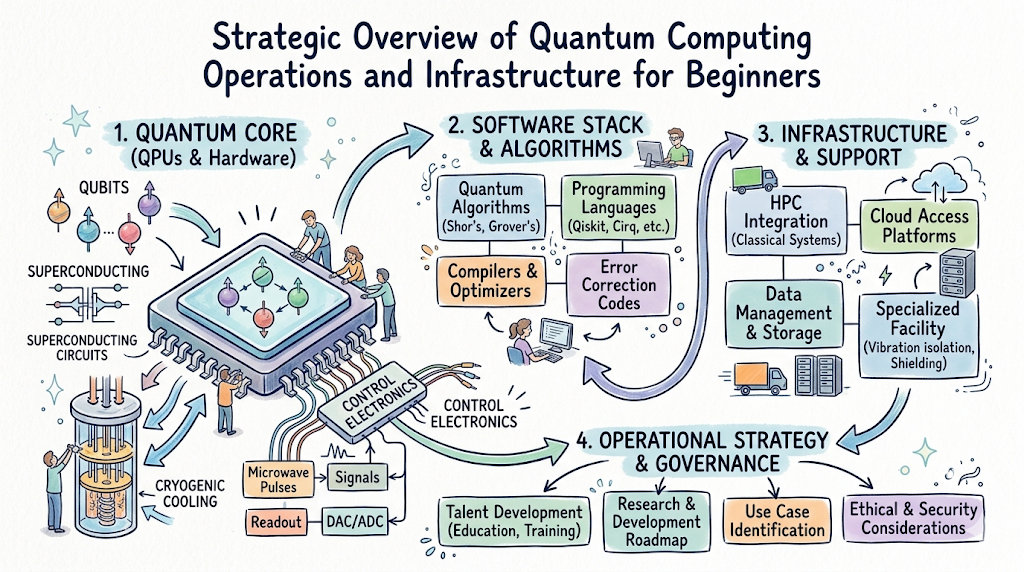
Quantum infrastructure is a complex assembly of hardware, not just a server in a rack. Key components include:
- Qubits: The fundamental processing units that hold quantum information.
- Cryogenic Cooling: Massive dilution refrigerators that maintain temperatures near absolute zero.
- Quantum Control Systems: Precision electronics that translate classical commands into microwave pulses for the qubits.
- Vacuum Environments: Shielded containers that block external interference.
Daily Responsibilities of Quantum Operations Engineers
An operations engineer monitors the health of the entire stack. They perform regular calibrations, adjust the frequency of control pulses, and manage the cryogenic health. They ensure that the interface between the classical control computer and the quantum processor remains calibrated so that researchers can submit jobs without worrying about hardware drift.
Quantum Monitoring vs. Traditional Infrastructure Monitoring
In traditional IT, you monitor CPU, RAM, and disk latency. In quantum operations, observability focuses on “fidelity,” “coherence time,” and “thermal stability.” You are watching for signs that the environment is warming up or that electromagnetic interference is degrading the performance of the qubits. If these metrics drift, the system is no longer producing reliable results.
The Stability and Precision Mindset
Working in quantum operations requires an extreme attention to detail. You must treat the environment as a living, breathing system. A change of a few millikelvin can be the difference between a successful computation and total data loss. The mindset here is one of constant, careful stewardship rather than the rapid, “fix-it-fast” approach often seen in traditional web operations.
The 7 Core Principles of Introduction to Quantum Computing Operations
1. Quantum System Stability
Stability is the primary objective. Operators maintain the system so that qubits stay in their quantum states as long as possible. This involves minimizing physical vibrations and electromagnetic noise that could cause decoherence.
2. Cryogenic Infrastructure Management
The refrigeration system is the heart of the operation. Operators monitor gas pressure, coolant circulation, and vacuum levels to ensure the system stays at the required temperature. If the cooling fails, the entire quantum computer becomes an expensive, non-functional box.
3. Precision Monitoring and Observability
Operations engineers use specialized sensors to get granular data on the state of the processor. They track “gate fidelity” to ensure that when a command is sent, the quantum system responds exactly as expected.
4. Error Detection and Quantum Error Correction
Noise is inevitable. Instead of trying to eliminate every source of error, operators manage “error correction” routines. These routines run alongside the main computation to detect and fix small discrepancies, ensuring the final output is accurate.
5. Hybrid Quantum-Classical Operations
Quantum computers do not run alone. They rely on classical computers for data management and instruction scheduling. Integrating these two worlds involves managing the latency between the classical control interface and the quantum processor.
6. Automation in Quantum Infrastructure
Manual tuning is far too slow for modern demands. Operators use scripts to automate routine calibrations, such as adjusting pulse widths or optimizing microwave frequencies. Automation allows the system to be ready for users at any time of the day.
7. Scalable Quantum Ecosystem Management
As we move toward larger processors, managing one quantum chip will evolve into managing clusters of processors. Scalability in this field means balancing workloads across multiple hardware units while maintaining consistent quality standards.
Key Quantum Operations Concepts Every Beginner Must Know
Classical Infrastructure vs. Quantum Operations — Explained Simply
- Classical: Focuses on bits, reliability, and simple redundancy.
- Quantum: Focuses on qubits, extreme environment control, and probability management.
- Classical: If it breaks, replace the part.
- Quantum: If it drifts, recalibrate the environment.
Qubits and Operational Stability
In simple terms, a qubit is a delicate piece of information. To keep it stable, the environment must be perfectly quiet. Operators track “coherence time,” which is the measurement of how long a qubit can hold information before it loses its quantum state.
Quantum Control Systems
Think of the control system as the bridge between your code and the hardware. It translates your instructions into the exact energy pulses required to manipulate the qubits. If the control electronics are off by even a tiny fraction, the result of the computation will be incorrect.
Quantum Error Management
Quantum systems are inherently noisy. Error management is not about making the machine perfect, but about building systems that can work correctly even when there is background interference. Operators focus on mitigating this noise through hardware shielding and software correction layers.
Operational Monitoring in Quantum Environments
Observability here is about tracking the “health” of the machine. Operators look at charts representing temperature, signal noise, and gate performance. If any of these metrics move outside the allowed zone, the operations team intervenes to bring the system back to baseline.
The Four Pillars of Quantum Operations
- Hardware Infrastructure: The refrigeration and shielding.
- Monitoring: Watching the system’s physical performance.
- Automation: Using scripts to keep the system calibrated.
- Reliability: Ensuring consistent performance for every user job.
Traditional IT Operations vs. Quantum Operations — What’s the Real Difference?
The Philosophy Difference
Traditional IT is built on a philosophy of “standardization.” You want your servers to be as identical as possible. Quantum operations follow a philosophy of “calibration.” Because every quantum processor has unique physical characteristics, each one requires a specific, tailored set of operational parameters.
Roles & Responsibilities Compared
- Infrastructure Engineer: Manages physical data centers and network hardware.
- Quantum Operations Engineer: Manages cryostat health, pulse-width calibrations, and job-scheduling interfaces.
- Researcher: Focuses on the physics and algorithm design.
Can Classical and Quantum Operations Work Together?
They must. A quantum computer cannot perform basic tasks like file management or user authentication. It needs a classical system to handle the “heavy lifting” of the environment, while the quantum processor solves the specific, complex mathematical problems it was designed for.
Which Career Path Should Beginners Explore?
If you like low-level hardware interaction and are interested in physics, this path is excellent. It is a niche field that values people who understand both the “code” side of computing and the “physical” side of infrastructure.
Real-World Use Cases of Quantum Computing Operations
Quantum Operations in Research Laboratories
In a lab, the operations team focuses on “up-time for discovery.” They provide the environment that researchers need to test new quantum algorithms. The goal is to provide the most stable possible platform so that researchers know their results are due to their algorithm, not hardware noise.
Quantum Infrastructure in Pharmaceutical Research
Companies use quantum computing to simulate molecular interactions. This requires long, uninterrupted computational runs. Operations teams must ensure that the quantum hardware remains stable for hours at a time, allowing these complex simulations to complete successfully.
Quantum Security and Encryption Operations
Quantum machines have the potential to challenge modern encryption. Operational management here focuses on security and isolation, ensuring that the infrastructure is air-gapped from the public internet to protect sensitive research findings.
Cloud-Based Quantum Computing Operations
This is the future of accessibility. Engineers manage massive arrays of quantum processors that are accessed remotely. The operational challenge is managing queue priority and ensuring that users get fair, stable access to the hardware from anywhere in the world.
Quantum Operations for Startups and Research Teams
Startups often work with a single, highly specialized quantum processor. Their operational team is usually small and focuses on high-speed iteration. They use advanced automation to ensure that their limited hardware is always running at peak performance.
Common Mistakes Beginners Make While Learning Quantum Operations
Mistake 1 — Thinking Quantum Systems Work Like Traditional Servers
Beginners often assume they can just SSH into a quantum computer and run updates. It does not work that way. You are managing a delicate physical experiment, not a standard Linux virtual machine.
Mistake 2 — Ignoring Basic Physics Concepts
You don’t need to be a theoretical physicist, but ignoring concepts like thermal noise or electromagnetic shielding is a huge mistake. Practical infrastructure management in this field is rooted in physics.
Mistake 3 — Underestimating Infrastructure Sensitivity
Some beginners overlook the physical environment. They might forget that the quality of the cooling system is just as important as the quality of the quantum processor itself.
Mistake 4 — Confusing Quantum Theory with Practical Operations
Theory is for the researchers. Operations is for the engineers. Beginners often get lost in complex math and forget that they need to focus on the operational reality of keeping the hardware running.
Mistake 5 — Overlooking Monitoring and Stability Requirements
If you aren’t monitoring the machine, you are flying blind. Beginners often focus on running their first program without setting up the proper telemetry to see if their machine is actually performing correctly.
Mistake 6 — Ignoring Hybrid Infrastructure Dependencies
Quantum computers rarely run in a vacuum. They are connected to classical servers. If you ignore the classical side of the infrastructure, you will never be able to successfully run a quantum job.
Essential Quantum Operations Tools & Technologies
Quantum Development Frameworks
Tools like Qiskit, Cirq, and PennyLane are the standard for translating your ideas into code that the hardware can understand. They are the interfaces that operations engineers use to submit calibration and test routines.
Quantum Hardware Platforms
From superconducting circuits to trapped-ion setups, each hardware platform has a different “personality.” Operations engineers learn how to manage the specific cooling and control requirements of the platform their organization uses.
Quantum Monitoring and Control Systems
These are the specialized dashboards used to track the health of the hardware. They provide real-time updates on gate fidelity and thermal status, which are essential for daily operational health.
Cloud-Based Quantum Infrastructure
Cloud platforms allow you to access hardware located thousands of miles away. They manage the connection between your code and the physical chip, handling the scheduling and job delivery efficiently.
Quantum Programming and Automation Tools
Automation is the secret weapon of the operations engineer. By using Python-based automation, you can ensure that the quantum processor is re-calibrated every morning, saving hours of manual work.
Becoming a Quantum Operations Professional — Career Roadmap
Essential Skills Every Beginner Should Learn
Focus on a strong foundation in Linux, Python scripting, and infrastructure monitoring. Add in a basic understanding of quantum mechanics—specifically what qubits are and how they interact with noise.
Step-by-Step Quantum Operations Learning Path
Start by building your classical IT skills. Then, learn the basics of quantum programming. Finally, study how quantum hardware is built and maintained. The best engineers are those who understand the full stack.
Certifications and Learning Programs Worth Exploring
Many industry-leading platforms offer specialized training. Look for programs that focus on infrastructure, as these are the most relevant for an operations-focused career.
Educational Resources with [PROVIDER_NAME]
To get a structured, professional start, explore the resources offered by QuantumOpsSchool. They provide practical pathways that help beginners transition into the professional world of quantum infrastructure management.
The Future of Quantum Computing Operations
Autonomous Quantum Infrastructure Management
Imagine a system that detects a drop in performance and fixes itself without human help. That is the goal of autonomous quantum operations. AI will eventually play a large role in managing these systems, making them more reliable and easier to use.
Hybrid Classical-Quantum Operational Ecosystems
We are moving toward a future where quantum processors are standard components in data centers. Operations teams will manage these “quantum-enabled” facilities, balancing the needs of classical and quantum systems side-by-side.
Enterprise Expansion of Quantum Operations
As quantum hardware becomes more available, businesses will move from experimental projects to full-scale operations. This growth will create a massive need for skilled operations engineers who can maintain high-quality computational services.
Skills That Will Matter Most in Future Quantum Careers
The future belongs to those who understand the full operational stack: infrastructure, observability, automation, and quantum-classical integration. These skills will be the backbone of the next generation of computing.
FAQ Section
1. Is a deep background in mathematics required to start?
No, you do not need to be a mathematician to start in operations. While a basic understanding helps, your primary job is managing the infrastructure, which relies more on engineering, Linux, and systematic monitoring.
2. How do I begin learning these specialized skills?
You should start by building a solid foundation in Linux and Python. Once you have those skills, look for courses that focus specifically on quantum hardware and infrastructure.
3. Is this a stable career path for the long term?
Yes, as quantum technology moves out of the lab and into the industry, the demand for people who can keep these complex systems running will only increase.
4. What does a typical day look like for an operations engineer?
A typical day involves checking system telemetry, running calibration scripts, troubleshooting hardware performance issues, and working with researchers to ensure their jobs are running effectively.
5. Do I need special certifications to work in this field?
While not always mandatory, having certifications in cloud infrastructure or specific quantum frameworks can certainly help. Experience with system monitoring and automation is often the most valued trait.
6. How do I get hands-on practice without an expensive quantum computer?
Most learning providers offer access to cloud-based quantum simulators and remote access to real quantum hardware, which allows you to practice without needing to own a massive cooling system.
Conclusion
Quantum computing operations is a challenging, rewarding field that sits at the intersection of traditional infrastructure and future-facing physics. It requires a calm, precise, and systematic approach to problem-solving. By focusing on environmental stability, continuous monitoring, and effective automation, you can help move quantum technology from the lab into the real world.
The transition to quantum-ready infrastructure is one of the most exciting developments in modern technology. If you are ready to build a career in this essential space, begin your journey by mastering the fundamentals at QuantumOpsSchool. The future of computation is waiting for the engineers who can keep it running.