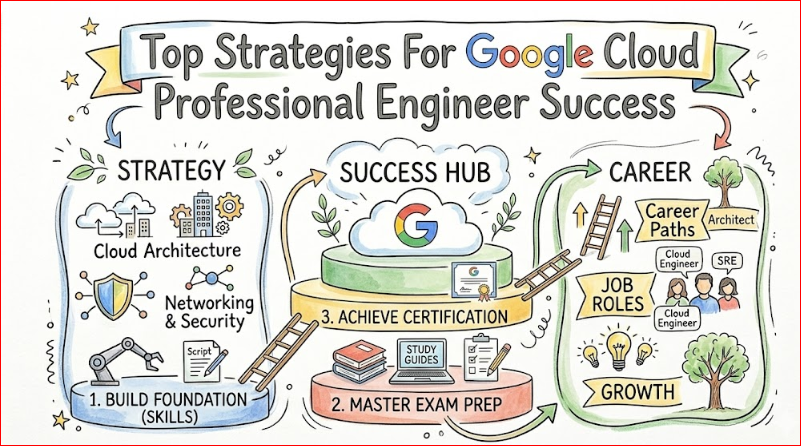
Introduction
The cloud is no longer a luxury for modern businesses; it is the engine that drives innovation. Throughout my career in the tech industry, I have watched the landscape move from static data centers to dynamic, automated cloud ecosystems. Google Cloud Platform (GCP) has emerged as a powerhouse in this space, particularly for those who prioritize data-driven decision-making and rock-solid system reliability. This guide is designed to help software engineers and managers—whether you are based in India or working globally—understand the Google Cloud Professional Engineer path. Staying relevant in today’s market means moving beyond basic administration and mastering these deep cloud competencies.
Detailed Certification Breakdown
What it is
This certification focuses on the technical skills required to build software delivery pipelines, deploy and monitor services, and manage incidents. It sits at the intersection of development and operations, heavily emphasizing the Site Reliability Engineering (SRE) philosophy that Google pioneered.
Who should take it
You should take this if you are a DevOps engineer, a systems administrator, or a software developer who wants to take ownership of the entire application lifecycle. It is also ideal for technical leads and engineering managers who need to oversee complex cloud transformations.
Skills you’ll gain
- Designing and implementing CI/CD pipelines on GCP.
- Managing service incidents and performing root cause analysis.
- Implementing site reliability engineering (SRE) principles.
- Optimizing service performance and cloud costs.
- Advanced monitoring and logging with the Google Cloud operations suite.
Real-world projects you should be able to do
- Build a fully automated pipeline that deploys code to GKE (Google Kubernetes Engine) with automated rollbacks.
- Set up multi-region failover and load balancing for a global web application.
- Create custom dashboards to monitor “Golden Signals” (Latency, Traffic, Errors, Saturation).
- Automate infrastructure provisioning using Terraform and Google Cloud Deployment Manager.
Preparation Plan
- 7–14 Days (The Fast Track): Best for those already working daily on GCP. Focus on the official exam guide, take 3-4 practice exams, and review Google’s official SRE documentation.
- 30 Days (The Standard Path): Spend 1-2 hours a day. Complete a structured video course, perform 10+ hands-on labs, and read the “Site Reliability Engineering” book by Google.
- 60 Days (The Deep Dive): Ideal for those new to GCP. Start with the Associate Cloud Engineer material, then move into professional labs. Build a personal project on GCP to understand the nuances of networking and IAM.
Common Mistakes
- Ignoring SRE Principles: This isn’t just a technical exam; it’s a cultural one. If you don’t understand SLIs, SLOs, and Error Budgets, you will struggle.
- Over-relying on Theory: Google’s exams are notorious for case studies. If you haven’t used the CLI or Console, the scenario-based questions will be confusing.
- Skipping Networking: Many candidates fail because they don’t understand VPCs, Peering, and Load Balancing deeply enough.
Best next certification after this
The Google Cloud Professional Cloud Architect is the natural next step, as it broadens your scope from delivery to high-level system design.
Master Table: Google Cloud Certification Portfolio
| Track | Level | Who it’s for | Prerequisites | Skills Covered | Recommended Order |
| DevOps | Professional | Engineers/SREs | Technical depth | CI/CD, SRE, Monitoring | 2nd |
| Architect | Professional | Solutions Architects | Cloud Fundamentals | Design, Compliance, Security | 3rd |
| Developer | Professional | App Developers | Coding proficiency | Cloud-native apps, APIs | 2nd |
| Data | Professional | Data Engineers | SQL/ML knowledge | BigQuery, Dataflow, Pub/Sub | 2nd |
| Security | Professional | Security Engineers | Identity management | IAM, Encryption, VPC Sec | 3rd |
| Network | Professional | Network Engineers | Networking basics | Hybrid connectivity, DNS | 3rd |
Choose Your Path: 6 Specialized Learning Tracks
1. The DevOps Path
Focus on automation and speed. Master Cloud Build, Artifact Registry, and Deployment Manager. Your goal is to make “Human intervention” a thing of the past for deployments.
2. The DevSecOps Path
This is about “Shifting Left.” Learn to integrate Container Analysis and Binary Authorization into your pipelines. Security should be a feature, not an afterthought.
3. The SRE (Site Reliability Engineering) Path
Focus on the health and uptime of the system. Master Cloud Monitoring and Cloud Logging. Learn how to manage “Error Budgets” so that speed doesn’t break your stability.
4. The AIOps/MLOps Path
This is for those managing AI at scale. Focus on Vertex AI and how to automate the retraining of models when data drift occurs.
5. The DataOps Path
Concentrate on the flow and quality of data. Master BigQuery for storage and Dataflow for processing. Ensure that data is clean, available, and secure for the business.
6. The FinOps Path
The goal here is “Cloud Value.” Learn how to use Recommenders, Committed Use Discounts (CUDs), and BigQuery billing exports to keep the cloud bill from exploding.
Role → Recommended Certifications Mapping
| Professional Role | Entry Level Certification | Professional Level Certification | Focus Area |
| DevOps Engineer | Associate Cloud Engineer | Cloud DevOps Engineer | Automation, CI/CD, and Delivery |
| SRE (Site Reliability) | Associate Cloud Engineer | Cloud DevOps Engineer | Reliability, SLOs, and Incident Response |
| Platform Engineer | Associate Cloud Engineer | Cloud Architect | Infrastructure Strategy and Governance |
| Cloud Engineer | Associate Cloud Engineer | Cloud Architect | General Administration and Design |
| Security Engineer | Associate Cloud Engineer | Cloud Security Engineer | IAM, Encryption, and Network Security |
| Data Engineer | Associate Cloud Engineer | Cloud Data Engineer | Big Data, ETL, and Analytics |
| FinOps Practitioner | Cloud Digital Leader | Cloud Architect | Cost Optimization and Cloud Value |
| Engineering Manager | Cloud Digital Leader | Cloud Architect | High-level Strategy and Team Alignment |
Next Certifications to Take
After completing your Professional Engineer certification, consider these three directions:
- Same Track (Deepening): Google Cloud Professional Security Engineer (to secure the pipelines you built).
- Cross-Track (Broadening): Google Cloud Professional Data Engineer (to understand the data your apps generate).
- Leadership (Growth): Google Cloud Professional Cloud Architect (to lead high-level organizational cloud strategy).
Top Institutions for Google Cloud Professional Training
finopsschool.com FinOpsSchool addresses one of the biggest challenges in the cloud: managing and optimizing costs. They provide the framework for technical teams to work with finance departments to ensure that every dollar spent on Google Cloud provides maximum business value. This training is essential for those who want to prove their value by saving their company significant infrastructure costs.
DevOpsSchool This is a leading institution for in-depth, hands-on technical training that focuses on real-world production scenarios. Their programs are designed by industry veterans to ensure you don’t just pass the exam but master the tools and SRE philosophies required for senior roles. They offer extensive support, making them a top choice for those wanting a complete professional transformation.
Cotocus Cotocus provides specialized, industry-aligned training tailored for corporate teams and working professionals seeking practical cloud skills. Their curriculum bridges the gap between theoretical cloud knowledge and the complex requirements of modern business environments. They are highly regarded for their clear, structured modules that focus on immediate job-ready applications.
Scmgalaxy As a community-driven powerhouse, Scmgalaxy offers a vast library of resources, tutorials, and expert blogs that keep engineers updated on the latest cloud trends. Their training programs are grounded in the actual daily challenges faced by the global DevOps community. It is an excellent choice for learners who want to stay connected to the pulse of the industry while they study.
BestDevOps BestDevOps specializes in high-intensity bootcamps that are designed to deliver maximum results in a short period. Their training is strictly focused on the most in-demand skills currently requested by top-tier tech hiring managers. This is the go-to option for fast learners who want a rigorous, high-energy environment to jumpstart their cloud career.
devsecopsschool.com This institution focuses entirely on the critical intersection of security and operations within the Google Cloud ecosystem. They teach you how to “shift left” by building automated security guardrails directly into your CI/CD pipelines. It is an essential stop for any engineer looking to specialize in protecting cloud infrastructure from modern threats.
sreschool.com Dedicated to the art of Site Reliability Engineering, this school teaches the exact principles Google uses to maintain its global services. You will learn to manage system health using SLOs, SLIs, and error budgets to ensure high availability and performance. It is the perfect training ground for those aiming for high-level SRE positions in major tech firms.
aiopsschool.com As AI and Machine Learning become standard in software, this school provides the specialized knowledge needed to manage these models at scale. They focus on the lifecycle of AI operations, ensuring that your machine learning deployments are as stable and automated as your traditional code. It is ideal for engineers wanting to lead the next wave of AI innovation.
dataopsschool.com This school is the premier destination for learning how to manage the complex data pipelines that drive business intelligence today. They focus on the automation and quality of data movement, ensuring that information is always clean, secure, and ready for analysis. It is a vital resource for anyone working in a data-heavy engineering environment.
Google Cloud Professional Engineer: Frequently Asked Questions
1. What is the primary focus of the Google Cloud Professional Engineer exam? The exam focuses on the intersection of software development and infrastructure operations. It heavily tests your ability to apply Site Reliability Engineering (SRE) principles to ensure that cloud-native applications are scalable, reliable, and secure. You aren’t just tested on how to use tools, but on how to architect entire delivery systems that can handle real-world traffic and failures.
2. Is there a specific coding language required for the certification? There is no requirement to be an expert in one specific language, but you should be comfortable reading and understanding common scripting and configuration formats. Most scenarios involve YAML for Kubernetes and CI/CD configurations, JSON for API responses, and basic Python or Bash for automation scripts. Understanding how application logic interacts with cloud services is key.
3. How does this certification differ from the Associate Cloud Engineer? The Associate Cloud Engineer certification is focused on the day-to-day “how-to” of deploying and monitoring applications. The Professional track is much broader and deeper; it asks you to make strategic decisions based on business requirements, such as choosing between different deployment strategies or designing a multi-region disaster recovery plan.
4. What are the most important GCP services to master for this exam? You should have deep expertise in Google Kubernetes Engine (GKE), Cloud Build, Artifact Registry, and the Operations Suite (formerly Stackdriver). Additionally, a strong understanding of networking components like Shared VPCs, Cloud Load Balancing, and Identity and Access Management (IAM) is essential for passing the scenario-based questions.
5. Can I take the exam if I have more experience in AWS or Azure? Yes, your existing cloud knowledge is a great foundation, but you must learn the “Google Way.” Google Cloud has a unique approach to networking and global service distribution that differs significantly from other providers. I recommend spending at least 30 days specifically focused on GCP’s unique architecture and SRE philosophies before attempting the professional exam.
6. What is the format and duration of the professional exam? The exam typically lasts 120 minutes and consists of 50–60 multiple-choice and multiple-select questions. These are often presented as “case studies” where you are given a company’s current problem and asked to provide the most efficient, cost-effective, or secure solution from a list of technical options.
7. Is the Google Cloud Professional Engineer certification recognized globally? Absolutely. It is one of the most respected cloud certifications in the world because of its high difficulty level and focus on modern engineering practices like SRE and DevOps. Professionals holding this certification are highly sought after by global tech giants, specialized cloud consultancies, and high-growth startups across India, the US, and Europe.
8. What happens if the technology changes after I get certified? Because the cloud moves so fast, Google requires you to recertify every two years. This ensures that you stay updated with the latest tools, such as new AI/ML integrations or serverless technologies. It also maintains the high value of the certification in the job market, as employers know a “Current” Google Cloud Professional is up to speed with today’s technology.
FAQs: Google Cloud Professional Engineer
1. How difficult is the exam?
It is one of the more challenging cloud exams because it requires a mix of technical knowledge and philosophical understanding of SRE.
2. How long does it take to prepare?
For a working professional, 30 to 60 days is usually enough to feel confident.
3. Are there any prerequisites?
There are no official prerequisites, but Google recommends having significant industry experience, including time spent on GCP.
4. In what order should I take the exams?
Start with the Associate Cloud Engineer, then move to Professional DevOps, and finally Professional Architect.
5. What is the value of this certification in India?
In the Indian market, GCP professionals are in high demand, often commanding competitive salaries due to the scarcity of certified experts.
6. Does the certification expire?
Yes, it is valid for two years. You will need to recertify to keep your status active.
7. Can I take the exam online?
Yes, Google offers both remote-proctored online exams and in-person testing at authorized centers.
8. What is the format of the exam?
It consists of multiple-choice and multiple-select questions. There are no live labs, but the questions simulate real scenarios.
9. How much does it cost?
The professional level exams typically cost $200 USD.
10. What career outcomes can I expect?
Most professionals transition into Senior DevOps, SRE, or Cloud Lead roles with significant career advancement.
11. Is the focus more on code or infrastructure?
It is a balanced mix. You need to understand YAML/JSON for configurations and how the underlying infrastructure behaves.
12. Why choose Google Cloud over others?
Google Cloud is often preferred for its superior data analytics, Kubernetes integration, and developer-friendly CLI.
Testimonials
“I had been working in a traditional Ops role for years. This guide and the training from DevOpsSchool helped me pivot into an SRE role at a top-tier tech firm. The focus on SLOs changed how I think about system health.”
— Animesh
“Coming from a development background, I was intimidated by networking. The structured path mentioned here made it easy to bridge my knowledge gaps. I cleared my Pro DevOps exam in 45 days!”
— Sandeep
Conclusion
The journey to becoming a Google Cloud Professional Engineer represents a fundamental shift in how you approach software delivery and system reliability in a cloud-native world. By mastering the SRE principles and automated workflows outlined in this guide, you move beyond basic administration into a high-impact role that balances rapid innovation with rock-solid stability. Whether you are leading a team in India or managing global infrastructure, this certification is the definitive proof of your ability to architect the future of technology. Now is the time to choose your specialized path, leverage expert training, and take the first step toward a career defined by technical excellence and professional growth.