Introduction
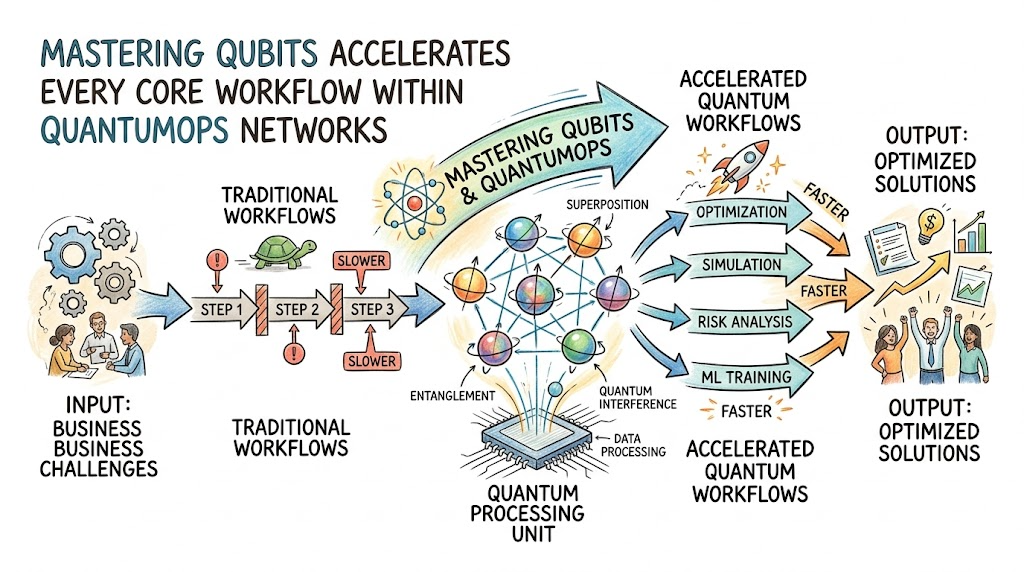
Managing a global logistics network with thousands of delivery trucks, changing traffic patterns, and shifting weather conditions creates a massive digital bottleneck for traditional computers. These standard systems fail to process multi-layered, real-world data streams simultaneously because they analyze problems step by step. This processing limitation is exactly why the technology industry is shifting toward Quantum Operations, widely known as QuantumOps. At the absolute center of this technological evolution is the qubit, which represents a massive leap forward in how we process data, manage workflows, and orchestrate complex infrastructure environments. In this comprehensive guide, you learn exactly how qubits function, why they are essential for QuantumOps, and how they transform modern digital infrastructure. We break down complex physics into simple, practical analogies that anyone can understand. If you want to master these next-generation systems and build a successful career in this cutting-edge field, you can start your journey today with the specialized training programs available at QuantumOpsSchool.com.
What is QuantumOps?
QuantumOps is the practical framework used to manage, orchestrate, and scale quantum computing workflows within real-world business environments. Just as DevOps bridges the gap between software development and traditional IT operations, QuantumOps bridges the gap between quantum physics and everyday business applications.
It focuses on building reliable pipelines, managing system resources, and making sure quantum hardware works seamlessly with traditional cloud networks. It turns theoretical quantum science into reliable, repeatable, and automated digital infrastructure.
Evolution of Quantum Operations
In the early days of quantum computing, systems lived exclusively inside highly isolated research laboratories. Scientists ran manual experiments on delicate prototype machines, focusing entirely on basic physics.
As the hardware matured, organizations realized they needed a structured way to run these systems continuously. This need triggered the evolution of QuantumOps. We transitioned from manual laboratory experiments to cloud-based quantum platforms, automated workflow scheduling, and hybrid systems that connect traditional data centers with quantum processors.
Difference Between Traditional Computing Operations and QuantumOps
Traditional computing operations manage predictable, binary systems where data is static and highly stable. Upgrades, server monitoring, and data deployments follow rigid, well-defined rules.
QuantumOps, on the other hand, deals with probabilistic environments. Data states change dynamically, hardware requires sub-zero cryogenic cooling, and workflows must balance tasks between classical CPUs and quantum chips. QuantumOps requires specialized monitoring tools to manage system stability, data interference, and live state transitions.
Importance of Quantum Infrastructure Management
Quantum computers are highly sensitive to their surrounding environments. Slight temperature changes, electromagnetic waves, or minor vibrations can disrupt an ongoing calculation.
This extreme sensitivity makes infrastructure management absolutely critical. Without strong QuantumOps protocols, a quantum system cannot maintain its operational stability. Proper management ensures that data flows smoothly, errors are caught instantly, and computational workloads run without costly interruptions.
Understanding Qubits
What is a Qubit?
A qubit, short for quantum bit, is the basic unit of information in a quantum computer. While a traditional computer uses standard bits to store and process data, a quantum computer uses qubits.
Think of a qubit as the fundamental building block of quantum computing power. Because it obeys the laws of quantum mechanics, a single qubit can hold far more operational potential than a standard digital bit.
Difference Between Classical Bits and Qubits
To understand the difference, imagine a simple coin resting on a table. A classical bit is like that coin lying flat on the surface; it can only show heads or tails. In the digital world, this represents a 0 or a 1.
A qubit, however, is like that same coin spinning rapidly on its edge. While it spins, it exists in a fluid combination of both heads and tails at the very same time. It only becomes a definite 0 or 1 when you slam your hand down on the coin to stop the spin.
Binary Computing vs Quantum States
Traditional computers rely completely on binary computing. Every email, video, and software program is broken down into massive strings of zeros and ones. The computer processes these numbers step by step.
Quantum states throw out this rigid, one-at-a-time limitation. By holding multiple data values simultaneously, a quantum state allows a system to analyze thousands of paths at once, entirely changing our approach to complex data processing.
Why Qubits are Central to QuantumOps
Qubits are the literal engine driving the entire QuantumOps ecosystem. Every orchestration tool, monitoring dashboard, and automation pipeline in a QuantumOps infrastructure is built for one specific purpose: to optimize the performance of qubits. If you do not understand how qubits behave, it is impossible to deploy, manage, or scale quantum workflows effectively.
Core Quantum Principles Behind Qubits
Superposition
Superposition is the unique ability of a qubit to exist in multiple states simultaneously. For example, a traditional computer bit behaves like a standard light switch that can only be turned ON or OFF.
A qubit in superposition behaves more like a dimmer switch that is continuously adjusting through every possible brightness level at once. This allows a quantum system to hold a 0, a 1, and every fractional combination in between, multiplying its raw processing potential.
Entanglement
Entanglement is a unique connection that can link two or more qubits together, regardless of how far apart they are. When qubits become entangled, the operational state of one qubit instantly influences the state of another.
Imagine having two magic dice in different cities. If you roll the first die and get a six, the second die instantly turns into a six as well. In QuantumOps, entanglement allows qubits to share information instantly, accelerating data synchronization across complex workflows.
Quantum Interference
Quantum interference is the method used to steer a quantum computer toward the correct answer to a problem. Think of it like acoustic waves in noise-canceling headphones. The headphones create sound waves that collide with outside noise, canceling out unwanted sounds while amplifying your music.
Quantum systems use interference to cancel out wrong answers and amplify the signal of the correct solution, ensuring highly accurate results during complex operations.
Quantum Measurement
Quantum measurement is the act of observing a qubit, which forces it to stop spinning and collapse into a solid classical state of 0 or 1. Before measurement, the qubit holds a cloud of possibilities.
Once measured, those possibilities disappear, leaving you with a single data outcome. Managing the exact timing of this collapse is a primary responsibility for platform engineers working within QuantumOps environments.
How Qubits Function Inside QuantumOps Environments
Quantum Data Processing
Inside a QuantumOps framework, data processing does not happen in a linear fashion. Instead, information is loaded into a sea of interconnected qubits.
The system manipulates these qubits collectively, running complex algorithms that process vast arrays of data simultaneously. This allows enterprises to evaluate thousands of operational scenarios in a fraction of a second.
Quantum State Management
Quantum state management is the practice of protecting qubits while they perform calculations. Because qubits are highly unstable, QuantumOps platforms use specialized telemetry tools to track their health. These tools monitor environmental factors, ensure the qubits stay in superposition, and prevent outside interference from degrading computational accuracy.
Quantum Gates and Operations
Traditional computers use physical silicon gates to manipulate electrical currents into 0s and 1s. Quantum systems use quantum gates to manipulate qubits.
These gates do not use physical switches; instead, they use precisely targeted laser beams or microwave pulses to change the spin and alignment of qubits. This process directs the qubits through the steps of a quantum algorithm.
Error Detection and Correction
Qubits are highly prone to calculation errors caused by environmental noise. To solve this, QuantumOps systems implement Quantum Error Correction (QEC).
QEC works by grouping multiple fragile physical qubits together to create a single, highly stable “logical qubit.” The system uses the extra qubits to monitor and correct errors automatically without interrupting the core calculation.
Quantum Workflow Coordination
A typical enterprise workflow requires both traditional servers and quantum processors to work together as a team. QuantumOps platforms orchestrate this hybrid process.
The traditional server handles standard data storage and user interfaces, while routing the ultra-complex mathematical problems to the quantum hardware. Once the qubits solve the problem, the QuantumOps pipeline translates the result back into standard digital data.
Types of Qubits Used in Quantum Systems
To help visualize how different organizations build quantum hardware, let us look at the primary types of qubits used in the industry today:
| Qubit Type | Core Technology | Primary Advantage | Major Operational Challenge |
| Superconducting | Tiny currents on silicon chips | Very fast processing speeds | Requires extreme sub-zero cooling |
| Trapped Ion | Suspended individual atoms | High stability and precision | Slower operational gate speeds |
| Photonic | Light particles (photons) | Works at room temperature | Hard to scale to millions of qubits |
| Spin Qubits | Electrons trapped in silicon | Uses standard chip manufacturing | Difficult to keep qubits entangled |
| Topological | Split Majorana fermions | Natural hardware error resistance | Extremely difficult to build and test |
Superconducting Qubits
Superconducting qubits are built using tiny electrical circuits made from materials that have zero electrical resistance when cooled to ultra-low temperatures. Tech giants favor this approach because these chips can be manufactured using modified versions of existing semiconductor factories. However, they require massive cooling units to operate correctly, creating a demanding infrastructure footprint for QuantumOps teams.
Trapped Ion Qubits
Trapped ion qubits use individual atoms that have been stripped of an electron to give them an electrical charge. Lasers hold these charged atoms suspended in place inside a vacuum chamber.
Because every atom of a specific element is completely identical, trapped ion qubits offer incredible stability and precision. The main operational challenge is scaling the physical laser systems to manage thousands of individual atoms simultaneously.
Photonic Qubits
Photonic qubits use single particles of light, called photons, to carry data. The biggest benefit of light-based quantum computing is that photons do not require extreme cooling systems and can travel easily through standard fiber-optic cables.
The operational challenge lies in directing these fast-moving light particles through complex optical pathways without losing them along the way.
Spin Qubits
Spin qubits work by trapping single electrons inside tiny silicon structures known as quantum dots. The system reads the directional spin of the electron as data.
Because they are built using silicon, spin qubits are incredibly small and can leverage existing computer chip manufacturing lines. This makes them a strong candidate for long-term scalability, though keeping the electrons stable remains technically demanding.
Topological Qubits
Topological qubits are a newer approach that protects data by twisting quantum information into complex, braided structures. Instead of relying purely on delicate physical states, the data is protected by the geometry of the system. This built-in hardware protection makes them highly resistant to outside noise, though building working versions of these systems remains an ongoing engineering challenge.
Real-World Applications of QuantumOps and Qubits
Quantum Computing in Healthcare
The pharmaceutical industry spends billions of dollars and years of research trying to discover new life-saving medications. Qubits can simulate the exact molecular structure and chemical reactions of new compounds on a computer screen before testing them in a physical laboratory. This accelerated simulation capability cuts down drug discovery timelines from decades to weeks.
Financial Modeling and Risk Analysis
Global financial systems rely heavily on predicting market trends and managing risk portfolios. QuantumOps frameworks allow banks to run massive simulations that analyze millions of economic variables at the same time.
By processing these scenarios simultaneously, financial institutions can optimize asset allocations and manage market risks with unprecedented accuracy.
Cybersecurity and Encryption
Most modern digital security relies on math problems that are too time-consuming for traditional computers to solve. However, a powerful quantum computer could break these traditional codes easily.
QuantumOps professionals are actively deploying quantum-safe encryption methods. These new systems use the natural laws of qubits to create unhackable security keys, protecting sensitive corporate and government data from future cyber threats.
Logistics and Optimization
From global shipping routes to automated factory floors, logistics is entirely about finding the most efficient way to move assets. Qubits can analyze thousands of routes, fuel variables, and scheduling conflicts all at once.
Example: QuantumOps environments may use quantum systems to optimize complex operational workloads faster, reducing fuel costs and eliminating supply chain bottlenecks for international shipping enterprises.
Artificial Intelligence and Machine Learning
Modern artificial intelligence models require massive datasets and weeks of training time to spot complex patterns. Qubits can process these large datasets much faster than traditional silicon chips. By running quantum-enhanced algorithms, companies can train AI models in a fraction of the time, leading to smarter automation and more accurate predictive analytics.
Benefits of Qubits in Quantum Operations
- Parallel Problem Solving: Qubits process massive amounts of operational data all at once rather than going through it line by line.
- Faster Computational Analysis: Complex mathematical equations that would stall a standard server for years can be solved in minutes.
- Advanced Simulation Capabilities: Organizations can accurately simulate complex physical systems, chemical reactions, and industrial workflows digitally.
- Improved Optimization Processes: Enables businesses to find the absolute best solution for resource allocation, scheduling, and distribution challenges.
- Efficient Complex System Management: Helps infrastructure teams monitor and orchestrate massive, highly unpredictable global data networks.
Challenges in QuantumOps Environments
Quantum Decoherence
Quantum decoherence is the natural process where qubits lose their quantum properties and stop working correctly. This happens because qubits are incredibly sensitive to their surroundings.
If a piece of hardware experiences a microscopic change in temperature, light, or vibration, the qubits drop out of superposition. Preventing decoherence is one of the toughest challenges faced by infrastructure managers.
Error Rates and Noise
Because qubits are so delicate, modern quantum computers experience much higher error rates than traditional silicon chips. This environmental “noise” can corrupt calculations if left unchecked. QuantumOps teams must deploy advanced software layers and error correction protocols to constantly clean up these calculations and ensure reliable operational results.
Infrastructure Complexity
Operating a quantum data center is vastly different from managing a standard server room. Superconducting systems require liquid helium cooling setups that keep temperatures colder than deep space. Managing these complex mechanical systems alongside high-frequency microwave arrays requires specialized infrastructure engineering knowledge.
High Hardware Costs
Building and maintaining a functional quantum computer requires a massive financial investment. The specialized materials, advanced lasers, and custom cryogenic cooling systems are incredibly expensive. Because of these high hardware costs, most companies access quantum power using cloud-based QuantumOps platforms rather than building their own physical data centers.
Scalability and Stability Challenges
While engineers have successfully built quantum processors with dozens of stable qubits, scaling those systems to handle thousands or millions of qubits is an immense challenge. As you add more qubits, the physical infrastructure becomes harder to control, requiring highly advanced orchestration tools to maintain system stability.
QuantumOps vs Traditional Computing Operations
To see how these paradigms differ across key operational categories, let us look at this direct comparison:
Data Processing Differences
Traditional computing operations process information using a linear, step-by-step approach where each bit is locked into a fixed position. QuantumOps uses parallel processing driven by superposition, allowing a system to evaluate countless variations of a problem at the exact same time.
Infrastructure Management
Traditional infrastructure focuses on server uptime, power distribution, and network bandwidth inside normal climates. QuantumOps infrastructure management requires overseeing extreme cryogenic cooling units, vacuum chambers, and specialized microwave signaling arrays.
Speed and Scalability
Traditional systems scale by adding more server racks, which linearly increases power consumption and space requirements. Quantum systems scale by increasing the quality and count of qubits, which exponentially increases computing power without requiring massive expansions of physical real estate.
Automation and Optimization
Traditional automation relies on predictable, rule-based scripts that execute when specific conditions are met. QuantumOps optimization uses probabilistic algorithms to dynamically adjust complex system workflows, making it ideal for highly unpredictable operational environments.
Operational Complexity
Traditional operations are well-suited for standard database management, website hosting, and everyday business applications. QuantumOps introduces higher architectural complexity, making it best reserved for ultra-complex mathematical computations, deep data analysis, and large-scale optimization challenges.
Essential Technologies Supporting QuantumOps
Quantum Processors
The Quantum Processing Unit (QPU) is the physical chip that holds and manipulates qubits. Unlike a traditional silicon CPU, a QPU is engineered to work with quantum states, using specialized architecture to execute quantum gates and algorithms.
Cryogenic Systems
Cryogenic systems are the massive cooling units used to protect superconducting quantum processors. These specialized refrigerators use liquid isotopes to lower the internal temperature of the system to near absolute zero. This extreme cold eliminates thermal noise, allowing the qubits to remain stable during calculations.
Quantum Algorithms
A quantum algorithm is a specialized set of instructions written specifically to run on qubits. Famous examples, like Shor’s or Grover’s algorithms, are designed to leverage superposition and entanglement to solve data problems much faster than traditional software code ever could.
Quantum Monitoring Systems
Quantum monitoring systems act as the eyes and ears of a QuantumOps engineer. These software tools track qubit health, measure decoherence rates, and provide real-world telemetry data. This insight allows teams to adjust system parameters before errors disrupt ongoing enterprise workloads.
Cloud-Based Quantum Platforms
Most enterprises do not buy physical quantum computers. Instead, they use cloud-based platforms to access quantum hardware over the internet. These platforms allow QuantumOps engineers to write code on a standard laptop and send the calculations to a remote quantum data center for processing.
Career Opportunities in QuantumOps
Skills Required for QuantumOps Professionals
To succeed in this growing field, you need a balanced blend of software development, systems engineering, and basic quantum mechanics. Professionals must understand how to work with Linux systems, cloud networks, and specialized quantum programming frameworks like Qiskit or Cirq. Strong problem-solving skills and a solid grasp of workflow automation are also highly valuable.
Popular Career Paths
The growth of this industry has created several new professional career paths:
- QuantumOps Engineer: Focuses on deploying, automating, and managing hybrid quantum workflows.
- Quantum Infrastructure Manager: Oversees the physical and cloud infrastructure required to keep quantum systems running smoothly.
- Quantum Cloud Architect: Designs the networks that connect traditional corporate applications to remote quantum processors.
- Quantum Software Deployment Specialist: Ensures that specialized quantum algorithms integrate cleanly into existing enterprise software pipelines.
Certifications and Learning Resources
As the industry expands, having a verified certification is a great way to stand out to employers. Taking structured courses that cover quantum foundational concepts, cloud integration, and workflow automation can help you transition from traditional IT roles into advanced quantum infrastructure positions.
Learning Opportunities from QuantumOpsSchool.com
If you are looking for high-quality, practical training designed for real-world careers, QuantumOpsSchool.com offers comprehensive educational resources. Their structured training programs focus on practical application, helping developers, system administrators, and IT managers gain the skills needed to confidently oversee modern quantum infrastructure.
Future of QuantumOps and Qubits
AI and Quantum Integration
The intersection of artificial intelligence and quantum operations is one of the most exciting areas of tech innovation. By combining the pattern-recognition capabilities of AI with the parallel processing power of qubits, companies can train complex machine learning models faster than ever before. This combination will unlock entirely new levels of automation and predictive intelligence.
Quantum Cloud Infrastructure
In the coming years, quantum hardware will become a standard component of global cloud infrastructure. Standard cloud environments will automatically route data workloads between traditional CPUs, graphics chips, and quantum processors based on which chip can solve the problem most efficiently.
Self-Optimizing Quantum Systems
Future QuantumOps platforms will feature self-optimizing software layers. These systems will use automated machine learning loops to detect qubit decoherence and adjust error-correction protocols in real time, requiring far less manual intervention from infrastructure engineers.
Quantum Security Innovations
As quantum computing power grows, the shift toward quantum-resistant encryption will accelerate. Organizations will universally adopt quantum key distribution networks, creating highly secure global communication channels that protect corporate and public data against next-generation security threats.
Future Enterprise Applications
Ultimately, qubits will transform everyday business operations. From optimizing global flight schedules in real time to perfectly balancing energy grids during peak hours, the practical applications of QuantumOps will help enterprises eliminate inefficiencies and solve problems that were once considered impossible.
FAQ Section
- What is the main difference between a classical bit and a qubit?
A classical bit can only exist in a fixed state of 0 or 1, acting like a standard on/off switch. A qubit can exist as a 0, a 1, or both states simultaneously through a property called superposition, which allows it to process multiple possibilities at the same time.
2. Do you need a degree in physics to work in QuantumOps?
No, you do not need a advanced physics degree to work in QuantumOps. While understanding core quantum concepts is important, QuantumOps focuses heavily on software engineering, cloud architecture, workflow automation, and infrastructure management.
3. Why do some quantum computers need to be kept so cold?
Superconducting quantum computers require extreme sub-zero cooling because qubits are highly sensitive to heat. Even tiny amounts of thermal energy can cause environmental noise, disrupting the qubits and causing them to drop out of their quantum states.
4. Can quantum computers completely replace traditional computers?
No, quantum computers are not meant to replace everyday traditional computers. Traditional computers will always be more efficient for tasks like streaming video, running databases, and everyday office software, while quantum systems will serve as specialized accelerators for ultra-complex mathematical challenges.
5. How do businesses access quantum operations today?
Most companies access quantum computing power through cloud platforms. This cloud-based model allows organizations to run quantum algorithms and manage workflows over the internet without having to buy or maintain expensive physical hardware themselves.
6. Where can I learn the skills required to work in QuantumOps?
You can learn these specialized technical skills through targeted educational platforms. Programs like those offered at QuantumOpsSchool.com provide practical, beginner-friendly training designed to help IT professionals transition smoothly into quantum infrastructure careers.
Conclusion
Qubits represent a fundamental shift in computing technology, serving as the core engine driving the entire QuantumOps ecosystem. By moving past the rigid limitations of traditional binary computing, qubits allow us to process complex data and optimize systems at unprecedented speeds. Managing these delicate quantum states requires robust, automated infrastructure and specialized operational frameworks.
As quantum technology continues to evolve, the demand for skilled professionals who can orchestrate these advanced systems will continue to rise. Embracing this shift today will prepare you for the next generation of enterprise infrastructure engineering.