Introduction
Austria attracts ambitious professionals and students from all over the world with its booming economy, high safety standards, and incredible career growth opportunities. To legally move and work there, you must successfully navigate the Red-White-Red (RWR) Card system, a merit-driven pathway that values your concrete skills over subjective visa interviews. This framework operates on a strict points system, allocating specific scores for your age, academic background, professional job experience, and language proficiencies. Because missing the minimum score threshold results in an instant denial, a preliminary self-assessment is vital for your preparation. Running your profile through the Desinri Austria PR Points Calculator removes the guesswork, gives you an accurate estimate of your eligibility, and helps you optimize your application for a seamless transition.
What Is Austria PR Points Calculator?
The Austria PR Points Calculator is an online self-assessment framework designed for immigration aspirants. It replicates the official scoring grid used by the Austrian government to evaluate third-country nationals. Instead of relying on subjective interviews, Austria uses this transparent, merit-based system to score your human capital. The primary purpose of the calculator is to give you an immediate, realistic picture of your immigration viability. It works by allocating specific points to various aspects of your personal and professional profile. You enter details regarding your higher education, age, work history, and verifiable language proficiency. The calculator sums these up to check if you cross the minimum score threshold set for your chosen visa pathway. Austria utilizes a points-based immigration system to actively combat severe nationwide labor shortages. By setting clear objective criteria, the country attracts highly specialized talent that can immediately integrate into the economy. Final approval depends on the thorough verification of your physical documents by the Austrian Public Employment Service (AMS). For example, a software developer might score 75 points on the calculator based on self-reported metrics. If their reference letters do not match official formats, the AMS may reject the application during formal review. The calculator is your initial green light, but your documented proof determines the final visa issuance.
Austria PR Points System Explained
The points system acts as the foundational engine of the entire Red-White-Red Card immigration pathway.
To succeed, you must understand how points are distributed across the core selection pillars.
Education Points
- Your academic qualification is heavily weighted and can yield up to 30 or 40 points depending on your category.
- A basic vocational training certificate or trade qualification gives you an entry-level score to start your journey.
- Completing a traditional three-year bachelor’s degree program at a recognized university unlocks a higher tier of points.
- If you possess a Master’s degree or a PhD, you stand to secure the maximum possible points under the education bracket.
- Furthermore, qualifications in MINT fields (Mathematics, Informatics, Natural Sciences, Technology) receive major bonus points.
Work Experience Points
- The system highly values your hands-on professional journey and awards points for every half-year or full year of work.
- Continuous employment in a role that directly matches your academic qualification ensures you get the highest score.
- Crucially, the immigration grid rewards you extra if you have previous documented work experience within Austria.
- International experience is valuable, but local experience shows you understand the Austrian workplace culture.
Age Factor
- Austria is looking for long-term economic contributors who can support its social systems for decades.
- Because of this, younger applicants receive the highest point allocation under the age category.
- Applicants under the age of 30 receive the maximum score, while those between 30 and 40 see a small drop.
- If you are between 40 and 50, you still get points, but the allocation is lower, requiring strong scores elsewhere.
Language Skills
- Communication is the absolute key to successful social and professional integration in Austria.
- Points are distributed between your verified proficiency in the German language and the English language.
- You must prove your skills through standardized certificates like IELTS for English or ÖSD/Goethe for German.
- Even basic beginner-level German (A1) can give you the vital edge needed to clear the minimum threshold.
- If you speak fluent German at a B1 or B2 level, your point score jumps up significantly.
Bonus Points
- The framework provides special bonus allocations to give specific profiles an extra competitive advantage.
- For instance, if you graduated from an Austrian high school or university, you receive unique bonus recognition.
- Additionally, if your prospective employer offers a salary well above the national median, bonus points apply.
- Let’s look at a quick practical example to make this completely clear for a beginner.
- If a candidate has a Master’s degree in Computer Science plus 3 years of verified international experience, they start strong.
- Being 28 years old gives them maximum age points, and an IELTS band 7 locks in excellent English points.
- This combination pushes them well past the target threshold, making them an ideal candidate for immigration.
Red-White-Red Card System
The Red-White-Red (RWR) Card is a combined residence permit and work permit issued to third-country citizens.
It does not tie you to a generic visa category; instead, it allows you to live and work with a specific employer.
The RWR system is split into distinct categories, each tailored to a specific type of global professional.
Very Highly Qualified Workers
This stream is designed for top-tier global professionals, researchers, and high-level corporate managers.
Unique to this category, you do not need an active job offer in Austria to start the initial process.
If you score high enough, you can get a 6-month Job Seeker Visa to look for work on the ground.
Skilled Workers in Shortage Occupations
This category applies if your specific profession is listed on Austria’s official nationwide shortage list.
Industries like mechanical engineering, IT, healthcare, and construction trades feature heavily on this list every year.
You need a valid, concrete job offer from an Austrian company to apply under this specific track.
Other Key Workers
If your occupation is not on the shortage list, you can still apply as an “Other Key Worker.”
This stream depends heavily on your prospective employer meeting specific minimum monthly gross salary requirements.
It allows Austrian companies to recruit specialized international talent for roles that cannot be filled locally.
Startup Founders
Austria actively welcomes innovative entrepreneurs looking to establish cutting-edge businesses within its borders.
To qualify here, you must bring scalable capital, a detailed business plan, and demonstrate real job creation potential.
| RWR Card Category | Minimum Points Required | Job Offer Needed Initially? | Core Focus Area |
| Very Highly Qualified Workers | 70 out of 100 | No (Can use Job Seeker Visa) | Academic research, elite management, patents |
| Skilled Workers in Shortage Occupations | 55 out of 90 | Yes | Technical trades, engineering, IT list |
| Other Key Workers | 55 out of 90 | Yes | Meeting specific minimum salary floors |
| Startup Founders | 50 out of 85 | No (Requires business plan) | Capital investment, local job creation |
How Austria PR Points Are Calculated
- Calculating your final score requires a methodical, step-by-step approach using official parameters.
- You cannot simply guess your points; you must calculate them against the exact category you fit into.
- The general process involves reviewing your credentials, matching them to the grid, and adding them up.
Step-by-Step Scoring Guide
- First, determine your primary immigration pathway from the four main categories listed above.
- Next, look at your highest level of education and assign the corresponding points from that specific category grid.
- After that, calculate your exact years of relevant work experience, converting them into half-year points if needed.
- Then, check your current age bracket to see the exact points allocated to your age group.
- Finally, add your certified language points for either English, German, or both if you are bilingual.
Let’s look closely at the points breakdown table for Skilled Workers in Shortage Occupations:
| Selection Criterion | Specific Profile Detail | Points Allocated | Maximum Limit |
| Qualification | Completed vocational training in shortage trade | 30 Points | Max 30 Points |
| General university entrance qualification | 25 Points | ||
| Work Experience | Each half-year of experience outside Austria | 1 Point | Max 20 Points |
| Each half-year of experience within Austria | 2 Points | ||
| Language Skills | German Language Proficiency (A1 Level) | 5 Points | Max 25 Points |
| German Language Proficiency (A2 Level) | 10 Points | ||
| German Language Proficiency (B1 Level) | 15 Points | ||
| English Language Proficiency (A2 Level) | 5 Points | ||
| English Language Proficiency (B1 Level) | 10 Points | ||
| Age Factor | Applicants up to 30 years of age | 15 Points | Max 15 Points |
| Applicants up to 40 years of age | 10 Points | ||
| Applicants up to 50 years of age | 5 Points |
To qualify under this specific shortage occupation stream, you must hit an absolute minimum threshold of 55 points.
Real-Life Sample Profile Calculation
Let’s calculate the score for a 32-year-old Senior CNC Machinist named Marcus.
Marcus has completed a certified vocational training program in his home country matching an Austrian shortage trade.
He has 6 years of documented professional work experience outside Austria, which equals 12 half-years of work.
He holds an official B1 English certificate (IELTS) and an introductory A1 German language certificate.
- Qualifications: Vocational training in shortage occupation = 30 Points
- Work Experience: 12 half-years of experience × 1 point = 12 Points
- Age: 32 years old fits into the under-40 bracket = 10 Points
- Language Skills: B1 English (10 points) + A1 German (5 points) = 15 Points
Total Calculated Score: 30 + 12 + 10 + 15 = 67 Points
Since 67 points is well above the required minimum threshold of 55, Marcus is fully eligible to apply.
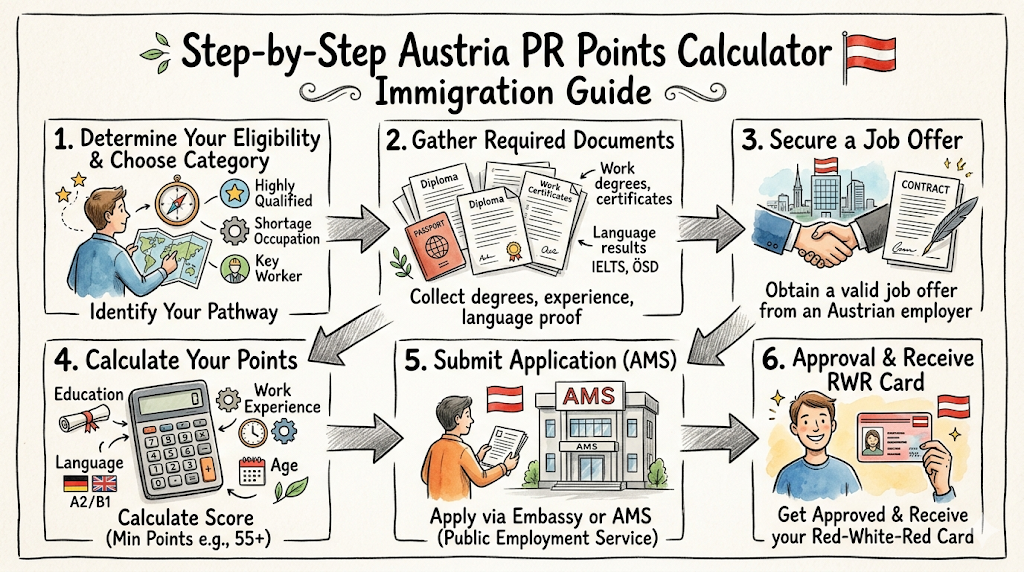
Step-by-Step Application Process
Navigating the application process requires careful planning and strict adherence to official timelines.
Missing a single step can lead to delays or require you to restart the entire process.
Step 1 – Check Eligibility
Use the online Austria PR points calculator to verify that your profile clears the required point boundary.
Identify your specific target stream and ensure your self-calculated score is completely accurate and realistic.
Step 2 – Collect Documents
Gather every piece of paper required to back up the points you claimed on the calculator tool.
This includes diplomas, employment references, official tax records, and language test results.
Step 3 – Secure a Job Offer
Unless you are applying as a Very Highly Qualified Worker, you must land a valid job offer.
The contract must explicitly state your monthly gross salary, job title, and detailed daily responsibilities.
Step 4 – Submit the Application
File your application at the competent Austrian embassy or consulate general in your current home country.
If you are already legally inside Austria on a visa-free stay, you can file directly at the local residence authority.
Step 5 – AMS Evaluation
The immigration authority forwards your complete application package to the Public Employment Service (AMS).
The AMS verifies your qualifications, checks your points, and runs a labor market test if your track requires it.
Step 6 – Approval and Visa Issuance
Once the AMS issues a positive evaluation, the residence authority approves your Red-White-Red Card.
You will receive a collection notice to pick up your physical residence permit card and begin your life in Austria.
Documents Required
The document collection phase is the most critical part of your entire immigration journey.
Every single claim you make on the points calculator must be backed by clear, verifiable paperwork.
- Valid International Passport: Must have at least several blank pages and be valid for the duration of your stay.
- Birth Certificate: An official copy, fully legalized or apostilled based on your country of origin.
- Passport-Sized Photographs: Recent biometric photos taken within the last six months matching Schengen visa standards.
- Degree Certificates & Diplomas: Full graduation certificates along with detailed academic transcripts for every year of study.
- Official Qualification Recognition: Proof that your foreign degree is equivalent to an Austrian qualification (via ENIC-NARIC).
- Work Experience Letters: Formal letters on company letterhead detailing your precise job titles, start dates, end dates, and tasks.
- Language Certificates: Official test results from recognized institutions like IELTS, TOEFL, ÖSD, TestDaF, or Goethe-Institut.
- Binding Job Contract: A signed employment agreement showing compliance with Austrian labor laws and minimum wage standards.
- Proof of Local Accommodation: A signed Austrian rental lease agreement or accommodation contract showing where you will reside.
- Comprehensive Health Insurance: A valid travel or local insurance policy providing complete medical coverage inside Austria.
- Proof of Sufficient Clean Funds: Recent bank statements showing you can support yourself before your first official paycheck.
Processing Time & Validity
- Understanding the operational timelines helps you plan your relocation, resignation, and travel logistics smoothly.
- The entire process moves efficiently if your documentation is clean and complete from day one.
- The standard official processing time for a Red-White-Red Card application is approximately 8 weeks.
- This timeline begins the moment you submit a complete application package with all fees paid.
- If the authorities request additional documents or clarifications, this processing clock pauses until you submit them.
- When your application is officially approved, your initial Red-White-Red Card is issued with a validity of 24 months.
- This card legally ties you to the specific employer and job role listed in your approved visa application.
- As you near the end of this two-year period, you can apply for a renewal called the Red-White-Red Card Plus.
- The RWR Card Plus removes the restriction of being tied to a single employer, granting you free access to the entire Austrian labor market.
- To transition to the RWR Card Plus, you must show you were employed for at least 21 months out of the previous 24 under your initial card.
- This system creates a clear, reliable pathway to permanent residency and long-term settlement.
- After living and working continuously in Austria for 5 years, you become eligible to apply for long-term EU permanent residency.
- This status gives you permanent living rights, social benefits, and puts you on the path toward full Austrian citizenship.
How to Increase Your Austria PR Points
If your initial score falls short of the required threshold, do not lose hope.
The points system is dynamic, meaning you can actively take steps to improve your profile score.
Learn the German Language
Investing time in learning German is one of the fastest ways to boost your overall points.
Moving from no German skills to a verified A1 or A2 level adds immediate, valuable points to your application.
If you can push your skills to the B1 level, you unlock a major point boost that can bridge a large score gap.
Gain More Professional Experience
If you are just a few points short, working for another year in your home country can help.
Every additional year of verified work experience adds points to your calculator grid, up to the maximum cap.
Elevate Your Educational Qualifications
Completing a relevant post-graduate diploma, a specialized certification, or a Master’s degree yields significant points.
If you choose to study a MINT subject, you also unlock high-value technical bonus points.
Secure a Higher Salary Offer
Talk with your prospective Austrian employer about your professional compensation package.
If they increase your gross monthly salary above the key worker thresholds, it can unlock extra points.
Pivot to a Shortage Occupation
Analyze the official Austrian shortage list to see if your skills align with any in-demand trades.
Pivoting your career toward a shortage occupation lowers your required passing score from 70 down to 55 points.
Common Mistakes Applicants Make
Even highly qualified professionals face rejections due to simple, avoidable errors during the application phase.
Being aware of these common pitfalls helps ensure your application moves forward smoothly.
Wrong Category Selection
Many applicants mistakenly calculate their scores using the wrong immigration stream grid.
For example, applying as a Highly Qualified Worker when your profile fits an Other Key Worker path leads to immediate rejection.
Submitting Expired or Unrecognized Language Certificates
The Austrian immigration authorities maintain a strict list of approved testing organizations.
Submitting an unapproved local language certificate or a test that has passed its two-year validity window will result in lost points.
Missing or Vague Work Experience Reference Letters
A generic reference letter that only states your job title and employment dates is not enough for the AMS.
Your letters must detail your daily technical tasks to prove your work directly matches your qualifications.
Misunderstanding the Points System Calculation
Some applicants assume their general degrees automatically give them maximum points without checking formal equivalency.
Always use an official framework to ensure your points match how the Austrian authorities will grade you.
Applying Without a Valid Job Offer
Except for the specific Very Highly Qualified track, you cannot get an RWR card without an active job offer.
Filing an application based only on your points without a signed Austrian employment contract will lead to an immediate denial.
Real-Life Examples
To see how the points system works in practice, let’s look at three realistic applicant profiles.
Example 1: The IT Professional
- Profile: Rajesh is a 29-year-old Senior Software Engineer from India. He holds a 4-year Bachelor’s degree in Computer Science (a MINT subject). He has 4 years of international work experience and holds a valid B1 English certificate, but speaks no German. He has a solid job offer from a tech company in Vienna.
- Points Estimation: Education: 30 points (MINT degree). Experience: 8 points (4 years = 8 half-years). Language: 10 points (B1 English). Age: 15 points (under 30). Total: 63 Points.
- Outcome: Rajesh applies under the Skilled Workers in Shortage Occupations stream, which requires a minimum of 55 points. Since his score is 63, his application is approved, and he receives his Red-White-Red Card.
Example 2: The Experienced Tradesperson with Moderate Points
- Profile: Elena is a 38-year-old CNC Machinist from Serbia. She completed a technical vocational high school program matching a shortage trade. She has 8 years of work experience outside Austria. She holds an A2 German certificate but does not speak English. She has a valid job contract from an engineering firm in Linz.
- Points Estimation: Education: 30 points (vocational training in shortage trade). Experience: 16 points (8 years = 16 half-years). Language: 10 points (A2 German). Age: 10 points (38 years old). Total: 66 Points.
- Outcome: Elena applies under the Shortage Occupations stream. Her score of 66 comfortably clears the 55-point minimum threshold, leading to a successful visa approval.
Example 3: The International Student Transitioning to Work
- Profile: Sarah is a 25-year-old citizen of Canada who just graduated with a Master’s degree from a university in Graz, Austria. She has a local job offer as a junior business analyst paying the required minimum wage for graduates.
- Points Estimation: As a graduate of an Austrian university, Sarah is exempt from the traditional points-based scoring grid. She does not need to count points for age, language, or experience.
- Outcome: The AMS simply verifies that her job offer matches her degree qualification and meets the minimum graduate salary floor. Once confirmed, Sarah easily transitions directly to her Red-White-Red Card.
FAQs
1. What is Austria PR Points Calculator?
The Austria PR Points Calculator is an online self-assessment tool that helps you calculate your score for immigration. It mimics the official points system used by the Austrian government to evaluate applicants for the Red-White-Red Card.
2. Is German language required for Austria PR?
German is not always mandatory, but it is highly recommended. You can earn points with English skills, but knowing German gives you a significant point boost and makes integrating into daily life much easier.
3. How many points are needed for the Red-White-Red Card?
The required points depend on your application stream. Very Highly Qualified Workers need at least 70 points, while Skilled Workers in Shortage Occupations and Other Key Workers require a minimum of 55 points.
4. Can I apply for Austria PR without a job offer?
Only applicants under the Very Highly Qualified Workers category can apply without an initial job offer. They can get a 6-month Job Seeker Visa to come to Austria and look for work. All other categories require a valid job contract to apply.
5. How long does it take to process the RWR Card?
The standard processing time for a complete Red-White-Red Card application is about 8 weeks. This timeline can extend if the immigration authorities require additional documents or clarifications from you or your employer.
6. Can I convert my Red-White-Red Card into Permanent Residency?
Yes, the Red-White-Red Card offers a clear pathway to permanent residency. After 2 years, you can transition to an RWR Card Plus, and after 5 years of continuous living and working, you can apply for long-term EU permanent residency.
7. What is the age limit for the Austria points system?
There is no strict maximum age limit to apply, but the points system favors younger applicants. You receive the maximum points if you are under 30, fewer points up to 40, and the minimum points between 41 and 50.
8. What happens if the AMS rejects my points calculation?
If the AMS finds that your documented proof does not support the points you claimed, your application will be refused. Always ensure you have clear, official paperwork for every point you claim on the calculator.
9. Are English language skills recognized in the points system?
Yes, official English language proficiency certificates like IELTS or TOEFL are recognized. They provide useful points under the language criteria across most Red-White-Red Card streams.
10. What is the Red-White-Red Card Plus?
The Red-White-Red Card Plus is a renewal visa available after holding your initial RWR card for 2 years. It grants you full, unrestricted access to the Austrian labor market, meaning you can change employers freely.
11. Do I need to get my foreign university degree verified?
Yes, foreign degrees must go through a formal recognition process to confirm they are equivalent to an Austrian qualification. This is typically done through ENIC-NARIC before you submit your visa application.
12. Can I bring my family with me on an RWR Card?
Yes, close family members, including your spouse and dependent children, can apply for accompanying residence permits. They receive a Red-White-Red Card Plus, which allows them to work freely in Austria from day one.
Conclusion
Navigating a new country’s immigration system can feel overwhelming at first, but Austria’s structured approach makes the journey clear and predictable. The Red-White-Red Card system removes the guesswork, giving you a transparent path based on your education, experience, age, and language skills. Taking the time to plan your profile, improve your language abilities, and organize your documents is the key to a successful application. Every step you take to optimize your profile brings you closer to a rewarding career and life in the heart of Europe. Stay focused, use the available tools to track your progress, and approach each step with care.