Introduction
Computers have come a long way from the giant, room-sized machines of the 1940s to the thin smartphones in our pockets. Yet, standard computers still hit a wall when faced with problems that involve nature’s most complex puzzles, like inventing life-saving medicines or building ultra-efficient solar panels. To crack these tough nuts, researchers are building quantum computers. Instead of basic bits that can only be a zero or a one, these futuristic machines use quantum bits, or qubits, which can exist as both numbers at the exact same time.
When most people picture a quantum computer, they imagine giant gold chandeliers made of coiled wires and frozen circuits chilled to temperatures colder than outer space. Giants like IBM and Google use this design, printing artificial circuits onto silicon chips. But another group of scientists is taking an entirely different approach. Instead of building qubits by hand inside a factory, they pick up individual, genuine atoms directly from nature and suspend them in mid-air using invisible electrical cages.
This approach is known as trapped ion quantum computing. It sounds like pure science fiction, but teams are already running calculations on floating atoms every single day. If you want to understand how these machines actually run behind the scenes, learning resources like Quantum Ops School can give you a clear map of the entire hardware landscape. Let us open up this invisible trap, shine a flashlight inside, and see how floating particles can calculate the future.
What is a Trapped Ion?
To understand this machine, we have to start with the absolute basics of matter. Everything around you—your desk, the water you drink, and your own hands—is made of tiny building blocks called atoms. At the center of every atom sits a nucleus, surrounded by a cloud of even smaller, buzzing particles called electrons. In its normal state, an atom is electrically neutral because its positive and negative parts balance each other out like an even seesaw.
An ion is simply an atom that has had this balance tipped. If you shoot a laser beam at a neutral atom with just the right amount of energy, you can knock one of its outer electrons right out of orbit. Because the atom just lost a negative charge, it suddenly becomes positively charged. That tiny change transforms an ordinary atom into an ion, and that positive charge is the secret handle scientists need to grab hold of it.
You cannot hold an uncharged atom in place easily because it will just drift away like dust in the wind. But because an ion carries an electric charge, it reacts strongly to electric and magnetic fields. Think of it like metal paperclips scattered across a table: you cannot move them with your breath alone, but the moment you bring a magnet nearby, you can lift them, steer them, and hold them in place without ever touching them with your fingers.
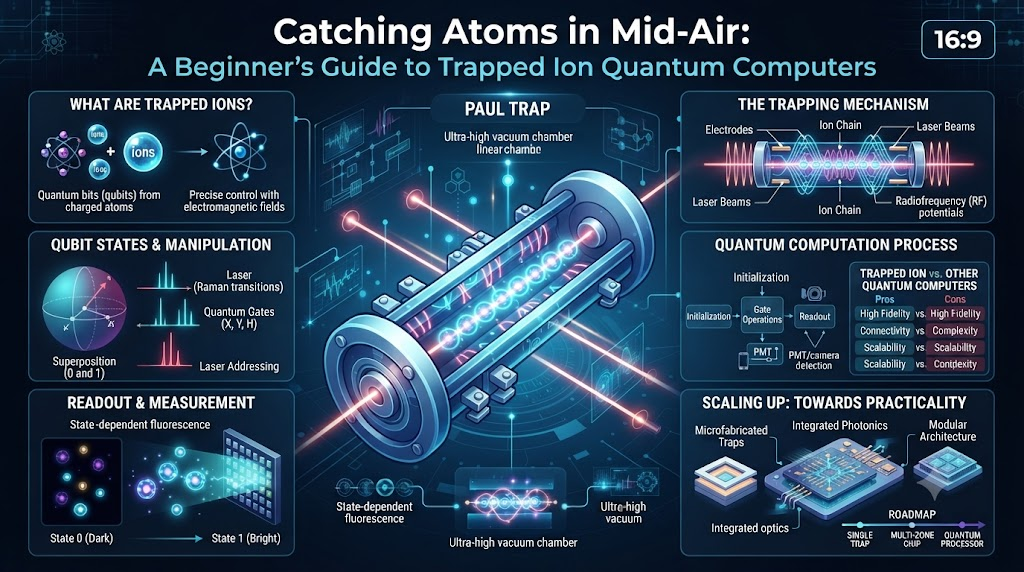
Scientists place these charged ions inside an airtight metal chamber where all the air has been pumped out, creating an ultra-clean vacuum emptier than deep space. Inside this empty room, special metal electrodes generate oscillating electric fields. These fields act like an invisible bowl, pushing on the ion from all sides so it cannot escape. The result is a row of perfectly still, glowing points of light floating completely free in the center of the chamber.
How Lasers Control Quantum Data
Once you have a line of charged atoms hovering in mid-air, you need a way to talk to them. A regular computer uses copper wires to send electrical signals back and forth across a motherboard. But you cannot attach a microscopic metal wire to a single floating atom without knocking it away. Instead of physical wires, trapped ion computers use ultra-precise beams of laser light as their keyboards, wires, and monitors.
The Magnetic Trap
The journey starts at the physical trap itself, which is often a microchip-sized piece of metal with tiny gold pads printed on top. High-frequency electrical voltages dance across these gold pads, creating a small electric field that acts like an invisible track. When scientists drop a few dozen ions into this track, the ions naturally line up in a neat, straight row.
Why do they line up so neatly? Because all the ions carry the same positive electric charge, and like charges push away from each other. At the same time, the electric trap pushes them inward to keep them from flying out. These two forces balance each other out perfectly. The atoms end up sitting in a straight, evenly spaced crystal line, suspended cleanly above the surface of the chip.
Writing Data with Lasers
Once the atoms are parked in their invisible garage, it is time to write information into them. Inside each atom, electrons can sit in different energy levels, which you can picture as the rungs of a ladder. The lowest rung is called the ground state, and a higher rung is called the excited state. Scientists label the lower rung as a “0” and the higher rung as a “1”.
To flip a bit from a 0 to a 1, a laser fires a quick pulse of light directly at a single atom. If the light hits the atom with the exact right frequency and duration, the atom absorbs that energy and its electron jumps up to the higher rung. By tuning the laser pulse just right, scientists can even place the electron halfway between both rungs at once. This strange half-and-half state is quantum superposition, the fundamental superpower that lets a quantum computer explore countless paths at once.
Reading the Answers
After the laser beams finish carrying out the calculation steps, the machine has to report the answer back to the human programmer. Reading the data is surprisingly straightforward and visually stunning. The computer turns on a specific detection laser that hits every atom in the row all at once.
If an atom ended up in the “0” state, it ignores the light and stays completely dark. But if the atom ended up in the “1” state, it absorbs the light and immediately spits it back out, glowing like a tiny firefly. High-resolution digital cameras pointed through the window of the vacuum chamber snap a picture of the row. The scientist sees a row of bright dots and dark gaps: bright means one, dark means zero. The math problem is solved.
Comparing Trapped Ions vs. Superconducting Qubits
The quantum computing race is filled with different technologies, but the biggest competition right now is between trapped ions and man-made superconducting circuits. Both designs can run calculations, but they work on completely different principles.
| Feature | Trapped Ion Computer | Superconducting Qubit Computer |
| Qubit Source | Real atoms from nature (like Ytterbium or Calcium) held in a vacuum | Artificial metal circuits printed on silicon chips |
| Error Rate & Memory | Very low errors; holds data for seconds or even hours | Higher errors; data fades away in tiny fractions of a second |
| Calculation Speed | Slower gate operations (measured in milliseconds) | Extremely fast gate operations (measured in nanoseconds) |
| Operating Temperature | The trap works at room temperature; uses basic cooling | Requires ultra-cold dilution refrigerators near absolute zero |
| Qubit Connection | Any atom can easily talk to any other atom in the chain | Atoms can usually only talk to their immediate chip neighbors |
This comparison highlights a classic trade-off between natural perfection and raw manufacturing speed. Because trapped ions are real atoms provided by nature, every single one is identical to its neighbor. You never have to worry about a factory flaw making one atom slightly different from another. Because they float in empty space without touching anything, their fragile quantum information lasts an unusually long time before fading into background noise.
On the other hand, superconducting chips can run individual operations thousands of times faster than trapped ions. Their challenge is that man-made circuits are never 100% identical under a microscope, and touching the surface of a physical chip exposes them to electrical noise and heat. While superconducting systems run like high-speed sports cars that need constant maintenance on a bumpy track, trapped ions run more like steady, ultra-reliable long-distance trains.
Furthermore, trapped ions enjoy an advantage known as all-to-all connectivity. If you want the first atom in a line of twenty to share information with the twentieth atom, you can simply wiggle the whole line like a plucked guitar string to pass the message down. On a printed silicon chip, information often has to hop through several intermediate neighbors to get across the board, which introduces extra opportunities for errors to creep in.
The Biggest Advantages of Floating Atoms
The greatest strength of trapped ion hardware comes down to a simple truth: nature is the world’s best manufacturer. When human engineers make computer chips in a factory, microscopic imperfections are unavoidable. Two chips printed on the same silicone wafer will still have tiny differences in wire thickness or material purity. With trapped ions, every single Ytterbium atom in the universe has the exact same mass, the exact same charge, and responds to the exact same laser frequency. You get flawless, identical parts right out of the box for free.
Another major benefit is memory lifetime, known to scientists as coherence time. Quantum information is notoriously delicate; even the slightest vibration or stray warmth can ruin a calculation. Because trapped ions float in an empty vacuum, they do not bump into stray air molecules or touch warm surfaces. A trapped ion can hold onto its quantum memory for many seconds, and in some lab tests, for over an hour. Superconducting qubits, by comparison, often lose their memory in a few hundred microseconds.
Finally, trapped ion systems can run their core logic traps at everyday room temperature. While the atoms themselves are laser-cooled to slow their movement down to a crawl, the giant, expensive, deep-freeze refrigerators required by other quantum designs are not strictly necessary here. This makes the physical hardware easier to service and allows engineers to run tests without waiting days for a giant metal tank to chill down to absolute zero.
The Challenge of Scaling Up
If trapped ions are so clean, stable, and identical, why does everyone not have one on their office desk already? The primary hurdle boils down to a classic engineering challenge: scale. While managing ten or thirty ions in a neat line is achievable in modern laboratories, managing ten thousand or a million of them is an entirely different beast.
When a line of ions gets too long, it behaves like an overly long piece of wet spaghetti. The ions start wobbling in unpredictable ways, making it hard to keep them in a stable row. If the chain starts vibrating randomly, the lasers can no longer hit their targets cleanly, and the calculations fall apart. Because of this, scientists cannot just keep stuffing more atoms into a single line; they have to find ways to link multiple smaller traps together.
The optical system creates another massive engineering puzzle. Each atom in the trap needs to be hit by tightly focused laser beams that cannot spill over onto the atom sitting right next to it. Imagine holding fifty laser pointers and trying to aim each one at fifty tiny specks of dust floating in a row, without your hands shaking even a fraction of a millimeter. As you add more atoms, the maze of lenses, splitters, and mirrors becomes overwhelmingly complex.
To solve this, hardware teams are working on modular systems. Instead of one giant trap, they are building chips with tiny intersections, shuttling atoms around corners like trains in a subway station. Other teams are connecting separate vacuum chambers together using fiber-optic cables to share light signals between boxes. These engineering solutions are advancing rapidly, but turning laboratory physics experiments into rugged, compact commercial machines remains a demanding journey.
FAQs
What is the simple difference between an atom and an ion?
An atom has an equal number of positive protons and negative electrons, meaning it has no electric charge. An ion is an atom that has gained or lost an electron, which gives it an electrical charge that allows it to be pushed or pulled by electric fields.
Why do trapped ion computers need a vacuum chamber?
If air molecules were floating around inside the machine, they would constantly slam into the suspended ions and knock them out of their trap. The vacuum chamber removes all air so the ions can float completely undisturbed.
Do trapped ion quantum computers need to be frozen like other quantum computers?
No, the vacuum chamber itself can sit at room temperature. The atoms inside are cooled down using special lasers that slow down their motion, but the system does not require the massive, sub-zero dilution refrigerators used by superconducting systems.
Can you see a trapped ion with your bare eyes?
Yes, under the right conditions. When a laser hits a trapped ion, the atom absorbs and re-emits millions of photons of light per second. In a dark room, through the window of the vacuum chamber, you can see it as a tiny, faint pinprick of glowing light.
How do scientists keep the ions from sticking together?
Because every ion in the trap has lost an electron, they all carry the same positive charge. Just like two matching ends of a magnet push each other away, the positive ions naturally repel each other and stay evenly spaced apart.
What element is used to make trapped ions?
Scientists commonly use elements like Ytterbium, Barium, Calcium, or Beryllium. These elements have single outer electrons that are easy to isolate and respond well to standard laser light colors.
How do lasers cool down atoms?
When an atom moves toward a laser beam, it absorbs light particles that push against its forward motion, much like running into a steady headwind. This process, known as Doppler cooling, drains the atom’s movement energy until it is nearly motionless.
What is coherence time and why does it matter?
Coherence time is the amount of time a qubit can hold onto its quantum information before outside noise ruins it. Trapped ions have long coherence times, meaning they can hold data for seconds or even hours without forgetting it.
Why is it hard to put thousands of ions in a single computer?
As you add more ions to a line, the chain becomes unstable and begins to wobble. Aiming hundreds of separate laser beams at hundreds of tiny floating targets without hitting neighboring atoms also becomes an overwhelming optical puzzle.
Are trapped ion computers available for people to use today?
Yes, several commercial companies build trapped ion systems and make them accessible to businesses, researchers, and developers over the cloud for running experimental algorithms.
Conclusion
Trapped ion quantum computing takes one of the most basic ingredients of the universe—a single charged atom—and turns it into an advanced computational tool. By taking atoms out of nature, stripping away an electron, and locking them inside an electric cage, researchers have bypassed many of the manufacturing flaws that plague traditional chipmaking.
Controlling matter with focused light beams instead of physical wires provides an incredibly clean way to store fragile quantum information. While engineers still face tough challenges in routing laser beams and scaling up to thousands of qubits, the clean physics of identical atoms gives this design a bright path forward. As these invisible traps become more sophisticated, they will continue to open new doors into chemistry, materials science, and complex problem-solving that standard computers could never hope to unlock.