Introduction
In complex enterprise environments, the greatest technical debt often hides not within the application code itself, but within brittle deployment processes and inconsistent server environments. Engineering teams frequently find themselves trapped in reactive maintenance cycles where ad-hoc terminal commands, untracked configuration changes, and opaque production outages consume valuable sprint cycles. Whether your organization manages on-premises server clusters, transitions workloads into hybrid cloud topographies, or restructures engineering teams around self-service internal tooling, a structured architectural methodology is critical. Modern engineering organizations prioritize building repeatable platforms that reduce operational friction and enforce verifiable delivery gates. Through structured DevOps training China, engineering leads and technical teams can systematically master automated delivery pipelines, container platforms, declarative infrastructure, and observability strategies to create predictable, resilient production environments.
Understanding Modern DevOps: Architectural Principles and System Design
Approaching DevOps from an architectural viewpoint reveals that it is primarily a discipline of system feedback, automation, and boundary reduction. Traditional organizational models divided the delivery lifecycle into isolated segments where developers wrote code without operational insight, while system administrators managed runtime behavior without visibility into code logic.
This division created operational drag. Deployments required manual intervention, environments drifted from staging baselines, and production incidents triggered blame cycles rather than technical root-cause analyses.
Modern operations eliminate this boundary by codifying infrastructure, baking security policies directly into delivery pipelines, and measuring runtime performance using quantifiable metrics.
By decomposing large, high-risk quarterly releases into automated, continuous micro-deployments, teams minimize the surface area of potential failures. When a change introduces unexpected behavior, automated telemetry detects the degradation immediately, allowing systems to self-heal or execute controlled rollbacks before users experience disruption.
Core architectural foundations include:
- Declarative System State: Defining servers, networks, and cluster resources as code, allowing engines to automatically reconcile differences between desired and actual states.
- Continuous Integration Feedback: Merging code continuously into shared branches and triggering automated unit, integration, and security scans to identify defects at the earliest possible stage.
- Shift-Left Defensive Validation: Embedding static analysis, dependency scanning, and compliance policy checks directly into automated build steps rather than waiting for external auditing gates.
- Telemetry-Driven Operations: Relying on structured telemetry—metrics, traces, and centralized logs—to make engineering decisions based on observable system behavior.
- Resilient Infrastructure Architecture: Designing services to tolerate unexpected node or network failures gracefully through self-healing controllers, load shedding, and circuit breakers.
How Automated Delivery Works: The Technical Lifecycle
A dependable deployment pipeline functions as an automated assembly line, enforcing strict quality gates before any binary reaches production compute resources.
Source Control → Build Engine → Validation Suite → Security Gates → Container Artifact → Orchestrated Rollout → Telemetry Feedback
The system execution flow operates through disciplined stages:
- Version-Controlled Change Submission: A developer initiates a pull request against a protected branch. Automated webhooks trigger initial linting, style checks, and commit-message validations.
- Deterministic Build Execution: Dedicated build agents instantiate isolated runners, compile application logic, and download locked dependencies from authenticated internal caches.
- Automated Test Suites: The runner executes unit and component integration tests against ephemeral backing databases, validating logic boundaries before proceeding.
- Automated Security Enforcement: Static Application Security Testing (SAST) engines and Software Composition Analysis (SCA) tools parse the source tree and third-party libraries, blocking builds that introduce critical known vulnerabilities.
- Container Image Generation: The runner packages application binaries and minimal runtime dependencies into multi-stage container images, tagging them with immutable Git commit hashes.
- Registry Verification: Images are stored in an authenticated artifact registry where container scanners analyze OS layers for base image CVEs.
- Declarative State Synchronization: GitOps controllers detect the updated image tag in an infrastructure repository and apply updated deployment manifests to the target cluster.
- Continuous Observability & Monitoring: Observability platforms scrape application health endpoints, latency distributions, and error budgets, closing the feedback loop back to the development team.
Core Tooling Across the Enterprise Delivery Stack
Selecting tools requires evaluating their technical fit, integration ergonomics, and long-term maintainability rather than chasing industry trends.
| Domain | Industry Standard Tools | Architectural Function |
| Version Control & Collaboration | Git, GitHub, GitLab | Acts as the single source of truth for application code, infrastructure declarations, and deployment histories. |
| Continuous Delivery Engines | Jenkins, GitLab CI, Argo CD | Automates build sequences, manages execution graphs, and reconciles declarative Git states with live clusters. |
| Container Runtimes | Docker, containerd | Provides isolated, reproducible process sandboxes across development workstations and production servers. |
| Container Orchestration | Kubernetes, Helm | Handles workload scheduling, auto-scaling, automated rollouts, service discovery, and cluster self-healing. |
| Infrastructure as Code | Terraform, OpenTofu, Ansible | Automates infrastructure provisioning across cloud environments and enforces baseline host configurations. |
| Telemetry & Observability | Prometheus, Grafana, OpenTelemetry | Captures real-time metrics, aggregates structured logs, and traces distributed microservice request paths. |
| Defensive Security | SonarQube, Trivy, HashiCorp Vault | Enforces security gates, identifies vulnerable software packages, and provides centralized dynamic secrets management. |
Key Specializations: Cloud Platforms, SRE, and Internal Platform Engineering
Enterprise architectures require specialized skill sets to handle scale, reliability, and security across distributed environments.
Cloud Computing and Hybrid Architectures
Modern architectures rarely exist in static server racks. Engineers design systems capable of operating efficiently across public clouds, private virtualization platforms, and hybrid configurations.
This requires understanding software-defined networking, Virtual Private Clouds (VPCs), Identity and Access Management (IAM) boundaries, and object storage lifecycles. Designing cloud-native systems involves optimizing compute resource allocation to prevent uncontrolled cost sprawl while ensuring high availability across distinct availability zones.
Site Reliability Engineering (SRE)
Site Reliability Engineering shifts operational discussions from subjective impressions to mathematical guarantees. Teams implement reliable operational loops:
SLI Measurement ──► SLO Tracking ──► Error Budget Management ──► Automated Incident Recovery
- Service Level Indicators (SLIs): Quantitative metrics reflecting user experience, such as the proportion of successful HTTP requests or response latency under 200 milliseconds.
- Service Level Objectives (SLOs): Defined operational targets, such as maintaining 99.9% successful transactions over a rolling 30-day window.
- Error Budgets: The acceptable margin of failure ($100\% – \text{SLO}$). When an error budget is healthy, teams release new features aggressively. If the error budget depletes due to production instability, deployments halt to prioritize reliability engineering.
- Root-Cause Analysis and Post-Mortems: Conducting blameless technical reviews after critical incidents to identify architectural weaknesses, improve monitoring coverage, and prevent recurrence.
Platform Engineering and Developer Self-Service
Platform engineering treats internal infrastructure as a product, where application developers are the primary customers. Instead of requiring developers to write complex deployment manifests or configure cloud security groups manually, platform teams build Internal Developer Platforms (IDPs).
These platforms provide curated “golden paths”—standardized templates, self-service provisioning portals, and automated deployment pipelines that allow development teams to deliver code autonomously without bypassing organizational governance or security policies.
Real-World Engineering Scenario: Canary Deployment with Automated Rollback
Consider an e-commerce platform updating its checkout service. A direct cutover risks exposing all active shoppers to unexpected latency spikes or payment processing failures. An architectural solution utilizes an automated canary deployment pattern on Kubernetes:
1. Pipeline Trigger and Verification:
A developer merges an optimized payment routing algorithm. The CI pipeline executes comprehensive unit tests, passes SAST security scans, builds checkout-service:v3.2.0, and pushes the image to the enterprise registry.
2. Incremental Canary Scheduling:
The deployment controller creates a canary Deployment alongside the stable checkout-service:v3.1.0 workload. The ingress controller routes 95% of incoming user traffic to the stable revision and directs 5% of real traffic to the canary instance.
3. Telemetry Ingestion and Analysis:
Prometheus scrapers capture error rates, HTTP 5xx responses, and transaction latency across both revisions in real time. The canary analysis controller evaluates telemetry data over a ten-minute observation window against defined SLIs.
4. Failure Detection and Self-Healing:
The canary instance begins emitting elevated database connection timeouts, increasing its HTTP 500 error rate to 2.1%, exceeding the acceptable threshold of 0.5%.
- The automated controller halts the promotion sequence immediately.
- Ingress routing dynamically drops canary traffic back to 0%, directing 100% of shopper requests back to the stable baseline.
- The canary Pods are safely scaled to zero without service degradation or manual intervention.
- An automated alert with relevant distributed trace links is dispatched to the service owners, enabling fast root-cause identification.
Resolving Critical Operational Bottlenecks
Transitioning to automated delivery models introduces technical and organizational hurdles that require structured mitigation strategies.
Configuration Drift Across Servers ──► Enforce Immutable Declarative Infrastructure
Uncoordinated Microservice Deploys ──► Implement GitOps & Automated Health Probes
Fragmented Logging & Blind Spots    ──► Standardize Structured OpenTelemetry Ingestion
Last-Minute Security Bottlenecks   ──► Shift-Left Vulnerability Scanning into CI
Challenge 1: Environment Drift and Untracked Modifications
Engineers logging directly into servers to install patches or modify configuration files inevitably cause environments to diverge, creating scenarios where software passes staging but fails unpredictably in production.
Mitigation: Adopt immutable infrastructure paradigms. Prohibit interactive SSH write permissions in production environments. All configuration changes must occur through version-controlled Infrastructure as Code (IaC) repositories using automated pull requests.
Challenge 2: Coordination Overhead in Distributed Microservices
As services multiply, managing inter-service dependencies, database schema migrations, and API backwards compatibility becomes complex.
Mitigation: Implement strict semantic versioning, contract testing, and backward-compatible API designs. Decouple database migrations from application deployments, allowing old and new application versions to operate concurrently during phased rollouts.
Challenge 3: Inefficient Incident Diagnostics
Distributed architectures make tracing single-user transactions across dozens of microservices challenging when logs are scattered across individual node filesystems.
Mitigation: Mandate structured JSON logging across all application runtimes. Standardize on distributed tracing frameworks like OpenTelemetry to inject trace and span IDs across network boundaries, allowing engineers to visualize entire execution graphs during incidents.
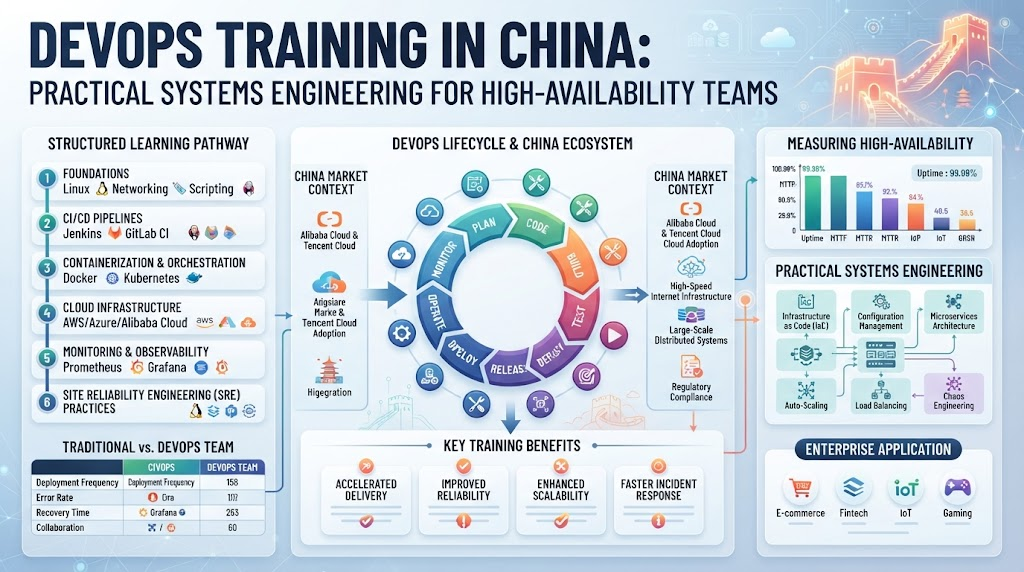
Recommended Skill Progression Roadmap
Building operational proficiency requires developing competency across multiple layers of the technology stack, moving deliberately from core systems to high-level platform architecture.
Foundations (Linux Systems, TCP/IP, Shell Scripting, Git Branching)
   │
   ▼
Automation & Containers (Docker Packaging, CI Pipelines, Automated Testing)
   │
   ▼
Orchestration & Infrastructure (Kubernetes Administration, Terraform IaC, Ingress)
   │
   ▼
Advanced Architecture (SRE Metrics, DevSecOps Compliance, Internal Platforms)
Step 1: System Foundations and Version Control
- Operating System Mechanics: Process lifecycles, memory allocation, systemd service management, and Linux namespaces.
- Networking Topologies: Subnetting, routing tables, DNS resolution, TLS handshakes, and reverse proxying.
- Operational Scripting: Bash and Python automation for parsing configurations, manipulating data structures, and orchestrating local commands.
- Git Fundamentals: Declarative commit hygiene, rebase workflows, and collaborative branch protections.
Step 2: Containerization and Continuous Integration
- Container Mechanics: Creating secure, multi-stage Dockerfiles that eliminate development toolchains from final production images.
- Build Orchestration: Configuring automated runners (Jenkins, GitLab CI, GitHub Actions) to run parallelized validation matrices.
- Artifact Management: Signing container images, scanning base layers, and maintaining internal dependency caches.
Step 3: Distributed Orchestration and Declarative IaC
- Kubernetes Workload Management: Managing Pod lifecycles, Services, Ingress objects, ConfigMaps, and persistent storage volumes.
- Infrastructure Automation: Writing modular, state-managed Terraform code to provision virtual networks, compute clusters, and storage resources reproducibly.
- Configuration Management: Using tools like Ansible to enforce consistent baseline configurations across hybrid infrastructure nodes.
Step 4: Reliability Engineering and Platform Governance
- Observability Design: Instrumenting code with distributed traces, aggregating metrics in Prometheus, and building actionable Grafana operational views.
- Security Automation: Implementing automated container image signing, runtime security monitoring, and policy-as-code enforcement.
- Developer Enablement: Abstracting complex Kubernetes YAML behind clean, self-service internal developer portals and reusable pipeline templates.
Professional Certifications vs. Engineering Experience
Balancing technical certifications with production experience is an important consideration for career progression and team development.
| Dimension | Professional Certifications | Practical Engineering Experience |
| Primary Value | Establishes structured technical foundations, validates command-line competence, and proves familiarity with core tooling APIs. | Develops diagnostic intuition, production troubleshooting skills, and the ability to make pragmatic engineering trade-offs. |
| Evaluation Method | Timed examinations, sandbox labs, and standardized architectural multiple-choice or terminal tasks. | Managing complex production outages, migrating legacy codebases, and designing highly available distributed systems. |
| Complementary Role | Provides the structured curriculum and theoretical knowledge needed to approach complex tools with confidence. | Tests an engineer’s ability to operate under pressure when production systems fail in unanticipated ways. |
Certifications such as the Certified Kubernetes Administrator (CKA) or cloud-specific architecture certifications demonstrate commitment to mastering modern platforms. However, top-tier engineering organizations value engineers who can combine verified tool familiarity with practical troubleshooting capabilities, architecture design skills, and clear technical communication.
Selecting the Appropriate Training Model
Choosing the right educational framework depends on your current engineering background and organizational priorities.
- Independent Study and Sandboxes: Effective for engineers seeking to familiarize themselves with tool syntax and open-source projects using self-paced labs.
- Structured Mentor-Led Programs: Recommended for developers and system administrators looking to transition into modern infrastructure roles with direct feedback on architectural best practices.
- Corporate Transformation Programs: Tailored for enterprise organizations migrating away from manual operational models. Corporate training aligns team practices directly with the enterprise’s existing tech stack, security policies, and production delivery constraints.
When evaluating external educational resources, organizations often seek comprehensive technical frameworks that combine theoretical foundations with realistic terminal labs. Platforms like DevOpsSchool.cn provide comprehensive learning paths covering continuous integration pipelines, Kubernetes orchestration, Site Reliability Engineering, and cloud automation workflows designed to meet enterprise delivery demands.
Frequently Asked Questions (FAQs)
What is the core focus of modern DevOps training China?
The training covers version control systems, continuous integration and delivery pipelines, containerization with Docker, container orchestration via Kubernetes, declarative Infrastructure as Code using Terraform, and comprehensive system observability.
How does an architectural approach to DevOps differ from a tool-centric view?
A tool-centric view focuses solely on learning syntax for utilities like Jenkins or Docker. An architectural approach emphasizes designing resilient delivery systems, automating feedback loops, eliminating environmental drift, and aligning technical tools with business stability.
Why is containerization essential for continuous delivery?
Containerization bundles application code together with its exact runtime dependencies into an immutable image. This ensures identical execution behavior across local development environments, automated testing runners, and production clusters, eliminating environment-specific bugs.
What makes Kubernetes a standard in cloud-native training?
Kubernetes provides automated scheduling, service discovery, rolling updates, self-healing, and declarative configuration. Mastering Kubernetes enables engineers to manage containerized microservices reliably at scale across hybrid and multi-cloud environments.
How does Site Reliability Engineering balance feature delivery and system health?
SRE introduces error budgets derived from Service Level Objectives. If system reliability stays within its target threshold, teams can deploy features rapidly. When the error budget is exhausted, releases pause to prioritize reliability improvements.
What defensive security practices are emphasized in DevSecOps curricula?
Key practices include static application security testing (SAST), software composition analysis (SCA) to identify vulnerable libraries, container layer vulnerability scanning, dynamic secrets management, and automated policy-as-code enforcement in pipelines.
What are the prerequisites for engineers entering an advanced DevOps program?
Candidates should possess a foundational understanding of Linux command-line administration, basic computer networking concepts (such as DNS, HTTP, and TCP/IP), Git version control basics, and familiarity with at least one scripting language like Bash or Python.
How do professional certifications complement practical operational experience?
Certifications provide a structured study roadmap and demonstrate baseline competency in tool syntax and architectural standards. Practical experience builds the critical troubleshooting skills, trade-off analysis, and composure needed during production outages.
What is the objective of Platform Engineering in enterprise teams?
Platform engineering designs and maintains internal developer platforms that provide self-service infrastructure and automated delivery workflows. This enables development teams to ship applications quickly while maintaining operational compliance and security standards.
How does declarative Infrastructure as Code eliminate configuration drift?
Declarative IaC defines the desired end-state of infrastructure in version-controlled configuration files. Automation tools continuously reconcile this specification with real-world infrastructure, automatically identifying and resolving unapproved manual modifications.
Conclusion
Modern software delivery demands speed, system stability, and defensive security. Relying on fragmented scripts, undocumented server modifications, and reactive troubleshooting creates systemic fragility that undermines business agility. By adopting declarative infrastructure, automated CI/CD validation pipelines, container orchestration, and disciplined reliability practices, engineering organizations build systems capable of evolving without fear of failure. Mastering these skills requires curiosity, consistent hands-on lab experimentation, and an architectural perspective focused on long-term maintainability. Engineers and teams that commit to structured learning paths and modern engineering practices will continue to lead the way in building resilient, high-velocity delivery platforms.