Introduction
Analytics engineers exist at the intersection of business logic and systems design. On any given day, an analytics engineer might receive conflicting requests: marketing requires a new attribution model by the end of the day, finance reports that monthly recurring revenue numbers are mismatched, and executive leadership questions why a dashboard refreshed forty minutes late. Without an automated platform backing them up, analytics engineers spend more time debugging brittle staging tables and explaining downstream discrepancies than actually building valuable analytical models. Solving this friction requires an intentional DataOps architecture. By approaching modeling, testing, orchestration, and deployments through a code-first engineering methodology, analytics engineers can ensure that every metric served to business users is tested, version-controlled, and observable. Whether you are standardizing analytical layers or following the technical guides on DataOpsSchool.com, this blueprint outlines how to build an end-to-end operational architecture designed for speed, modularity, and reliability.
What Is DataOps Architecture from an Analytics Engineering Viewpoint?
From the perspective of an analytics engineer, DataOps architecture is the system harness that allows data modelers to write, test, review, and deploy transformation logic with the same rigor and confidence as software engineers.
Historically, business intelligence relied on monolithic procedural scripts or graphical drag-and-drop ETL tools. Transformations were executed directly inside production databases, creating opaque calculations hidden from version control. When a query broke, finding the root cause required stepping through hundreds of lines of legacy database stored procedures.
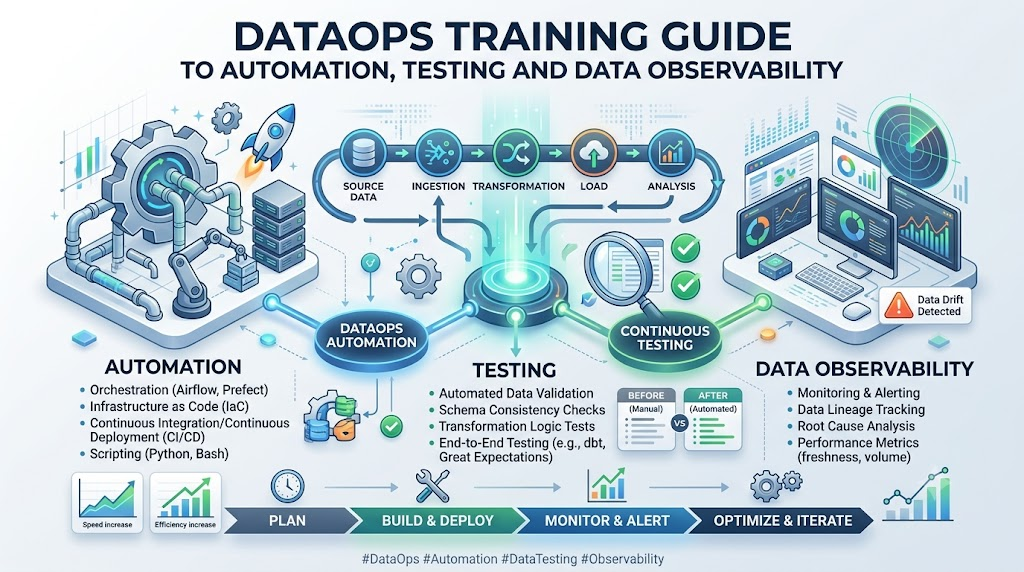
                      ANALYTICS ENGINEERING DATA LIFECYCLE
+---------------------------------------------------------------------------------------+
|  CODE DEFINITION: Version-Controlled SQL / YAML Models, Semantic Metrics, Contracts   |
+---------------------------------------------------------------------------------------+
|  VERIFICATION HARNESS: Pre-Commit Linting, Slim CI Builds, Ephemeral Target Schemas   |
+---------------------------------------------------------------------------------------+
|  TRANSFORMATION ENGINE: Declarative Staging, Intermediate Joining, Mart Aggregations  |
+---------------------------------------------------------------------------------------+
|  QUALITY GATES: Column Assertions, Referential Tests, Automated Circuit Breakers      |
+---------------------------------------------------------------------------------------+
|  SERVING & GOVERNANCE: Certified Dimensions, Machine-Readable Lineage, Observability  |
+---------------------------------------------------------------------------------------+
A modern operational architecture converts data modeling into a declarative software workflow:
- Transformation code is authored as modular SQL select statements.
- Dependencies between dimensional entities resolve programmatically via lineage graphs (DAGs).
- Pull requests trigger automated continuous integration (CI) jobs that build altered models in ephemeral testing environments.
- Production deployments run automatically, protected by runtime assertions that intercept anomalies before dashboards update.
The Modeler’s Dilemma: Why Transformations Break Without Architecture
When data teams lack an operational architecture, the analytics layer absorbs the downstream shock of every upstream failure:
[Legacy Anti-Pattern]:
Raw Ingestion ──> Unchecked Transformations ──> Shared Production Schema ──> Broken Dashboards
                  (Silent Schema Drifts)        (Colliding Git Branches)     (User Discovers Error)

[DataOps Pattern]:
Raw Ingestion ──> Ingestion Contracts ──> Ephemeral CI Validation ──> Gated Production Marts
                  (Schema Enforcement)    (Slim Builds on PRs)        (Circuit Breakers)
Unannounced Upstream Schema Drift
An upstream product engineer renames a user ID field or splits a single address column into two fields in the application database. If the ingestion pipeline dumps this data directly into the analytical warehouse, downstream dimensional models fail during execution, stalling subsequent updates for the rest of the company.
Shared Database Collision
When multiple modelers build features in a shared staging database, branches collide. One analyst alters a shared reference table to test a temporary report, inadvertently causing a teammate’s continuous transformation job to produce incorrect metrics.
Silent Semantic Degradation
A query may execute without throwing a syntax error while still generating invalid calculations. For example, a left join that accidentally produces a Cartesian product inflates revenue figures by 300%. Without explicit uniqueness assertions running inside the architecture, business users consume distorted metrics without warning.
Core Layers of an Analytics-Centric DataOps Architecture
A resilient architecture structures the data journey into logical, isolated tiers. Each layer serves a dedicated transformation objective, maintaining clear boundaries between raw inputs and certified consumption outputs.
+-----------------------------------------------------------------------------------+
|                           1. CONSUMPTION & SEMANTIC LAYER                         |
|             BI Dashboards, Self-Service Exploration, Reverse ETL Feeds            |
+-----------------------------------------------------------------------------------+
                                         ▲
                           (Validated Gold Dimensional Marts)
+-----------------------------------------------------------------------------------+
|                        2. MODULAR TRANSFORMATION LAYER                            |
|             Staging (Cleaning) ➔ Intermediate (Joins) ➔ Marts (Business)          |
+-----------------------------------------------------------------------------------+
                                         ▲
                           (Clean Raw Tables & Ingestion Contracts)
+-----------------------------------------------------------------------------------+
|                         3. INGESTION & RAW LANDING LAYER                          |
|             Immutable Storage, Partitioned Raw Payloads, Ingestion Alerts         |
+-----------------------------------------------------------------------------------+
                                         ▲
+-----------------------------------------------------------------------------------+
|                       4. AUTOMATION, QUALITY & CI/CD HARNESS                      |
|          Automated Slim Builds, dbt Tests, Data Observability, Lineage            |
+-----------------------------------------------------------------------------------+
1. Ingestion and Raw Landing (The Bronze Tier)
Data lands from transactional databases, cloud event logs, and third-party APIs via automated connectors. In a robust architecture, analytics engineers never query raw ingestion tables directly. Raw tables remain immutable, append-only historical records partitioned by ingestion timestamps.
2. Staging Layer: Standardization and Type Casting
The first transformation tier is the staging layer. Staging models maintain a 1:1 relationship with raw tables, serving as an isolation barrier.
Within this layer, analytics engineers apply defensive modeling:
- Renaming ambiguous column names to standardized naming conventions.
- Casting raw string payloads into strongly typed timestamps, booleans, and numerics.
- Handling basic null values with default fallbacks.
- Pruning unused or deprecated fields before downstream computation.
3. Intermediate Layer: Complex Business Joins
The intermediate layer handles entity resolution, complex joins, and business logic calculations. These models take cleaned staging inputs and join disparate data sets together (such as combining payment charges with customer billing profiles). Intermediate tables are designed to be modular and reusable across multiple end marts, eliminating repetitive code.
4. Marts Layer: Dimensional Serving (The Gold Tier)
The marts layer delivers certified dimensional models (facts and dimensions) optimized for analytical consumption. Models here follow star-schema or wide-table design principles, allowing business analysts and executives to query performance metrics with high speed and zero confusion regarding column meanings.
5. Semantic and Governance Layer
The semantic layer defines business metrics—such as Net Revenue, Daily Active Users, or Customer Acquisition Cost—as version-controlled code rather than isolated calculations in individual BI tools. By managing metrics alongside the transformation models, analytics engineers ensure that regardless of the consumption tool used, calculations remain consistent across all departments.
Tooling Ecosystem for Analytics Engineering
An analytics-centric DataOps architecture focuses on tools that treat data transformations as modular, testable software.
+-----------------------------------------------------------------------------------------+
|                         ANALYTICS ENGINEERING TOOL ECOSYSTEM                            |
+--------------------+--------------------------------+-----------------------------------+
| Operational Tier   | Representative Tools           | Core Architectural Role           |
+--------------------+--------------------------------+-----------------------------------+
| Transformation     | dbt, SQLMesh                   | Modular SQL modeling, DAG lineage,|
|                    |                                | automated documentation           |
+--------------------+--------------------------------+-----------------------------------+
| Cloud Storage      | Snowflake, BigQuery,           | Scalable analytical compute,      |
|                    | Databricks                     | zero-copy clones, partitioning    |
+--------------------+--------------------------------+-----------------------------------+
| Orchestration      | Dagster, Apache Airflow        | Asset-oriented dependency tracking|
|                    |                                | and schedule management           |
+--------------------+--------------------------------+-----------------------------------+
| Quality & Testing  | dbt tests, Great Expectations, | Declarative column constraints and|
|                    | Soda                           | statistical anomaly checks        |
+--------------------+--------------------------------+-----------------------------------+
| CI/CD Automation   | GitHub Actions, GitLab CI      | Pull-request validation, linting, |
|                    |                                | and automated slim builds         |
+--------------------+--------------------------------+-----------------------------------+
| Observability      | Elementary, Monte Carlo        | Freshness monitoring, volume      |
|                    |                                | tracking, automated schema alerts |
+--------------------+--------------------------------+-----------------------------------+
Transformation Engines
- dbt (data build tool): The foundation of analytics engineering. dbt allows modelers to write declarative
SELECTstatements, managing database object creation (tables, views, incremental runs) while automatically resolving dependencies into a directed acyclic graph. - SQLMesh: An emerging transformation platform designed with native environment isolation, automated semantic versioning, and change-impact analysis.
Analytical Data Warehouses
- Snowflake: Provides decoupled compute warehouses and zero-copy cloning, enabling developers to spin up isolated staging schemas instantly without incurring extra storage fees.
- Databricks: Combines Delta Lake formats with scalable compute clusters, offering ACID transactions and time-travel rollbacks for analytical datasets.
- Google Cloud BigQuery: Serverless analytical engine that executes queries across petabyte-scale datasets with built-in machine learning and partition-level caching.
Orchestration and Asset Coordination
- Dagster: An asset-centric orchestrator ideally suited for analytics engineers. Rather than tracking abstract tasks, Dagster tracks the status, freshness, and lineage of physical data assets.
- Apache Airflow: The widely adopted standard for cross-platform workflow orchestration, managing complex tasks that stretch across ingestion, warehouse transformation, and reverse ETL pushes.
Architectural Comparison: Ad-Hoc SQL vs. Modern DataOps
Adopting a structured architecture fundamentally alters how an analytics engineer spends their working hours.
| Dimension | Ad-Hoc Query Modeling | DataOps Architecture |
|---|---|---|
| Logic Storage | Scattered across BI tools, local scripts, and DB views | Version-controlled in a centralized Git repository |
| Testing Strategy | Manual spot-checks after queries finish running | Automated schema, relationship, and custom SQL tests |
| Pipeline Runs | Manual execution or brittle time-based cron jobs | Asset-aware orchestration tracking dependencies |
| Change Review | Changes pushed directly to production schemas | Pull-request reviews with automated CI test builds |
| Metric Definitions | Hand-coded formulas varying across BI dashboards | Centralized semantic layer defining metrics as code |
| Incident Triage | Tracing queries manually through nested views | Machine-readable lineage graphs identifying root causes |
Automated CI/CD Pipelines for Analytics Engineers
The core operational differentiator in a modern architecture is the pull-request automation harness. Analytics engineers should never deploy an untested model directly to production.
[Developer Opens PR] ──> [SQLFluff Linting] ──> [Spin Up Ephemeral Schema]
                                                        │
                                                        ▼
[Merge to Main] ◄── [Peer Code Review] ◄── [Slim Build & dbt Test Suite]
1. Static Analysis and SQL Linting
Before compute resources spin up, automated pre-commit actions run static analysis tools like SQLFluff. These verify that queries follow standardized naming conventions, avoid anti-patterns (such as SELECT *), and contain proper column formatting.
2. Ephemeral Staging Environments
When a pull request opens, the CI runner creates an isolated, ephemeral warehouse schema unique to that pull request branch. This guarantees that test runs never overwrite production tables or interfere with ongoing transformations.
3. Slim Builds and Impact Analysis
Running an entire analytics project on every pull request is slow and expensive. Modern CI frameworks leverage state comparison to execute slim builds:
- The CI pipeline references the manifest of the latest production run.
- It identifies only the models modified in the current branch along with their immediate downstream dependents.
- The system executes and tests only those selected models against the ephemeral schema, reducing CI test execution from hours to minutes.
4. Automated Quality Assertions
Once models compile and run in the ephemeral schema, the CI harness runs automated test suites:
- Uniqueness Assertions: Ensuring primary keys contain zero duplicate records.
- Not-Null Tests: Validating mandatory fields are populated across all rows.
- Referential Integrity Tests: Confirming that foreign keys map cleanly to existing parent dimension records.
- Custom Business Logic Tests: Validating mathematical invariants (such as asserting discount amounts never exceed total transaction values).
5. Automated Promotion and Teardown
Once the pull request receives peer review approval and passes all automated test suites, it merges into the main branch. Production runners execute the updated models against production schemas, and the ephemeral test environment drops automatically to manage cloud costs.
Protecting Metrics with Runtime Circuit Breakers
Even the most thorough CI tests cannot predict anomalous payloads from upstream source feeds. Runtime circuit breakers safeguard analytical models during scheduled pipeline updates.
[Staging Run] ──> [Intermediate Build] ──> [Execute Runtime Tests]
                                                     │
                          ┌──────────────────────────┴──────────────────────────┐
                          ▼                                                     ▼
                  (All Tests Pass)                                      (Assertion Fails)
                          │                                                     │
                          ▼                                                     ▼
               [Publish to Gold Marts]                               [Trip Circuit Breaker]
                          │                                                     │
                          ▼                                                     ▼
               [Update BI Dashboards]                               [Halt Pipeline Execution]
                                                                                │
                                                                                ▼
                                                                     [Retain Prior Clean Data]
- Intermediate Table Creation: Models compile and write records into temporary staging tables rather than overwriting existing production tables immediately.
- Assertion Checkpoints: Automated queries evaluate row volume thresholds, null-rate spikes, and distribution parameters.
- Execution Decision: If all validation assertions pass, an atomic operation swaps the staging table into production. If an assertion fails, the circuit breaker trips: the pipeline halts, an incident alert dispatches to the team, and production dashboards continue serving the previous verified batch without displaying corrupted data.
Professional Career Pathways in Analytics Engineering
As organizations realize that data accuracy directly impacts their bottom line, the demand for professionals who blend analytical acumen with operational engineering discipline continues to grow.
Analytics engineers seeking to scale their impact focus on developing key competencies:
- Advanced declarative SQL modeling, Jinja templating, and dimensional warehouse design.
- Pipeline dependency management, asset scheduling, and incremental data materialization strategies.
- CI/CD deployment automation, version control hygiene, and containerization.
- Data quality framework implementation, contract design, and end-to-end data observability.
To master these architectural skills systematically, many practitioners complete a targeted DataOps Course or pursue a formal DataOps Certification. Preparing for the Certified DataOps Engineer credential validates a practitioner’s ability to build automated testing harnesses, design CI/CD deployment pipelines, and configure cloud infrastructure.
Senior modelers and technical leaders often pursue the Certified DataOps Architect track, which emphasizes multi-tier platform design, enterprise-wide governance frameworks, cloud cost governance, and zero-downtime migration strategies. While certification validates structured understanding, practical experience delivering models in live production environments remains essential.
Enterprises seeking to modernize legacy architectures often accelerate their transformation by engaging professional DataOps Consulting or comprehensive DataOps Services. External platform architects assist teams in establishing declarative modeling standards, building automated CI/CD validation gates, and structuring reliable dimensional marts before internal teams assume full operational ownership.
For tutorials, reference architectures, and deep-dive learning materials, practitioners can explore the educational resources available through DataOpsSchool.com.
Practical Tips
- Model in Layers: Maintain a strict separation between raw ingestion, cleaned staging models, intermediate joins, and dimensional serving marts.
- Test Before You Merge: Always run automated slim builds and schema tests in isolated ephemeral environments before deploying code changes to production.
- Define Metrics Centrally: Use a centralized semantic layer to define business metrics once in code rather than duplicating calculations across disparate dashboards.
- Halt on Assertion Failures: Implement pipeline circuit breakers that halt transformations the moment data quality checks fail, protecting executive dashboards from bad data.
- Document via Code: Maintain column descriptions, lineage graphs, and data tests directly within your model configuration files to ensure documentation stays updated automatically.
FAQs
What is DataOps architecture from an analytics engineering perspective?
It is the operational framework and tooling harness that allows analytics engineers to treat data transformations as software products. It combines modular SQL modeling, version control, automated testing, continuous deployment, and runtime observability.
How does an analytics engineer fit into a DataOps culture?
Analytics engineers translate raw data into clean, dimensional models for business consumption. Within a DataOps culture, they apply software engineering best practices—such as writing automated tests, creating modular code, and participating in peer code reviews—to ensure data reliability.
What role does dbt play in a DataOps architecture?
dbt acts as the transformation and modeling engine. It enables analytics engineers to write modular SQL models, programmatically manages dependencies into a DAG, executes automated testing assertions, and generates documentation from code definitions.
What is a slim build in continuous integration?
A slim build is a CI pipeline optimization that compares the current code branch against the latest production manifest. It compiles and runs tests only for the models that have changed and their immediate downstream dependents, saving significant time and compute costs.
Why are ephemeral environments essential for analytics engineering?
Ephemeral environments provide isolated, temporary database schemas spun up dynamically during pull requests. They allow engineers to build and test models against realistic data structures without overwriting production tables or interfering with colleagues’ work.
What is the difference between staging and intermediate models?
Staging models maintain a 1:1 relationship with raw source tables, focusing on renaming columns, casting data types, and cleaning fields. Intermediate models join multiple staging models together, executing complex business logic and entity transformations before serving data to marts.
How do circuit breakers protect analytics dashboards?
Circuit breakers execute automated validation checks on newly transformed staging data before writing to production tables. If assertions fail (such as unexpected duplicate records or negative amounts), the pipeline stops immediately, ensuring public dashboards continue displaying the last known good state.
What is the difference between data testing and data observability?
Data testing executes explicit, predetermined assertions (such as verifying a primary key is not null) at specific pipeline stages. Data observability continuously monitors the entire data platform, detecting unforeseen anomalies such as unexpected volume drops, schema drifts, and freshness delays.
What skills are required to become a Certified DataOps Engineer?
Key skills include advanced SQL and Python, experience with orchestration platforms, mastery of transformation tools like dbt, knowledge of automated testing frameworks, expertise in CI/CD pipeline creation, and cloud warehouse administration.
When should an enterprise consider DataOps consulting services?
Organizations should consider external consulting when struggling with unreliable reporting dashboards, high cloud warehouse expenses, long analytics development cycles, or when migrating from legacy stored procedures to a modern, automated platform without in-house DataOps expertise.
Conclusion
Analytics engineering is transforming how modern enterprises consume data, but clean SQL queries alone cannot guarantee reliable reporting. Building a scalable DataOps architecture gives analytics engineers the operational foundation required to deliver trustworthy metrics consistently. By structuring transformations into modular layers, enforcing automated CI/CD verification gates, and implementing protective circuit breakers, data teams can permanently eliminate silent data corruption. Whether you are standardizing internal modeling standards or building platform engineering skills through the tutorials at DataOpsSchool.com, success comes from treating data models as mission-critical software assets. Invest in automated testing, protect your deployment boundaries, and build an analytics architecture that scales seamlessly with your business.