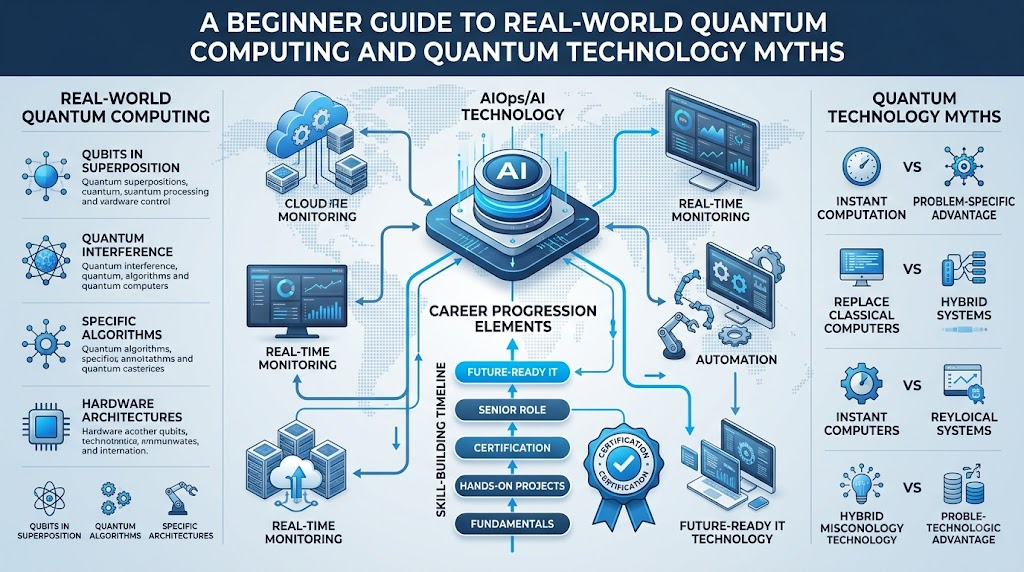
In popular media and science fiction, quantum computers are often portrayed as glowing, pocket-sized super-machines capable of breaking any encryption in seconds, enabling faster-than-light communication, or instantly solving every complex problem, but physical laboratory reality is grounded in delicate hardware, noisy qubits, and strict physical laws. Real-world quantum systems do not brute-force every answer simultaneously; instead, they rely on carefully engineered phenomena like superposition and entanglement to amplify the probability of correct solutions through quantum interference. As educational platforms like QuantumOpsSchool.com
highlight, understanding the difference between real world quantum vs imagined quantum allows developers, researchers, and learners to separate science fiction from the genuine hardware breakthroughs, algorithmic advantages, and engineering limitations shaping modern quantum information science.
What Does “Real-World Quantum” Mean?
Real-world quantum computing refers to physical systems built upon the actual laws of quantum mechanics to process information. This includes:
- Actual Quantum Hardware: Physical processors fabricated on silicon chips, held in electromagnetic traps, or routed through optical tables.
- Physical Qubits: Quantum two-level systems engineered from superconducting circuits, isolated ions, neutral atoms, or photons.
- Quantum Software and Algorithms: Structured sequences of quantum gates designed to solve specific mathematical formulations.
- Laboratory Experiments and Benchmarks: Measurable tests run on existing machines to characterize noise, fidelity, and algorithmic behavior.
- Engineering Constraints: Practical challenges such as cryogenics, RF cabling, laser alignment, and real-time control electronics.
Real quantum processors operate within strict physical boundaries. They are susceptible to environmental noise, thermal fluctuations, decoherence, and gate inaccuracies. In the real world, building a quantum computer is an engineering discipline defined by error management, calibration routines, and hardware scalability challenges.
What Is “Imagined Quantum”?
“Imagined quantum” represents quantum technology as portrayed through science fiction tropes, oversimplified analogies, and marketing hype.
It treats quantum mechanics as an open license for magic, assuming that because subatomic behavior is counterintuitive, quantum computers can bypass the fundamental laws of thermodynamics and information theory.
While creative imagination inspires scientific exploration, confusing speculation with current capability leads to distorted expectations. Real progress in quantum information science requires focusing on what mathematics and physical hardware can verifiably achieve.
Real Quantum vs Imagined Quantum
The table below highlights the foundational differences between real physical quantum systems and the imagined versions often found in popular media:
| Topic | Real Quantum Computing | Imagined Quantum Computing |
| Qubits | Fragile physical systems prone to noise, decay, and environmental interference | Perfect, infinitely stable digital units with indefinite coherence |
| Processing | State manipulation via unitary gate operations and wave interference | Instantaneous brute-force checking of all combinations at once |
| Speed | Algorithmic speedups for specific mathematical problem classes | Universal, unlimited acceleration for every application and game |
| Measurement | Probabilistic collapse yielding a single classical bit-string per shot | A direct readout that automatically outputs every valid possibility |
| Entanglement | Non-classical statistical correlations between measurement outcomes | Faster-than-light communication, instantaneous data transfer, or telepathy |
| Communication | Secure key distribution and quantum state transfer bounded by light speed | Instantaneous galactic messaging bypassing relativistic limits |
| Error Rates | High physical error rates requiring active mitigation and correction research | Zero errors, perfect calculations, and flawless hardware execution |
| Hardware | Large, complex setups (dilution refrigerators, vacuum chambers, lasers) | Pocket-sized, ambient-temperature consumer chips |
| Applications | Chemistry simulation, materials research, specific optimizations | Instant universal problem-solving, mind reading, and infinite simulation |
| Scalability | Incremental scaling limited by crosstalk, wiring, and thermal loads | Effortless scaling to billions of flawless qubits overnight |
| AI Integration | Active research into hybrid classical-quantum models and specific speedups | Sentient, self-aware AI emerging automatically from quantum circuits |
| Future Potential | Fault-tolerant quantum computing after substantial engineering progress | Near-term replacement of all classical computing infrastructure |
Real Quantum Computers Exist Today
Quantum computers are not theoretical concepts waiting to be built; operational processors exist today in research labs and commercial facilities worldwide.
Different teams pursue different physical architectures, each offering unique trade-offs:
- Superconducting Circuits: Tiny electrical circuits cooled to millikelvin temperatures that behave as artificial atoms. They offer fast gate speeds and leverage established semiconductor fabrication techniques, though they face challenges with thermal management and short coherence times.
- Trapped Ions: Individual charged atoms suspended in electromagnetic fields and manipulated using precise laser pulses. They provide long coherence times and high-fidelity gates, though gate operations are generally slower.
- Neutral Atoms: Arrays of uncharged atoms held in place by optical tweezers. They enable dense 2D and 3D configurations and strong interactions when excited to Rydberg states.
- Photonic Systems: Photons traveling through optical waveguides and interferometers at room temperature. They excel at networking and low-loss transmission, though generating deterministic single photons and multi-qubit interactions remains challenging.
- Silicon-Based Spin Qubits: Individual electron spins trapped in silicon quantum dots. They present an attractive pathway for leveraging industrial semiconductor manufacturing.
According to research organizations such as NIST, each of these architectures represents an active area of quantum hardware development. None has yet eliminated the core challenges of physical noise and system scaling.
Imagined Quantum Computers vs Actual Hardware
Popular media often depicts a quantum computer as a sleek desktop console or an unobtrusive glowing crystal. The engineering reality involves complex infrastructure designed to isolate delicate quantum states from environmental noise.
+-------------------------------------------------------------+
|                      POPULAR FICTION                        |
|                                                             |
|   [ Small Desktop Box ] ---> [ Instant Error-Free Results ] |
|   • Ambient room temp        • No control wiring needed     |
|   • Unlimited stability      • Replaces every laptop        |
+-------------------------------------------------------------+

                              VS

+-------------------------------------------------------------+
|                      PHYSICAL REALITY                       |
|                                                             |
|   +-----------------------------------------------------+   |
|   | Cryostat / Vacuum Chamber (15 mK or Ultra-Vacuum)   |   |
|   |   +---------------------------------------------+   |   |
|   |   | Quantum Processor Unit (QPU)                |   |   |
|   |   | Fragile Qubits prone to noise & decay       |   |   |
|   |   +---------------------------------------------+   |   |
|   |       |               |               |             |   |
|   +-------|---------------|---------------|-------------+   |
|           | Coaxial Lines | Laser Pulses  |                 |
|   +-----------------------------------------------------+   |
|   | Classical Control Racks (Microwave pulses, AWGs)    |   |
|   +-----------------------------------------------------+   |
|   | Classical High-Performance Server & Error Mitigator |   |
|   +-----------------------------------------------------+   |
+-------------------------------------------------------------+
A functional superconducting quantum computer requires a dilution refrigerator to reach approximately 15 millikelvin—temperatures colder than deep space. Trapped-ion and neutral-atom platforms require ultra-high vacuum chambers, precision laser arrays, and magnetic shielding.
In every real-world architecture, the quantum processing unit (QPU) relies heavily on racks of classical electronics to generate microwave pulses, manage timing, read output voltages, and process data.
Real Qubits vs Fictional “Super Bits”
A standard classical bit is deterministic: it is strictly in state $0$ or state $1$.
In popular explanations, a qubit is frequently described as “a bit that can be 0 and 1 at the same time.” While intuitive, this phrasing is mathematically imprecise and encourages the misconception that a single qubit stores multiple classical values simultaneously.
Mathematically, a single pure qubit state $\vert{}\psi\rangle$ is represented as a linear combination of two basis states, $\vert{}0\rangle$ and $\vert{}1\rangle$:
$$\vert{}\psi\rangle = \alpha\vert{}0\rangle + \beta\vert{}1\rangle$$
Here, $\alpha$ and $\beta$ are complex probability amplitudes satisfying the normalization condition:
$$\vert{}\alpha\vert{}^2 + \vert{}\beta\vert{}^2 = 1$$
- The quantum state is a vector in a two-dimensional complex Hilbert space.
- When the qubit is measured in the standard computational basis, the superposition collapses. The system yields a single classical outcome: either $0$ with probability $\vert{}\alpha\vert{}^2$, or $1$ with probability $\vert{}\beta\vert{}^2$.
A qubit does not provide access to both answers simultaneously upon measurement. It holds continuous probability amplitudes that determine the likelihood of obtaining specific discrete classical outcomes when sampled.
Superposition: Reality vs Popular Interpretation
Superposition is often misunderstood as the ability to run infinite computations in parallel and inspect every outcome for free.
- The Reality: A quantum register can be prepared in a coherent superposition over many computational basis states. When quantum gates act on this register, they transform the entire state space simultaneously via unitary operations.
- The Misconception: That a quantum computer evaluates every path, extracts every individual answer, and prints them all out instantly.
If a quantum computer merely evaluated all possibilities but measurement collapsed the system to a random outcome, it would be no more useful than rolling a dice.
Real quantum computing relies on quantum interference. Algorithms like Shor’s or Grover’s use sequences of quantum logic gates to adjust the phases of the amplitudes.
Constructive interference amplifies the probability amplitudes of the correct answers, while destructive interference cancels out incorrect paths. Measurement then returns the desired result with high probability.
Entanglement: Reality vs Science Fiction
Entanglement occurs when two or more qubits become correlated such that the quantum state of an individual qubit cannot be described independently of the others, regardless of the physical distance separating them.
       Entangled Pair Preparation: (|00> + |11>) / sqrt(2)
                           /        \
                          /          \
                         v            v
                 [ Qubit A ]        [ Qubit B ]
                 Measurement        Measurement
                 Outcome: 0         Outcome: 0 (Correlated)
                 Outcome: 1         Outcome: 1 (Correlated)
In science fiction, entanglement is often portrayed as an instantaneous communication conduit—a cosmic walkie-talkie that transmits messages across the universe without delay.
In physical reality, the No-Communication Theorem proves that quantum entanglement cannot be used to transmit usable classical information faster than the speed of light.
When an experimenter measures Qubit A, the outcome is intrinsically random (50% chance of $0$, 50% chance of $1$). While the measurement of Qubit B will show a correlated result, the observer at Qubit B cannot know what occurred at Qubit A without receiving classical data over a standard, speed-of-light-limited channel.
Quantum Teleportation: Real vs Imagined
Popular culture associates teleportation with “beaming” physical objects or humans across space. Quantum teleportation in physics is entirely different.
- Real Quantum Teleportation: A protocol that transfers an unknown quantum state from one physical system to another using shared entanglement, local quantum gate operations, and a classical communication channel.
- Imagined Teleportation: Dematerializing matter in one location and reconstructing physical atoms somewhere else instantly.
[ Sender (Alice) ]                                   [ Receiver (Bob) ]
  • Has Unknown State |psi>                             • Holds Entangled Qubit
  • Performs Joint Measurement                          • Waits for Classical Bits
            |                                                      ^
            |========= 2 Classical Bits (Speed of Light) =========|
            v                                                      |
  [ State |psi> Destroyed at Alice ]                    [ Applies Corrections -> Recreates |psi> ]
In the standard teleportation protocol, the original quantum state is destroyed during measurement (in accordance with the No-Cloning Theorem), and the receiver cannot reconstruct the state until they receive two classical bits transmitted through standard channels.
No matter moves through space, and no information travels faster than light. This protocol is fundamental to quantum networking and distributed quantum processors, but it has nothing to do with transporting physical matter.
Quantum Speed: What Is Actually Faster?
A widespread misconception is that quantum computers are universally faster versions of classical computers. If a quantum computer ran a standard operating system or web browser, it would likely execute instructions far more slowly than a modern classical CPU.
Quantum speedups apply only to specific mathematical problem classes where quantum algorithms can exploit interference to find shortcuts.
- Exponential Speedups: Certain structured problems, such as integer factorization (via Shor’s algorithm) or simulating quantum systems, exhibit exponential theoretical advantages over known classical algorithms.
- Polynomial Speedups: Unstructured search problems (via Grover’s algorithm) offer a quadratic speedup ($O(\sqrt{N})$ versus $O(N)$), which provides a mathematical advantage but requires significant overhead to realize in practice.
- No Advantage: Everyday general-purpose computing tasks—such as text processing, database lookups, image rendering, and network routing—gain no algorithmic benefit from quantum hardware.
Algorithmic advantage is problem-specific. A quantum computer excels only when the underlying mathematical structure maps efficiently to quantum mechanical operations.
Quantum Computers Are Not Classical Computer Replacements
Future computing architectures will not replace classical computers with quantum ones. Instead, they will operate as heterogeneous hybrid systems, where classical CPUs and GPUs offload specific, mathematically intensive subroutines to a Quantum Processing Unit (QPU).
| Task | Classical Computing | Quantum Computing |
| Web Browsing & Video Streaming | Optimal, highly efficient | Inefficient and impractical |
| Word Processing & Spreadsheets | Native fit | No algorithmic benefit |
| Relational Databases & File Storage | Mature, scalable, and fast | Not suited for persistent storage |
| Simulating Molecular Ground States | Exponentially hard as size grows | Natural mapping to quantum states |
| Simulating Quantum Materials | Computationally prohibitive | High potential for physical accuracy |
| Factoring Large Composite Integers | Computationally intensive | Exponential speedup via Shor’s Algorithm |
Classical computers excel at sequential logic, high-speed input/output, floating-point arithmetic, and massive persistent data storage. Quantum computers serve as specialized co-processors for specific computational challenges.
Real Quantum Applications
Real-world quantum research focuses on problems whose underlying structure aligns naturally with quantum mechanics:
- Quantum Chemistry and Molecular Simulation: Calculating the ground-state energies and reaction mechanisms of complex molecules. NIST notes that quantum processors have already performed foundational calculations of small molecules and magnetic models, laying the groundwork for future drug and catalyst discovery.
- Materials Science: Investigating high-temperature superconductivity, battery chemical kinetics, and novel crystalline structures that are computationally intractable to model on classical machines.
- Optimization Subroutines: Exploring quantum approximate optimization algorithms (QAOA) and variational quantum algorithms (VQE) for logistics, grid management, and portfolio optimization.
- Quantum Communication and Sensing: Developing ultra-sensitive atomic clocks, gravimeters, and quantum key distribution (QKD) networks that use quantum states to detect eavesdropping.
While these applications represent active and promising areas of laboratory research, large-scale, fault-tolerant industrial applications remain under active development.
Imagined Quantum Applications
Unsubstantiated claims often surround emerging technologies. When evaluating quantum capabilities, it helps to categorize claims by their actual technical maturity:
- Instant Global Logistics Optimization: [Active Research] While quantum algorithms for combinatorial optimization are being actively explored, current hardware cannot yet outperform classical solvers on large-scale logistics networks.
- Superintelligent, Self-Aware AI: [Not Currently Demonstrated / Fiction] Quantum circuits do not generate consciousness or automatic artificial general intelligence.
- Universal Real-Time Decryption: [Possible Future] Breaking standard RSA-2048 encryption requires millions of physical qubits with low error rates executing Shor’s algorithm—a capability that remains a long-term engineering goal rather than a current reality.
- Instant Drug Discovery: [Active Research] Quantum chemistry will accelerate molecular modeling, but it does not bypass the clinical trial, validation, and synthesis pipelines required for medicine.
- Quantum Consumer Smartphones: [Not Currently Demonstrated] Due to thermal, environmental, and control constraints, pocket-sized consumer quantum processors are not on any realistic engineering roadmap.
Quantum AI: Reality vs Hype
The intersection of quantum computing and artificial intelligence is an active research area known as Quantum Machine Learning (QML). However, popular commentary often inflates these investigations into claims of impending superintelligence.
- The Reality: Researchers are exploring variational quantum classifiers, parameterized quantum circuits, and quantum kernel methods. These models explore whether quantum feature spaces can represent complex data correlations more efficiently than classical models.
- The Limitations: Training quantum models faces fundamental hurdles, such as the input-loading bottleneck (efficiently converting massive classical datasets into quantum states) and “barren plateaus” (vanishing gradients during optimization).
- The Misconception: That quantum computers will immediately render modern GPU clusters obsolete or automatically endow neural networks with human-level reasoning.
Current QML remains experimental, with researchers working to establish rigorous theoretical baselines where quantum models offer measurable advantages over modern classical machine learning architectures.
Quantum Cryptography: Reality vs Fiction
Discussions of quantum security often conflate two distinct areas: Quantum Cryptography and Post-Quantum Cryptography.
+-----------------------------------------------------------------------------------+
|                           QUANTUM SECURITY LANDSCAPE                              |
+---------------------------------------------------------+-------------------------+
| POST-QUANTUM CRYPTOGRAPHY (PQC)                         | QUANTUM KEY DISTRIBUTION|
| • Classical mathematical algorithms                     | • Physical hardware     |
| • Runs on existing laptops, servers, and routers        | • Uses single photons   |
| • Resistant to both classical and quantum attacks       | • Detects eavesdropping |
| • Standardized by organizations like NIST               | • Requires fiber/lasers |
+---------------------------------------------------------+-------------------------+
- Quantum Key Distribution (QKD): A hardware-based protocol that uses quantum states (typically photons) to establish shared cryptographic keys. Any eavesdropping attempt perturbs the quantum state, alerting the communicating parties. QKD does not make all communications “magically unbreakable”; it secures key exchange across a dedicated physical link.
- Post-Quantum Cryptography (PQC): New classical cryptographic algorithms (such as lattice-based cryptography) designed to run on existing digital infrastructure while remaining secure against attacks by future quantum computers.
Post-quantum cryptography does not require a quantum computer to run; it is the practical defense being deployed today to safeguard global data networks.
Quantum Error Rates: Reality vs Perfect Machines
In classical silicon processors, bit-flip errors occur so rarely (roughly once per $10^{17}$ operations) that hardware errors are virtually negligible in everyday programming.
In real quantum computing, physical qubits are exceptionally vulnerable to their surroundings.
- Decoherence: The loss of quantum information caused by interactions with the external environment (thermal vibrations, electromagnetic noise, cosmic rays).
- Gate Inaccuracies: Imperfections in the control pulses used to execute quantum operations, leading to slight phase and amplitude errors.
- Measurement Errors: Inaccuracies occurring when reading out the state of a qubit at the end of a circuit.
- Crosstalk: Unintended interactions between neighboring qubits that corrupt nearby quantum states.
NIST emphasizes that current quantum processors are noisy and error-prone. The primary challenge in quantum hardware engineering is not merely adding more physical qubits, but improving the fidelity of gates and isolating systems from environmental noise.
Quantum Error Correction
To transition from noisy, experimental hardware to reliable machines, the field relies on Quantum Error Correction (QEC).
QEC distributes the information of a single logical qubit across an entangled ensemble of multiple physical qubits. By continuously measuring specific multi-qubit parity checks (without measuring and destroying the underlying data state), the system can detect and correct bit-flip ($X$) and phase-flip ($Z$) errors in real time.
+---------------------------------------------------------------+
|                      ONE LOGICAL QUBIT                        |
|                                                               |
|  [ Physical Qubit 1 ]   [ Physical Qubit 2 ]   [ Physical 3 ] |
|  [ Physical Qubit 4 ]   [ Physical Qubit 5 ]   [ Physical 6 ] |
|  [ Physical Qubit 7 ]   [ Physical Qubit 8 ]   [ Physical 9 ] |
|                                                               |
|  + Syndrome Measurement Qubits (Continuously Detecting Noise) |
+---------------------------------------------------------------+
- Fault-Tolerant Threshold: Error correction only works if the physical error rate is below a strict mathematical threshold. If physical gates are too noisy, adding more qubits introduces more errors than the code can correct.
- Hardware Overhead: Creating a single, highly reliable logical qubit may require hundreds to thousands of high-quality physical qubits, along with continuous real-time classical control decoding.
Recent experimental breakthroughs have demonstrated fault-tolerant operations and logical qubits that outperform physical qubits. However, scaling these systems to thousands of logical qubits remains an active, long-term engineering effort.
Quantum Hardware: Real Machines vs Fiction
The table below contrasts physical quantum systems with the effortless devices imagined in popular fiction:
| Feature | Real Quantum Hardware | Imagined Quantum Hardware |
| Qubit Control | Complex RF lines, microwave generators, and calibrated laser pulses | Instantaneous, invisible digital execution |
| Operating Environment | Millikelvin cryogenics or ultra-high vacuum chambers | Standard room temperature with no special housing |
| Noise Profile | Constant susceptibility to thermal fluctuations, decay, and crosstalk | Completely noiseless, perfect state retention |
| Calibration | Requires frequent automated recalibration and characterization | Zero calibration needed; runs indefinitely |
| Error Management | Active mitigation techniques and heavy error-correction overhead | Naturally error-free without redundancy |
| Physical Footprint | Multi-rack systems, large cryostats, and specialized lab facilities | Microscopic standalone computer chips |
| Software Interface | Low-level circuit design, pulse shaping, and gate scheduling | Natural language commands (“Solve this puzzle”) |
Quantum Programming: Reality vs Movie Logic
In fiction, quantum programming often involves typing an open-ended request like “Compute the cure” or “Decrypt the mainframe.”
Real quantum programming is closer to low-level assembly language and hardware engineering. Developers design quantum circuits consisting of sequential quantum gates applied to specific qubits over time:
q_0: ──| H |──■───────────■───────M──
              │           │       │
q_1: ─────────┼─────| H |─■───────M──
              │           │       │
q_2: ─────────■───────────┼───────M──
In platforms such as Qiskit (IBM) or Cirq (Google), quantum software engineering involves:
- Initializing qubits into known ground states ($\vert{}0\rangle$).
- Applying single-qubit gates (such as Hadamard $H$, Pauli-$X$, and Phase-shift $R_z$) to create superpositions and phase differences.
- Applying multi-qubit entangling gates (such as $CNOT$ or $CZ$).
- Mapping virtual circuits to physical hardware topology (transpilation and routing).
- Measuring qubits into classical registers across repeated execution shots to build statistical probability distributions.
Quantum software development focuses on optimizing circuit depth and minimizing gate counts to complete computations before decoherence corrupts the system.
Quantum Simulation: Reality vs Imagined Capability
A quantum simulator is a classical software package that calculates how a quantum circuit would behave mathematically on a traditional computer.
- The Reality: Classical simulators are indispensable educational and development tools. They allow engineers and students to design, test, and debug quantum circuits without waiting in hardware queues or dealing with physical device noise.
- The Limitation: A general quantum state of $n$ qubits requires storing $2^n$ complex amplitudes. Simulating 30 qubits requires roughly 16 gigabytes of RAM; simulating 50 qubits requires petabytes, quickly exceeding the memory limits of even the largest classical supercomputers.
Simulators are vital for learning and validating small-scale algorithms, but their exponential resource scaling is the exact reason physical quantum hardware is necessary.
Quantum Measurement: Reality vs Misconception
Measurement plays an active, irreversible role in quantum mechanics.
- The Misconception: A quantum computer contains all possible answers inside its memory, and measuring it simply “prints the list.”
- The Reality: Measuring a quantum register collapses its wave function. A system in an arbitrary state $\vert{}\psi\rangle = \sum c_x \vert{}x\rangle$ collapses into a single classical bit-string $\vert{}x\rangle$ with probability $\vert{}c_x\vert{}^2$.
Superposition State: α|00⟩ + β|01⟩ + γ|10⟩ + δ|11⟩
                    │
           [ Measurement Event ]
                    │
                    v
    One Output Only: e.g., "01" (Observed with probability |β|²)
Because a single measurement returns only one classical string, quantum algorithms are run repeatedly (over many “shots”) to compile a statistical distribution, or they are structured with interference so the correct answer appears with near-certainty on the first measurement.
Real Quantum Advantage vs Imagined Quantum Advantage
The term quantum advantage (historically referred to in early benchmarks as quantum supremacy) has a precise scientific definition.
+---------------------------------------------------------------------------------+
|                       LEVELS OF QUANTUM PERFORMANCE                             |
+---------------------------------------------------------------------------------+
| 1. THEORETICAL SPEEDUP                                                          |
|    A mathematical algorithm shows asymptotic advantages on paper (e.g., Shor). |
+---------------------------------------------------------------------------------+
| 2. BENCHMARK ADVANTAGE                                                          |
|    A physical QPU solves a specialized synthetic task faster than supercomputers|
|    (e.g., Random Circuit Sampling, Boson Sampling).                             |
+---------------------------------------------------------------------------------+
| 3. PRACTICAL QUANTUM ADVANTAGE                                                  |
|    A QPU solves a commercially or scientifically valuable, real-world problem   |
|    faster, cheaper, or more accurately than any classical alternative.          |
+---------------------------------------------------------------------------------+
Demonstrating advantage on an abstract mathematical benchmark confirms that quantum hardware can outperform classical systems at specific tasks.
However, achieving practical quantum advantage—where a quantum computer solves a commercially useful problem in chemistry, optimization, or materials science better than a classical supercomputer—remains the ongoing goal of current hardware and algorithmic research.
Current Limitations of Quantum Computing
Developing large-scale quantum technology involves overcoming major physical and engineering hurdles:
- Decoherence: Environmental noise destroys delicate quantum superpositions in microseconds or milliseconds.
- Gate Inaccuracies: Imperfect control pulses limit the maximum depth (length) of circuits that can run before results turn to pure noise.
- Measurement Fidelity: Reading out the final state introduces classification errors between $|0\rangle$ and $|1\rangle$.
- Physical Scaling Bottlenecks: Routing thousands of high-frequency microwave cables into cryogenic systems introduces severe thermal and spatial constraints.
- Crosstalk: Driving one qubit can unintentionally alter the state of an adjacent qubit on a dense processor chip.
- Error Correction Overhead: Current codes require large physical-to-logical qubit ratios, demanding substantial increases in physical qubit counts.
- Control Electronics Complexity: Synchronizing thousands of precision pulse generators and readout lines requires massive classical computing support.
- Algorithmic Constraints: Quantum speedups exist only for specific problem structures, limiting the scope of applicable use cases.
- Data Loading Inefficiencies: Transforming large classical datasets into quantum states can easily negate algorithmic speedups.
- Cryogenic and Vacuum Constraints: Sustaining millikelvin temperatures and ultra-high vacuums requires specialized, energy-intensive laboratory equipment.
- Benchmarking Difficulties: As quantum processors grow beyond 50 qubits, verifying their accuracy becomes challenging because classical computers cannot simulate them.
- Material Imperfections: Microscopic defects in superconducting substrates and silicon chips cause localized energy dissipation and erratic qubit behavior.
Real Quantum vs Imagined Quantum: Myth-Busting Table
| Popular Myth | Technical Reality |
| Quantum computers test every answer at once and pick the best one. | Quantum algorithms use wave interference to amplify the probability of correct answers and cancel incorrect ones before measurement. |
| Quantum computers will make all software and video games faster. | Quantum computers only offer advantages for specific mathematical problem classes; classical tasks run better on classical processors. |
| Entanglement allows instant, faster-than-light communication. | Entanglement produces non-classical correlations, but extracting usable data strictly requires classical communication limited by the speed of light. |
| Quantum computers will replace classical home PCs and smartphones. | Quantum computers will operate as specialized cloud co-processors alongside classical supercomputers, servers, and PCs. |
| A qubit is simply a bit that is 0 and 1 at the same time. | A qubit is a state vector with complex amplitudes whose squared magnitudes represent the probabilities of measuring 0 or 1. |
| Quantum teleportation beams physical matter across space. | Quantum teleportation transfers an unknown quantum state to another system using entanglement and classical signaling; no matter travels. |
| Current quantum computers are perfect machines ready for global deployment. | Existing systems are noisy, intermediate-scale processors facing active challenges in coherence, gate fidelity, and error correction. |
| Quantum AI will automatically trigger artificial general intelligence. | Quantum machine learning explores specific linear algebra speedups and feature spaces, facing significant data-loading and optimization constraints. |
| Quantum computing operates completely independently of classical systems. | Real quantum processors rely entirely on complex classical electronics, compilers, and servers for control, calibration, and readout. |
| Quantum technology is purely theoretical and has not been built. | Real quantum processors operate daily across multiple physical modalities in research institutions and industrial labs worldwide. |
Where Quantum Technology Is Today
A grounded perspective categorizes quantum development into clear milestones:
+-------------------------------------------------------------------------------+
|                      THE QUANTUM TECHNOLOGY SPECTRUM                          |
+-------------------------------------------------------------------------------+
| [ CURRENT REALITY ]                                                           |
| • Dozens to hundreds of noisy physical qubits (NISQ era)                      |
| • Cloud-accessible quantum hardware and educational simulators                |
| • Proof-of-concept experiments in small-molecule chemistry and magnetism       |
| • Commercial deployment of Post-Quantum Cryptography standards                |
+-------------------------------------------------------------------------------+
| [ ACTIVE RESEARCH & DEVELOPMENT ]                                             |
| • Demonstration of fault-tolerant logical qubits with lower error rates       |
| • Quantum error correction across multi-qubit surface codes                   |
| • High-fidelity multi-qubit entangling gates (>99.9% fidelity)                |
| • Small-scale quantum communication and repeater nodes                        |
+-------------------------------------------------------------------------------+
| [ FUTURE GOALS ]                                                              |
| • Millions of physical qubits supporting thousands of fault-tolerant logicals |
| • Practical, commercial-scale materials and pharmaceutical simulation         |
| • Global-scale quantum networks (Quantum Internet)                            |
| • Broad industrial optimization advantage over classical supercomputers       |
+-------------------------------------------------------------------------------+
How Organizations Should Approach Quantum Computing
Organizations evaluating quantum technology should navigate between uncritical dismissal and unrealistic hype.
- Identify Real Use Cases: Focus on problem areas where quantum algorithms offer proven theoretical advantages—such as molecular simulation, chemical modeling, complex combinatorial optimization, and cryptographic resilience.
- Track Hardware and Algorithm Metrics: Monitor peer-reviewed progress in gate fidelity, logical qubit demonstrations, and error-mitigation protocols rather than raw physical qubit headcounts.
- Adopt Hybrid Classical-Quantum Workflows: Recognize that real-world implementations integrate classical high-performance computing (HPC) with quantum acceleration subroutines.
- Begin Post-Quantum Migration: Prioritize upgrading classical security architectures to post-quantum cryptography (PQC) standards to protect long-term data against future decryption capabilities.
- Build Foundational Literacy: Encourage engineering and development teams to learn core quantum principles, circuit programming frameworks, and operational constraints through accessible educational platforms.
How to Separate Quantum Facts From Hype
When evaluating quantum computing claims in news headlines, press releases, or marketing materials, apply this critical evaluation checklist:
- Is there a physical demonstration? Distinguish between a theoretical algorithm proposed on paper and an experiment executed on physical quantum hardware.
- What hardware architecture was used? Check whether the test was run on superconducting circuits, trapped ions, neutral atoms, photonics, or a classical software simulator.
- Was a classical baseline included? Verify whether the researchers benchmarked the quantum result against modern, highly optimized classical algorithms running on high-performance hardware.
- Is the problem useful or synthetic? Determine whether the demonstration solves a specialized mathematical benchmark or a practical, real-world computational problem.
- Are error rates and limitations clearly stated? Credible scientific research explicitly documents physical gate fidelities, measurement errors, shot counts, and coherence times.
- Does the claim distinguish today from the future? Check if the announcement describes an operational feature available today or a projected capability requiring years of error-correction development.
Learning Roadmap: From Imagined Quantum to Real Quantum
Developing genuine proficiency in quantum information science requires focusing on fundamental concepts:
[ Step 1: Classical Foundations ]
  • Linear algebra (vectors, matrices, inner products)
  • Basic probability and classical logic gates
                 │
                 v
[ Step 2: Single-Qubit Systems ]
  • State vectors: |ψ⟩ = α|0⟩ + β|1⟩
  • The Bloch sphere and state representations
                 │
                 v
[ Step 3: Core Quantum Principles ]
  • Superposition and relative phase
  • Quantum measurement and state collapse
  • Entanglement and Bell states: (|00⟩ + |11⟩)/√2
                 │
                 v
[ Step 4: Quantum Circuits & Gates ]
  • Single-qubit gates (H, X, Y, Z, Phase rotations)
  • Two-qubit entangling operations (CNOT, CZ)
  • Circuit diagrams, reversibility, and unitary matrices
                 │
                 v
[ Step 5: Hands-On Simulation & Code ]
  • Write circuits using frameworks like Qiskit or Cirq
  • Execute statevector and shot-based simulations
                 │
                 v
[ Step 6: Fundamental Algorithms ]
  • Quantum teleportation protocol
  • Deutsch-Jozsa and phase kickback
  • Grover's search algorithm and Shor's factoring algorithm
                 │
                 v
[ Step 7: Hardware & Practical Operations ]
  • Physical architectures (superconducting, trapped ions, neutral atoms)
  • Decoherence ($T_1$, $T_2$ times) and gate error characterization
  • Quantum error correction principles (surface codes, logical qubits)
The Role of Educational Platforms
As the quantum ecosystem matures, accessible educational platforms are essential for bridging the gap between abstract academic theory and practical software engineering.
Resources such as QuantumOpsSchool.com help demystify the technology by focusing on foundational concepts, practical circuit operations, quantum software development, and the realities of physical hardware.
By focusing on foundational physics, linear algebra, and hands-on circuit design rather than speculative hype, learners and developers can build the practical skills needed to contribute to the emerging quantum industry.
The Future of Real Quantum Computing
The path forward in quantum technology is defined by concrete engineering roadmaps rather than sudden, cinematic breakthroughs:
- High-Fidelity Physical Qubits: Improving materials science, substrate purity, and control electronics to push two-qubit gate fidelities past 99.9%.
- Demonstrated Logical Qubits: Implementing real-time quantum error correction across surface codes and color codes where logical error rates are demonstrably lower than physical error rates.
- Fault-Tolerant System Scaling: Developing modular cryogenic interfaces, optical interconnects, and scalable control architectures to support thousands of fault-tolerant logical qubits.
- Integrated Hybrid High-Performance Computing: Embedding quantum processors directly alongside classical supercomputing clusters to accelerate specialized scientific subroutines.
- Quantum Networking and Sensing: Advancing atomic-scale quantum sensors and deploying quantum repeaters for secure state distribution across regional networks.
Frequently Asked Questions
What is the difference between real and imagined quantum computing?
Real quantum computing involves physical machines using the laws of quantum mechanics to run specialized algorithms, constrained by noise, hardware errors, and physical scaling limits. Imagined quantum computing is the fictional depiction of quantum technology as an instantaneous, error-free machine capable of instantly solving any problem.
Are quantum computers real today?
Yes. Operational quantum processors using superconducting circuits, trapped ions, neutral atoms, silicon spin qubits, and photonics exist in commercial and academic laboratories worldwide, accessible largely via cloud platforms.
Are quantum computers faster than classical computers at everything?
No. Quantum computers offer mathematical speedups only for specific problem classes whose structures exploit quantum interference. For standard everyday tasks like word processing, web browsing, and database lookups, classical computers are much more efficient.
What can quantum computers actually do today?
Current processors perform experimental demonstrations, characterize quantum algorithms, run small-scale molecular and magnetic simulations, and execute benchmark tasks designed to test hardware limits. Large-scale practical applications in chemistry and optimization remain active areas of research.
Is quantum superposition the same as being in two states at once?
No. Describing a qubit as being “in two states at once” is an oversimplification. A qubit exists in a linear combination (superposition) of basis states with complex probability amplitudes that determine the mathematical odds of measuring a 0 or a 1.
Does quantum entanglement allow faster-than-light communication?
No. The No-Communication Theorem in physics proves that measuring an entangled qubit produces a random outcome that cannot transmit usable classical data without a secondary, speed-of-light-limited classical communication channel.
Can quantum computers completely replace classical computers?
No. Future computing will rely on hybrid architectures. Classical processors handle sequential logic, operating systems, user interfaces, and data storage, while quantum processors serve as specialized accelerators for specific computational subroutines.
What are the biggest limitations of current quantum processors?
The most significant limitations are environmental noise, short coherence times, gate errors, measurement errors, crosstalk, and the large physical-to-logical qubit overhead required for full quantum error correction.
Is quantum AI already practical?
No. Quantum machine learning is an active and promising research field, but researchers are still working to resolve major bottlenecks like data-loading overhead and trainability issues before quantum models can consistently outperform classical machine learning on practical tasks.
How can beginners start learning real quantum computing?
Beginners should start with basic linear algebra, understand single-qubit states and gate operations, build simple circuits using software frameworks like Qiskit or Cirq, and run simulations to observe how quantum algorithms work in practice.
Conclusion
The distinction between real world quantum vs imagined quantum comes down to the difference between engineering reality and popular speculation: Quantum computing is neither science fiction nor an all-powerful shortcut around the laws of mathematics. It is a genuine, rapidly developing engineering discipline that utilizes quantum mechanical principles to solve specific, highly challenging computational problems. Physical qubits are fragile, current hardware remains noisy, and achieving fault-tolerant computation requires sustained engineering effort. Yet, the authentic progress being made in laboratories across quantum simulation, cryptography, and circuit design is far more interesting than any fictional counterpart.