Introduction
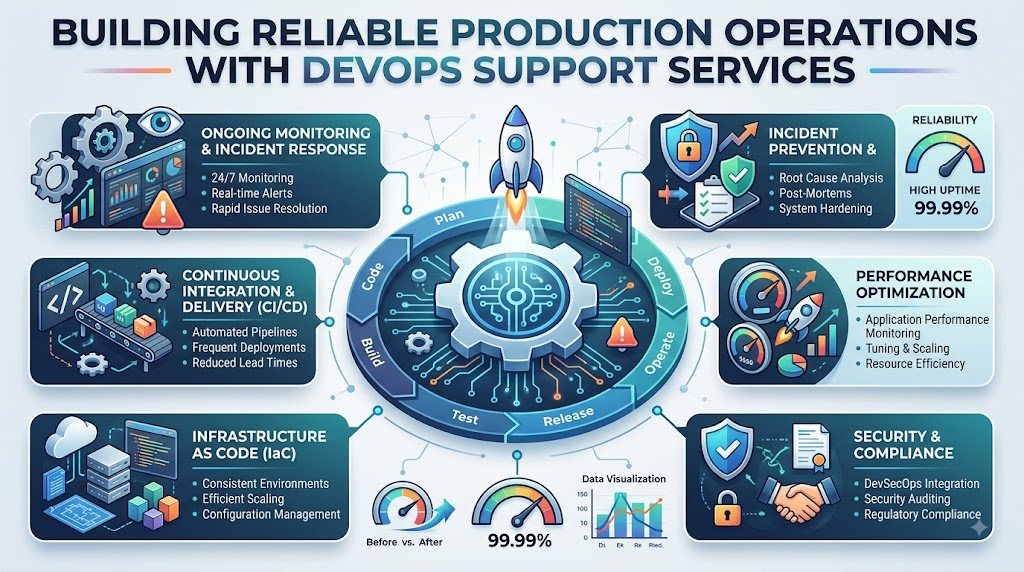
Technology environments rarely stay the same for long. An application that begins with a small infrastructure footprint can eventually require multiple cloud services, deployment environments, automated pipelines, containers, monitoring systems, and security controls. As this happens, keeping everything operational becomes a continuous engineering responsibility. This is one reason organizations consider DevOps Support Services. Rather than treating infrastructure support as an occasional activity, ongoing DevOps assistance creates a structured way to handle recurring operational requirements. Support can cover areas such as cloud administration, CI/CD, Infrastructure as Code, monitoring, incident management, Kubernetes, security, SRE practices, and MLOps. The exact combination should depend on the organization’s technology stack and business requirements. The objective is not simply to add another technical team. A well-designed support model should improve operational ownership, make troubleshooting more organized, and work alongside existing engineering capabilities.
What Are DevOps Support Services?
DevOps support is the ongoing management and assistance required to keep software delivery and production infrastructure operating effectively.
There is a significant difference between setting up DevOps practices and maintaining them over time. A team may initially build a pipeline, automate infrastructure, configure monitoring, and deploy an application successfully. But after the environment becomes part of daily operations, new challenges emerge.
Pipelines require maintenance. Infrastructure needs updates. Cloud environments change. Alerts need tuning. Deployments can fail. Applications need to scale. Security controls require attention.
DevOps support can address these recurring activities through areas such as:
- CI/CD pipeline maintenance
- Cloud infrastructure operations
- Deployment assistance
- Infrastructure troubleshooting
- Monitoring and alert management
- Incident response
- Infrastructure as Code
- Automation
- Configuration management
- Performance analysis
- Production support
Support does not necessarily mean transferring complete responsibility to an outside organization. It can also mean bringing in specialists for selected operational areas while internal engineers continue managing architecture and product development.
Why Ongoing DevOps Support Is Important
A production environment is an evolving system. Changes to applications, infrastructure, dependencies, cloud resources, and security policies can create new operational requirements.
For example, an organization may begin with a single deployment environment. As the product matures, it might introduce separate development, testing, staging, and production environments. More environments mean more configuration, access management, monitoring, deployment logic, and infrastructure to maintain.
Cloud growth creates similar challenges. Resources may be added quickly to support new workloads, but managing those resources consistently requires ongoing attention.
Internal engineering teams can certainly handle these responsibilities. The question is whether they have enough time and specialized expertise to do so without affecting other priorities.
External DevOps assistance can complement internal teams by taking responsibility for recurring operational work. This can allow developers and platform engineers to spend more time on architecture, automation improvements, and product-related initiatives.
The right model depends on the organization’s maturity, technical complexity, staffing, and operational requirements.
24/7 DevOps Support Services
Some systems cannot be treated as nine-to-five environments. Global applications, customer-facing platforms, and business-critical services may experience incidents at any hour.
24/7 DevOps Support Services can provide continuous operational coverage for activities such as:
- Infrastructure monitoring
- Alert investigation
- Production troubleshooting
- Incident response
- Deployment support
- Escalation
- Availability monitoring
- Emergency operational assistance
However, effective 24/7 support requires more than having engineers available around the clock.
There should be clear procedures for identifying critical incidents, assigning responsibility, escalating unresolved issues, and communicating with relevant stakeholders. Engineers also need access to useful logs, metrics, dashboards, architecture information, and operational documentation.
For example, when a production alert occurs at 2 a.m., the engineer should be able to determine what service generated the alert, how severe the issue is, what dependencies are involved, and which team should be contacted if escalation is required.
Round-the-clock support can be valuable, but it should not be interpreted as an automatic guarantee of uptime or incident resolution.
Managed DevOps Services Explained
Managed DevOps Services take the idea of ongoing support a step further by assigning recurring operational responsibilities to an external team.
Traditional consulting is often project-oriented. A consultant may help implement a pipeline, migrate infrastructure, or introduce a container platform and then complete the engagement.
Managed DevOps is more continuous. Depending on the agreement, an external team may remain involved with:
- CI/CD operations
- Cloud administration
- Infrastructure automation
- Monitoring
- Release management
- Configuration management
- Infrastructure maintenance
- Backup-related operations
- Security activities
- Production support
This approach can be useful for organizations that have limited platform engineering resources or do not want their developers spending most of their time on infrastructure maintenance.
At the same time, managed services should not create unnecessary dependency. Organizations should retain appropriate documentation, ownership, access controls, and knowledge of their critical systems.
Kubernetes Support Services
Kubernetes can provide a flexible foundation for containerized applications, but production Kubernetes operations require specialized knowledge.
Kubernetes Support Services may cover:
- Cluster administration
- Application workload management
- Scaling
- Networking
- Resource management
- Monitoring
- Security
- Troubleshooting
- Cluster upgrades
- Production optimization
A Kubernetes issue is not always obvious from the application itself. A failed workload might result from insufficient resources, an incorrect deployment configuration, networking problems, storage issues, policy restrictions, or an unhealthy dependency.
Clusters also require ongoing maintenance. Kubernetes versions change, workloads evolve, and resource requirements increase.
Support can therefore be useful when organizations need help maintaining clusters while their internal teams focus on applications and platform development.
These practices can apply to managed Kubernetes services such as AWS EKS, Azure AKS, and Google GKE. The specific approach should depend on the cluster architecture and workload requirements.
AWS DevOps Support Services
AWS provides a broad collection of services for computing, containers, serverless applications, infrastructure automation, and monitoring.
AWS DevOps Support Services can assist organizations operating environments that include technologies such as:
- EC2
- EKS
- ECS
- Lambda
- Terraform
- CloudFormation
- CI/CD pipelines
- Cloud monitoring
- Infrastructure automation
- Deployment systems
Consider a company operating a containerized application on EKS. The operational environment might also include Terraform-managed infrastructure, automated deployment pipelines, monitoring, and supporting AWS services.
Managing these components requires more than knowing individual services. Engineers need to understand how infrastructure, application releases, security, networking, monitoring, and automation interact.
AWS architecture should always be based on the workload. A service that works well for one application may not be suitable for another because requirements around performance, security, scaling, architecture, or operations can differ.
Azure DevOps Support Services
Azure environments have their own operational requirements, especially when organizations use Azure Pipelines, AKS, and other Azure infrastructure services.
Azure DevOps Support Services can help with:
- Azure Pipelines
- AKS operations
- Azure infrastructure
- Deployment automation
- Release management
- CI/CD
- Monitoring
- Infrastructure maintenance
- Production troubleshooting
As an application grows, its release process can become increasingly complex. Different environments may require different configurations, permissions, deployment rules, and monitoring requirements.
Automation can make these processes more consistent, while monitoring helps teams identify problems after changes are introduced.
Azure support can therefore provide additional operational capacity for teams managing recurring infrastructure and deployment responsibilities.
DevSecOps Support Services
Security is most effective when it is considered throughout the software delivery process rather than added immediately before deployment.
DevSecOps Support Services focus on bringing security practices into development, CI/CD, infrastructure, and production operations.
Common activities include:
- SAST
- DAST
- Dependency scanning
- Container security
- Secrets management
- Vulnerability management
- Security automation
- Secure CI/CD
- Compliance-related controls
For example, automated dependency scanning can identify known vulnerabilities before software reaches production. Container scanning can help teams inspect images for potential security issues. Secrets management can reduce the risk of credentials being exposed in source code or configuration files.
The right security controls depend on application architecture, infrastructure, regulatory requirements, and organizational risk.
DevSecOps is therefore not about adding every available security tool. It is about applying relevant security controls at appropriate points in the engineering lifecycle.
SRE Support Services
Site Reliability Engineering applies software engineering ideas to operational reliability.
SRE Support Services can include:
- Observability
- Incident management
- SLI and SLO management
- Error-budget practices
- Capacity planning
- Reliability automation
- Performance engineering
- Root-cause analysis
An SLI provides a measurement of an important service behavior. An SLO defines a target for that measurement. An SLA can represent a formal service commitment, while an error budget provides a framework for balancing reliability and change.
SRE encourages teams to study recurring incidents rather than simply fixing individual failures.
For instance, if a service repeatedly becomes overloaded during releases, the long-term solution might involve capacity planning, better autoscaling, performance improvements, or changes to deployment practices.
This makes reliability a continuous engineering activity rather than an emergency response function.
MLOps Support Services
Machine-learning systems introduce operational requirements that differ from conventional software applications.
A model must eventually run in an environment where it can be deployed, monitored, updated, and maintained.
MLOps Support Services can include:
- Model deployment
- ML infrastructure
- ML pipelines
- Model monitoring
- Version management
- Production operations
- Automation
- Resource management
- Scaling
ML environments may contain multiple model versions, data pipelines, compute resources, and deployment processes. Without appropriate operational practices, managing these components can become difficult as usage increases.
MLOps connects data science and machine learning workflows with software engineering and production operations.
The implementation should depend on the organization’s models, data architecture, infrastructure, deployment requirements, and operational objectives.
DevOps Support Technology Areas
| Area | Common Technologies / Practices | Primary Purpose |
|---|---|---|
| CI/CD | Jenkins, GitHub Actions, GitLab CI/CD, Azure Pipelines | Automated software delivery |
| Cloud | AWS, Azure, Google Cloud | Infrastructure operations |
| Containers | Docker, Kubernetes | Consistent application environments |
| Infrastructure as Code | Terraform, CloudFormation | Repeatable infrastructure |
| Monitoring | Metrics, logs, traces | Operational visibility |
| Security | SAST, DAST, secrets management | Secure software delivery |
| SRE | SLI, SLO, error budgets | Reliability management |
| MLOps | ML pipelines, model monitoring | Production ML operations |
These tools and practices represent common options rather than an exhaustive list. Technology choices should reflect existing systems, team expertise, workload requirements, and organizational goals.
Benefits of Continuous DevOps Support
Continuous operational support can help engineering organizations in several practical ways.
Quicker investigation: Established troubleshooting procedures can help engineers approach incidents systematically.
Less repetitive work: Automation can reduce manual infrastructure and deployment activities.
Improved visibility: Monitoring and observability provide information about application and infrastructure behavior.
More predictable releases: Consistent CI/CD practices can reduce variations between deployments.
Stronger incident processes: Defined escalation procedures make it easier to coordinate during production problems.
Integrated security: Security controls can become part of everyday development and delivery.
Improved infrastructure management: Regular operational attention helps teams respond to infrastructure changes.
These benefits depend on implementation. A support arrangement will not automatically solve problems if systems lack documentation, monitoring, clear ownership, or appropriate access.
Common Challenges in DevOps Support
1. Poor Documentation
Outdated documentation makes it harder for engineers to understand architecture and troubleshoot incidents.
2. Unclear Ownership
Every important infrastructure and application component should have clearly defined responsibility.
3. Weak Escalation Processes
Teams need agreed procedures for handling incidents that cannot be resolved at the first level.
4. Limited Observability
Without useful metrics, logs, and traces, identifying root causes can take longer.
5. Excessive Manual Operations
Manual changes create additional opportunities for configuration mistakes and inconsistent environments.
6. Configuration Drift
Differences between development, testing, and production environments can create unexpected failures.
7. Communication Problems
Support teams need clear communication channels for incidents, maintenance, and changes.
8. Insufficient Knowledge Transfer
Operational knowledge should not remain with only one external team or individual.
9. Excessive Dependency
External support should strengthen the organization’s capabilities rather than eliminate internal understanding.
10. Weak Security Practices
Security ownership and procedures should be clearly defined across development, infrastructure, and operations.
How to Select a DevOps Support Company
Choosing a provider requires looking beyond the list of technologies it claims to support.
Organizations should evaluate:
- Cloud platform experience
- Kubernetes expertise
- CI/CD knowledge
- Infrastructure as Code capabilities
- Security experience
- SRE practices
- MLOps knowledge when relevant
- Monitoring and observability
- Incident response
- Documentation
- Communication
- Support coverage
- Escalation procedures
- SLA structure
- Knowledge transfer
- Security practices
- Ability to collaborate with internal teams
It is also useful to discuss onboarding. What access will be required? What documentation must be provided? How are incidents classified? Who approves infrastructure changes? How is knowledge shared with internal engineers?
These questions can reveal whether the support model will work effectively in real operational conditions.
DevOps Support Area and Business Need
| Support Area | Typical Business Need |
| DevOps Support | Continuous infrastructure and delivery assistance |
| 24/7 DevOps Support | Around-the-clock monitoring and incident response |
| Managed DevOps | Support for recurring operational responsibilities |
| Kubernetes Support | Management of containerized production environments |
| AWS DevOps Support | AWS infrastructure and deployment operations |
| Azure DevOps Support | Azure infrastructure and delivery management |
| DevSecOps Support | Security integration across engineering workflows |
| SRE Support | Reliability and operational improvement |
| MLOps Support | Production operation of ML environments |
Frequently Asked Questions
What are DevOps Support Services?
They are ongoing technical services that help organizations operate infrastructure, CI/CD pipelines, cloud environments, monitoring systems, and production workloads.
Why is ongoing DevOps support necessary?
Cloud infrastructure, applications, security requirements, and deployment processes continue to change. Regular support helps teams manage these changes and respond to operational issues.
What can 24/7 DevOps Support Services provide?
They may provide continuous monitoring, alert investigation, production troubleshooting, incident response, deployment assistance, and escalation.
What makes managed DevOps different from standard support?
Managed DevOps generally involves broader responsibility for recurring operational tasks, while standard support may focus on particular technologies, incidents, or operational requirements.
When does Kubernetes support become useful?
It can be valuable when an organization runs production Kubernetes clusters and needs assistance with administration, scaling, security, monitoring, upgrades, networking, or troubleshooting.
What is included in AWS DevOps support?
Depending on requirements, AWS support may involve EC2, EKS, ECS, Lambda, Terraform, CloudFormation, CI/CD, monitoring, automation, and deployment operations.
How does DevSecOps support help engineering teams?
It integrates security practices such as code scanning, dependency analysis, container security, secrets management, and vulnerability management into normal development and deployment workflows.
How do SRE and MLOps fit into DevOps support?
SRE focuses on reliability and production operations, while MLOps applies operational engineering practices to machine-learning infrastructure, pipelines, deployments, and monitoring.
Conclusion
Modern software infrastructure requires continuous engineering attention. Cloud platforms, CI/CD pipelines, Kubernetes clusters, monitoring systems, security controls, and production applications all evolve over time. As these environments become more complex, operational work can consume a significant portion of engineering capacity. A structured DevOps support model can help organizations handle recurring responsibilities while allowing internal teams to focus on product development, architecture, and longer-term engineering improvements. Support can be broad or specialized, covering areas such as cloud operations, Kubernetes, DevSecOps, SRE, or MLOps. However, the right model will differ from one organization to another. Technical maturity, infrastructure complexity, internal expertise, security requirements, application criticality, operational coverage, and long-term objectives should all be considered before choosing a provider.