Introduction
Managing cash flow remains one of the most critical operational challenges for growing enterprises and mid-market businesses. While sales teams drive revenue top-line growth, finance departments often struggle with fragmented billing workflows, manual follow-ups, delayed payment collections, and complex bank reconciliations. Automation is no longer a luxury; it is an operational imperative. Implementing modern invoice and payment management software helps organizations bridge the gap between issuing an invoice and securing real-time bank settlements. By centralizing invoice generation, collection links, gateway processing, and automated ledger matching into a single unified workspace, businesses eliminate revenue leakage and accelerate cash cycles. Platforms like PayManagerPro empower enterprise finance teams with automated end-to-end payment management, seamless GST compliance, and actionable real-time analytics.
What is Invoice and Payment Management Software?
Invoice and payment management software is a centralized digital solution designed to create, send, track, collect, and reconcile customer invoices automatically. Rather than managing invoices in separate billing software and tracking payments through isolated bank dashboards, an integrated platform combines these workflows into an end-to-end digital pipeline.
The standard workflow starts with automated invoice creation, incorporating accurate tax calculations, customized branding, and compliant invoice numbering. Once generated, the system creates dynamic payment links or embeds multi-gateway checkout options directly into the invoice document. The customer receives the digital invoice via email, WhatsApp, or SMS, enabling immediate payment through UPI, credit cards, net banking, or digital wallets. Upon successful transaction completion, the software automatically captures payment logs, updates accounts receivable ledgers, triggers real-time status updates, and executes automated payment reconciliation.
Core components include:
- Compliant Billing Engine: Dynamic template creation with GST, TDS, and multi-currency support.
- Unified Payment Gateway Dashboard: Centralized management across primary gateways.
- Automated Communication Matrix: Scheduled multi-channel reminders and instant payment receipts.
- Reconciliation Engine: Real-time matching of bank settlements with outstanding ledger entries.
Businesses adopting this software achieve significant time savings, complete visibility into working capital, and higher operational accuracy.
Why Modern Businesses Need Automated Payment Management
Relying on legacy spreadsheets, physical bills, or manual payment matching creates blind spots across your entire organization. As transaction volumes grow, manual processing costs increase linearly while error rates spike exponentially. Modern enterprises require automated payment management for four fundamental reasons:
- Uninterrupted Cash Flow: Late payments directly hamper operational efficiency, inventory replenishment, and payroll execution. Automated payment reminders and one-click payment links lower Friction and shorten Average Days Sales Outstanding (DSO).
- Real-Time Financial Visibility: Finance managers need immediate clarity on collected funds, pending dues, and aging balances. Automated platforms offer centralized dashboards that display real-time financial health metrics.
- Drastic Reduction in Manual Labor: Manual payment matching consumes hundreds of administrative hours each month. Automation frees up qualified accounting personnel to focus on strategic financial planning and compliance analysis.
- Superior Customer Payment Experience: Providing friction-free, secure payment options directly from digital invoices enhances customer retention and satisfaction.
Key Features of PayManagerPro
PayManagerPro provides a robust, enterprise-grade suite built specifically to eliminate payment delays and streamline financial workflows:
- GST Invoicing: Generate full-fledged, GST-compliant invoices with automatic state code matching, HSN/SAC lookups, and flexible CGST, SGST, and IGST breakdowns.
- Sequential Invoice Numbering: Maintain strict compliance with customizable, tamper-proof sequential numbering schemes tailored for multi-branch organizations.
- Dynamic Payment Links: Generate secure, trackable payment links attached directly to specific invoices for quick customer settlement.
- Collection Dashboard: Monitor pending, partially paid, fully paid, and overdue invoices from a unified command center.
- Multi-Gateway Integrations: Unify multiple payment processing accounts into a single interface for optimal routing and redundancy.
- Financial Reports: Access detailed aging schedules, tax reports, ledger summaries, and settlement audit logs instantly.
- Automated Reconciliation: Automatically match bank settlement files against open invoice records with high accuracy.
- Robust APIs: Connect seamlessly with custom ERPs, CRMs, and core accounting software.
- Approval Workflows: Implement strict Maker-Checker controls for invoice creation, adjustments, and refunds.
- Detailed Audit Logs: Maintain complete, timestamped tracking of every system action to ensure legal and financial compliance.
GST Invoice Software in India
Operating a business in India requires strict alignment with regulations established by the GST Council and Central Board of Indirect Taxes and Customs (CBIC). Non-compliance, incorrect tax calculations, or mismatched invoice numbers can result in heavy penalties and lost Input Tax Credit (ITC) for your enterprise clients.
An enterprise platform must handle CGST, SGST, and IGST calculations dynamically based on the place of supply and customer registration details. It must generate legal invoice formats including mandatory fields such as GSTIN, HSN/SAC codes, state codes, and legal terms. By ensuring structured data collection and strict invoice numbering validation, businesses can export accurate GSTR-1 and GSTR-3B filings easily, maintaining flawless compliance with the Income Tax Department and Ministry of Corporate Affairs regulations.
Payment Link Management
Payment links simplify the collection experience by turning every invoice into a quick digital payment transaction. PayManagerPro allows finance teams to create custom or dynamic payment links associated directly with specific billing accounts.
Key capabilities include:
- Multi-Channel Distribution: Deliver links instantly via integrated WhatsApp messaging, transactional email, or SMS notification.
- Flexible Payment Options: Allow full settlement or structured partial payments based on agreed credit terms.
- Expiry Rules & Control: Set custom expiration dates on payment links to enforce strict payment windows and quote validity.
- Real-Time Status Tracking: Track link engagement from the moment it is opened to payment completion.
Automated Payment Collection
Modern buyers expect flexibility when settling corporate and retail invoices. PayManagerPro consolidates diverse payment channels into one seamless collection framework.
By integrating direct support for Unified Payments Interface (UPI), debit/credit cards, digital wallets, and corporate net banking, businesses remove payment friction entirely. Built-in routing capabilities ensure high transaction success rates by distributing processing across primary gateways like Razorpay, Cashfree, and Paytm. All successful collections reflect instantly on your centralized dashboard, updating customer balances automatically without manual intervention.
Invoice Payment Tracking
Tracking open invoices manually in spreadsheets quickly leads to uncollected debt and cash flow leakage. Automated invoice payment tracking provides absolute control over outstanding balances.
Finance managers can analyze real-time collection aging buckets (0–30 days, 31–60 days, 60+ days) to identify credit risks early. The system automatically schedules automated multi-step payment reminders via WhatsApp and email, ensuring gentle yet consistent follow-ups before and after due dates. Detailed tracking histories document every sent reminder, opened email, and payment attempt, ensuring complete accountability across accounts receivable teams.
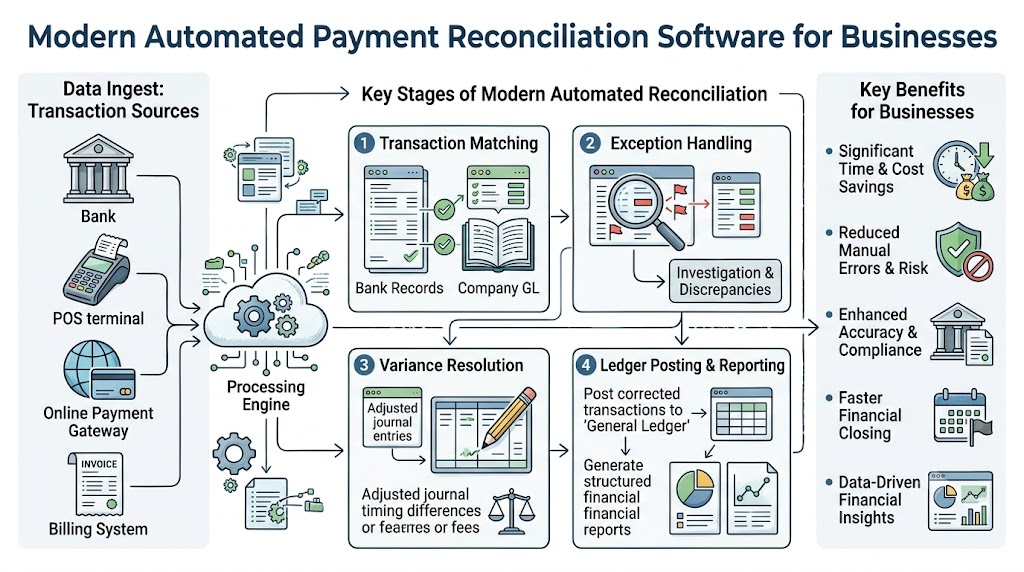
Automated Payment Reconciliation
Manual payment reconciliation is one of the most tedious tasks for finance departments. Matching bank settlement dumps, gateway fee deductions, and net payouts against individual open invoices manually often leads to reconciliation backlogs and undetected discrepancies.
Automated payment reconciliation uses smart matching rules to cross-reference settlement files directly with internal transaction logs. The engine matches unique reference numbers, payment link IDs, and transaction amounts, automatically marking matched invoices as settled. When partial payments or fee deductions occur, the platform flags exceptions for quick manual review, establishing an immutable audit trail aligned with standard Accounting Standards.
Accounts Receivable Automation
Accounts receivable automation elevates cash management from a reactive collection effort to a streamlined, predictable operational workflow.
[Invoice Creation] ➔ [Automated Delivery] ➔ [Dynamic Reminders] ➔ [Multi-Gateway Collection] ➔ [Ledger Auto-Update]
Automating accounts receivable standardizes the complete lifecycle:
- Instant Issuance: Billing data pushes automatically from sales systems to generate accurate invoices.
- Automated Reminders: Pre-scheduled communications trigger based on customer payment history and due dates.
- Automated Allocation: Incoming receipts update customer accounts immediately, unlocking credit limits automatically for trusted clients.
- Strategic Reporting: Management receives clear reports detailing collection efficiency, working capital metrics, and outstanding risks.
Invoice-to-Cash Automation
The invoice-to-cash cycle encompasses every operational touchpoint required to convert a completed sale into usable cash in your bank account.
Invoice Generation
  └──> Dynamic Payment Link Attached
        └──> Multi-Channel Customer Dispatch
              └──> Automated Collection via Preferred Channel
                    └──> Bank Settlement & Gateway Processing
                          └──> Automated Reconciliation & ERP Ledger Entry
                                └──> Real-Time Financial & Executive Reporting
Standardizing this entire lifecycle eliminates systemic delays. By connecting every step in a single automated pipeline, enterprises shorten transaction times from weeks to minutes, lower processing overhead, and maintain consistent cash reserves.
Enterprise Payment Management
Large enterprises operating across multiple branches, business units, or subsidiary companies require elevated operational controls and structural flexibility.
PayManagerPro delivers true enterprise capability by supporting multi-tenant hierarchical account structures. Operations teams can assign strict role-based access control (RBAC), implementing Maker-Checker approval flows for high-value invoices, credit notes, or manual write-offs. Dedicated API endpoints allow deep, custom integrations across enterprise IT environments, while centralized management dashboards provide consolidated visibility into financial metrics across all operating entities.
Security & Compliance
Financial operations demand strict data security, privacy controls, and regulatory adherence. Modern payment management infrastructure must safeguard sensitive transactional data against unauthorized access and system failures.
Key security measures include end-to-end data encryption in transit and at rest, secure API tokenization, and multi-factor administrative authentication. Strict adherence to PCI-DSS standards ensures safe handling of cardholder details. Furthermore, automated audit logging records every user interaction, permission edit, invoice modification, and payout authorization, satisfying stringent regulatory frameworks governed by the Reserve Bank of India (RBI) and National Payments Corporation of India (NPCI).
Integration Capabilities
A software ecosystem is only as powerful as its ability to communicate with existing technology stacks. PayManagerPro integrates cleanly across core enterprise layers:
- Payment Gateways: Built-in connectors for Razorpay, Cashfree, Paytm, and traditional banking gateways.
- Enterprise ERPs: Sync bi-directionally with SAP, Oracle, Microsoft Dynamics, Tally, and Zoho Books.
- CRM Solutions: Connect directly with Salesforce, HubSpot, and Zoho CRM to auto-trigger billing upon contract closure.
- Custom Software: Developer-friendly REST APIs and webhooks ensure seamless, lightweight integration with proprietary applications.
Industries That Can Use PayManagerPro
- Manufacturing: Manage high-volume dealer billing, structured partial credit collections, and complex GST batch calculations.
- Healthcare: Streamline hospital patient billing, diagnostic lab invoicing, and insurance claim co-pay settlements.
- Education: Automate recurring tuition fee collections, multi-channel payment links for parents, and branch-wise fee tracking.
- Logistics: Simplify freight billing, proof-of-delivery payment releases, and vendor payment tracking.
- Retail & E-commerce: Power B2B wholesale invoicing, omnichannel collection dashboards, and quick payment settlements.
- SaaS Companies: Manage recurring subscription billing, dynamic usage metrics, and automated invoice delivery.
- Agencies: Handle project milestone billing, retainer tracking, and automated overdue client reminders.
- Finance & NBFCs: Streamline loan processing fees, EMI collections, and dynamic payment link dispatch.
- Professional Services: Manage consulting retainers, hourly time-billing invoices, and client audit trails accurately.
Manual Process vs PayManagerPro
| Operational Metric | Traditional Manual Process | PayManagerPro Automation |
| Invoice Creation | Manual entry into spreadsheets or basic tools; error-prone | Automated, template-driven, instant GST compliance |
| Payment Collection | Offline bank transfers, manual follow-up calls, cheques | Dynamic payment links via WhatsApp/Email; instant UPI/Card payout |
| Payment Reconciliation | Hours spent cross-matching bank statements with ledgers | Instant, automated matching with detailed exception handling |
| Financial Reporting | Static, delayed end-of-month spreadsheet summaries | Real-time dashboards with aging analysis and instant audit logs |
| Error Rates | High risk of duplicate numbers, bad GSTINs, calculation mistakes | Near-zero error rates backed by automated system validation |
| Processing Time | Days to weeks per billing and collection cycle | Real-time settlement updates and instant reconciliation |
Business Benefits
- Accelerated Cash Flow: Shorten collection cycles dramatically by providing immediate payment options.
- Substantial Cost Savings: Reduce manual administrative labor hours spent on data entry and statement matching.
- Complete Accuracy: Eliminate human errors in GST calculations, invoice numbering, and balance entries.
- Actionable Financial Intelligence: Gain immediate visibility into working capital, revenue streams, and collection metrics.
- Enhanced Client Relationships: Provide professional, branded, and convenient digital payment experiences to your buyers.
Best Practices
To maximize the efficiency of your automated invoice and payment ecosystem:
- Standardize Credit Terms: Clearly outline payment due dates, partial payment rules, and late fee policies on every invoice.
- Automate Reminders Early: Schedule polite automated communications 3 days prior to due dates, on the due date, and structured follow-ups post due date.
- Offer Multiple Payment Options: Enable UPI, net banking, and cards on every invoice link to eliminate payment barriers.
- Reconcile Daily: Run automated reconciliation daily to identify payment disputes or failed transactions immediately.
- Enforce Role-Based Permissions: Restrict invoice editing and approval rights using structured Maker-Checker workflows.
Common Mistakes to Avoid
- Relying on Manual Spreadsheet Tracking: Leads to lost records, missed follow-ups, and uncollected revenue.
- Neglecting Timely Follow-ups: Delaying payment reminders significantly lowers the probability of timely collection.
- Creating Duplicate or Invalid Invoices: Violates GST rules and damages professional client trust.
- Incorrect Tax Calculations: Applying wrong CGST/SGST/IGST rates leads to tax filing discrepancies and lost ITC.
- Delaying Bank Reconciliation: Allowing un-reconciled transactions to accumulate creates financial audit risks.
Future of Digital Payment Management
The digital payments ecosystem continues to evolve rapidly driven by technological innovation and regulatory frameworks. The future of accounts receivable lies in hyper-automation, where artificial intelligence predicts payment delays based on buyer behavior, automatically tailoring communication schedules for maximum collection efficiency. Smart reconciliation engines will resolve complex multi-invoice settlements autonomously, while embedded finance solutions will allow businesses to offer instant supply chain financing directly within digital billing portals. Adopting API-first payment infrastructure today ensures your enterprise remains agile, secure, and prepared for future innovations in corporate finance.
Frequently Asked Questions
What is invoice and payment management software?
Invoice and payment management software is an integrated digital platform that automates the generation, distribution, collection, and bank reconciliation of business invoices. By combining billing engines with multi-gateway payment links and real-time ledger updates, it streamlines accounts receivable operations and improves enterprise cash flow.
How does automated payment reconciliation work?
Automated payment reconciliation imports bank settlement files and gateway payout data, automatically matching transaction IDs, payment link references, and amounts against open invoices. Matched invoices are marked as paid immediately, while unmatched items are flagged for fast administrative review.
Is PayManagerPro compliant with Indian GST laws?
Yes, PayManagerPro fully supports Indian GST compliance rules. It automatically calculates CGST, SGST, and IGST based on the place of supply, validates HSN/SAC codes, maintains sequential invoice numbering, and generates accurate report exports suitable for standard GSTR filings.
Can I send payment links directly through WhatsApp?
Yes, you can generate dynamic payment links attached directly to specific invoices and distribute them instantly via WhatsApp, transactional email, or SMS. Customers can click the link and pay immediately using UPI, cards, or net banking.
How does this software help reduce Average Days Sales Outstanding (DSO)?
By automating pre-due date and post-due date reminders, offering instant digital payment links, and providing multiple payment methods, friction is removed from the buyer’s checkout process, leading to significantly faster invoice settlements.
Can PayManagerPro integrate with my existing ERP software?
Yes, PayManagerPro features developer-friendly REST APIs and webhooks designed to integrate seamlessly with major enterprise systems including SAP, Oracle, Microsoft Dynamics, Tally, Zoho Books, and custom CRM platforms.
What payment methods are supported for customer collections?
The system supports a wide range of modern digital payment channels including Unified Payments Interface (UPI), major credit and debit cards, net banking across all major banks, and popular digital wallets.
What is the Maker-Checker workflow in enterprise payment management?
The Maker-Checker workflow is an internal control mechanism where one user creates or modifies an invoice or credit note (the Maker), and a supervisor or manager (the Checker) must review and approve it before it is finalized or issued.
How secure is enterprise payment management software?
Enterprise platforms employ multi-layer security including end-to-end encryption for data in transit and at rest, strict role-based access controls, multi-factor authentication, PCI-DSS compliance, and comprehensive immutable audit logs.
Can multi-branch businesses manage billing centrally?
Yes, PayManagerPro supports multi-tenant and multi-branch organizational structures, allowing central finance teams to oversee collections across different business units while maintaining separate billing rules and permissions.
What happens if a customer makes a partial payment?
The platform accurately records partial payments against the master invoice, updates the remaining balance automatically, reflects the updated status on the live dashboard, and adjusts future payment reminders to reflect the remaining due amount.
Conclusion
Managing corporate cash flow effectively requires moving away from outdated manual billing processes toward scalable digital solutions. An enterprise invoice and payment management software unifies billing, multi-channel payment collection, automated reminder schedules, and real-time bank reconciliation into a single platform. By eliminating manual data entry, enforcing GST compliance, and removing payment friction for clients, businesses can drastically lower operating costs, eliminate revenue leakage, and accelerate working capital velocity. Embracing modern payment automation provides the operational foundation required to sustain predictable growth and maintain complete control over accounts receivable.