Introduction
Quantum computing is transforming how we process complex information, pushing computation far beyond the physical boundaries of classical hardware. Yet, for developers, cloud engineers, and researchers transitioning into Quantum Information Science and QuantumOps, one initial hurdle consistently stands out: how do we visualize a quantum state? In classical computing, state visualization is simple because a bit is either an open or closed circuit represented as a discrete 0 or 1. A quantum bit (qubit), however, exists in a continuous state space of superposition and relative phase that cannot be drawn as a binary switch. This is where the Bloch Sphere becomes an indispensable tool. Named after Nobel laureate physicist Felix Bloch, the Bloch Sphere is a geometric framework that maps the abstract mathematical vector space of a single qubit onto a 3D sphere, providing an intuitive visual language for understanding quantum states, analyzing single-qubit quantum gates, and debugging algorithms across modern learning platforms like QuantumOpsSchool.com.
What is the Bloch Sphere?
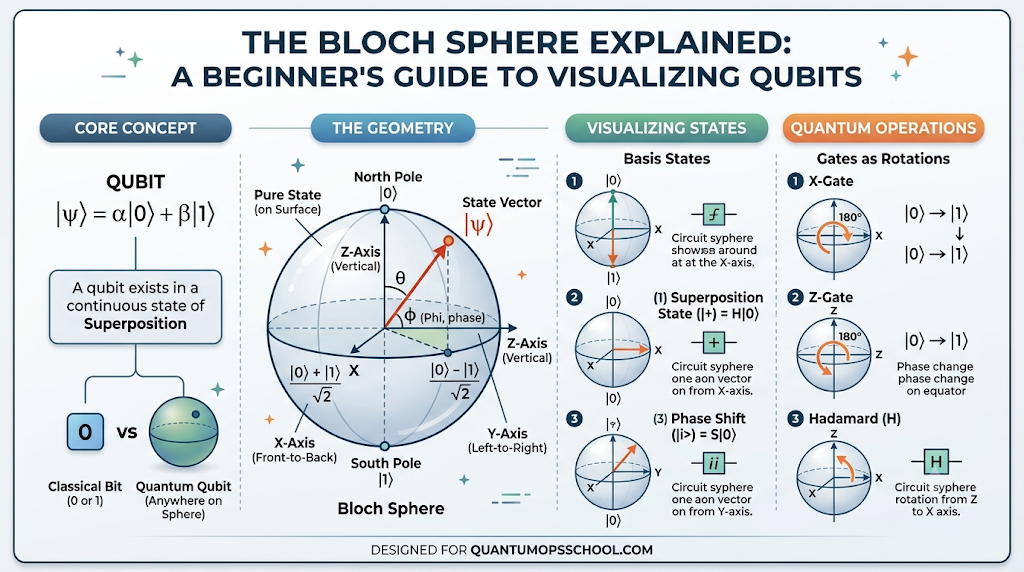
At its core, the Bloch Sphere is a unit sphere used to geometrically represent the pure state of a two-level quantum mechanical system (a single qubit).
Think of a standard globe. The surface of the earth can be identified using latitude and longitude angles. Similarly, every point on the outer surface of the Bloch Sphere corresponds to a unique state of a single qubit.
- The North Pole represents the classical basis state $\vert{}0\rangle$ (pronounced “ket zero”).
- The South Pole represents the classical basis state $\vert{}1\rangle$ (pronounced “ket one”).
- Every point on the surface between the poles represents a valid quantum state in superposition.
By translating complex numbers and linear algebra into spatial geometry, the Bloch Sphere allows developers to view quantum operations not as intimidating matrix multiplications, but as smooth spatial rotations around an axis.
                 |0> (North Pole)
                  |
                  |   . (State Vector |Ψ>)
                  |  /
                  | /  θ (Polar Angle)
                  |/------- Phase Angle (φ)
     -------------+------------- Y-axis
                 /|
                / |
               /  |
              X   |
                  |1> (South Pole)
Text Diagram: Spatial arrangement of the Bloch Sphere showing the basis states at the poles, the internal state vector $\vert{} \psi \rangle$, and its spherical coordinates $(\theta, \phi)$.
Why the Bloch Sphere is Important in Quantum Computing
As quantum software engineering evolves into a standardized discipline (QuantumOps), visualization tools play a critical role in pipeline verification, circuit design, and debugging.
- Translates Abstract Math into Geometry: A qubit state is defined mathematically as a vector in a two-dimensional complex Hilbert space ($\mathbb{C}^2$). The Bloch Sphere maps this complex vector space directly into a real, three-dimensional space ($\mathbb{R}^3$) that humans can visually process.
- Intuitive Understanding of Quantum Gates: Operations like Pauli-X, Hadamard, and Phase gates act as rigid physical rotations of the state vector around specific axes on the sphere.
- Demystifies Quantum Phase: Unlike classical systems, qubits possess a relative phase angle ($\phi$). The equatorial plane of the Bloch Sphere provides a clear visual indicator of phase orientation.
- Essential Educational Bridge: It provides the foundation necessary to understand advanced topics in quantum algorithms, quantum error correction, and quantum cloud computing.
Classical Bits vs Quantum Bits
To appreciate why a geometric representation like the Bloch Sphere is necessary, we must compare classical bits with quantum bits.
| Feature | Classical Bit | Quantum Bit (Qubit) |
| Possible States | Strictly 0 or 1 | $\vert{}0\rangle$, $\vert{}1\rangle$, or any superposition of both |
| State Space | Discrete (2 points) | Continuous (Surface of a 3D unit sphere) |
| Mathematical Representation | Scalar integer ($0$ or $1$) | State vector in complex Hilbert space ($\alpha\vert{}0\rangle + \beta\vert{}1\rangle$) |
| Phase Properties | None | Contains Relative Phase ($\phi$) |
| Visual Model | On/Off Switch | Bloch Sphere Vector |
| Measurement Effect | Deterministic (Reading does not alter state) | Probabilistic (Measurement collapses state to $\Vert{}0\rangle$ or $\Vert{}1\rangle$) |
Understanding Qubits
Mathematically, a pure single-qubit state $\vert{}\psi\rangle$ is written as a linear combination of its computational basis states, $\vert{}0\rangle$ and $\vert{}1\rangle$:
$$\vert{}\psi\rangle = \alpha\vert{}0\rangle + \beta\vert{}1\rangle$$
Where $\alpha$ and $\beta$ are complex numbers representing probability amplitudes. When we measure a qubit, the probability of obtaining outcome $0$ is $\vert{}\alpha\vert{}^2$, and the probability of obtaining outcome $1$ is $\vert{}\beta\vert{}^2$. Because the total probability across all outcomes must equal $100\%$, the normalization constraint dictates that:
$$\vert{}\alpha\vert{}^2 + \vert{}\beta\vert{}^2 = 1$$
Because $\alpha$ and $\beta$ are complex numbers, this equation initially appears to require four real variables (two real and two imaginary components). However, applying normalization and ignoring the unmeasurable global phase reduces the state space down to two independent parameters: two real angles, $\theta$ (theta) and $\phi$ (phi).
This parameter reduction allows us to rewrite any single-qubit state in its canonical Bloch Sphere parameterization:
$$\vert{}\psi\rangle = \cos\left(\frac{\theta}{2}\right)\vert{}0\rangle + e^{i\phi}\sin\left(\frac{\theta}{2}\right)\vert{}1\rangle$$
How the Bloch Sphere Represents Quantum States
The canonical equation links pure quantum mechanics to 3D spherical coordinates:
- Polar Angle ($\theta$): Dictates the position along the vertical axis from the North Pole to the South Pole ($0 \le \theta \le \pi$). It determines the probability distribution between $\vert{}0\rangle$ and $\vert{}1\rangle$.
- Azimuthal Angle ($\phi$): Dictates the rotation around the equator ($0 \le \phi < 2\pi$). It determines the relative phase of the qubit.
The Cartesian coordinates $(x, y, z)$ on the Bloch Sphere surface are computed using standard spherical transformations:
$$x = \sin(\theta)\cos(\phi)$$
$$y = \sin(\theta)\sin(\phi)$$
$$z = \cos(\theta)$$
Every point on the surface of the sphere is represented by a Bloch Vector $(x,y,z)$ extending from the center origin $(0,0,0)$ to the sphere’s shell ($r = 1$).
Understanding the X, Y, and Z Axes
The 3D Cartesian framework of the Bloch Sphere provides intuitive reference directions:
- Z-Axis (Vertical Axis): Represents the computational basis axis.
- Top Pole $(0, 0, 1)$ corresponds to state $\vert{}0\rangle$ ($\theta = 0$).
- Bottom Pole $(0, 0, -1)$ corresponds to state $\vert{}1\rangle$ ($\theta = \pi$).
- X-Axis (Horizontal Front-to-Back Axis): Represents equal superposition states with zero relative phase difference.
- Positive X-axis $(1, 0, 0)$ represents state $\vert{}+\rangle = \frac{1}{\sqrt{2}}(\vert{}0\rangle + \vert{}1\rangle)$.
- Negative X-axis $(-1, 0, 0)$ represents state $\vert{}-\rangle = \frac{1}{\sqrt{2}}(\vert{}0\rangle – \vert{}1\rangle)$.
- Y-Axis (Horizontal Left-to-Right Axis): Represents equal superposition states with a $90^\circ$ ($\pi/2$) relative phase shift.
- Positive Y-axis $(0, 1, 0)$ represents state $\vert{}+i\rangle = \frac{1}{\sqrt{2}}(\vert{}0\rangle + i\vert{}1\rangle)$.
- Negative Y-axis $(0, -1, 0)$ represents state $\vert{}-i\rangle = \frac{1}{\sqrt{2}}(\vert{}0\rangle – i\vert{}1\rangle)$.
North Pole, South Pole, and Superposition States
Understanding the polar positions clarifies how superposition operates geometrically:
             |0> (North Pole, θ = 0)
                \
                 \  Upper Hemisphere (Higher probability of measuring 0)
                  \
   ================+================ Equator (θ = π/2: 50/50 Superposition)
                  /
                 /  Lower Hemisphere (Higher probability of measuring 1)
                /
             |1> (South Pole, θ = π)
- North Pole ($\theta = 0$): $\vert{}\psi\rangle = \cos(0)\vert{}0\rangle + \sin(0)\vert{}1\rangle = 1\vert{}0\rangle + 0\vert{}1\rangle = \vert{}0\rangle$. Measuring this qubit yields
0with 100% certainty. - South Pole ($\theta = \pi$): $\vert{}\psi\rangle = \cos(\pi/2)\vert{}0\rangle + \sin(\pi/2)\vert{}1\rangle = 0\vert{}0\rangle + 1\vert{}1\rangle = \vert{}1\rangle$. Measuring this qubit yields
1with 100% certainty. - Equator ($\theta = \pi/2$): At any equatorial point, $\cos(\pi/4) = \frac{1}{\sqrt{2}}$ and $\sin(\pi/4) = \frac{1}{\sqrt{2}}$. Measuring this qubit yields
0with $50\%$ probability and1with $50\%$ probability.
Visualizing Quantum State Rotations
Single-qubit operations do not create or destroy probability; they manipulate the orientation of the state vector. In physical quantum mechanics, quantum transformations are unitary operations.
Geometrically, a unitary operation applied to a pure state corresponds to a rigid rotation of the Bloch Vector around a specific axis on the sphere without changing its length ($r=1$).
If a qubit is at the North Pole ($\vert{}0\rangle$), applying a transformation that rotates the Bloch vector by $\pi$ radians ($180^\circ$) around the X-axis flips it directly to the South Pole ($\vert{}1\rangle$).
Quantum Gates on the Bloch Sphere
Single-qubit quantum gates act as rotational transformations. Below is a practical breakdown of standard gates and their geometric mechanics:
        Initial State: |0> (North Pole)
                 │
                 │ Hadamard Gate (H)
                 ▼
        Rotates 180° around (X+Z)/√2 axis
                 │
                 ▼
        Equatorial State: |+> (Positive X-axis)
                 │
                 │ Phase Gate (S)
                 ▼
        Rotates 90° around Z-axis
                 │
                 ▼
        Equatorial State: |+i> (Positive Y-axis)
1. Pauli-X Gate ($X$)
- Function: The quantum equivalent of a classical
NOTgate. - Bloch Operation: Rotates the state vector by $\pi$ radians ($180^\circ$) around the X-axis.
- Result: Flips $\vert{}0\rangle \rightarrow \vert{}1\rangle$ and $\vert{}1\rangle \rightarrow \vert{}0\rangle$.
2. Pauli-Y Gate ($Y$)
- Function: Bit and phase flip combined.
- Bloch Operation: Rotates the state vector by $\pi$ radians ($180^\circ$) around the Y-axis.
- Result: Flips $\vert{}0\rangle \rightarrow i\vert{}1\rangle$ and $\vert{}1\rangle \rightarrow -i\vert{}0\rangle$.
3. Pauli-Z Gate ($Z$)
- Function: Phase flip gate.
- Bloch Operation: Rotates the state vector by $\pi$ radians ($180^\circ$) around the Z-axis.
- Result: Leaves $\vert{}0\rangle$ unchanged while flipping the sign of $\vert{}1\rangle$ ($\vert{}1\rangle \rightarrow -\vert{}1\rangle$). On the equator, it flips $\vert{}+\rangle \rightarrow \vert{}-\rangle$.
4. Hadamard Gate ($H$)
- Function: Creates superposition from a basis state.
- Bloch Operation: Rotates the state vector by $\pi$ radians ($180^\circ$) around the diagonal axis $(X + Z)/\sqrt{2}$.
- Result: Maps the North Pole $\vert{}0\rangle$ to the X-axis $\vert{}+\rangle$, and the South Pole $\vert{}1\rangle$ to $\vert{}-\rangle$.
5. Phase Gates ($S$ and $T$)
- S Gate ($\sqrt{Z}$): Rotates the state vector by $\pi/2$ radians ($90^\circ$) around the Z-axis.
- T Gate ($\sqrt{S}$): Rotates the state vector by $\pi/4$ radians ($45^\circ$) around the Z-axis.
- Effect: Alters the relative phase ($\phi$) without changing measurement probabilities ($\vert{}\alpha\vert{}^2$ and $\vert{}\beta\vert{}^2$).
6. Arbitrary Rotation Gates ($R_x, R_y, R_z$)
- Rotation Operators: Allow precise continuous rotations by any arbitrary angle $\theta$ around the X, Y, or Z axes. These form the core parameters in variational quantum algorithms (VQAs) and Quantum Machine Learning (QML).
Relationship Between the Bloch Sphere and Quantum Circuits
Quantum circuits represent chronological operations read from left to right. Each single-qubit gate in a circuit diagram acts as an instruction set for rotating the Bloch vector.
Consider this simple pipeline:
- Initialization: Qubit starts at state $\vert{}0\rangle$ (Pointed at North Pole).
- Apply $H$ Gate: Rotates vector to state $\vert{}+\rangle$ (Pointed along X-axis equator).
- Apply $S$ Gate: Rotates vector $90^\circ$ clockwise along the equator to state $\vert{}+i\rangle$ (Pointed along Y-axis).
- Apply $Z$ Gate: Rotates vector $180^\circ$ along the Z-axis, pointing to state $\vert{}-i\rangle$ (Negative Y-axis).
By executing these steps, a Quantum Software Engineer can map out the precise trajectory of a qubit through 3D space during circuit execution.
Measurement and State Collapse Explained
One of the most crucial concepts in quantum information is measurement. How does measurement look on the Bloch Sphere?
      Superposition State |+> (Equator)
                 │
                 │ Quantum Measurement Applied
                 ▼
      ---------------------------------
      │ Probabilistic Projection      │
      ---------------------------------
        /                           \
  50% /                               \ 50%
    ▼                                   ▼
|0> (State collapses to North Pole)   |1> (State collapses to South Pole)
- Before Measurement: The qubit’s Bloch vector can point to any location on the sphere’s surface.
- The Act of Measurement: Measuring along the computational Z-axis forces the qubit to make a probabilistic choice.
- State Collapse: The Bloch vector instantly snaps from its position (e.g., on the equator) directly to either the North Pole ($\vert{}0\rangle$) or the South Pole ($\vert{}1\rangle$).
All relative phase information ($\phi$) is destroyed during state collapse. The measurement outcome returns a classical bit (0 or 1), and the original superposition state is irreversibly lost.
Global Phase vs Relative Phase
Understanding the distinction between global and relative phase is crucial when working with the Bloch Sphere.
- Global Phase: A phase factor $e^{i\gamma}$ that multiplies the entire state vector:
$$\vert{}\psi’\rangle = e^{i\gamma}\vert{}\psi\rangle = e^{i\gamma}\left(\alpha\vert{}0\rangle + \beta\vert{}1\rangle\right)$$
Global phase has no physically observable effect. The probability of measuring any outcome remains identical: $\vert{}e^{i\gamma}\alpha\vert{}^2 = \vert{}\alpha\vert{}^2$. Because global phase is unmeasurable, the Bloch Sphere ignores it entirely.
- Relative Phase: The phase difference $\phi$ between the basis states $\vert{}0\rangle$ and $\vert{}1\rangle$:
$$\vert{}\psi\rangle = \cos\left(\frac{\theta}{2}\right)\vert{}0\rangle + e^{i\phi}\sin\left(\frac{\theta}{2}\right)\vert{}1\rangle$$
Relative phase is physically observable through quantum interference. Geometrically, relative phase dictates the vector’s exact horizontal orientation on the equatorial plane.
Common Misconceptions About the Bloch Sphere
Avoid these common pitfalls when learning quantum state visualization:
Misconception 1: “Orthogonal states on the Bloch Sphere are separated by 90 degrees.”
- Fact: In linear algebra, orthogonal quantum states have an inner product of zero ($\langle 0\vert{}1\rangle = 0$). On the Bloch Sphere, orthogonal states are located directly opposite each other—separated by 180 degrees ($\pi$ radians). $\vert{}0\rangle$ and $\vert{}1\rangle$ sit at opposite poles.
Misconception 2: “The Bloch Sphere can represent multi-qubit systems like Bell states.”
- Fact: The standard Bloch Sphere can only represent a single qubit. It cannot represent multi-qubit systems or quantum entanglement.
Misconception 3: “Points inside the Bloch Sphere are invalid.”
- Fact: Points on the surface ($r = 1$) represent pure states. Points inside the volume ($r < 1$) represent mixed states—statistical ensembles caused by quantum noise, decoherence, or incomplete information. The center origin $(0,0,0)$ represents a maximally mixed state.
Practical Examples Using Qiskit and IBM Quantum
Let’s put theory into practice using Qiskit (IBM’s open-source quantum SDK). You can write python code to visualize single-qubit states directly on a Bloch Sphere.
Code Example 1: Creating Superposition and Plotting on a Bloch Sphere
Python
# Import necessary modules from Qiskit
from qiskit import QuantumCircuit
from qiskit.quantum_info import Statevector
from qiskit.visualization import plot_bloch_multivector
import matplotlib.pyplot as plt

# Step 1: Create a 1-qubit Quantum Circuit
qc = QuantumCircuit(1)

# Step 2: Apply a Hadamard Gate to place Qubit 0 in superposition
qc.h(0)

# Step 3: Extract the Statevector
state = Statevector.from_instruction(qc)

# Step 4: Plot the Statevector on the Bloch Sphere
plot_bloch_multivector(state)
plt.show()
What Happens Geometrically:
- The circuit initializes in state $\vert{}0\rangle$ (pointing up toward the North Pole).
qc.h(0)executes a Hadamard rotation.- The resulting plot shows the Bloch vector pointing horizontally along the positive X-axis, representing state $\vert{}+\rangle$.
Code Example 2: Rotating Phase around the Z-Axis
Python
# Create a 1-qubit Quantum Circuit
qc_phase = QuantumCircuit(1)

# Move vector to Equator (|+)
qc_phase.h(0)

# Apply S-Gate (90-degree rotation around Z-axis)
qc_phase.s(0)

# Extract Statevector and Plot
state_phase = Statevector.from_instruction(qc_phase)
plot_bloch_multivector(state_phase)
plt.show()
What Happens Geometrically:
- The
Hgate brings the vector to the X-axis. - The
Sgate rotates the vector $90^\circ$ counterclockwise along the equator. - The vector now points along the positive Y-axis, representing state $\vert{}+i\rangle$.
Real-World Applications of Bloch Sphere Visualization
- Debugging Quantum Algorithms: Developers use tools like
plot_bloch_multivectorin Qiskit to inspect individual qubit transformations step-by-step. - Quantum Hardware Calibration: Experimental physicists track how environmental noise affects physical qubits by measuring vector drift from the sphere’s surface toward its interior.
- Quantum Education and Training: Universities and platforms like QuantumOpsSchool.com rely on Bloch Sphere models to teach quantum concepts intuitively.
- Quantum Control and Pulse Tuning: Pulse-level quantum engineers use Bloch rotations to calibrate microwave pulses aimed at physical transmon qubits.
Bloch Sphere vs State Vector Representation
While both methods represent quantum states, they serve different operational roles in quantum computing:
| Metric | Bloch Sphere Representation | State Vector Representation |
| Primary Medium | Geometric 3D Unit Sphere | Complex Vector Array ($\mathbb{C}^{2^n}$) |
| Qubit Capacity | 1 Qubit per sphere (or multi-sphere plots) | Scales to $N$ Qubits ($2^N$ complex numbers) |
| Entangled States | Cannot depict entanglement | Fully depicts multi-qubit entanglement |
| Human Interpretability | High (Visual, spatial, intuitive) | Low for large $N$ (Dense matrices) |
| Phase Visibility | Visible as azimuthal angle ($\phi$) | Visible as complex phase coefficients |
| Noise Representation | Can represent mixed states (interior vector $r < 1$) | Requires Density Matrices ($\rho$) for mixed states |
Limitations of the Bloch Sphere
While the Bloch Sphere is a foundational educational tool, it has notable limitations:
- Single-Qubit Restriction: The Bloch Sphere is fundamentally restricted to visualizing 2-level systems.
- Inability to Show Quantum Entanglement: Entanglement represents non-local correlations between multiple qubits. Because individual entangled qubits do not possess independent pure state vectors, they cannot be drawn on separate single-qubit Bloch Spheres.
- Scalability Challenges: To visualize an 8-qubit unentangled circuit, you must render 8 individual spheres side-by-side. For entangled states, this multi-sphere approach breaks down entirely.
For multi-qubit systems, engineers use advanced tools like Density Matrix Plots, Q-Sphere Visualization, and State City Plots.
Beginner Learning Roadmap for Quantum State Visualization
If you are beginning your journey in quantum software engineering, follow this structured roadmap:
Step 1: Master Linear Algebra Basics
        └─ Focus on complex vectors, inner products, matrices, and unitaries.

Step 2: Learn Single-Qubit Mechanics
        └─ Understand computational basis states |0> and |1>, superposition, and measurement.

Step 3: Master the Bloch Sphere
        └─ Practice mapping angles (θ, φ) to Cartesian axes (X, Y, Z) and state vectors.

Step 4: Analyze Quantum Gates as Rotations
        └─ Learn how X, Y, Z, H, S, and T gates rotate vectors around the sphere.

Step 5: Hands-On Programming with Qiskit
        └─ Build circuits, run statevector simulators, and plot Bloch spheres programmatically.

Step 6: Transition to Multi-Qubit Systems
        └─ Learn tensor products, Bell states, quantum entanglement, and Q-Sphere representations.
Common Mistakes Students Make
- Confusing State Angles with Rotation Angles: Applying an $R_x(\theta)$ gate rotates the Bloch vector by angle $\theta$. However, the vector’s position on the sphere uses $\theta/2$ in its mathematical state formula.
- Assuming $X$-axis is $\vert{}1\rangle$: The basis state $\vert{}1\rangle$ is located at the South Pole (Z-axis), not along the X-axis. The X-axis represents the superposition states $\vert{}+\rangle$ and $\vert{}-\rangle$.
- Attempting to Plot Entangled Qubits: Trying to plot a Bell state like $\frac{1}{\sqrt{2}}(\vert{}00\rangle + \vert{}11\rangle)$ on two Bloch spheres is a common error. Individual entangled qubits lack pure states and collapse to the interior center of the sphere if plotted as reduced density matrices.
- Ignoring the Phase Angle: Focusing only on measurement probabilities ($\vert{}\alpha\vert{}^2, \vert{}\beta\vert{}^2$) leads students to ignore the azimuthal angle ($\phi$), which is critical for interference algorithms like Phase Estimation and Grover’s Search.
Best Resources for Learning More
- Official Documentation: Qiskit SDK Documentation & IBM Quantum Learning Portal.
- Interactive Visualizers: Clean-Web Bloch Sphere Simulators (e.g., Quantum Composer, Grokking Quantum).
- Books: Quantum Computation and Quantum Information by Nielsen & Chuang.
- Specialized Training Programs: Certified QuantumOps, Quantum Software Engineering, and Quantum Developer courses available on QuantumOpsSchool.com.
Career Opportunities in Quantum Computing
As industries adopt quantum technologies, the demand for trained professionals continues to expand rapidly. Mastery of fundamentals like state visualization opens paths to roles such as:
- Quantum Software Engineer: Designs, optimizes, and compiles quantum algorithms using SDKs like Qiskit, Cirq, or TKET.
- QuantumOps & Cloud Infrastructure Specialist: Manages hybrid classical-quantum cloud architectures, execution pipelines, and quantum hardware backends.
- Quantum Algorithm Researcher: Focuses on quantum machine learning, quantum chemistry simulations, and optimization models.
- Quantum Control Engineer: Interfaces software abstractions with hardware pulse dynamics.
Future of Quantum Visualization Tools
The future of quantum state visualization is moving beyond simple static 3D models. Key innovations include:
- Real-Time Quantum Telemetry: Live visualization of noise and decoherence during execution on physical quantum hardware.
- Higher-Dimensional Qudit Sphere Models: Extending spherical representations to $d$-level quantum systems (qudits).
- AR/VR Quantum Circuit Design: Immersive 3D environments allowing engineers to manually rotate Bloch vectors and manipulate quantum pipelines in real-time.
- Integrated QuantumOps Dashboards: Enterprise-grade monitoring platforms that correlate Bloch sphere trajectories with error mitigation metrics.
Frequently Asked Questions
What is the Bloch Sphere used for?
The Bloch Sphere is a 3D geometric tool used to visualize the pure quantum state of a single qubit. It helps developers understand superposition, phase, and quantum gate operations.
Can the Bloch Sphere represent more than one qubit?
No, the standard Bloch Sphere is strictly limited to single-qubit systems. Multi-qubit systems—especially entangled ones—require matrix state representations or tools like the Q-Sphere.
What do the North and South Poles represent?
The North Pole represents the basis state $\vert{}0\rangle$, while the South Pole represents the basis state $\vert{}1\rangle$.
What is the difference between pure and mixed states on the Bloch Sphere?
Pure states lie directly on the sphere’s outer surface ($r = 1$). Mixed states, caused by noise or decoherence, lie inside the sphere’s volume ($r < 1$).
How does a Hadamard gate affect a qubit on the Bloch Sphere?
The Hadamard gate rotates the state vector by $180^\circ$ around the $(X+Z)/\sqrt{2}$ diagonal axis. It maps $\vert{}0\rangle$ at the North Pole to $\vert{}+\rangle$ on the positive X-axis equator.
What is relative phase on the Bloch Sphere?
Relative phase ($\phi$) is the angle around the sphere’s equator (azimuthal angle). It dictates quantum interference properties without changing the probabilities of measuring 0 or 1.
Why is global phase ignored on the Bloch Sphere?
Global phase affects the entire quantum state equally and has no physically observable impact on measurement results. Therefore, it is omitted from the Bloch Sphere equation.
How do I plot a Bloch Sphere in Qiskit?
You can use the plot_bloch_multivector() function from qiskit.visualization along with a valid Statevector object.
What is the radius of the Bloch Sphere?
The Bloch Sphere is a unit sphere with a maximum radius of $r = 1$, representing pure quantum states normalized to a total probability of 1.
Where can I get hands-on training in Quantum Computing and QuantumOps?
You can access industry-aligned certifications, hands-on tutorials, and quantum software engineering courses directly on QuantumOpsSchool.com.
Conclusion
The Bloch Sphere serves as a vital bridge connecting abstract linear algebra with intuitive geometric spatial reasoning. By mapping complex quantum state vectors onto a 3D unit sphere, developers can easily visualize superposition, track relative phase, and conceptualize quantum gates as smooth spatial rotations. While it has limitations—such as its restriction to single-qubit states—mastering the Bloch Sphere is a mandatory first step for anyone aspiring to build a career in quantum programming, quantum algorithm design, or QuantumOps.