Introduction
We are currently witnessing one of the most exciting shifts in computing history. For decades, classical computers built on traditional silicon chips have powered everything from smartphones to global financial networks. However, as business problems grow increasingly complex—such as optimizing global logistics, discovering life-saving drugs, or simulating molecular structures—classical systems hit a physical ceiling. Enter quantum computing. By leveraging the principles of physics, quantum systems solve complex problems in minutes that would take traditional supercomputers thousands of years. If you are a student, engineering graduate, or beginner developer looking at the future of technology, understanding QuantumOps early gives you a massive career advantage. In this detailed guide, we will break down what QuantumOps is, why it matters, the core skills you need to build first, and a step-by-step roadmap to start your career.
What is QuantumOps?
To understand QuantumOps (Quantum Operations), it helps to look at how traditional software development evolved.
In traditional software, developers write code, and operations teams deploy and manage it on servers. To bridge the gap between building and deploying software, the tech industry created DevOps—a combination of practices, tools, and cultural philosophies that automates the delivery of software applications.
QuantumOps applies these same principles to quantum computing environments.
       [ Classical Code / APIs ]
                  │
                  ▼
         ┌──────────────────┐
         │ Quantum Compiler │
         └────────┬─────────┘
                  │
                  ▼
   ┌──────────────────────────────┐
   │ Noise Mitigation & Pulse     │
   │ Optimization                 │
   └──────────────┬───────────────┘
                  │
                  ▼
   ┌──────────────────────────────┐
   │ Quantum Hardware / Simulator │
   └──────────────────────────────┘
QuantumOps is the practical practice of integrating quantum software, hybrid classical-quantum algorithms, quantum hardware access, and cloud orchestration into a unified, automated operational pipeline. It ensures that quantum code runs reliably, efficiently, and securely across noise-prone quantum processors (QPU) and classical High-Performance Computing (HPC) clusters.
Why QuantumOps is Becoming Important
Quantum hardware is progressing rapidly. Companies like IBM, Google, Rigetti, and IonQ are routinely launching processors with higher qubit counts and lower error rates. However, writing a quantum algorithm in a lab notebook is vastly different from running that algorithm as part of an enterprise application.
Here is why QuantumOps is becoming essential for the industry:
- Hybrid Infrastructure Management: Modern quantum applications rarely run 100% on quantum hardware. They use classical computers for preprocessing and postprocessing, sending only specific math-heavy routines to the Quantum Processing Unit (QPU). QuantumOps manages this hybrid classical-quantum communication.
- Managing Hardware Noise and Decoherence: Today’s quantum computers operate in the NISQ (Noisy Intermediate-Scale Quantum) era. Qubits are fragile and susceptible to environmental interference. QuantumOps workflows automatically handle error mitigation, calibration, and retry strategies.
- Resource Queueing and Cost Control: Quantum hardware access is expensive and scarce. QuantumOps pipelines queue jobs efficiently, run local simulations first, and only send optimized jobs to actual QPUs to minimize costs.
- Automation and Continuous Delivery: Just like standard web platforms need automated testing (CI/CD), quantum applications need continuous integration pipelines to verify that circuit optimizations work as expected across different QPU backends.
Difference Between Quantum Computing and QuantumOps
While these terms are closely related, they refer to different layers of the quantum ecosystem.
| Feature / Aspect | Quantum Computing | QuantumOps |
| Primary Focus | Theoretical foundation, quantum physics, algorithm design, and QPU hardware. | Deployment, orchestration, automation, and hybrid infrastructure management. |
| Core Goal | Creating quantum algorithms to solve complex mathematical problems. | Running quantum workloads reliably, repeatedly, and efficiently in production. |
| Key Skillsets | Quantum physics, linear algebra, quantum logic gates, algorithm complexity. | DevOps, Python, API integration, CI/CD pipelines, containerization, cloud systems. |
| Primary Tools | Qiskit, Cirq, PennyLane, Q#, Dirac notation math. | Docker, GitHub Actions, Cloud APIs, Qiskit Runtime, monitoring dashboards. |
| Typical Role | Quantum Information Scientist, Quantum Algorithm Researcher. | QuantumOps Engineer, Quantum Cloud Architect, Quantum Software Engineer. |
Who Should Learn QuantumOps?
QuantumOps is an interdisciplinary field, which means you do not need a Ph.D. in theoretical physics to build a successful career in it. The field welcomes individuals from various backgrounds:
- Computer Science and Software Engineering Students: If you know basic programming, system design, and software pipelines, learning QuantumOps allows you to apply those principles to next-generation computing.
- DevOps and Cloud Enthusiasts: If you enjoy working with Docker, Linux, CI/CD, and cloud computing platforms, transitioning into QuantumOps gives you a specialized niche in high-demand enterprise environments.
- Physics and Mathematics Majors: If you understand quantum mechanics and linear algebra, adding QuantumOps skills helps you transform theoretical math models into operational software products.
- IT Professionals and Infrastructure Engineers: Systems administrators and cloud engineers who want to stay ahead of infrastructure shifts can prepare for hybrid QPU-HPC enterprise architectures.
Essential Skills Students Should Learn First
If you are starting from scratch, diving straight into advanced quantum physics can feel overwhelming. To build a solid foundation without getting stuck, focus on these essential core skills first.
                  ┌────────────────────────────────────────┐
                  │ 1. Mathematics & Quantum Fundamentals  │
                  └───────────────────┬────────────────────┘
                                      │
                                      ▼
                  ┌────────────────────────────────────────┐
                  │  2. Python & Command Line Essentials   │
                  └───────────────────┬────────────────────┘
                                      │
                                      ▼
                  ┌────────────────────────────────────────┐
                  │  3. Quantum SDKs (Qiskit / PennyLane)  │
                  └───────────────────┬────────────────────┘
                                      │
                                      ▼
                  ┌────────────────────────────────────────┐
                  │ 4. DevOps, Cloud & Automated Pipelines │
                  └────────────────────────────────────────┘
Mathematics Fundamentals for QuantumOps
Quantum computing relies on specific branches of mathematics. You do not need to be a mathematician, but you should feel comfortable with these core concepts:
- Linear Algebra: Vectors, matrices, matrix multiplication, eigenvectors, and eigenvalues form the primary language used to describe quantum states and logic gates.
- Complex Numbers: Quantum state amplitudes are represented using complex numbers, which include both real and imaginary parts ($a + bi$).
- Probability and Statistics: Quantum measurement yields probabilistic results rather than fixed deterministic outputs. Understanding probability distributions is key to analyzing quantum outputs.
Basics of Quantum Mechanics
You only need an intuitive understanding of a few fundamental quantum mechanics concepts to write quantum programs:
- Qubit (Quantum Bit): Unlike classical bits that store either a 0 or a 1, a qubit can exist in a state that is a linear combination of both.
- Superposition: The ability of a quantum system to exist in multiple state combinations simultaneously until measured. Think of it like a spinning coin—while spinning, it holds a state of both heads and tails until it lands.
- Entanglement: A unique quantum phenomenon where two or more qubits become interconnected, such that the state of one instantly informs the state of another, regardless of distance.
- Measurement and Decoherence: Observing a qubit forces its superposition to collapse into a definite classical state (0 or 1). Environmental interference causing this collapse prematurely is known as decoherence.
Programming Languages for Quantum Computing
To build and automate quantum workflows, you need to write clean, maintainable code.
- Python for Quantum Computing: Python is the uncontested industry standard for quantum development. Almost all major quantum SDKs—including Qiskit, Cirq, and PennyLane—are native Python libraries. Master concepts like object-oriented programming, data structures, and packages like
NumPyandMatplotlib. - Q# (Q-Sharp): Developed by Microsoft, Q# is a domain-specific language designed specifically for quantum algorithm development within the .NET ecosystem.
- C++ and Rust: Used primarily under the hood in quantum compilers and low-level pulse simulation engines where execution speed is critical.
Linux and Command-Line Skills
All cloud-based quantum workloads run on Linux-based environments. As a QuantumOps engineer, the terminal is your main workspace.
- Essential Shell Commands: Master navigating directories, file handling, process management, and environment variable settings using
bashorzsh. - Scripting: Write automation scripts using Shell or Python to process quantum output files, trigger execution jobs, and log error outputs.
- SSH and Remote Management: Understand how to securely log into remote server instances and HPC clusters.
Cloud Platforms for Quantum Development
Since quantum computers require specialized cryogenic cooling systems, users interact with them almost exclusively through cloud providers.
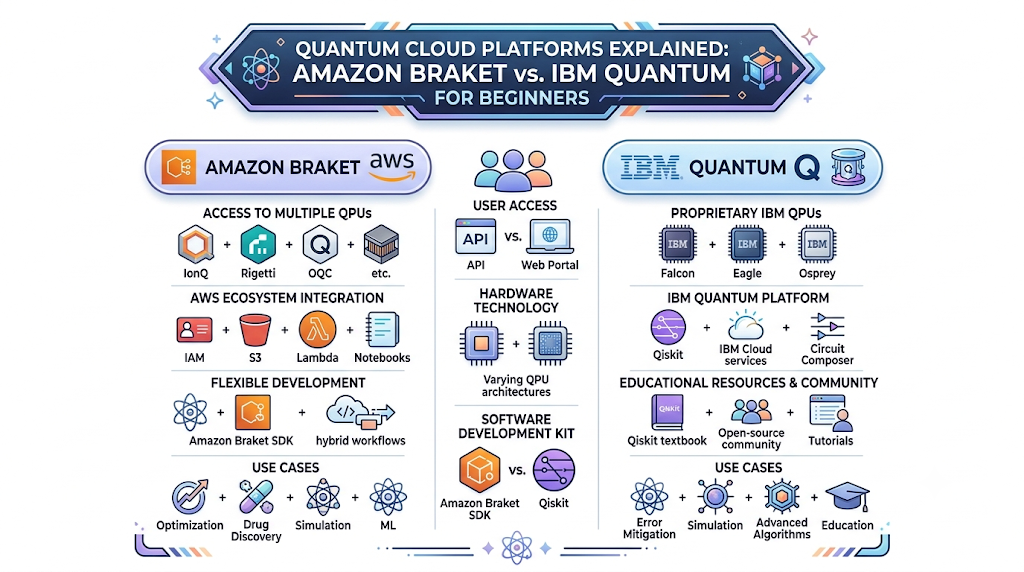
- IBM Quantum Platform: Offers free and enterprise cloud access to real superconducting quantum devices and simulators via Qiskit.
- Amazon Braket: A fully managed cloud service from AWS that lets you test algorithms on diverse quantum hardware architectures (such as superconducting, trapped-ion, and neutral-atom systems).
- Microsoft Azure Quantum: Integrates multiple quantum hardware providers and offers tools to simulate quantum systems using Q# and Python.
Version Control with Git and GitHub
Modern team development requires tracking code changes and collaborating cleanly.
- Git Essentials: Learn how to track repositories, make commits, create feature branches, and handle merge conflicts.
- GitHub Operations: Understand pull requests, code reviews, issue tracking, and tagging releases.
- Continuous Integration Foundations: Get comfortable writing simple automation scripts using GitHub Actions to run test suites every time new code is pushed.
Quantum Development Frameworks
Software Development Kits (SDKs) allow you to write quantum circuits using high-level code instead of configuring manual hardware setups.
| Framework | Lead Developer | Primary Focus Area | Best For |
| Qiskit | IBM | General Quantum Computing, Hardware Execution, Error Mitigation | Beginners, IBM QPU execution, universal gate-based algorithms. |
| PennyLane | Xanadu | Quantum Machine Learning, Differentiable Programming | QML experiments, hybrid neural networks, optimization. |
| Cirq | NISQ-era Circuit Optimization, Low-Level Gate Control | Google Quantum AI access, customized hardware-level control. | |
| Amazon Braket SDK | Amazon Web Services | Cross-Platform Hardware Execution | Multi-hardware access across different hardware vendors via AWS. |
Understanding Quantum Algorithms
Once you learn how to assemble simple quantum logic gates (such as Hadamard, CNOT, and Pauli gates), you can explore foundational quantum algorithms:
- Bernstein-Vazirani & Deutsch-Jozsa Algorithms: Great introductory algorithms that demonstrate how quantum parallel processing offers speedups over classical methods.
- Grover’s Search Algorithm: Demonstrates quadratic speedups when searching unsorted databases.
- Shor’s Factorization Algorithm: A famous algorithm showing how large-scale fault-tolerant quantum systems can factor numbers exponentially faster than classical algorithms.
- Variational Quantum Eigensolver (VQE): A hybrid algorithm used in modern NISQ devices for chemistry simulations and molecular modeling.
Introduction to Quantum Machine Learning
Quantum Machine Learning (QML) sits at the intersection of quantum computing and artificial intelligence.
QML blends quantum computing principles with classical machine learning frameworks like PyTorch and TensorFlow. Instead of processing feature vectors exclusively on GPUs, hybrid QML model layers map classical data into high-dimensional quantum states (Hilbert space).
Python
# Conceptual Hybrid Quantum-Classical Workflow
import qiskit
from qiskit import QuantumCircuit
import numpy as np

# Create a 2-qubit circuit for feature encoding
qc = QuantumCircuit(2)
qc.h(0)            # Put qubit 0 into superposition
qc.cx(0, 1)        # Entangle qubit 0 and qubit 1
qc.rz(0.5, 0)      # Parameterized rotation (trainable parameter)
qc.measure_all()

print("Quantum Workflow Circuit Initialized:")
print(qc)
By leveraging frameworks like PennyLane, students can train parameterized quantum circuits using standard optimization techniques like gradient descent.
Automation and DevOps Concepts for QuantumOps
The true “Ops” aspect of QuantumOps centers around managing workloads reliably using automated tools:
- Containerization with Docker: Package your quantum Python dependencies, SDK versions, and environment configs into lightweight containers so your code runs identically across local machines and cloud clusters.
- CI/CD Pipelines: Set up GitHub Actions or GitLab CI to automatically build container images, run unit tests on local simulator backends, and flag breaking changes.
- Job Monitoring and Queue Management: Quantum execution requests can sit in remote cloud queues. QuantumOps frameworks handle auto-retries, check execution status, parse output JSON files, and trigger downstream notifications automatically.
Building Your First Quantum Workflow
To visualize how a QuantumOps pipeline operates in practice, here is what a standard automated workflow looks like:
- Local Development: Write your quantum circuit locally in Python using Qiskit or PennyLane.
- Local Simulation Verification: Test your circuit logic against a local classical simulator (
aer_simulator) to verify its math without spending QPU credits. - Automated Sanity Build: Push the code to GitHub. An automated GitHub Action triggers a build that checks syntax, verifies formatting, and ensures dependencies compile clean.
- Cloud Job Submission: The pipeline authenticates with a quantum cloud API (like IBM Quantum or Amazon Braket) and submits the circuit job.
- Post-Processing & Logging: Once the QPU finishes execution, the pipeline retrieves raw measurement counts, applies error mitigation filters, and logs results to a dashboard.
Common Beginner Mistakes and How to Avoid Them
Learning QuantumOps can be smooth if you avoid these common pitfalls:
- Mistake 1: Trying to master all quantum physics before writing code.
- Correction: Focus on linear algebra and basic gate operations first. Learn by building and testing actual circuits using modern software libraries.
- Mistake 2: Sending unvalidated code directly to expensive QPU backends.
- Correction: Always run local simulations first. Only submit jobs to real hardware backends once your circuit structure is verified.
- Mistake 3: Ignoring classical software engineering best practices.
- Correction: Write clean code, maintain structured Git commits, document environment dependencies, and use virtual environments.
- Mistake 4: Expecting quantum computers to replace classical computers completely.
- Correction: Understand that the future is hybrid. Quantum units act as specialized accelerators alongside classical high-performance computing clusters.
Step-by-Step QuantumOps Learning Roadmap
Use this structured roadmap to guide your learning progression over time:
[Phase 1: Foundations] ──► [Phase 2: SDKs & Math] ──► [Phase 3: Automation] ──► [Phase 4: Advanced Systems]
Phase 1: Foundations (Weeks 1–4)
- Learn Python syntax, data structures, and virtual environments (
venv,conda). - Get comfortable with Linux command-line tools and shell scripting.
- Master Git version control basics and setup your GitHub account.
Phase 2: Quantum SDKs & Core Math (Weeks 5–8)
- Study linear algebra basics (matrices, vectors, complex inner products).
- Install Qiskit or PennyLane and run basic quantum logic gate circuits.
- Practice running local simulations on your laptop.
Phase 3: Cloud Execution & Automation (Weeks 9–12)
- Create free cloud developer accounts on IBM Quantum and Amazon Braket.
- Learn to build Docker containers for your Python quantum workloads.
- Set up automated CI/CD workflows using GitHub Actions.
Phase 4: Hybrid Applications & Portfolio (Weeks 13+)
- Experiment with hybrid algorithms like VQE or simple Quantum Machine Learning models.
- Build complete end-to-end sample projects and post your code publicly on GitHub.
- Write technical blog write-ups explaining your project architecture.
Hands-on Practice Projects for Students
Building practical projects is the best way to solidify your knowledge and stand out to future employers:
- Automated Quantum Random Number Generator (QRNG):Build a simple service that uses quantum superposition to generate true random numbers, containerize it in Docker, and expose it via a REST API.
- QPU Performance Comparison Pipeline:Write an automated script that submits the same benchmark quantum circuit to both a local simulator and a real cloud QPU, collects the output distributions, and plots error rate comparisons.
- CI/CD Pipeline for Circuit Optimization:Set up a GitHub repository that uses GitHub Actions to automatically run transpile optimizations on any newly pushed quantum circuit files.
- Hybrid Quantum Classifier:Use PennyLane and PyTorch to build a small image classification pipeline that passes feature layers through a parameterized quantum circuit.
Certifications That Can Help
Earning recognized industry certifications helps validate your technical skills to recruiters and hiring managers:
- IBM Certified Associate Developer – Quantum Computation: Validates your core understanding of quantum circuits, gate operations, and hands-on execution using Qiskit.
- AWS Certified Cloud Practitioner / Solutions Architect: Demonstrates foundational knowledge of cloud infrastructure, essential for managing services like Amazon Braket.
- Linux Foundation Certified System Administrator (LFCS) or HashiCorp Terraform Associate: Validates the DevOps, automation, and infrastructure-as-code skills needed for QuantumOps roles.
Career Opportunities in QuantumOps
As enterprise interest in quantum applications expands, organizations are actively building out hybrid infrastructure teams.
                  ┌────────────────────────────────────────┐
                  │          QuantumOps Engineer           │
                  └───────────────────┬────────────────────┘
                                      │
         ┌────────────────────────────┼────────────────────────────┐
         │                            │                            │
         ▼                            ▼                            ▼
┌─────────────────┐          ┌─────────────────┐          ┌─────────────────┐
│  Quantum Cloud  │          │Quantum Software │          │ Hybrid HPC/QPU  │
│    Architect    │          │    Developer    │          │ Systems Engineer│
└─────────────────┘          └─────────────────┘          └─────────────────┘
Top emerging roles include:
- QuantumOps Engineer: Focuses on orchestrating hybrid quantum-classical workflows, job queue management, and automating deployment pipelines.
- Quantum Software Developer: Builds and maintains core application software, SDK integrations, and quantum circuit libraries.
- Quantum Cloud Infrastructure Architect: Designs enterprise-grade cloud environments that securely connect classical enterprise databases with remote QPU backends.
- Quantum Solutions Consultant: Helps enterprise clients translate business problems into viable quantum computing research projects.
Future of QuantumOps in Enterprise Computing
The future of high-performance enterprise computing is inherently hybrid. Over the coming years, we expect to see:
- Fault-Tolerant Quantum Systems: As hardware developers achieve logical, error-corrected qubits, QuantumOps frameworks will scale up to manage millions of virtual qubits.
- Standardized Infrastructure Automation: Terraform providers, Kubernetes operators, and dedicated orchestration tools will emerge specifically designed to manage QPU resources alongside classical GPU and CPU clusters.
- Widespread Enterprise Integration: Industries like pharmaceuticals, finance, aerospace, and logistics will regularly run hybrid quantum pipelines as part of their day-to-day operations.
Frequently Asked Questions
Do I need a Ph.D. in physics to get started with QuantumOps?
No. While research roles designing hardware require advanced physics degrees, QuantumOps focuses on software operations, automation, cloud platforms, and pipeline orchestration. A background in computer science, software engineering, or IT is a great foundation.
Which programming language should I learn first for quantum computing?
Python is the absolute first language you should master. Almost every leading quantum framework—including Qiskit, Cirq, and PennyLane—uses Python as its primary interface.
What is the best way to practice running quantum algorithms for free?
Platforms like IBM Quantum Platform and Amazon Braket offer free access tiers and cloud simulator environments where you can write, test, and run quantum code at no initial cost.
How is QuantumOps different from standard DevOps?
DevOps focuses on traditional software running on classical hardware. QuantumOps addresses unique quantum challenges like job queuing on scarce QPU hardware, managing probabilistic outputs, noise mitigation, and hybrid classical-quantum system orchestration.
Can I run quantum software on my personal laptop?
Yes. You can install quantum SDKs like Qiskit on your local computer to build circuits and run them on local classical simulators. To run jobs on real quantum hardware, your scripts will connect to cloud QPUs via APIs.
Which quantum framework should I learn first: Qiskit, Cirq, or PennyLane?
Qiskit is ideal for general quantum computing and learning core gate mechanics. PennyLane is the go-to choice if you are interested in Quantum Machine Learning. Cirq is great for lower-level, hardware-focused circuit optimization.
What math subjects should I review before starting?
Focus on linear algebra (vectors, matrices, matrix multiplication), complex numbers, and basic probability theory.
Are there real job openings in QuantumOps today?
Yes. Major technology firms, cloud providers, defense contractors, financial institutions, and specialized quantum startups actively recruit professionals who understand both software engineering pipelines and quantum development.
What is the NISQ era?
NISQ stands for “Noisy Intermediate-Scale Quantum.” It describes the current phase of quantum hardware development, where computers have tens to hundreds of qubits but remain sensitive to environmental noise and errors.
How long does it take a student to learn the basics of QuantumOps?
With consistent effort (around 5–10 hours per week), a student with basic programming experience can learn core quantum concepts, SDK workflows, and basic automation pipelines in 3 to 4 months.
Conclusion
The transition toward quantum-accelerated computing is no longer a distant theoretical idea—it is actively taking shape today. Just as cloud computing transformed IT infrastructure over the past two decades, QuantumOps is set to define how high-performance hybrid applications will be built, deployed, and managed in the future. As a student or early-career professional, learning QuantumOps gives you a unique advantage at the intersection of modern software operations and next-generation computing. By focusing on foundational math, mastering Python, exploring frameworks like Qiskit and PennyLane, and applying traditional DevOps practices to quantum workflows, you position yourself at the forefront of this emerging field.