Introduction
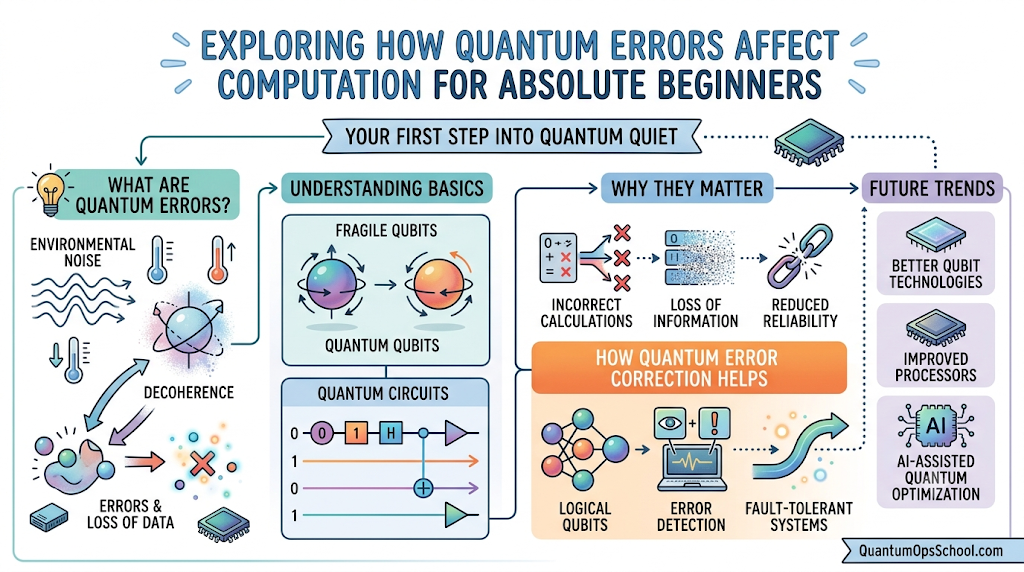
Quantum computing is one of the most exciting frontiers in modern technology. By harnessing the strange laws of physics at the subatomic scale, these advanced machines promise to solve problems that would take classical supercomputers thousands of years to process. However, building a reliable quantum computer is incredibly difficult. The very feature that gives these systems their immense power—their extreme sensitivity to the universe around them—is also their greatest vulnerability. To read more about the foundation of these machines, you can check out the learning resources available at QuantumOpsSchool.com. Understanding how quantum errors affect computation is essential for anyone looking to work with these systems. Unlike standard computers, which are highly stable, quantum computers are incredibly delicate.
What Are Quantum Errors?
Definition and Origin
In the simplest terms, a quantum error is any unauthorized change in the state of a quantum system that corrupts the information being processed. While standard computers deal with bits that are either 0 or 1, quantum systems use states that are far more fluid. A quantum error occurs when the environment forces these fluid states to shift unexpectedly, leading to incorrect calculations.
Why They Occur
Quantum systems operate at the level of atoms, photons, or electrons. Because these particles are so tiny, they are easily influenced by their surroundings. If a quantum processor is exposed to the tiniest bit of stray heat or radiation, the delicate balance of the subatomic particles is disrupted. This sensitivity means that errors are not a rare accident in quantum systems; they are a constant, natural hurdle that hardware engineers must fight against every second a machine runs.
Difference from Classical Computing Errors
In a standard smartphone or laptop, data is stored as billions of tiny electrical switches. It takes a massive amount of relative energy to accidentally flip a classical switch from a 1 to a 0. Because of this, classical computing errors are incredibly rare. Quantum computers, however, use properties that exist in a delicate state of transition. Instead of a hard switch, think of a quantum state as a spinning coin. It is much easier to accidentally bump a spinning coin off course than it is to flip a heavy light switch.
Importance in Quantum Systems
Managing these errors is the single most important roadblock in modern computer engineering. A quantum computer with high error rates cannot successfully run long algorithms. Without addressing these flaws, the answers generated by a quantum circuit become nothing more than random noise, rendering the machine useless.
Understanding the Basics of Quantum Computation
To understand how errors disrupt a quantum system, we first need to look at the basic building blocks of quantum computation.
Classical Bit:  [ 0 ]  OR  [ 1 ]  (Static Switch)
Quantum Qubit:  [ 0 ] --- (Superposition) --- [ 1 ] (Spinning Coin)
Qubits
A classical computer uses bits as its basic unit of information. A bit is binary, meaning it can only exist in one of two positions: 0 or 1. A quantum computer uses qubits (quantum bits).
- Analogy: Think of a classical bit like a light switch that is either turned completely off (0) or completely on (1). A qubit is like a spinning coin. While the coin is spinning, it is not just a heads or a tails; it contains the potential for both states at the same time.
Superposition
Superposition is the ability of a qubit to exist in multiple states simultaneously. This allows a quantum processor to evaluate vast numbers of possibilities at once.
- Analogy: Imagine trying to find your way out of a maze. A classical computer walks down one path at a time, backs up if it hits a dead end, and tries the next. A quantum computer in a state of superposition can explore every single path of the maze simultaneously.
Entanglement
Entanglement is a unique connection where two or more qubits become deeply linked. The state of one qubit instantly influences the state of another, no matter how far apart they are.
- Analogy: Imagine a pair of magical dice. If you roll one in New York and it lands on a six, the other die in Tokyo will instantly land on a six as well, even though nobody touched it. This allows quantum circuits to share information instantaneously, speeding up complex calculations.
Quantum Gates
In classical computers, logic gates (like AND, OR, NOT) manipulate bits to perform calculations. Quantum gates manipulate qubits by altering their probabilities and shifting their alignments.
- Analogy: If a qubit is a spinning coin, a quantum gate is like a gentle tap from a finger that changes the speed or angle of the spin without stopping the coin completely.
Quantum Circuits
A quantum circuit is a collection of quantum gates arranged in a specific sequence to perform a computation. It guides qubits through a series of changes to reach a final answer.
- Analogy: Think of a quantum circuit like a highly choreographed dance routine. Every dancer (qubit) must move precisely in sync with the music (the gates) to create the perfect performance. If one dancer slips, the entire routine falls apart.
Types of Quantum Errors
Quantum computing suffers from several unique types of errors due to the complex nature of qubits.
Bit-Flip Errors
A bit-flip error occurs when a qubit that is supposed to represent a 0 accidentally turns into a 1, or vice versa. This is the closest equivalent to a classical computing error.
- Example: If your quantum program expects a qubit to be standing upright (representing 0), a bit-flip knocks it completely upside down (representing 1).
Phase-Flip Errors
Because qubits act like waves, they have a property called a phase, which relates to the timing and alignment of the wave. A phase-flip error happens when the wave’s alignment is inverted without changing its overall value.
- Example: Imagine two children swinging on swings in perfect sync. A phase-flip error is like suddenly pushing one child so they are swinging completely out of sync with the other, disrupting the harmony of the system.
Depolarization Errors
This error occurs when a qubit completely loses its quantum properties and becomes entirely randomized. It disconnects from the rest of the system and acts as unpredictable static.
- Example: Imagine a compass needle spinning wildly out of control because a strong magnet was brought too close to it. The needle no longer points north; it is just uselessly twitching.
Measurement Errors
To get an answer from a quantum computer, you have to read the final state of the qubits. A measurement error occurs when the hardware misreads the final state at the very end of the calculation.
- Example: You look at a coin that clearly landed on heads, but because the room is dark, you mistakenly write down that it landed on tails.
Leakage Errors
Sometimes, a qubit escapes its designated energy levels entirely. Quantum computing relies on qubits staying within a strict two-level system (like 0 and 1). A leakage error happens when the particle jumps into a third, unintended energy state.
- Example: A train suddenly jumps off its tracks and starts driving through a field where there are no stations or signals.
Gate Errors
These errors happen during the execution of a quantum gate. If a gate applies slightly too much or too little energy to a qubit, the resulting state will be slightly off.
- Example: A baker adds half a teaspoon too much sugar to a cake recipe. The cake still bakes, but the taste is slightly wrong.
Why Quantum Errors Affect Computation
When errors slip into a quantum system, they do not just cause minor glitches; they can completely derail the entire process.
Perfect Circuit:  [Start] ---> [Precise Operations] ---> [Correct Answer]
Error Circuit:    [Start] ---> [Noise Interference]  ---> [Random Static]
Incorrect Calculations
Because quantum computing relies on precise mathematical interference to cancel out wrong answers and amplify right ones, a single altered qubit can corrupt the math. This results in the computer outputting an incorrect answer at the end of the run.
Loss of Quantum Information
Quantum information is fragile. When an error introduces quantum noise, the unique characteristics of superposition and entanglement vanish. The data literally dissolves into the environment before the computer can finish its job.
Reduced Algorithm Accuracy
As a quantum program runs, errors compound over time. The longer and more complex the algorithm, the more errors accumulate. This drastically reduces the accuracy of long-term calculations, meaning complex problems become impossible to solve cleanly.
Increased Computational Complexity
To battle errors, engineers have to run the same program thousands of times to look for averages, or add massive amounts of extra hardware to double-check the work. This vastly increases the time and energy needed to complete a task.
Reduced Reliability
If a computer gives you a different answer every time you run the exact same program, it cannot be trusted for critical work. Quantum errors destroy the consistency that businesses and researchers need to rely on quantum systems.
Common Causes of Quantum Errors
Quantum systems are plagued by external and internal disruptions. Here are the most common culprits behind these calculation errors.
Decoherence
Decoherence is the process where a qubit loses its quantum state because it interacted with the outside world. It is the ultimate enemy of quantum hardware. The moment a qubit bumps into its environment, it stops acting like a quantum particle and turns back into a regular, classical particle.
Environmental Noise
This includes stray magnetic fields, Wi-Fi signals, radio waves, and even cosmic rays passing through the room. Because qubits are incredibly sensitive, these invisible waves act as loud background static that disrupts their operations.
Hardware Imperfections
No manufacturing process is perfect. The microscopic chips, lasers, and microwave lines used to control qubits often have tiny physical flaws. These manufacturing imperfections introduce small, systematic errors every time the machine runs.
Crosstalk
Quantum circuits crowd many qubits close together on a tiny chip. Crosstalk happens when an operation intended for one specific qubit accidentally bleeds over and alters the qubit sitting next to it.
Temperature Fluctuations
Most quantum computers must be kept at temperatures colder than deep space (near absolute zero) using specialized refrigerators. If the temperature rises by even a fraction of a degree, thermal energy agitates the qubits, causing immediate errors.
Control Inaccuracies
Engineers use highly precise laser pulses or microwave signals to control qubits. If the timing of these signals is off by even a picosecond, or if the power level fluctuates slightly, the control system itself introduces an error.
Impact on Real-World Quantum Applications
Quantum computing has the potential to revolutionize many industries, but quantum errors currently limit how effectively we can deploy these applications today.
- Drug Discovery: Quantum systems can simulate molecular interactions at an atomic level to find life-saving cures. However, small errors can misrepresent chemical bonds, leading to incorrect molecular models and failed drug designs.
- Cryptography: Quantum computers can theoretically crack modern encryption methods. Currently, error rates prevent systems from running the long, complex algorithms required to break these security codes, keeping our data safe for now.
- Financial Modeling: Wealth managers want to use quantum systems to optimize risk in massive financial portfolios. Errors can distort market simulations, leading to flawed financial advice and unpredictable investment risks.
- Optimization: From logistics to delivery routing, quantum systems excel at finding the most efficient paths. A stray error in the circuit can cause the system to miss the absolute best route, offering a sub-optimal solution instead.
- Artificial Intelligence: Quantum-enhanced AI could process complex datasets at lightning speed. However, if the underlying quantum computation is plagued by errors, the AI models will train on corrupted data, leading to flawed machine learning patterns.
- Scientific Research: Simulating materials like superconductors requires absolute precision. Even minor quantum noise can mask new scientific discoveries, making it hard for physicists to verify their experimental results.
How Quantum Error Correction Helps
To build reliable systems, scientists developed a field known as Quantum Error Correction (QEC). Since we cannot physically protect qubits perfectly, we use clever system designs to fix errors on the fly.
Physical vs. Logical Qubits
Because individual physical qubits are prone to errors, we group them together. By linking multiple physical qubits through entanglement, we create a single, highly stable logical qubit. If one physical qubit in the group suffers an error, the others retain the clean information.
Error Detection
We cannot look directly at a qubit to see if it has an error, because the act of looking (measuring) destroys the superposition. Instead, QEC codes use auxiliary qubits to check the relationships between particles, spotting anomalies without destroying the active calculation.
Error Correction Codes
Specialized frameworks, such as the Surface Code, act as safety nets. They constantly run background checks on the quantum system, identifying bit-flips and phase-flips and applying corrective gates to fix them instantly.
Fault-Tolerant Quantum Computing
The ultimate goal of the industry is fault-tolerant quantum computing. This describes a system where the error correction is so fast and efficient that the computer can successfully finish a massive calculation even if individual physical parts are constantly failing in the background.
Current Challenges
We are currently in the NISQ (Noisy Intermediate-Scale Quantum) era. This means our computers are powerful enough to do cool things, but they are still heavily limited by noise and errors.
- Hardware Limitations: Building millions of perfectly identical, high-quality qubits is an extraordinary engineering challenge that our current manufacturing plants cannot easily handle.
- High Error Rates: As of today, the error rates in physical hardware are still too high. We need to lower these rates by several orders of magnitude before large-scale operations become commercially practical.
- Scalability: To make one stable logical qubit, you might need hundreds or thousands of physical qubits as backups. Scaling a machine to millions of physical qubits requires massive refrigeration units and vast control networks.
- Cost: Building and maintaining these ultra-cold, high-tech machines costs millions of dollars per unit, limiting access to major tech corporations, top universities, and wealthy research labs.
- Engineering Complexity: Managing thousands of laser lines, microwave cables, and advanced cooling systems without introducing noise is one of the most complex engineering puzzles humanity has ever faced.
Best Practices for Learning About Quantum Errors
If you are a student or developer looking to master this field, navigating the complexities of quantum mechanics can feel overwhelming. Here are a few practical tips to help you get started:
- Focus on the Concepts First: Before diving into complex physics or advanced matrix calculus, focus on mastering the conceptual analogies of superposition, entanglement, and noise.
- Use Visual Simulators: Tools like IBM Quantum Composer let you build circuits visually. Watching how adding a gate alters a state helps build an intuitive understanding of the mechanics.
- Start with Classical Coding: Understanding standard computer science logic makes it much easier to see exactly why quantum systems are so radically different and disruptive.
- Study Basic Linear Algebra: You do not need a PhD in math, but understanding vectors and matrices will help you decode how gates manipulate qubits without getting lost in the weeds.
- Learn with Open-Source Frameworks: Experiment with open-source toolkits like Qiskit or Cirq. They have built-in noise models that allow you to deliberately introduce errors into your code to see how they impact your results.
Future Trends
The quantum industry is moving fast, and the next decade promises major breakthroughs in how we handle system noise.
Better Qubit Technologies
Researchers are developing new types of hardware, like topological qubits, which are physically shaped to protect themselves from environmental noise. This could inherently reduce errors at the hardware level.
Improved Quantum Processors
Next-generation chips are designed with better physical layouts, reducing crosstalk and allowing for cleaner, faster control signals across the processor.
Advanced Error Correction
Software developers are designing incredibly efficient error-correcting codes that require far fewer physical qubits to protect a single logical qubit, lowering the hardware barrier to entry.
AI-Assisted Quantum Optimization
Engineers are beginning to use machine learning algorithms to monitor quantum systems in real-time. These AI systems can predict environmental noise and adjust control signals instantly to stop errors before they even happen.
Common Types of Quantum Errors
| Error Type | Cause | Impact on Computation | Possible Solution |
| Bit-Flip | Environmental noise, stray magnetic fields | Flips a 0 to a 1 or vice versa, ruining binary data accuracy | Quantum Error Correction codes (e.g., Repetition code) |
| Phase-Flip | Decoherence, wave phase shifting over time | Disrupts wave alignment, causing destructive interference errors | Surface codes and phase-checking auxiliary qubits |
| Measurement | Poor readout sensor calibration, background noise | Misidentifies the final answer at the end of a program | Advanced readout resonators and post-processing calibration |
| Leakage | Excessive control pulse energy, thermal excitation | Qubit escapes the 0 and 1 states into an unusable energy level | Leakage reduction pulses and reset cycles |
| Crosstalk | Tight spacing between physical qubits on a chip | Nearby qubits accidentally alter each other’s active data | Physical shielding and optimized spacing layouts |
Comparison Table 2: Classical Computing Errors vs. Quantum Computing Errors
| Feature | Classical Computing | Quantum Computing | Key Difference |
| Basic Unit | Bits (0 or 1) | Qubits (Superposition of 0 and 1) | Quantum units carry far more complex, fluid information. |
| Error Frequency | Incredibly rare (one in billions of hours) | Extremely frequent (constant background occurrence) | Classical hardware is naturally stable; quantum hardware is highly volatile. |
| Primary Cause | Physical hardware damage, extreme power surges | Thermal heat, cosmic rays, Wi-Fi, minor vibrations | Quantum systems are disrupted by everyday ambient environment levels. |
| Correction Method | Simple redundancy (copying data across extra bits) | Sophisticated networks (Logical qubits made of physical ones) | Quantum states cannot be copied directly, requiring indirect correction. |
| Impact of Reading | Harmless (data can be read anytime safely) | Destructive (reading collapses the quantum state) | You must check quantum systems indirectly to avoid destroying data. |
FAQs
What is the main cause of errors in quantum computing?
The main cause is environmental interference, often called decoherence. Because qubits are microscopic particles, ambient heat, vibrations, Wi-Fi signals, and magnetic fields disrupt their delicate quantum states, introducing calculation errors.
Can we just copy quantum data to back it up like classical data?
No, a fundamental law of physics called the No-Cloning Theorem states that you cannot make a perfect, independent copy of an unknown quantum state. This makes correcting quantum errors much harder than correcting classical ones.
What is the difference between a physical qubit and a logical qubit?
A physical qubit is a single quantum component, like an individual atom or electron, which is highly prone to errors. A logical qubit is a stable group of many physical qubits working together to protect a single piece of clean data.
How cold does a quantum computer need to be to avoid errors?
Most leading quantum computers must be cooled to around 0.015 Kelvin. This is fractionally above absolute zero, making the inside of a quantum computer significantly colder than the vacuum of deep space.
What happens to an algorithm when a quantum error occurs?
When an error occurs, the delicate balance of probabilities inside the system shifts. This corrupts the math, causing the algorithm to generate random static or an entirely incorrect answer when read.
What is the NISQ era?
NISQ stands for Noisy Intermediate-Scale Quantum era. It describes our current phase of technology, where we have computers with enough qubits to perform interesting tasks, but they are still too noisy and error-prone for large-scale commercial use.
How do engineers check for quantum errors without destroying the data?
Engineers use auxiliary qubits that are entangled with the main data qubits. By measuring only these auxiliary particles, they can infer where an error occurred without looking at or destroying the active calculation.
What is a phase-flip error?
A phase-flip error is unique to quantum systems. It occurs when a qubit’s binary value remains the same, but its wave alignment shifts out of sync, which ruins the mathematical interference needed for the calculation.
Are quantum computers usable today despite these errors?
Yes, they are usable for small-scale experiments, research, and testing prototype algorithms. However, they cannot yet handle massive real-world problems because errors build up too fast over long operations.
When will we have error-free quantum computers?
While completely error-free machines are physically impossible, true fault-tolerant quantum computers—which correct errors faster than they happen—are expected to emerge over the next decade as hardware and software improve.
Conclusion
Minimizing quantum errors is the single most important challenge we must solve to unlock the true potential of quantum technology. While these systems promise to revolutionize everything from medicine to artificial intelligence, their extreme sensitivity to the world around them remains a massive bottleneck. Fortunately, the industry is making immense progress. Through the steady evolution of quantum hardware, cleaner manufacturing, and advanced Quantum Error Correction strategies, researchers are successfully shrinking these vulnerabilities day by day. As we move closer to reliable, fault-tolerant quantum computing, we are laying the groundwork for a technological leap that will reshape scientific discovery and global innovation for generations to come.