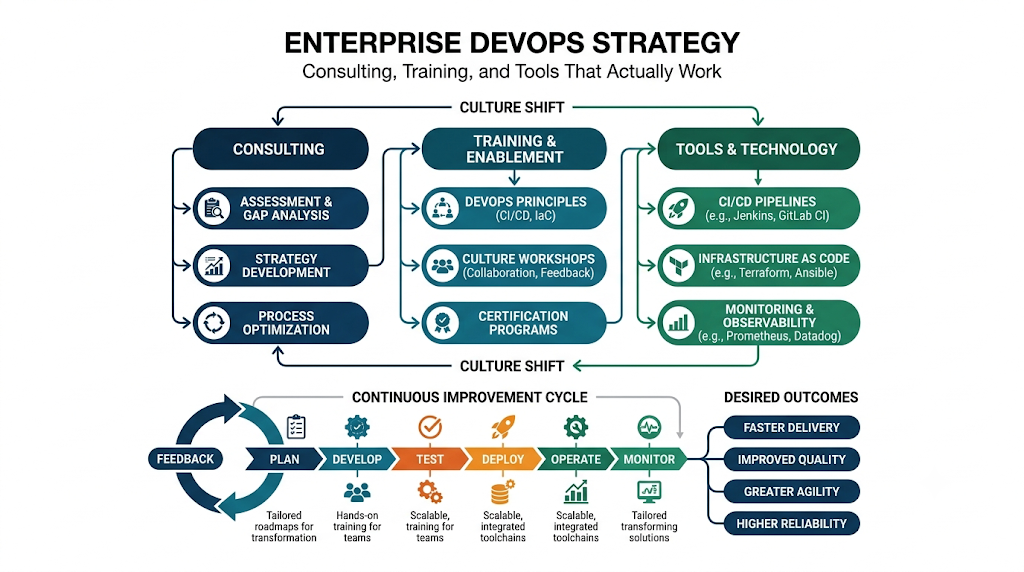
Introduction
Modern enterprises can no longer afford slow releases, fragile systems, and siloed teams. DevOps, cloud-native platforms, and automation have become the backbone of competitive digital businesses. A specialized DevOps consulting company helps organizations turn these buzzwords into measurable delivery, reliability, and security outcomes that align with business goals. By combining DevOps consulting services cotocus with DevOps corporate training, enterprises can modernize technology, upskill teams, and accelerate digital transformation with confidence.
What Modern DevOps Consulting Really Means
DevOps consulting today goes far beyond tooling recommendations or a one-time CI/CD setup. It is about aligning people, processes, and platforms so that software can move from idea to production quickly, safely, and repeatedly. A mature DevOps consulting company helps you define an operating model that connects architecture decisions, environment strategy, security controls, and delivery workflows end to end.
Instead of “installing tools,” DevOps consulting services should map your value streams, identify bottlenecks, and then re-architect both pipelines and team structures around outcomes. This includes everything from branching strategies and deployment gates to observability practices and incident management. For enterprises, the value is not in adopting DevOps buzzwords but in standardizing a way of working that scales across dozens of teams and multiple business units.
Key Pillars of Effective DevOps Consulting
- Clear alignment between business outcomes and technical objectives
- Standardized CI/CD patterns and golden paths for engineering teams
- Embedded security, compliance, and governance at every stage
- Strong observability, incident response, and SRE practices
- Continuous learning via DevOps training for companies and coaching
Why Enterprises Need DevOps, SRE, and DevSecOps Expertise
Enterprises typically manage complex landscapes: multiple clouds, legacy systems, regulatory requirements, and globally distributed teams. Internal teams may be strong technically but often lack the bandwidth or specialized experience to design and embed modern practices across the entire organization. DevOps, SRE, and DevSecOps consulting services bring structured frameworks, reference architectures, and proven playbooks that reduce risk and shorten the learning curve.
Site Reliability Engineering consulting focuses on reliability as an engineering problem rather than a firefighting activity. It helps organizations define SLOs, error budgets, and reliability metrics that guide investment in resilience and performance. DevSecOps consulting services ensure that security is not a late-stage gate but an automated, repeatable part of the pipeline, enabling teams to ship faster without increasing risk. Together, these capabilities form the foundation of an enterprise-grade delivery ecosystem.
Core DevOps Consulting Services Enterprises Rely On
A well-rounded DevOps consulting company offers an integrated portfolio of services that cover the entire software delivery lifecycle. This typically includes CI/CD pipeline consulting, infrastructure automation consulting, cloud consulting services, and SRE consulting services. When these are delivered as a cohesive program rather than isolated projects, enterprises gain consistency, traceability, and visibility across teams.
Effective DevOps consulting services also prioritize knowledge transfer. Rather than creating dependency on external experts, they embed patterns, templates, and automation that internal DevOps teams and platform squads can own. This approach aligns with digital transformation consulting company best practices, where the goal is to leave behind lasting capabilities, not just short-term fixes.
CI/CD Pipeline Consulting and Infrastructure Automation
CI/CD pipeline consulting focuses on building robust, secure, and standardized delivery pipelines across applications and services. It covers branching models, automated testing strategies, deployment strategies (blue-green, canary, rolling), and release governance. Infrastructure automation consulting complements this by codifying infrastructure with tools like Terraform, Ansible, or cloud-native IaC services, enabling consistent, repeatable environments from development to production.
SRE Consulting Services and Reliability Engineering
SRE consulting services help enterprises define service-level objectives, instrument the stack with observability, and implement error budget policies. This translates uptime and performance into business-aware metrics. Site Reliability Engineering consulting also establishes runbooks, incident response workflows, and post-incident review practices that turn outages into learning opportunities rather than repeated crises.
DevSecOps and GitOps Consulting Services
DevSecOps consulting services embed security scanning, policy-as-code, and compliance checks directly into CI/CD pipelines. This reduces manual review overhead and catches issues earlier in the lifecycle. GitOps consulting services extend this by making Git the single source of truth for both code and infrastructure state, improving auditability, rollback capability, and collaboration across development and operations.
Cloud, Kubernetes, and Platform Engineering in Practice
Cloud migration services and cloud consulting services are often the entry point for enterprise modernization. But real value comes when cloud adoption is combined with Kubernetes consulting services and platform engineering consulting. Instead of treating each product team as a snowflake, enterprises build shared internal platforms that provide secure, reusable building blocks for application teams.
Kubernetes consulting services guide organizations in cluster design, multi-tenancy, cost optimization, and security hardening. Platform engineering consulting takes this further by designing internal developer platforms (IDPs) that provide self-service environments, standardized pipelines, and observability out of the box. The result is faster onboarding, fewer configuration errors, and a consistent developer experience across the enterprise.
Kubernetes Consulting Services for Enterprise Platforms
Kubernetes corporate training and consulting help teams understand not just how to deploy containers, but how to operate production-grade clusters. This includes network policies, secrets management, autoscaling, resource quotas, and integration with service meshes or API gateways. For regulated industries, it also means aligning cluster operations with compliance and audit requirements.
Platform Engineering Consulting and Internal Developer Platforms
Platform engineering consulting focuses on building products for internal developers: curated templates, standardized pipelines, and secure defaults. These platforms abstract away low-level complexity while preserving flexibility where teams need it. When combined with CI/CD pipeline consulting and GitOps, platform teams can provide paved roads that dramatically accelerate delivery while maintaining governance and security.
Comparison Table: Traditional IT vs Modern DevOps & Cloud
| Aspect | Traditional IT Model | Modern DevOps & Cloud Model | Benefits (Modern) | Best Choice |
|---|---|---|---|---|
| Release frequency | Quarterly or yearly | Weekly, daily, or on-demand | Faster feedback, quicker value delivery | DevOps & Cloud |
| Provisioning | Manual tickets | Automated IaC | Consistency, reduced errors | DevOps & Cloud |
| Ownership | Siloed departments | Cross-functional squads | Better collaboration, fewer handoffs | DevOps & Cloud |
| Security | Late-stage reviews | DevSecOps integrated | Earlier risk detection | DevOps & Cloud |
| Scalability | Hardware-bound | Cloud-native and elastic | On-demand scaling, cost efficiency | DevOps & Cloud |
Building High-Performance Teams with DevOps Corporate Training
Technology transformation fails when people are left behind. DevOps corporate training and DevOps training for companies ensure that engineering teams, operations staff, and even product leaders share a common language and set of practices. Effective training blends theory with labs, covering topics like CI/CD, containerization, infrastructure as code, SRE, and DevSecOps.
For HR and L&D teams, partnering with a DevOps consulting company that also delivers Kubernetes corporate training, cloud training, and advanced workshops on GitOps or platform engineering is a force multiplier. It allows enterprises to standardize practices across teams, create clear learning paths, and align skill development with strategic technology initiatives.
DevOps Training for Companies and Enterprise L&D
Enterprise-ready DevOps training programs are typically role-based: foundation tracks for beginners, practitioner tracks for engineers, and leadership tracks for managers and architects. This structure helps organizations embed DevOps, SRE, and cloud-native concepts into daily decision-making rather than treating them as side projects. Certifications and hands-on labs reinforce learning and make progress visible to both individuals and leadership.
Kubernetes Corporate Training and Hands-On Enablement
Kubernetes corporate training focuses on real-world scenarios such as deploying microservices, designing high-availability clusters, and troubleshooting performance issues. When paired with Kubernetes consulting services, enterprises can quickly move from pilot projects to resilient production platforms. This combination of consulting and enablement is essential for sustainable cloud-native adoption.
Comparison Table: Consulting Partner vs In-House Only
| Criteria | Consulting Partner Approach | In-House Only Approach | Limitations (In-House) | Best Use Case |
|---|---|---|---|---|
| Speed of adoption | Accelerated with experts | Slower, trial-and-error | Longer time-to-value | Consulting for transformation, in-house for steady-state |
| Specialized skills | Access to niche expertise | Limited to current staff | Gaps in areas like SRE, GitOps | Consulting |
| Knowledge transfer | Structured enablement | Ad-hoc, informal | Inconsistent practices | Mixed model |
| Cost structure | Project-based or retainer | Full-time salaries | Over-investment in rare skills | Mix, depending on scale |
| Risk management | Proven patterns, benchmarks | Local experience only | Higher risk of missteps | Consulting-led in complex environments |
Common DevOps Implementation Mistakes and How to Avoid Them
Many organizations start their DevOps journey by installing tools before defining outcomes, metrics, or ownership. This “tool-first” approach often leads to fragmented pipelines, duplicated configurations, and frustrated teams. Another common issue is underestimating the cultural shift required, assuming a small central DevOps team can fix systemic issues alone.
To avoid these pitfalls, enterprises should begin with a clear assessment of their current state, define a target operating model, and prioritize a few high-impact value streams. DevOps consulting services can facilitate this assessment, guide architecture decisions, and help create a roadmap. Combined with DevOps corporate training and leadership coaching, this ensures that new practices are adopted consistently rather than in isolated pockets.
Organizational Pitfalls in DevOps Transformation
- Treating DevOps as a “side project” rather than a strategic initiative
- Overloading a small DevOps team with every request
- Lack of executive sponsorship and clear metrics for success
- Ignoring HR, L&D, and change management aspects
Technical Anti-Patterns in Tooling and Architecture
- Multiple overlapping CI/CD tools with no standard patterns
- Poorly governed Kubernetes clusters with ad-hoc configurations
- No clear strategy for secrets management, security scanning, or compliance
- Limited observability, making incidents hard to diagnose
Best Practices for Sustainable DevOps and Cloud Adoption
Sustainable DevOps and cloud adoption require a balance between standardization and autonomy. Enterprises should define a core platform (including CI/CD, observability, and security tooling) while allowing product teams to innovate at the edges. Clear reference architectures and reusable templates help teams move fast without reinventing the wheel.
Governance should focus on guardrails rather than roadblocks. This includes policy-as-code, automated compliance checks, and consistent tagging and cost management strategies in cloud environments. When combined with ongoing DevOps training for companies and a strong community of practice, organizations can keep improving their delivery performance year over year.
Governance, Compliance, and Security by Design
- Implement DevSecOps practices from the start, not as an afterthought
- Use policy-as-code for access control, resource limits, and compliance rules
- Standardize logging, tracing, and metrics across platforms
- Define clear escalation paths and responsibilities for incidents
Comparison Table: Ad-Hoc Tooling vs Platform Engineering
| Dimension | Ad-Hoc Tooling by Teams | Platform Engineering Approach | Benefits (Platform) | Best Choice |
|---|---|---|---|---|
| Tool sprawl | High | Controlled, curated stack | Lower complexity | Platform |
| Developer experience | Inconsistent | Standardized golden paths | Faster onboarding | Platform |
| Security | Uneven controls | Centralized, automated policies | Better compliance | Platform |
| Operational effort | Duplicated per team | Central platform team | Economies of scale | Platform |
| Innovation speed | Local optimizations | Shared capabilities reused | Faster feature delivery | Platform |
Industry Trends: AIOps, MLOps, DataOps, and Beyond
As systems become more complex, enterprises are turning to AIOps consulting services to make sense of logs, metrics, and traces at scale. AIOps applies machine learning to detect anomalies, predict incidents, and automate routine remediation tasks. This helps SRE and operations teams focus on higher-value engineering work rather than repetitive manual triage.
In parallel, MLOps consulting services and DataOps consulting services bring DevOps principles to the data and machine learning lifecycle. They standardize how models are trained, deployed, monitored, and governed. For enterprises investing in AI-driven products, integrating MLOps and DataOps practices with existing DevOps and platform engineering strategies is essential for reliability, compliance, and speed.
AIOps, MLOps, and DataOps Consulting Services
- AIOps: Automated anomaly detection, intelligent alerting, and remediation
- MLOps: Reproducible pipelines for training, deployment, and monitoring ML models
- DataOps: Reliable, versioned data pipelines with strong governance and quality checks
Why Partner with a DevOps Consulting Company Like Cotocus
A specialized DevOps consulting company that also delivers cloud migration services, Kubernetes consulting services, and DevOps corporate training can act as a single partner for end-to-end transformation. This reduces integration overhead, aligns strategies across multiple domains, and provides leadership with a unified roadmap.[cotocus]
Cotocus, for example, supports organizations with DevOps and cloud consulting, AI-first software engineering, and corporate training across DevOps, cloud, and AI/ML topics. This mix of consulting and enablement is particularly valuable for enterprises that need both rapid transformation and long-term capability building across their teams.[cotocus]
How Cotocus Aligns Consulting and Training for Impact
- Assessment-led consulting engagements that define clear roadmaps and KPIs
- Integrated DevOps, SRE, and DevSecOps consulting services aligned with cloud migration and platform engineering
- Customized DevOps training for companies and Kubernetes corporate training aligned to real projects
- Flexible engagement models for enterprises, startups, and global teams[cotocus]
Expert Tips for CTOs and Engineering Leaders
CTOs and technology leaders should treat DevOps, SRE, and platform engineering as long-term capabilities, not one-off projects. Start by identifying two or three critical value streams and invest in improving their end-to-end flow using CI/CD pipeline consulting, infrastructure automation consulting, and SRE practices. This creates visible wins that build momentum and executive support.
Make DevSecOps and GitOps non-negotiable foundations instead of optional add-ons. Adopt a platform engineering mindset by forming a dedicated platform team and giving them a clear product vision: internal developer experience. Finally, pair DevOps consulting services with DevOps corporate training to ensure teams can sustain improvements long after the initial engagement ends.
Actionable Next Steps for Technology Leaders
- Run a baseline assessment of delivery, reliability, and security maturity
- Define an enterprise DevOps and cloud roadmap with measurable outcomes
- Consolidate tooling around standardized CI/CD and observability platforms
- Launch structured DevOps, Kubernetes, and cloud training for key roles
Frequently Asked Questions (15)
- What does a DevOps consulting company actually do?
A DevOps consulting company helps organizations design and implement modern software delivery practices. This includes CI/CD pipelines, infrastructure automation, observability, SRE, and DevSecOps. Consultants assess your current state, recommend a roadmap, and work with teams to implement patterns, tools, and processes that improve speed, reliability, and security. - How are DevOps consulting services different from hiring more engineers?
Hiring more engineers adds capacity but does not always change how work flows through the system. DevOps consulting services bring battle-tested patterns, reference architectures, and transformation experience. They accelerate adoption of best practices, help avoid common pitfalls, and focus on building reusable platforms and guardrails that internal teams can own over time. - When should enterprises consider cloud consulting services?
Enterprises should consider cloud consulting services when they plan large-scale cloud migration, need to modernize legacy applications, or want to optimize multi-cloud environments. Consultants can help with landing zone design, security, governance, and cost optimization. This ensures cloud migration services are executed with minimal disruption and aligned to long-term platform and DevOps strategies. - Why are Kubernetes consulting services important for large organizations?
Kubernetes consulting services are important because production-grade Kubernetes is complex. Enterprises must handle cluster design, multi-tenancy, security, and observability at scale. Consultants provide opinionated architectures, help standardize deployments, and improve reliability. They also support teams with Kubernetes corporate training so they can operate and evolve the platform confidently. - What is the role of SRE consulting services in DevOps?
SRE consulting services bring a disciplined approach to reliability. They help define SLOs and error budgets, instrument systems with observability, and improve incident response processes. Site Reliability Engineering consulting focuses on reducing toil, preventing outages, and aligning reliability investments with business priorities. This complements DevOps efforts by making reliability measurable and actionable. - How does DevSecOps consulting reduce security risk?
DevSecOps consulting services integrate security into every stage of the software delivery lifecycle. This includes automated code scanning, dependency checks, container image scanning, and policy-as-code in pipelines. By shifting security left, teams catch vulnerabilities earlier, reduce manual review overhead, and maintain compliance without slowing down releases. Security becomes part of everyday engineering work. - What is GitOps and why does it matter?
GitOps is an operational model where Git stores the desired state of infrastructure and applications. Automated agents reconcile actual and desired state, enabling consistent, auditable deployments. GitOps consulting services help teams adopt this model using tools that integrate with Kubernetes and cloud platforms. It improves reproducibility, rollbacks, and collaboration between development and operations. - How does platform engineering consulting benefit developers?
Platform engineering consulting helps build internal developer platforms that provide self-service environments, pipelines, and observability out of the box. Developers can focus on writing business logic instead of wiring infrastructure and tooling. This improves developer experience, reduces cognitive load, and accelerates delivery. It also gives leaders better visibility and governance across teams. - Why is DevOps corporate training critical for transformation?
DevOps corporate training ensures that teams understand not just the tools but the principles behind modern delivery practices. It creates shared language between development, operations, and security. When aligned with real projects and consulting initiatives, training accelerates adoption, reduces resistance to change, and helps organizations sustain improvements after consultants step back. - What topics should DevOps training for companies cover?
Effective DevOps training for companies typically covers CI/CD fundamentals, version control strategies, infrastructure as code, containerization, Kubernetes basics, observability, incident response, and DevSecOps. Advanced tracks may include GitOps, SRE, platform engineering, and AIOps concepts. Training should be hands-on and tailored to the roles and maturity level of participants. - How do AIOps consulting services support SRE teams?
AIOps consulting services use machine learning to analyze logs, metrics, and traces, identifying anomalies and patterns humans might miss. This helps SRE teams reduce alert noise, detect issues earlier, and automate routine responses. Over time, AIOps can suggest optimizations and reduce mean time to resolution, improving overall reliability and efficiency in operations. - What is the difference between MLOps and DataOps consulting services?
MLOps consulting services focus on the machine learning lifecycle: data preparation, model training, deployment, monitoring, and governance. DataOps consulting services focus on data pipelines, quality, and reliability. Both apply DevOps principles to their respective domains. Together, they ensure that data and ML models are delivered, updated, and governed in a repeatable, compliant way. - How can a digital transformation consulting company help beyond DevOps?
A digital transformation consulting company looks at technology, processes, and culture holistically. Beyond DevOps, it can support product strategy, UX, data platforms, and AI initiatives. For enterprises, this means aligning DevOps and cloud initiatives with broader business goals, customer experiences, and innovation roadmaps, ensuring investments deliver measurable outcomes and not just technical upgrades. - What metrics should we track to measure DevOps success?
Common metrics include deployment frequency, lead time for changes, change failure rate, and mean time to recovery. Reliability-focused measures like SLO attainment and incident counts are also key. Security teams may track vulnerability remediation time. Together, these metrics give a balanced view of speed, stability, and risk, and guide continuous improvement efforts. - Why choose Cotocus for DevOps consulting and training?
Cotocus offers integrated DevOps consulting services, cloud migration services, and corporate training tailored to enterprise needs. Its teams bring experience across DevOps, SRE, cloud, and AI-first software engineering, enabling end-to-end transformation from strategy to implementation. For organizations seeking both expert guidance and long-term capability building, this unified approach creates a strong foundation for sustainable success.[cotocus]
Conclusion
DevOps, SRE, and cloud-native platforms have moved from early-adopter territory to essential capabilities for every digital enterprise. Success now depends on how effectively organizations combine DevOps consulting services, cloud migration services, and platform engineering with structured DevOps corporate training. When done well, this combination accelerates delivery, strengthens reliability, reduces security risk, and unlocks innovation. By partnering with a trusted DevOps consulting company and investing in people, processes, and platforms together, enterprises can build a technology foundation that supports growth, resilience, and continuous improvement for years to come.
Strong Call-to-Action
If you are planning a DevOps, cloud, or Kubernetes transformation—or need to scale reliable, secure delivery across multiple teams—consider partnering with Cotocus. Their experts can help you design modern architectures, implement CI/CD and platform engineering, and deliver customized DevOps training for companies and enterprise teams. Reach out to explore how Cotocus can support your next phase of digital transformation with consulting, implementation, and corporate training tailored to your business goals.[cotocus]
Additional SEO deliverables
Suggested internal links (on Cotocus properties)
- DevOps corporate training page[cotocus]
- DevOps and cloud consulting or services overview[cotocus]
- Corporate training overview page[cotocus]
- Contact page for consulting and training inquiries[cotocus]
- Blog posts on DevOps certifications or advanced DevOps topics[cotocus]
Suggested external authority references
- CNCF (Cloud Native Computing Foundation) for Kubernetes and cloud-native best practices
- Google SRE books and documentation for Site Reliability Engineering concepts
- OWASP for DevSecOps and application security guidance
- DORA/Accelerate research for DevOps performance metrics
- Major cloud providers’ best practices (AWS Well-Architected, Azure, Google Cloud)
Image suggestions
- Diagram of a modern CI/CD and GitOps-based delivery pipeline
- Illustration of traditional vs modern DevOps operating model
- Visual of an internal developer platform and self-service workflows
- Team workshop photo representing DevOps corporate training
- Conceptual graphic for AIOps and automated incident response
SEO image alt text examples
alt="DevOps consulting services designing enterprise CI/CD pipeline"alt="Kubernetes consulting services for cloud-native applications"alt="DevOps corporate training workshop for engineering teams"alt="Platform engineering consulting building internal developer platform"alt="AIOps consulting services automating incident response"
FAQ schema suggestions (JSON-LD outline)
- Use
@type: FAQPagewith each of the 15 questions as@type: Questionand the corresponding answer as@type: Answer. - Ensure each
namefield matches the FAQ question text exactly, andacceptedAnswer.textcontains the concise answer.
Article schema suggestions (JSON-LD outline)
- Use
@type: BlogPostingwith:headline: same as H1description: same as meta descriptionauthor: organization or named authorpublisher: Cotocus with logo URLmainEntityOfPage: canonical URLarticleSection: DevOps consulting, cloud migration, Kubernetes, SRE, DevSecOpsabout: DevOps consulting services, DevOps corporate training, cloud migration services, Kubernetes consulting services
Would you like me to adjust the focus more toward any one area, such as Kubernetes consulting, SRE, or DevSecOps, for a more niche variant of this article?