Introduction
For decades, the foundation of modern technology has rested on a simple, comforting assumption: the world can be broken down into clean, binary choices. Every software application, global data pipeline, and digital transaction relies on billions of microscopic silicon switches turning either on or off. This rigid, binary structure has shaped not just our machines, but our entire approach to analytical problem-solving. We have been trained to think in straight lines, evaluate choices sequentially, and seek definite, deterministic outcomes. Learning How Quantum Computing Challenges Traditional Thinking helps technology professionals, business leaders, and software engineers prepare for a major shift in digital innovation. Moving past binary assumptions allows teams to build predictive models and optimization frameworks that were once considered computationally impossible. To help technical professionals master these emerging architectural concepts, QuantumOpsSchool.com provides comprehensive training programs, hands-on learning pathways, and technical guides. This article explores how quantum logic upends traditional software development, breaks down core quantum computing principles, and details the structural shifts required to build a quantum-ready workforce.
Understanding Traditional Computing Thinking
Binary Logic and Classical Computation
Traditional computing is built entirely on Boolean algebra. At its absolute lowest layer, every text document, high-definition video, and complex database is represented as a long string of binary digits: 0s and 1s. A classical bit is a physical transistor that holds one single value at any given microsecond.
Deterministic Problem-Solving
Because classical computers rely on explicit physical states, they operate deterministically. If you provide the exact same input to a standard software program, it will execute the identical step-by-step logic and return the exact same output every single time. This predictable cause-and-effect flow has trained software teams to design systems using strict, linear logic trees.
Sequential Processing Concepts
When a classical computer faces a complex maze of choices—such as finding the most efficient route for a global shipping fleet—it operates like a human traveler checking paths one by one. Even with multiple processing cores running in parallel, a classical chip still evaluates individual paths in sequential blocks, discarding incorrect options until it uncovers the single ideal answer.
Limitations of Traditional Approaches
As datasets grow larger and more interconnected, the total number of possible combinations scales exponentially. A problem with only a few hundred variables can create more potential outcomes than there are atoms in the observable universe. When classical systems try to calculate these vast combinations, they run out of memory and compute time, rendering highly complex optimization problems unsolvable.
What Makes Quantum Computing Different?
Definition of Quantum Computing
Quantum computing is a completely new computational paradigm that uses the principles of quantum mechanics to store, manipulate, and process complex information. Rather than replacing standard silicon chips, these advanced processors serve as specialized accelerators designed to run highly multi-variable mathematical calculations.
Quantum Bits (Qubits)
The foundational building block of a quantum processor is the quantum bit, or qubit. Unlike a standard silicon transistor that must pick between a 0 or a 1, a qubit can exist in a fluid combination of both options simultaneously. This physical capability alters how data is structured and processed at the hardware layer.
Classical Bit:  [ 0 ]  OR  [ 1 ]       --> (Fixed, Single State)
Quantum Qubit:  [ 0 ]  AND  [ 1 ]      --> (Fluid, Superposition State)
Superposition
Superposition allows a qubit to hold a fluid balance of multiple computational states at once. Instead of choosing a single fixed value, the qubit remains in a state of rolling probabilities until the algorithm concludes and a final measurement forces it to settle into a definite classical position.
Entanglement
Entanglement is a unique physical phenomenon where multiple qubits become deeply interconnected. When qubits are entangled, changing the state of one instantly alters the properties of the others, regardless of their distance. This shared link allows quantum computers to share data across processing modules instantly, skipping the step-by-step data buses used by classical chips.
Quantum Interference
Quantum interference is the algorithmic technique used to guide a quantum computer toward the correct answer. Much like noise-canceling headphones use sound waves to block out ambient background noise, a quantum algorithm uses constructive interference to amplify the signal of the correct solution while using destructive interference to cancel out millions of incorrect options.
Challenging Conventional Assumptions
These quantum concepts break our standard understanding of information processing. They force developers to stop viewing data as static, isolated values on a hard drive and instead treat information as fluid, interacting wave functions that explore millions of calculations at the same time.
How Quantum Computing Challenges Traditional Thinking
The arrival of quantum hardware does not just upgrade our processing speeds; it fundamentally challenges our long-held assumptions about logic, security, and analytical strategy.
Challenging Binary Thinking
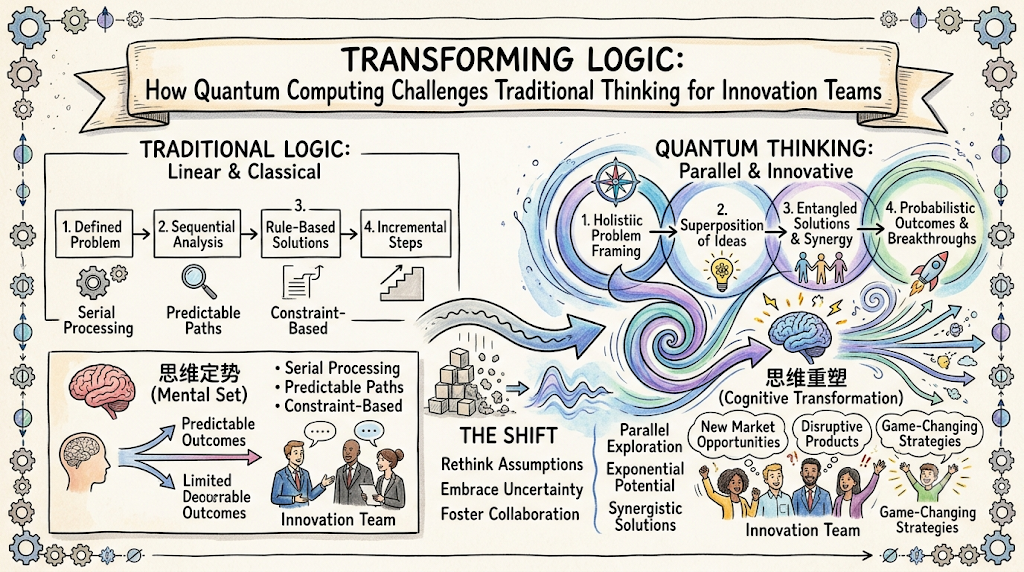
Traditional education trains us to analyze scenarios through clear-cut opposites: right or wrong, pass or fail, 0 or 1. Quantum computing proves that information can exist in a fluid blend of possibilities simultaneously. This challenges developers to move beyond rigid binary logic trees and design software frameworks around continuous ranges of potential states.
Challenging Linear Problem Solving
When solving an optimization puzzle, classical thinking directs us to evaluate each option one after another. Quantum computing replaces this linear mindset with a holistic, parallel approach. A quantum processor looks at all potential answers across a massive data landscape simultaneously, mapping the entire problem space at once rather than analyzing individual choices in sequence.
Classical Strategy: Path A ---> Path B ---> Path C ---> Path D (Sequential)
Quantum Strategy:   [ Path A / Path B / Path C / Path D ]      (Simultaneous)
Challenging Deterministic Outcomes
We expect computer systems to provide definitive, unvarying answers. Quantum computing challenges this expectation by operating on a foundation of probabilities. Running a quantum algorithm does not produce a simple, single result; instead, it reveals an optimized mathematical map of probabilities, requiring engineers to become comfortable designing systems around statistical distributions rather than absolute certainties.
Challenging Traditional Optimization Methods
Standard enterprise optimization relies on brute-force calculations or simplified mathematical models that often discard vital variables to save compute time. Quantum computing upends this approach by allowing teams to include every real-world constraint in a single calculation. This shifts the focus from finding an approximate compromise to uncovering the mathematically perfect solution.
Challenging Existing Security Assumptions
Modern cybersecurity relies almost entirely on the assumption that factoring giant prime numbers is too difficult for a computer to achieve in a realistic timeframe. Quantum computing shatters this core security belief. Advanced quantum algorithms can factor these massive numbers in minutes, forcing security professionals to completely rebuild global encryption standards before quantum processors reach scale.
Quantum Computing vs. Classical Computing
| Computational Aspect | Classical Computing | Quantum Computing | Impact on Strategic Thinking |
| Data Representation | Rigid binary bits (0 or 1) | Fluid qubits in superposition | Shift from binary options to rolling probabilities. |
| Processing Methods | Sequential or basic multi-core | Multi-variable quantum interference | Move from step-by-step loops to holistic data analysis. |
| Problem-Solving Style | Deterministic logic trees | Probabilistic wave distribution | Shift from expecting unvarying outputs to evaluating probability maps. |
| Scalability Growth | Linear scaling ($N$ bits = $N$ inputs) | Exponential scaling ($N$ qubits = $2^N$ states) | Encourages teams to tackle complex problems once labeled impossible. |
| Optimization Focus | Approximate or simplified answers | High-precision, absolute solutions | Replaces partial estimations with complete real-world tracking. |
| Security Architecture | Dependent on prime factorization | Built on quantum-safe cryptography | Forces a proactive redesign of global data encryption networks. |
Real-World Examples of Quantum Thinking
- Advanced Scientific Research: In traditional chemistry labs, researchers use rough estimations to simulate molecular behaviors because classical chips cannot track every electron interaction. Quantum systems simulate these subatomic particles naturally, allowing teams to accurately evaluate new materials without costly, slow physical trial-and-error.
- Accelerated Drug Discovery: Pharmaceutical companies waste years testing chemical compounds sequentially to see which ones bind effectively to target proteins. Quantum computing transforms this timeline by evaluating billions of molecular combinations simultaneously, shortening the initial discovery phase from years to days.
- Complex Financial Modeling: Wall Street risk systems require massive server farms running all night to calculate market scenarios using random sampling. Quantum algorithms process these risk factors concurrently, providing investment firms with highly accurate risk metrics during active trading hours.
- Global Logistics Optimization: Global shipping networks regularly struggle with route planning when weather patterns, port delays, and fuel constraints shift unexpectedly. Quantum optimization models process these moving parts together, instantly identifying the lowest-cost paths for thousands of transit vehicles at once.
Key Quantum Concepts That Redefine Problem Solving
To master quantum algorithm design, engineers must replace traditional computing concepts with four foundational physical metaphors:
- Quantum Superposition (The Spinning Coin): A classical bit is like a coin lying flat on a table—it must show either heads or tails. A qubit in superposition is like a coin spinning rapidly on its edge; it contains a fluid combination of both possibilities until you stop it to read the result.
- Quantum Entanglement (The Matching Dice): Imagine rolling a die in New York and having a friend roll another in Tokyo. If these dice were entangled, every time you rolled a 3, your friend’s die would instantly show a 3 as well. This shared connection allows quantum processors to synchronize computing elements without traditional data cables.
- Quantum Tunneling (The Mountain Pass): When a classical algorithm faces a difficult mathematical barrier, it must spend significant compute power climbing over the obstacle step-by-step. Quantum particles can “tunnel” directly through these energy barriers, allowing the system to find the lowest-energy solution much faster.
- Quantum Interference (The Rippling Pond): Think of tossing two stones into a still pond. Where the water ripples meet, some waves reinforce each other and grow larger, while others cancel each other out and leave the surface flat. Quantum software uses this exact mechanism to amplify the right answer while completely canceling out wrong solutions.
Business and Technology Implications
The shift toward quantum operations creates major strategic advantages for early-adopting enterprises:
- Massive Innovation Opportunities: Companies can pioneer brand-new product spaces, such as creating hyper-efficient solar cells or lightweight grid batteries that classical tools could never design.
- Unfair Competitive Advantages: Uncovering absolute optimization paths allows logistics firms and hedge funds to operate with cost margins that legacy competitors simply cannot match.
- Strategic Research Investments: Forward-thinking enterprises are investing in cloud-based quantum development environments today, building up their intellectual property before hardware scaling hits the mainstream market.
- Complete Industry Transformations: From agriculture companies designing cheaper fertilizers to manufacturing brands streamlining assembly lines, quantum solutions will completely reshape standard operating models across the economy.
Common Misconceptions About Quantum Computing
- Misconception: Quantum computers will replace everyday laptops.Reality: Quantum processors are specialized accelerators designed for specific, highly complex mathematical problems. For standard daily tasks like writing text documents, browsing websites, or streaming video, classical silicon chips will always remain more efficient and cost-effective.
- Misconception: Quantum machines offer instant solutions to every problem.Reality: Quantum computers require highly specialized algorithms to deliver an advantage. If you attempt to run a basic, non-optimized software task on a quantum machine, it will perform no faster than a standard home computer.
- Misconception: Quantum speed is achieved simply by running a faster internal clock.Reality: Quantum processors do not achieve speed by completing sequential tasks faster; they achieve it by restructuring the problem itself, cutting down the total number of calculation steps required from billions to just a handful.
Challenges Facing Quantum Computing Adoption
- Fragile Hardware Constraints: Modern physical qubits are incredibly sensitive to outside interference, requiring dilution refrigerators to keep them chilled to near absolute zero to prevent decoherence.
- Complex Error Correction Requirements: Because raw physical qubits are prone to noise errors, engineering teams must bundle thousands of them together to form a single, reliable logical qubit.
- Severe Skills Shortages: There is a major global shortage of engineers who understand both quantum mechanics and practical enterprise software development.
- Unique Infrastructure Needs: Running these processors requires specialized laboratory environments, advanced microwave control systems, and custom cryogenic infrastructure that are difficult to manage outside dedicated data centers.
Future of Quantum Thinking
- Hybrid Enterprise Computing Models: The immediate future relies on hybrid clouds where classical data pipelines handle user interfaces and storage, while passing complex optimization sub-routines to remote quantum hardware.
- Autonomous Quantum Innovation: Merging artificial intelligence with quantum architecture will allow automated models to run molecular simulations independently, accelerating the discovery of advanced materials.
- Workforce Transformation: Educational institutions are shifting their focus to train a new generation of software developers to think natively in quantum terms, skipping traditional binary assumptions entirely.
Career Opportunities in Quantum Computing
The expansion of the quantum technology sector has opened up high-paying, long-term career tracks for multidisciplinary software professionals.
[Software Engineer / Analyst] ---> [Learn Quantum Logic & Math] ---> [Specialized Career Path]
                                     (Qiskit, Cirq, Linear Algebra)   (Quantum Systems / DevOps)
In-Demand Roles
- Quantum Software Developer: Writes and optimizes the quantum gate sequences and algorithms that run on physical processors.
- Quantum Systems Architect: Designs the hybrid workflows that connect classical enterprise databases to cloud-based quantum chips.
- Quantum Operations Specialist: Focuses on managing the continuous deployment, error tracking, and scheduling pipelines for quantum systems.
Core Skill Paths
To build a career in this space, focus on mastering linear algebra, learning quantum programming toolkits like Qiskit or Cirq, and understanding how to structure hybrid workflows that bridge classical databases with quantum backends.
Practical Lessons Traditional Technology Teams Can Learn from Quantum Thinking
- Adopt a Non-Linear Problem-Solving Mindset: Stop automatically breaking every engineering problem into rigid, step-by-step silos; look for ways to evaluate intersecting system variables together.
- Build an Innovation Mindset: Encourage your development teams to test radical, parallel architectural ideas instead of settling for minor, incremental updates to aging legacy platforms.
- Embrace Advanced Systems Thinking: Train your engineers to look at infrastructure holistically, tracking how a minor configuration adjustment in one microservice creates ripple effects across your entire application network.
- Learn to Handle Uncertainty Comfortably: Design modern analytics platforms to handle fluctuating probability ranges, moving away from a reliance on rigid, unchanging assumptions.
Frequently Asked Questions
- How exactly does quantum computing challenge traditional binary thinking?
Traditional computing forces us to look at information as static 0s or 1s inside rigid logic trees. Quantum computing challenges this approach by allowing data to exist in a fluid blend of multiple states at once, forcing engineers to design software around rolling probabilities.
- Will quantum computers make standard classical computers obsolete?
No. Classical computers will always be faster and cheaper for everyday tasks like database storage, word processing, and web streaming. Quantum systems will operate alongside them as specialized accelerators for complex mathematical problems.
- What is the practical value of quantum entanglement for software developers?
Entanglement allows qubits to share information instantly across a processor without traditional data cables, helping developers design highly coordinated parallel algorithms that solve multi-variable problems simultaneously.
- Why does quantum computing require a completely new approach to cybersecurity?
Because quantum processors can run advanced algorithms that factor massive prime numbers in minutes—a task that would take a classical supercomputer thousands of years to complete—they will easily break standard global encryption systems.
- What does it mean to use constructive and destructive interference in software?
Constructive interference amplifies the mathematical signal of the correct answer within an algorithm, while destructive interference completely cancels out the signals of millions of incorrect options, leaving only the right solution behind.
- Can a company leverage quantum computing today without owning physical hardware?
Yes. Most organizations interact with quantum processors through cloud computing platforms, writing code locally in languages like Python and sending it to real quantum hardware located in remote server laboratories.
- Why is it so difficult to scale up physical quantum processors?
Qubits are highly sensitive to their surroundings. Minimal changes in room temperature or slight electromagnetic noise can cause them to lose their quantum properties, requiring complex cooling systems and advanced error correction to keep them stable.
- What is a hybrid quantum-classical computing model?
A hybrid model uses standard classical servers to handle data storage, user authentication, and basic processing, while routing specific, highly complex optimization formulas to a quantum processor over the cloud.
- What programming languages are used to write quantum software?
Most developers use Python paired with specialized quantum development libraries like IBM’s Qiskit or Google’s Cirq to define quantum gates and execute algorithms.
- How should an enterprise tech team begin preparing for the quantum era?
Teams should start by training their senior developers in basic quantum logic and linear algebra, identifying existing optimization bottlenecks in their current workflows, and testing simple cloud-based quantum simulations.
Final Summary
Quantum computing fundamentally challenges traditional thinking by shifting our focus away from rigid binary choices, linear processing paths, and deterministic outcomes. Embracing core quantum principles like superposition and entanglement allows technology teams to move past the limits of classical silicon chips and unlock new approaches to optimization, encryption, and system modeling. Adapting to this new paradigm requires a deliberate shift in how we train developers, design software architectures, and evaluate complex business problems.