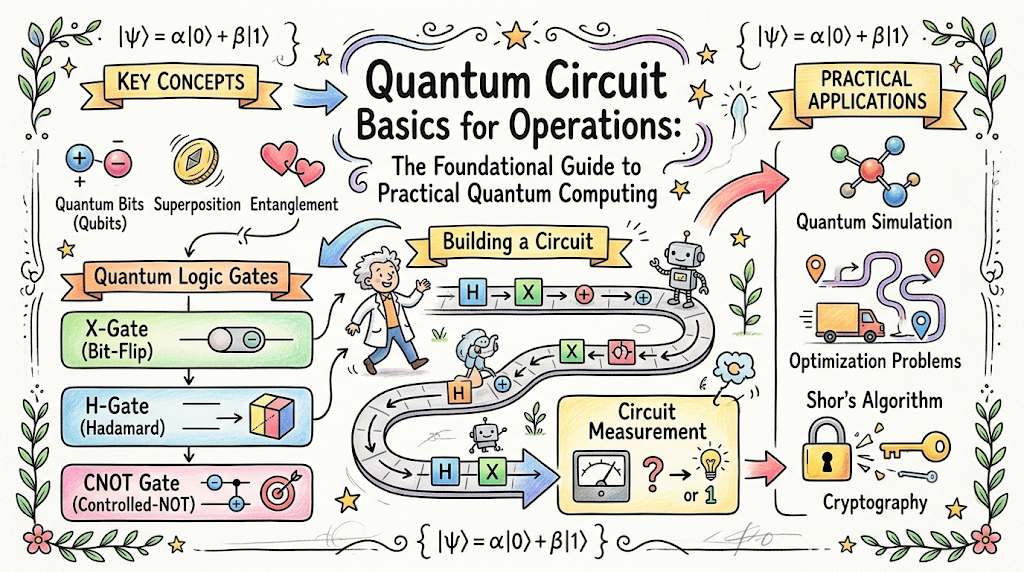
Introduction
The global shift toward quantum computing marks a profound departure from traditional digital information processing. For decades, classical computing has relied on silicon transistors to execute instruction sequences. However, as modern data processing challenges expand, classical circuits are hitting strict physical limitations. Transistors cannot shrink beyond atomic scales without experiencing electronic leakage, rendering traditional hardware scaling unsustainable for highly complex optimization problems. Transitioning into this innovative environment requires moving past the rigid logic of silicon chips. Exploring these concepts through practical, operationally-focused educational platforms like QuantumOpsSchool allows enterprise professionals to build the structural skills needed to operate real quantum hardware. This comprehensive guide details the mechanics of quantum circuits, analyzes core gate behaviors, and establishes the foundational knowledge required to design next-generation computational workflows.
Core Highlights: Key Takeaways
- Operational Blueprint: Quantum circuits act as the primary structural language of quantum hardware, mapping how subatomic information changes over time.
- State Control: Quantum gates alter the probability configurations of qubits, creating superposition and entanglement to run complex parallel calculations.
- Probabilistic Reading: Measuring a quantum circuit causes the wave state to collapse, converting fluid subatomic values into standard classical data.
- Architectural Limits: Minimizing circuit depth and managing environmental noise are the primary challenges when optimizing quantum systems for business applications.
What Is a Quantum Circuit?
A quantum circuit is a structured model of computation in which a sequence of quantum gates performs sequential operations on a collection of quantum bits, or qubits. In classical processing, circuits are constructed from physical copper traces, wires, and logic gates that physically alter electric currents. In a quantum environment, the circuit is an abstract timeline mapping how individual subatomic particles are manipulated inside a highly controlled chamber.
Within this framework, qubits serve as the wires of computation. However, unlike a traditional copper wire that carries a steady flow of electrons representing a static $0$ or $1$, a qubit wire represents the ongoing state of an isolated particle over time. The horizontal lines in a quantum circuit diagram do not show physical paths across a chip; instead, they represent the continuous timeline of an individual qubit as it undergoes calculation.
Quantum gates act as the operations within the circuit. These gates do not alter physical switches; rather, they introduce highly targeted forces—such as microwave pulses or laser bursts—that shift the particle’s quantum state. By running a qubit through a sequence of gates, the system builds complex mathematical probabilities that represent multi-layered computational paths.
The circuit sequence concludes at the measurement stage, which functions as the system output. Measurement is the step where the fluid quantum values are forced to settle into standard classical bits. This process extracts a definitive, binary answer from the system, translating the wave-like behaviors of the subatomic particles into data that traditional computers can read and store.
Structure of a Quantum Circuit
To read or design quantum computing applications, you must understand the visual and operational structure of a quantum circuit diagram. These schematics map out the life cycle of a calculation, reading from left to right to trace the passage of time.
Qubit 0 (q0) ───[ Initialization ]───[ Gate A ]───[ Gate C ]───┐M│───> Classical Bit 0
                                         │                        │
Qubit 1 (q1) ───[ Initialization ]───[ Gate B ]───■────────────┐M│───> Classical Bit 1
Horizontal Qubit Wires
The foundation of the diagram consists of parallel horizontal lines, where each line represents a single qubit. The top line is typically labeled $q_0$, the second $q_1$, and so forth. These lines chart the continuous existence of each qubit throughout the entire calculation, ensuring developers can track individual particle states at any point in the schedule.
Step-by-Step Gate Operations
Quantum gates are represented as square boxes placed directly along the horizontal qubit lines. A gate block sitting on a line means that a specific operation is applied to that exact qubit. As you read the timeline from left to right, the sequence of blocks shows the precise order in which operations are executed by the hardware.
Continuous Time Evolution
The horizontal axis of a quantum circuit represents the continuous timeline of the calculation. The leftmost edge shows the start of the program, where all qubits are set to their baseline values. As the system moves rightward, it transitions through successive operational time steps, showing how the subatomic states evolve as gates are applied.
The Final Measurement Stage
The rightmost section of the circuit diagram features the measurement stage, symbolized by a specialized meter box. This component marks the point where quantum operations stop and the system reads the final states. The measurement blocks connect to a double-lined wire that carries the collapsed classical bits out to traditional database systems.
Quantum Gates Basics
Quantum gates are the primary components used to manipulate information within a quantum architecture. While classical logic gates—like AND, OR, and NOT—combine input currents to output a brand-new bit value, quantum gates function by transforming the existing probability attributes of isolated qubits without destroying their delicate balance.
These operations are divided into two primary categories: Single-qubit gates and multi-qubit gates. Single-qubit gates interact with one standalone particle line, altering its spin direction or putting it into a state of superposition. Multi-qubit gates connect multiple particle wires together, allowing the state of one qubit to control or alter the state of another.
Every quantum gate operation is a reversible transformation, meaning you can theoretically run the gate backward to undo the changes and restore the qubit to its original state. This reversibility is a core requirement of quantum physics, ensuring that information is never lost or accidentally destroyed during the computation steps.
Initial Qubit State ──> [ Forward Gate Transformation ] ──> Altered Qubit State
                                                                     │
Initial Qubit State <── [ Reverse Gate Transformation ] <───┘
Instead of physically changing a binary bit, a quantum gate shifts the coordinate position of a qubit’s state vector on a mathematical sphere. By tilting, spinning, or rotating this vector pointer, gates allow the particle to explore complex paths. This fluid transformation capability forms the core engine that drives all quantum algorithm designs.
Key Quantum Gates Explained Simply
The Hadamard Gate (H)
The Hadamard gate is the primary tool used to create quantum superposition. When a qubit resting in a standard $0$ state passes through a Hadamard gate, its certain binary value is transformed into an equal combination of both $0$ and $1$ simultaneously. This operation acts like spinning a flat coin on a table, turning a static, predictable state into a fluid cloud of possibilities.
Standard [ 0 ] State ──> [ Hadamard Gate ] ──> Fluid Superposition ( 50% Zero / 50% One )
The Pauli-X Gate (X)
The Pauli-X gate functions as the quantum equivalent of a classical NOT gate, executing a clean bit flip. If a qubit is in a definitive $0$ state, the X gate shifts it to a definitive $1$, and vice versa. When applied to a qubit in superposition, the X gate flips the internal phase values of the particle, swapping the probabilities of the outcomes.
The Pauli-Z Gate (Z)
The Pauli-Z gate handles phase management, executing a precise phase change on a qubit without altering its raw outcome percentages. If a qubit is in a state of superposition, the Z gate flips its mathematical alignment, changing how its wave patterns behave. This phase shift is vital for managing quantum interference patterns during complex calculations.
The CNOT Gate (Controlled-NOT)
The CNOT gate is a foundational multi-qubit gate used to generate quantum entanglement across different wires. It operates on two distinct components: a control qubit and a target qubit. If the control qubit is in a $1$ state, the CNOT gate flips the target qubit; if the control qubit is $0$, the target qubit remains unchanged. When the control qubit is in a state of superposition, the CNOT gate links both particles together, entangling their paths.
Control Qubit [Superposition] ──┐
                                ├─> [ CNOT Gate ] ──> Linked Entanglement State
Target Qubit  [Standard Zero]  ──┘
How Quantum Circuits Work Step-by-Step
Step 1: Baseline Qubit Initialization
The workflow begins by setting all the circuit’s qubits to a clean baseline state, usually defined as the standard $|0\rangle$ state. This setup ensures the entire system starts from a known position, providing a dependable foundation before any calculations begin.
Step 2: Applying the Gate Sequence
Once initialization is complete, the platform executes the planned sequence of quantum gates according to the circuit layout. The hardware delivers targeted control pulses to the qubits, shifting their states in the precise order mapped out along the timeline.
Step 3: Generating Superposition and Entanglement
As the qubits pass through early gates like the Hadamard and CNOT operations, the system enters a fluid quantum state. Qubits expand into states of superposition to explore multiple paths at once, while multi-qubit gates link different lines together to form entanglement networks across the circuit.
Step 4: Executing the Final Measurement Step
After the last gate operation finishes, the circuit runs the qubits through measurement blocks. This interaction shatters the delicate quantum balance, forcing the fluid wave-like states to collapse instantly into solid classical binary bits ($0$ or $1$).
Step 5: Probabilistic Result Interpretation
Because quantum systems are inherently probabilistic, running a circuit once only provides a single binary data fragment. To gather useful insights, operations teams run the exact same circuit thousands of times in rapid succession. The resulting collection of classical outputs is compiled into a statistical histogram, allowing engineers to analyze the probability distribution and extract the final answer to the problem.
Run Circuit 10,000 Times ──> Gather Binary Outputs ──> Compile Histogram ──> Extract Solution
Quantum Circuit vs Classical Circuit
| Operational Capability | Classical Circuits | Quantum Circuits |
| Foundational Data Unit | Uses binary bits that must represent either a $0$ or a $1$. | Uses qubits that can hold $0$ and $1$ values simultaneously. |
| System Output Type | Completely deterministic; repeating a run yields identical values. | Inherent probabilistic output; outcomes are verified via statistical runs. |
| Gate Interaction Logic | Logic gates combine separate input paths to create a new output bit. | Quantum gates rotate the existing probability attributes of active qubits. |
| Reversibility Rule | Operations are typically irreversible; input data is overwritten. | All operations are completely reversible, preserving system information. |
| Processing Paradigm | Executes commands sequentially or via separate parallel cores. | Leverages superposition and entanglement to explore vast paths at once. |
| Physical Manifestation | Solid copper traces and silicon transistors etched onto microchips. | Isolated subatomic particles manipulated via laser or microwave pulses. |
Measurement in Quantum Circuits
Measurement inside a quantum circuit is not a passive data-gathering step; it is an active physical intervention that permanently redefines the state of the system. Before measurement occurs, a qubit can exist in a fluid cloud of possibilities, holding multiple values simultaneously. The moment a measurement tool interacts with that particle, the delicate quantum balance is shattered.
This interaction causes an immediate wavefunction collapse. The fluid mathematical probabilities that described the qubit’s superposition state disappear instantly, forcing the system to freeze into a single, static classical value ($0$ or $1$). The specific binary outcome you observe depends directly on the probability amplitudes established by the circuit’s gates before the measurement block was reached.
Fluid Probability Cloud ──> [Measurement Sensor] ──> Instant Collapse to Static 0 or 1
Once a qubit undergoes measurement, all its unique quantum information is completely lost. The particle stops behaving like a wave and begins acting like a standard, classical transistor bit. Because you cannot peer inside a running superposition without collapsing it, quantum software engineers must design their circuits to optimize probabilities before the measurement stage occurs, ensuring the correct answer stands out clearly when the system freezes.
Entanglement in Quantum Circuits
Quantum entanglement is a unique phenomenon where two or more qubits become deeply linked, meaning the physical state of one particle instantly dictates the state of its entangled partners, no matter how far apart they are. In quantum circuit design, this connection is built using multi-qubit gates like the CNOT gate, which weave individual qubit lines into a shared informational network.
Qubit A State ──┐
                ├─> [ Multi-Qubit CNOT Gate ] ──> Shared Entanglement State
Qubit B State ──┘
Once entangled, these particles display non-local correlations that cannot be replicated by classical logic systems. If two qubits are perfectly entangled in a complementary setup, measuring the first qubit and finding a $0$ means the second qubit will instantly collapse into a $1$ when checked, even if it sits on the opposite side of a data center. The particles no longer hold separate individual identities; instead, they function as a single, interconnected system.
This non-local connectivity is essential for achieving true quantum advantage. Entanglement allows a quantum circuit to coordinate calculations across dozens of qubits simultaneously, scaling the machine’s processing capacity exponentially with each new wire added. This deep correlation allows quantum algorithms to solve complex data challenges—like analyzing sprawling supply chains or modeling chemical bonds—at speeds far beyond classical supercomputers.
Quantum Circuit Depth and Complexity
As enterprises design quantum applications for production environments, managing circuit depth becomes a primary technical priority. Circuit depth is defined as the number of sequential gate layers executed along the circuit timeline from start to finish. Think of it as the total time required for a quantum program to complete its run; a circuit with a high depth count takes longer to execute because it requires a longer chain of consecutive gate operations.
Shallow Circuit:  [ Gate 1 ] ──> [ Gate 2 ] ──> (Short Timeline, Low Error Risk)
Deep Circuit:     [ Gate 1 ] ──> [ Gate 2 ] ──> [ Gate 3 ] ──> [ Gate 4 ] ──> (Long Timeline, High Noise Risk)
In modern quantum systems, deeper circuits are significantly harder to execute reliably. Because qubits are highly sensitive to their surroundings, they can only maintain their delicate quantum states for a fraction of a second before collapsing. As a circuit’s timeline extends, the system accumulates environmental noise, increasing the risk that qubits will decohere and corrupt your calculation before it reaches the measurement blocks.
This vulnerability creates major optimization challenges for quantum developers. Every gate applied to a qubit wire introduces a small amount of operational error, and as these errors travel down a deep circuit path, they compound rapidly. To ensure accuracy, platform architects must continuously refine their circuit designs, using advanced optimization techniques to compress gate layouts and minimize depth without losing computational power.
Real-World Quantum Circuits
Advanced Quantum Algorithms
Quantum algorithms use structured gate sequences to solve complex mathematical problems far faster than traditional software. Frameworks like Shor’s algorithm combine Hadamard gates, phase-shifting gates, and complex quantum Fourier transforms to find the prime factors of massive numbers, a capability that forms the foundation of modern cybersecurity research.
Quantum Simulation Circuits
These circuits are designed to accurately mirror the wave mechanics of atoms, molecules, and chemical bonds. By mapping subatomic attributes directly onto controllable qubit networks, simulation circuits allow research teams to analyze complex chemical reactions, accelerating the discovery of new medicines and clean energy materials.
Optimization Circuits
Enterprise operations groups rely on optimization frameworks like the Quantum Approximate Optimization Algorithm (QAOA) to solve difficult logistics challenges. These circuits use alternating layers of entangling gates and phase rotations to evaluate millions of operational options simultaneously, allowing companies to optimize global shipping routes, manage financial portfolios, and streamline factory production schedules.
Cryptography Circuits
Quantum cryptography applications use specialized circuit layouts to build secure communication networks using the laws of physics. By using gates to encode encryption keys onto single photons in delicate superposition states, these circuits ensure total privacy; any attempt by an outside hacker to spy on the data stream breaks the configuration, instantly alerting the network operators.
Noise and Errors in Quantum Circuits
Managing noise and hardware errors is one of the most persistent operational challenges when running real-world quantum computing fundamentals. Unlike traditional silicon computers, which can run for days without a single transistor error, modern quantum systems are highly sensitive to environmental disruptions that can quickly corrupt data accuracy.
The primary threat to calculation stability is quantum decoherence, which happens when a qubit accidentally interacts with stray heat, electromagnetic fields, or ambient vibrations. This outside noise breaks the particle’s superposition, washing away its data patterns before it can finish the circuit path. Additionally, current quantum systems suffer from gate errors, where control pulses slightly over-rotate a qubit’s state vector, introducing minor inaccuracies that accumulate across the timeline.
Stray Heat / Ambient Vibration ──> [ Qubit Wire ] ──> Decoherence / Gate Rotation Drift
Measurement errors present another challenge, occurring when a sensor misidentifies a qubit’s collapsed state during the final reading phase. Furthermore, because qubits are interconnected through entanglement networks, a single error on one wire can easily travel across other lines in the circuit. Mitigating this error propagation requires operations teams to deploy advanced error-mitigation software and continuous calibration routines to keep calculations dependable.
Quantum Circuit Design Principles
To build dependable, production-ready quantum applications, developers must follow strict quantum circuit design principles. The primary goal of efficient design is maximizing gate usage efficiency, ensuring every single block placed along a qubit wire serves a direct purpose. Eliminating redundant gate blocks keeps your code streamlined and reduces processing overhead.
Redundant Gate Clusters ──> [ Streamlining Review ] ──> Compressed Gate Patterns
A core focus of this discipline is minimizing total circuit depth. Software designers compress separate operational steps into single, concurrent layers so that multiple gates execute simultaneously across different qubits. Compressing the layout shortens the execution timeline, helping the program finish before environmental noise can cause decoherence.
Sequential Layers (Slow) ──> [ Gate Compression ] ──> Concurrent Layers (Fast)
Reducing error accumulation also requires developers to choose gate selections that match the strengths of their specific quantum hardware. Different computing chips excel at executing specific gate types while struggling with others. Designing your circuits to favor a machine’s native gate selections minimizes execution errors and improves final data accuracy.
Finally, engineers must design circuits around the core concept of reversible computation. Because quantum physics requires that all gate transformations be undoable, every step of an algorithm must preserve information without discarding data. Mastering this reversible logic allows developers to construct clean, stable code paths that fully harness the power of subatomic processing.
Tools for Quantum Circuit Design
Circuit Visualization Tools
Visual design tools allow developers to construct quantum circuits using intuitive drag-and-drop interfaces. These interactive portals let engineers place gate symbols directly onto qubit timelines, generating a clean graphical map of the calculation sequence. This visual layout helps teams spot routing conflicts, check gate orders, and verify circuit depth before executing the program on real machines.
Quantum Simulators
Before running software on expensive quantum hardware, developers test their circuit code using classical quantum simulators. These specialized software suites use standard supercomputers to mimic the probabilistic behavior of qubits. While classical machines cannot simulate massive qubit arrays, they provide a safe environment to debug logic paths and check error rates on smaller configurations.
New Circuit Code ──> [ Classical Quantum Simulator ] ──> Code Debugging & Path Testing
Advanced Programming Frameworks
Modern quantum engineering relies on advanced, open-source programming frameworks to translate visual circuit designs into real machine instructions. Software development kits like Qiskit, Cirq, and PennyLane let developers write quantum code using standard languages like Python, offering built-in libraries to manage gates, build entanglement networks, and connect directly to cloud-based quantum processors.
Future of Quantum Circuits
The next major evolution in quantum computing is the transition toward fault-tolerant quantum circuits. Modern systems use noisy, intermediate-scale hardware, where individual physical qubits are highly vulnerable to environmental errors. The industry is actively solving this by implementing advanced quantum error correction software, which bundles thousands of physical qubit lines together into single logical qubits that are highly stable and completely protected against noise.
Physical Qubits (Thousands) ──> [ Quantum Error Correction ] ──> 1 Fault-Tolerant Logical Qubit
This stabilization will enable the deployment of scalable quantum architectures capable of running millions of operations without data corruption. Future processors will feature modular chip layouts where separate qubit arrays communicate via quantum networks. This modular design will allow enterprises to expand their compute capacity easily by adding new nodes as data demands grow.
Modular Qubit Chips ──> [ Quantum Data Network Connections ] ──> Scalable Multi-Node Compute
We will also see a massive expansion of hybrid quantum-classical circuits integrated into corporate data infrastructures. Instead of trying to run entire applications on quantum processors, next-generation platforms will use a split approach. Classical servers will manage user interfaces, handle databases, and run basic logic, while handing off complex optimization and simulation tasks to quantum accelerators.
Ultimately, this development track will unlock AI-assisted circuit optimization platforms. As quantum circuit design grows to include thousands of logical qubits, configuring gate layouts manually will become too complex for human engineers. Next-generation AI models will analyze algorithm requirements and automatically design the most efficient circuit paths, maximizing computing speed and driving breakthroughs across global industries.
Key Takeaways
- Computational Core: Quantum circuits are the foundational engine of quantum computing, mapping out how data changes across a timeline.
- Algorithmic State Control: Quantum gates alter qubit variables, creating superposition and entanglement to execute parallel calculations.
- Output Extraction: Measuring a circuit causes the wave state to collapse, converting fluid quantum probabilities into classical binary data.
- Design Efficiency: Minimizing circuit depth and reducing gate counts are critical steps for protecting software against noise and errors.
18. FAQ Section
1.What is a quantum circuit?
A quantum circuit is a structured model of computation where a planned sequence of quantum gates performs operations on a collection of qubits over a timeline. It serves as the primary system schematic for mapping how information is initialized, transformed, and measured within quantum computing architectures.
2.How does a quantum circuit work?
A quantum circuit works by initializing qubits to a baseline state and passing them through a sequence of gate operations. These gates deliver precise control pulses to shift the particles’ positions, generating superposition and entanglement to evaluate vast data paths simultaneously before a final measurement extracts the results.
3.What are quantum gates?
Quantum gates are the structural processing components used to modify information within a quantum circuit wire. Unlike traditional logic gates that switch electrical currents, quantum gates alter the mathematical probabilities of qubits by rotating their state orientations on a coordinate sphere.
4.What is the difference between classical and quantum circuits?
Classical circuits use silicon transistors to process binary bits that must represent either a $0$ or a $1$ deterministically. Quantum circuits manipulate subatomic particles that can hold $0$ and $1$ values simultaneously via superposition, utilizing wave interactions to evaluate multiple data outcomes at once.
5.What is a qubit in a circuit?
A qubit is a quantum bit that functions as the primary unit of information inside a quantum circuit line. Represented as a horizontal wire in diagrams, it tracks the continuous quantum state of an isolated subatomic particle as it moves through successive gate transformations.
6.What is circuit depth in quantum computing?
Circuit depth is the total number of sequential gate layers executed along a circuit’s timeline from start to finish. Circuits with high depth counts take longer to run and are more vulnerable to environmental noise, making depth minimization a key priority in quantum circuit design.
7.How does measurement work in quantum circuits?
Measurement works by introducing a physical sensor to read a qubit’s state at the end of a calculation timeline. This interaction causes an immediate wavefunction collapse, forcing a fluid quantum probability state to freeze into a static classical binary bit ($0$ or $1$).
8.What is entanglement in circuits?
Entanglement in circuits is the process of linking multiple qubits together using multi-qubit operations like the CNOT gate. Once entangled, the state of one qubit instantly dictates the state of its partners, enabling highly coordinated parallel processing across the entire system.
9.Why are quantum circuits sensitive to noise?
Quantum circuits are highly sensitive to noise because qubits rely on delicate subatomic states that are easily disrupted by their surroundings. Stray heat, electromagnetic waves, or physical vibrations can cause quantum decoherence, breaking your superposition states and corrupting your data before calculations finish.
10.How can beginners learn quantum circuits?
Beginners can master quantum circuit basics by studying foundational wave mechanics, practicing with drag-and-drop visualization interfaces, and testing simple algorithms on classical simulators. Exploring structured training tracks on specialized learning platforms like QuantumOpsSchool provides an excellent path to mastering these advanced skills.
Conclusion
Mastering quantum circuit basics requires moving past the standard binary logic of traditional microchips. At the quantum scale, data processing transitions from flipping simple electronic switches to managing a fluid ecosystem of subatomic wave patterns, probabilities, and interconnected particles. Attempting to design or manage modern enterprise software platforms without understanding these core circuit interactions creates major integration bottlenecks, as quantum hardware relies on principles completely foreign to classical computing. Using a circuit-based approach to programming gives development teams total control over these complex quantum phenomena. Quantum gates allow engineers to shape qubit states with incredible precision, utilizing superposition to explore millions of data paths at once and using entanglement to link operations across the entire system.