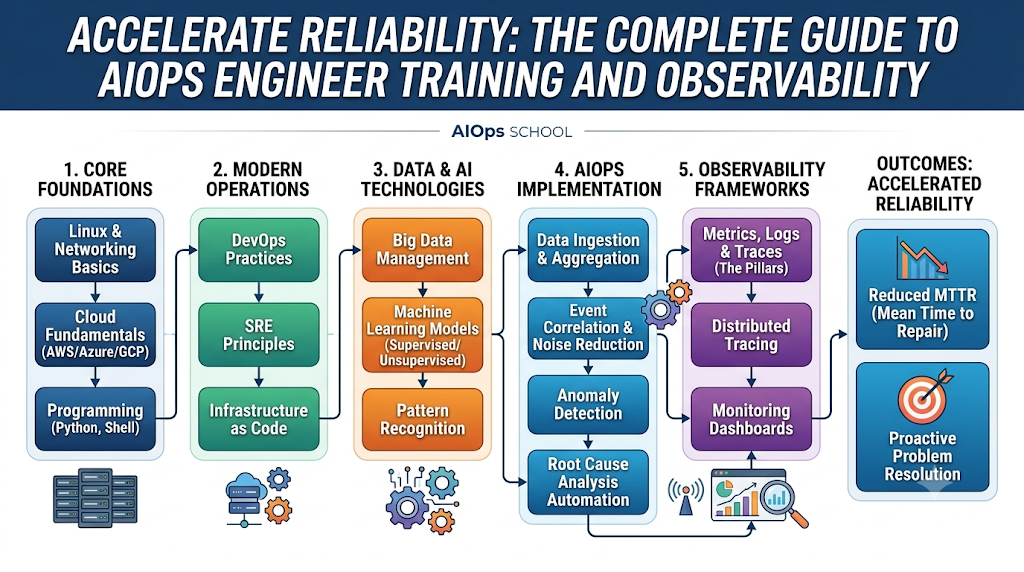
Introduction
Modern enterprise IT environments have reached a level of complexity that outpaces human processing capacity. The rapid migration to cloud-native systems, microservices architectures, and massive Kubernetes clusters generates millions of signals every second. Within this massive sea of data, infrastructure teams are frequently overwhelmed. They spend hours sifting through disconnected logs, metrics, and traces trying to figure out which alert is the actual root cause and which ones are merely symptoms. Building these capabilities requires structured knowledge and verified expertise. Specialized training platforms like AIOpsSchool provide the formal certification, practical training courses, and enterprise consulting services needed to transition from reactive troubleshooting to predictive, AI-driven IT operations.
What Is AIOps?
AIOps (Artificial Intelligence for IT Operations) is the application of machine learning, data science, and natural language processing to enhance and automate modern IT operations. By aggregating and analyzing vast quantities of logs, metrics, traces, and events, AIOps platforms automatically isolate root causes, correlate disparate alerts, and drive autonomous incident remediation.
Understanding AIOps
What Is Artificial Intelligence for IT Operations?
AIOps sits at the intersection of big data, machine learning, and infrastructure management. It does not replace existing monitoring tools; instead, it ingests the multi-layered data streams produced by those tools, normalizes the information, and applies algorithmic analysis to uncover patterns that humans cannot see in real time.
Why Traditional IT Operations Are No Longer Enough
Traditional IT operations rely on static, threshold-based rules—such as triggering an alert when CPU usage exceeds 85%. In a dynamic, auto-scaling cloud environment, these static thresholds generate immense noise, leading to alert fatigue, missed critical anomalies, and delayed resolution times.
How AI and Machine Learning Improve Operations
Machine learning algorithms excel at mathematical pattern recognition. Instead of waiting for a threshold breach, an AIOps model establishes a dynamic baseline of normal behavior. It detects subtle mathematical deviations across multiple systems simultaneously, predicting failures before they impact end users.
Evolution from Monitoring to Intelligent Operations
Monitoring tells you when a system is broken. Observability helps you understand why it broke. AIOps takes the next step: it tells you what will break, how to fix it, and can execute automated workflows to resolve the issue without human intervention.
| Traditional Operations | AIOps-Driven Operations |
| Static Thresholds: Fixed rules that require constant manual tuning. | Dynamic Baselines: ML models that adapt naturally to workload changes. |
| Siloed Dashboards: Separate views for networks, infrastructure, and apps. | Unified Context: Algorithmic correlation of data across all operational layers. |
| Reactive Troubleshooting: Remediation begins only after a failure occurs. | Predictive Anomaly Detection: Systems identify and flag issues before downtime. |
| Manual Incident Resolution: Engineers must execute every step of a playbook. | Closed-Loop Automation: Automated triggers execute self-healing scripts. |
In Simple Terms
Imagine your IT infrastructure is a massive, crowded city. Traditional monitoring is a set of static security cameras that only record what happens. AIOps is an intelligent traffic control system that uses real-time data to predict traffic jams, reroute cars before gridlock occurs, and automatically fix broken traffic lights.
Real-World Example
An e-commerce platform experiences an unexpected surge in database read latency during a holiday sales event. Instead of firing twenty individual alerts to different teams, the AIOps platform correlates the database latency with a recent microservice deployment, pinpoints the specific unindexed query causing the issue, and alerts the precise engineering pod responsible.
Why It Matters
Unplanned downtime can cost enterprises thousands of dollars per minute. Moving from traditional manual monitoring to intelligent operations protects digital revenue, preserves brand reputation, and prevents engineering burnout by eliminating operational chaos.
Key Takeaways
- Traditional static thresholds fail to scale within complex cloud architectures.
- AIOps combines big data and machine learning to find patterns across infrastructure silos.
- The technology moves engineering teams from reactive firefighting to predictive remediation.
Why AIOps Skills Are Becoming Essential
Growth of Cloud-Native Infrastructure
As enterprises migrate workloads to multi-cloud ecosystems, the sheer volume of telemetry data expands exponentially. Managing thousands of ephemeral containers requires automated algorithmic analysis rather than manual human oversight.
Rise of Distributed Systems
Microservices solve software delivery velocity challenges but introduce deep operational complexity. A single user request might traverse dozens of distributed services. When a failure occurs, trace data is too vast for human engineers to trace manually without advanced AI assistance.
Demand for Reliability Engineering
Organizations are shifting away from old-school sysadmin roles toward Site Reliability Engineering (SRE). SRE teams prioritize engineering their way out of operational problems, leveraging AIOps to build software systems that handle operational data programmatically.
Automation of Incident Management
Enterprise operations require minimal Mean Time to Resolution (MTTR). AIOps skills allow engineers to build intelligent pipelines where incidents are automatically categorized, prioritized, routed, and frequently resolved via automated runbooks.
Future of Autonomous Operations
We are moving toward self-healing infrastructure. The professionals who design, train, and maintain these autonomous operational models will be the architects of tomorrow’s enterprise IT environments.
AIOps Certification Explained
What Is an AIOps Certification?
An AIOps certification is a professional credential verifying an engineer’s ability to design, implement, and manage AI-driven operational workflows. It proves competence in data ingestion, machine learning model application for infrastructure, automated event correlation, and full-stack observability.
Benefits of Professional Certification
- Career Advancement: Validates high-demand skills, making you stand out to enterprise employers.
- Operational Confidence: Provides a structured framework to solve real-world infrastructure failures.
- Strategic Value: Empowers you to lead internal AI transformations within legacy IT departments.
Skills Validated Through Certification
- Advanced log parsing and multi-source telemetry data ingestion.
- Configuration of algorithmic event correlation and deduplication engines.
- Implementation of open-source observability frameworks like OpenTelemetry.
- Design of closed-loop automated remediation systems.
Who Should Pursue AIOps Certification?
- DevOps Engineers wanting to reduce pipeline failures and optimize release cycles.
- SRE Engineers seeking to eliminate operational toil and minimize MTTR.
- Cloud & Platform Engineers designing self-healing, highly available cloud systems.
- Monitoring Specialists transitioning from traditional dashboards to intelligent telemetry.
- IT Managers & Directors aiming to oversee successful AI-driven operational transformations.
AIOps Training and Courses
Comprehensive AIOps training programs bridge the gap between abstract data science principles and practical infrastructure engineering.
What Learners Typically Study
[Telemetry Ingestion (OpenTelemetry)] ➔ [Algorithmic Event Correlation] ➔ [Automated Remediation]
- Machine Learning for IT OperationsUnderstanding how clustering, regression, and anomaly detection models apply directly to timeseries metrics and structural log patterns without requiring a deep data science degree.
- Event CorrelationLearning how to compress thousands of disparate alerts into a single, contextualized incident ticket by grouping events based on time proximity, topology, and historical patterns.
- Intelligent AlertingDesigning systems that eliminate alert fatigue by ignoring baseline noise and only notifying human operators when a true operational anomaly presents real business risk.
- Root Cause AnalysisConfiguring automated dependency mapping to track how an infrastructure failure cascades through upstream and downstream application components.
- Predictive AnalyticsUsing capacity planning algorithms to forecast storage, memory, and compute exhaustion before they impact system performance.
- Incident AutomationConnecting AIOps platforms to IT Service Management (ITSM) systems and automation engines (like Ansible or Terraform) to trigger auto-remediation scripts.
- ObservabilityMoving past basic metrics collection to achieve complete system visibility by binding telemetry types into a single contextual graph.
- OpenTelemetryMastering the vendor-agnostic standard for collecting metrics, logs, and traces across highly distributed containerized applications.
- Monitoring AutomationProgrammatically deploying monitoring agents and configurations alongside application code deployments via CI/CD pipelines.
In Simple Terms
AIOps training teaches you how to install a brain into your cloud infrastructure. Instead of teaching you how to read a messy dashboard, it teaches you how to build a smart system that reads the dashboard for you and tells you exactly what needs to be fixed.
Real-World Example
An engineer completes an intermediate AIOps course and uses their training to overhaul a company’s legacy Nagios alert system. By implementing an open-source correlation engine, they successfully compress 40,000 weekly infrastructure alerts into 12 actionable incident reports, immediately giving time back to the engineering team.
Why It Matters
Without formal training, engineers often build brittle, overly complex custom scripts that are difficult to maintain. Structured AIOps training ensures teams use standardized, enterprise-grade frameworks that scale reliably alongside the business.
Key Takeaways
- Core coursework blends data science concepts with day-to-day infrastructure engineering.
- Focuses heavily on reducing noise through algorithmic alert compression and correlation.
- Teaches engineers how to link automated insights directly to closed-loop remediation workflows.
AIOps Engineer Certification Path
Building expertise in AIOps requires a structured progression from fundamental systems administration to advanced architectural design.
| Level | Skills | Outcome |
| Beginner | Linux internals, fundamental cloud architecture, basic monitoring metrics, and log analysis. | Capable of configuring basic telemetry collectors and navigating unified operations dashboards. |
| Intermediate | OpenTelemetry standards, log parsing, event deduplication, and baseline anomaly detection. | Capable of designing multi-source data ingestion pipelines and setting up automated alert correlation rules. |
| Advanced | Custom ML model tuning, closed-loop automated self-healing, and enterprise-wide AIOps architecture. | Capable of architecting full-scale autonomous enterprise operations, reducing organizational MTTR toward zero. |
AIOps Engineer Career Roadmap
Required Technical Skills
To succeed as an AIOps engineer, you must build a multi-disciplinary technical foundation:
- Linux: Deep understanding of OS internals, process management, and system resource distribution.
- Networking: Mastery of TCP/IP, DNS, load balancing, and service mesh architectures in distributed environments.
- Cloud Platforms: Operational proficiency across major hyperscalers (AWS, Azure, GCP).
- Kubernetes: Managing container orchestration, microservice networks, and ephemeral resource behavior.
- Monitoring Tools: Experience with legacy tools alongside modern telemetry platforms (Prometheus, Grafana, Datadog, Splunk).
- Automation: Scripting infrastructure management using tools like Ansible, Terraform, and Python.
- Python: The core language for writing automation scripts, data parsing routines, and interfacing with machine learning libraries.
- Observability: The conceptual framework of unifying logs, metrics, traces, and events into a single queryable layer.
Learning Sequence
- Master Infrastructure Fundamentals: Build absolute comfort managing Linux environments, container configurations, and cloud networking.
- Learn Modern Telemetry: Shift from basic server health checks to configuring distributed tracking with OpenTelemetry across various microservices.
- Study Applied Machine Learning: Focus on how clustering models and timeseries forecasting operate within cloud monitoring ecosystems.
- Integrate Intelligent Automation: Bridge the gap between detection and action by writing code that responds automatically to validated system anomalies.
- Pursue Formal Certification: Validate your operational and technical skills through an industry certification program at AIOpsSchool to verify your capabilities to enterprise employers.
AI Observability Training
What Is AI Observability?
AI Observability uses machine learning to interpret internal software states based on external outputs. Traditional monitoring counts errors; AI observability analyzes the relationships within system telemetry to explain the context of those errors.
Why Observability Matters
In modern distributed systems, failure modes are unpredictable. You cannot write a static monitoring rule for a problem you have never encountered before. Observability provides the deep telemetry data required to diagnose these unexpected failures.
Logs, Metrics, Traces, and Events
These four foundational data types form the backbone of modern operations:
- Logs: A time-stamped text record of a discrete event within an application.
- Metrics: Numeric values measured over intervals of time (e.g., memory utilization).
- Traces: The end-to-end journey of a single request as it passes through a distributed system.
- Events: Structured operational occurrences with business impact (e.g., a code deployment or a cloud auto-scaling event).
OpenTelemetry Fundamentals
OpenTelemetry provides a standardized, vendor-neutral collection framework for telemetry data. Training in OpenTelemetry ensures engineers can instrument applications once and stream high-quality data to any modern AIOps analysis engine.
Intelligent Monitoring Systems
By applying artificial intelligence to unified OpenTelemetry data streams, intelligent monitoring systems identify systemic anomalies across logs, metrics, and traces simultaneously.
| Monitoring | Observability |
| Focuses on known failure modes and static parameters (“Is the system up?”). | Focuses on systemic understanding and unknown failure modes (“Why is the system slow?”). |
| Uses isolated dashboards separated by infrastructure layer. | Uses unified, contextual dependency graphs across all layers. |
| Relies heavily on human operators to correlate data during an outage. | Uses machine learning algorithms to automatically spot deep data correlations. |
In Simple Terms
Traditional monitoring is like a dashboard light that illuminates when your car engine overheats. AI Observability is like a digital diagnostic scanner that reads the engine sensor data, monitors real-time fuel efficiency, traces the coolant flow, and points directly to the exact worn-out valve causing the heat.
Real-World Example
A fintech application experiences sporadic transactional delays. Standard monitoring shows normal CPU and memory usage across all servers. An AI Observability platform analyzes the end-to-end distributed traces and isolates a specific microservice waiting on a third-party payment gateway API timeout, automatically flagging the external vendor dependency.
Why It Matters
Without clean, high-quality observability data, an AIOps platform cannot deliver value. Training teams in advanced AI observability ensures your machine learning engines ingest rich, accurate data, preventing the “garbage-in, garbage-out” pitfall.
Key Takeaways
- Logs, metrics, traces, and events must be contextualized together to be effective.
- OpenTelemetry provides the critical foundation for modern, vendor-neutral data ingestion.
- AI Observability shifts focus from identifying known issues to diagnosing unexpected system behaviors.
AIOps for SRE and DevOps Engineers
How AIOps Supports SRE Practices
SRE teams focus on balancing feature velocity with system reliability. AIOps platforms automate the manual data mining required to track Service Level Objectives (SLOs) and Error Budgets, allowing SREs to focus on structural engineering improvements.
Reducing Alert Fatigue
Alert fatigue burns out engineers and causes critical incidents to be ignored. AIOps helps solve this by grouping related symptoms into single, contextual incident alerts, stripping away up to 90% of operational noise.
Improving Incident Response
When a production issue occurs, an AIOps engine can automatically pull relevant logs, reference recent code commits, show dependency maps, and suggest the most probable root cause—saving valuable time during high-pressure incidents.
Enhancing Reliability Engineering
By predicting resource exhaustion and identifying architectural bottlenecks before they manifest as failures, AIOps shifts reliability work from a reactive cleanup posture to a proactive optimization practice.
Supporting Continuous Delivery
AIOps tools can monitor Canary deployments and blue-green rollouts in real time. If an algorithmic baseline shift is detected immediately following a code push, the platform can trigger automated rollbacks, preserving system stability.
Enterprise AIOps Consulting
Many organizations fail in their AIOps initiatives because they purchase expensive enterprise tools without updating their operational processes or technical skill sets.
Why Organizations Need AIOps Consulting
Enterprise environments feature deeply entrenched legacy infrastructure, multi-layered organizational politics, and disparate teams. Professional consulting provides the objective technical strategy required to successfully integrate AI across legacy and cloud-native systems.
Assessing Operational Maturity
A successful transformation begins by accurately benchmarking an organization’s current operations. Consultants evaluate tool sprawl, data quality, team skill sets, and incident management maturity before proposing any technology changes.
[Maturity Assessment] ➔ [Data Standardization] ➔ [AIOps Platform Ingestion] ➔ [Autonomous Scale]
Tool Selection Strategies
The modern operations marketplace is highly fragmented. Experienced consultants help enterprises avoid vendor lock-in by evaluating existing monitoring configurations and selecting the ideal AIOps platforms that naturally integrate with their specific technology stack.
Building AIOps Roadmaps
AIOps cannot be fully implemented overnight. Consulting teams construct multi-phased roadmaps that deliver rapid value through quick wins—such as initial alert deduplication—before scaling into advanced closed-loop automated infrastructure remediation.
Change Management Considerations
Technology is only half the battle; people must adopt it. Consulting frameworks address organizational resistance by upskilling infrastructure engineers, redefining team workflows, and building internal confidence in algorithmic recommendations.
AIOps Implementation Services
Implementation services turn a high-level strategic architecture into a functional, production-grade operational realities.
+-------------------------------------------------------------+
|               AIOps Implementation Lifecycle                |
+-------------------------------------------------------------+
|  1. Assessment    --> Evaluate data quality & tool sprawl   |
|  2. Design        --> Build telemetry pipeline architecture  |
|  3. Integration   --> Connect OpenTelemetry & API inputs     |
|  4. Automation    --> Deploy correlation models & alerts    |
|  5. Optimization  --> Refine ML baselines & self-healing     |
+-------------------------------------------------------------+
Implementation Lifecycle
- AssessmentAudit all active monitoring configurations, verify documentation accuracy, and evaluate data quality across all log repositories.
- DesignArchitect a centralized telemetry pipeline capable of aggregating data securely from multi-cloud environments and on-premise data centers.
- Tool SelectionProcure or configure open-source and commercial software components perfectly matched to the target architecture and budget constraints.
- IntegrationDeploy OpenTelemetry agents, establish secure API webhooks to ITSM platforms, and aggregate historical incident data to train ML baseline engines.
- AutomationBuild, test, and activate event correlation rules, automated ticketing workflows, and script triggers for standard recurring operational tasks.
- OptimizationContinuously review algorithmic false positives, refine machine learning model sensitivities, and optimize alert delivery pathways.
- Continuous ImprovementRegularly audit operational performance data to iteratively expand automated self-healing scripts into more critical infrastructure environments.
Real-World Enterprise Use Cases
Banking and Financial Services
- Operational Challenge: A global retail bank experienced frequent mobile banking login delays during high-volume processing windows, leading to regulatory scrutiny.
- AIOps Solution: Deployed real-time transactional stream analysis coupled with automated log correlation across legacy mainframe systems and cloud API gateways.
- Business Outcome: Isolated a recurring database lock anomaly, reducing incident identification time from 4 hours to 90 seconds, avoiding regulatory penalties.
Healthcare Platforms
- Operational Challenge: A telehealth application suffered from intermittent video dropouts during consultations, caused by complex network route failures across multiple regions.
- AIOps Solution: Implemented network topology mapping combined with predictive anomaly detection on cloud load balancer telemetry.
- Business Outcome: System predicted and rerouted traffic away from failing cloud infrastructure nodes prior to session disruption, preserving patient care delivery.
SaaS Companies
- Operational Challenge: A high-growth B2B SaaS business suffered from severe alert fatigue, with engineers receiving over 10,000 monitoring notifications every day.
- AIOps Solution: Built an algorithmic event deduplication pipeline to group alerts based on cross-microservice dependency mapping.
- Business Outcome: Reduced total alert volume by 93%, directly lowering engineering turnover while improving overall platform availability.
Telecommunications
- Operational Challenge: A network provider struggled to find the root cause of cell tower disruptions across vast geographic territories during volatile weather events.
- AIOps Solution: Applied algorithmic spatial-temporal clustering to correlate weather feeds with regional tower performance metrics.
- Business Outcome: Automated dispatch workflows, ensuring field technicians were routed immediately to the exact core hub causing regional downstream outages.
E-Commerce Platforms
- Operational Challenge: A global retailer experienced cart checkout failures during a major online shopping event, causing immediate revenue loss.
- AIOps Solution: Integrated automated end-to-end distributed trace tracking across the checkout microservice ecosystem.
- Business Outcome: Instantly identified an incorrect configuration change in an inventory update service, triggering an automatic self-healing system rollback that restored checkout functionality within 2 minutes.
Benefits of AIOps Adoption
- Reduced DowntimeBy predicting system failures before they occur and isolating root causes immediately, enterprises protect critical revenue channels from unexpected service interruptions.
- Faster Root Cause AnalysisAIOps engines cut through operational data noise, analyzing millions of data points to present engineers with the specific point of failure in seconds.
- Better User ExperienceMaintaining reliable, high-performing software services ensures customers enjoy smooth interactions, protecting brand equity.
- Reduced Operational CostsEliminating manual investigation work and consolidating redundant monitoring software tool deployments lowers ongoing IT operating expenses.
- Improved ReliabilityMoving past fragile, manual rule configurations allows infrastructure teams to build more resilient architectures capable of handling complex scaling demands.
- Smarter Decision-MakingAccessing clear, trend-analyzed telemetry data enables technology leaders to make evidence-based choices regarding platform infrastructure investments and resource allocations.
Common Challenges in AIOps Adoption
- Data Quality IssuesThe Problem: Machine learning models require structured, high-quality input data to produce accurate insights. Siloed, malformed, or missing logs result in inaccurate operational conclusions.The Solution: Standardize all telemetry collection via OpenTelemetry frameworks and enforce strict, uniform logging guidelines across all development groups.
- Tool Integration ChallengesThe Problem: Legacy enterprise systems often use proprietary software platforms that do not naturally share data with modern AI correlation systems.The Solution: Leverage specialized AIOps consultants to design custom API integration pipelines and data transformation layers to securely bridge legacy and modern stacks.
- Skills GapThe Problem: Traditional infrastructure management groups frequently lack familiarity with machine learning workflows, data pipeline management, and modern observability frameworks.The Solution: Partner with educational training platforms like AIOpsSchool to upskill existing teams through practical, certification-focused learning paths.
- Organizational ResistanceThe Problem: Systems engineers may worry about job automation or feel skeptical about relying on algorithmic infrastructure recommendations.The Solution: Implement AIOps tools initially in an advisory role, using human-in-the-loop validation to build confidence before enabling automated remediation.
- Lack of Observability MaturityThe Problem: Organizations try to implement advanced predictive machine learning models while lacking basic logs, metrics, and tracing pipelines.The Solution: Follow a structured maturity roadmap. Prioritize establishing robust application observability before enabling automated AI operations.
Common Mistakes Professionals Make
Checklist for AIOps Implementation
- Avoid Focusing Only on Tools: Do not assume purchasing an expensive platform will instantly fix poor internal processes.
- Do Not Ignore Observability Fundamentals: Never attempt to configure machine learning models without first setting up high-quality telemetry ingestion.
- Ensure Complete Data Collection: Avoid feeding incomplete, isolated data sets into your correlation systems.
- Have a Clear Automation Strategy: Do not use AI to generate alerts if you have no automated plan or standard workflow to handle them.
- Commit to Continuous Learning: Never view AIOps as a one-time project; regularly retrain models and optimize rules to keep pace with system updates.
Future of AIOps
Autonomous Operations
The long-term vision of IT infrastructure is a self-managing environment. Future enterprise systems will deploy, monitor, scale, tune, and repair themselves based on continuous business intent data.
AI-Driven Incident Management
Generative AI and advanced LLMs are being integrated with AIOps platforms to allow engineers to query system states using natural language, auto-generating incident summaries and infrastructure-as-code remediation scripts.
Predictive Reliability Engineering
Instead of reviewing historical reliability metrics, SREs will use predictive simulations to stress-test architectures against simulated black swan infrastructure failures before they manifest.
Intelligent Capacity Planning
As global computing needs face energy and hardware constraints, AIOps will optimize workload placements across multi-cloud networks in real time, balancing peak software performance against energy efficiency and cost.
Self-Healing Infrastructure
Closed-loop automation will evolve from executing simple restart scripts to autonomously modifying application configuration topologies and patching zero-day code vulnerabilities on the fly.
AI-Powered Observability
Telemetry agents will become completely self-configuring, automatically identifying new microservice applications as they spin up and adjusting tracing depths dynamically based on detected operational risks.
Why Learn with AIOpsSchool
As enterprises increasingly transition to autonomous software environments, demand for certified professionals continues to rise. AIOpsSchool provides the educational ecosystem needed to succeed in this shifting marketplace.
- Industry-Focused CurriculumCourse content is built directly by senior enterprise architects, focusing on real-world practical tools and actual production environments instead of pure academic data science theory.
- Hands-On LearningStudents gain practical experience inside live sandboxed environments, configuring real telemetry pipelines, troubleshooting simulated production outages, and writing live automation scripts.
- Certification ProgramsProfessional credentials earned through AIOpsSchool offer clear validation of skills, giving employers confidence in your technical and operational capabilities.
- Enterprise Consulting ExpertiseThe insights shared across training programs are drawn directly from live enterprise consulting transformations, ensuring you learn modern best practices.
- Career-Oriented Skill DevelopmentCourse plans are tailored around actual job placement requirements, directly preparing engineers to step confidently into advanced DevOps, SRE, and platform management roles.
FAQ Section
1. What is AIOps Certification?
An AIOps certification is an industry credential validating an engineer’s technical ability to apply big data analytics, machine learning frameworks, and automation strategies to improve enterprise IT operations.
2. Who should learn AIOps?
DevOps engineers, Site Reliability Engineers (SREs), cloud administrators, platform engineers, database managers, and technology directors looking to modernize operational workflows should study AIOps.
3. What skills are required for AIOps Engineers?
AIOps engineers need solid foundational skills in Linux administration, cloud infrastructure, Python coding, database management, monitoring design, automated scripting, and modern observability frameworks.
4. How does AIOps help DevOps teams?
AIOps assists DevOps teams by filtering out unnecessary alert noise, pointing directly to root causes during deployment errors, tracking system health metrics automatically, and triggering auto-remediation scripts within active delivery pipelines.
5. What is AI Observability?
AI Observability is an operational approach using machine learning to interpret system performance by connecting logs, metrics, traces, and events together into a unified context.
6. What is OpenTelemetry?
OpenTelemetry is a popular open-source collection framework that provides software development teams with standardized APIs, tools, and vendor-neutral agents to ingest logs, metrics, and traces.
7. How long does it take to learn AIOps?
Depending on your previous infrastructure experience, master goals can take 3 to 6 months of dedicated training to build comfort with data pipelines, machine learning models, and automated engineering workflows.
8. What are AIOps Implementation Services?
AIOps implementation services are technical consulting engagements where specialists analyze corporate infrastructure, design telemetry streams, configure AI software platforms, and set up automated self-healing scripts.
9. Is AIOps a good career choice?
Yes. With modern cloud networks growing increasingly complex, engineering professionals who understand how to apply automation and artificial intelligence to infrastructure management remain highly sought after by enterprise employers.
10. What is the future of AIOps?
The discipline is evolving toward fully autonomous operations, featuring natural language interfaces, self-configuring observability telemetry, predictive risk assessments, and robust self-healing cloud architectures.
Final Summary
The accelerating scale of modern cloud-native systems has made manual infrastructure monitoring obsolete. To keep pace with distributed architectures, organizations must pivot toward intelligent, data-driven automation. Mastering these modern practices requires structured technical training and verified expertise. Acquiring an industry-recognized AIOps certification empowers engineers to lead high-impact operational transformations, while enterprise consulting and implementation services provide organizations with the blueprint needed to eliminate alert noise and scale performance.