Introduction
At the heart of every technological revolution lies a simple question: How do we store and manipulate information? For decades, our answer has been the classical bit. Every email you send, video you stream, and application you run is ultimately chopped up into an astronomical sequence of 1’s and 0’s. This binary approach built the modern digital world, but it faces fundamental physical limits when tackling some of the universe’s most complex problems. Enter quantum information processing. Instead of relying on rigid, binary switches, quantum computers leverage the strange and beautiful rules of quantum mechanics. To understand this paradigm shift, you must first understand Data Representation in Quantum Computing. It is the absolute bedrock upon which all quantum algorithms, architectures, and software systems are built. If you are transitioning from traditional computer science or exploring technology for the first time, learning how quantum data operates can feel like learning a new language. That is where QuantumOpsSchool.com comes in. As a premier educational resource, our mission is to break down these complex barriers, translating deep physics into practical, actionable knowledge for everyday developers and tech enthusiasts.
What Is Data Representation in Quantum Computing?
Definition
In classical computing, data representation refers to how real-world information—like text, images, or numbers—is translated into electrical signals representing 0 or 1. In the quantum realm, Data Representation in Quantum Computing is the mathematical and physical process of mapping information into the quantum states of physical particles.
Importance
Why does this matter? Because a quantum computer cannot process data in its raw, classical format. A database of logistics routes, a molecular structure, or a financial portfolio must first be translated into a quantum format before a quantum processor can execute an algorithm. The efficiency of your quantum program depends directly on how smartly you encode this data.
Role in Quantum Information Processing
Quantum data representation fundamentally dictates how information flows through a quantum system. Instead of moving bits through logic gates sequentially, quantum information processing manipulates an entire web of interconnected possibilities simultaneously. If the data is represented poorly, the quantum advantage disappears, and the machine performs no better than a standard desktop computer.
Relationship with Quantum Algorithms
Every famous quantum algorithm—such as Shor’s algorithm for factoring numbers or Grover’s algorithm for searching databases—relies on specific configurations of quantum data. The data must be structured in a way that allows quantum gates to amplify the correct answers while canceling out the incorrect ones. In short, data representation is the canvas, and the quantum algorithm is the painting.
Core Concepts
To grasp the mechanics of quantum data, we must first break down its foundational building blocks. Let us look at these core concepts step by step.
Classical Bits
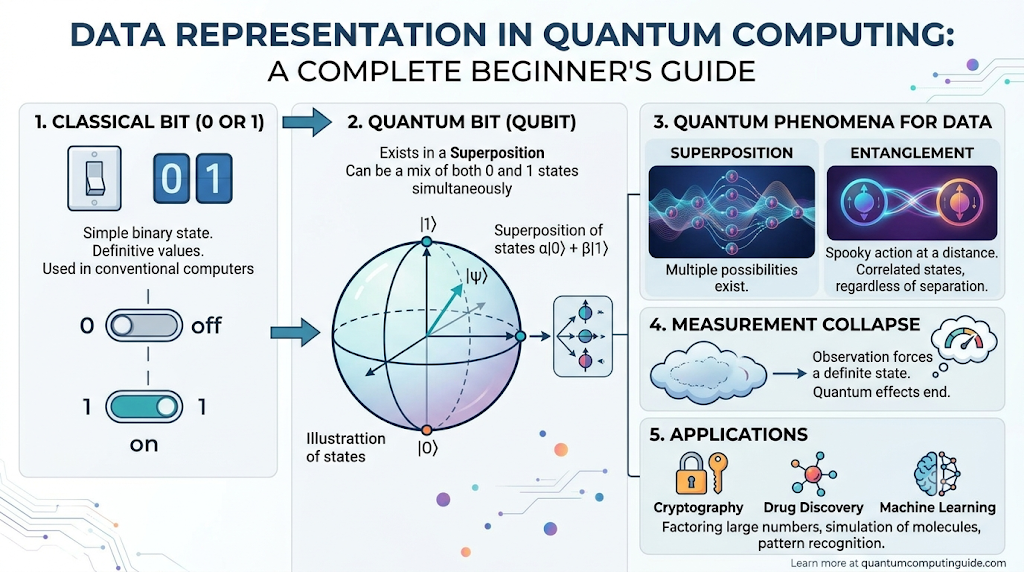
A classical bit is a binary digit. Think of it as a standard household light switch. It can only ever be in one of two distinct positions: completely OFF (0) or completely ON (1). There is no middle ground. If you turn off the light, the state is 0. If you flip it up, it is 1.
Qubits
A quantum bit, or qubit, is the fundamental unit of quantum information. Unlike a classical light switch, a qubit behaves more like a spinning coin. While the coin is spinning on a table, it isn’t strictly “heads” or “tails.” It exists in a fluid combination of both possibilities. Only when you slap your hand down on the coin does it stop and lock into a single, definite state.
Quantum States
A quantum state is the mathematical description of a qubit’s current condition. While a classical bit can only be in state $|0\rangle$ or state $|1\rangle$, a qubit’s state can occupy an infinite number of configurations between them. We write these states using a special notation called Dirac notation (or bra-ket notation), where $|0\rangle$ and $|1\rangle$ represent the foundational baseline positions.
Superposition
Superposition is the ability of a quantum system to exist in multiple states at the same time. It does not mean the qubit is secretly hiding a value, nor does it mean it is fluctuating wildly between 0 and 1. Instead, it means the qubit embodies a precise probability of being a 0 and a precise probability of being a 1 simultaneously.
Quantum Registers
Just as classical computers group bits together into bytes and registers to store larger numbers, quantum computers group multiple qubits into quantum registers. The magic here is exponential scale. While a 3-bit classical register can store exactly one of eight possible numbers at any given moment, a 3-qubit quantum register can hold all eight numbers at the exact same time.
Measurement
Measurement is the act of observing a quantum state. This is a disruptive process. The moment you measure a qubit in superposition, its delicate fluid state collapses. It instantly drops its quantum properties and forces itself to become a classical 0 or 1. You can never directly “see” a superposition; you can only observe the classical footprint it leaves behind after measurement.
Data Representation in Quantum Computing
Let us dive deeper into the mechanics of how data is organized, altered, and read inside a quantum processor.
Encoding Classical Information into Qubits
To process classical data on a quantum machine, we must use quantum encoding. Think of this as translating an English book into Morse code. There are three primary ways to achieve this:
- Basis Encoding: This maps classical binary strings directly to corresponding qubit states. For example, the binary data
10becomes the quantum state $|10\rangle$. - Amplitude Encoding: This treats your data as a sequence of numbers and stores them as the mathematical probabilities (amplitudes) of a quantum state. It is incredibly compact, allowing you to fit vast amounts of data into just a few qubits.
- Angle Encoding: This rotates the qubit by a specific angle on a sphere (called the Bloch Sphere) based on the input data value. It is highly popular in quantum machine learning applications.
Representing Quantum States
To visualize how a single qubit represents data, scientists use a tool called the Bloch Sphere. Imagine a perfectly round globe. The North Pole represents $|0\rangle$, and the South Pole represents $|1\rangle$.
A classical bit can only live precisely at the North Pole or precisely at the South Pole. A qubit, however, can point to any spot on the surface of the globe—the equator, the tropics, or anywhere in between. The exact latitude and longitude of the pointer represent the specific blend of data held by that qubit.
Binary Data vs Quantum Data
The leap from binary to quantum data completely transforms data capacity:
Classical Binary Data (2 bits):
[00] OR [01] OR [10] OR [11]  --> Holds only ONE state at a time.

Quantum Data (2 qubits):
α|00⟩ + β|01⟩ + γ|10⟩ + δ|11⟩ --> Holds ALL four states simultaneously.
Quantum Registers and Multi-Qubit Systems
When you link qubits together into a quantum register, their information capacity grows exponentially. Every time you add a single qubit to a register, you double the amount of data it can simultaneously represent.
- 1 Qubit = 2 simultaneous states ($|0\rangle, |1\rangle$)
- 2 Qubits = 4 simultaneous states
- 3 Qubits = 8 simultaneous states
- 10 Qubits = 1,024 simultaneous states
- 30 Qubits = Over 1 billion simultaneous states
By the time you reach a few hundred perfectly stable qubits, the quantum register can represent more simultaneous states than there are atoms in the observable universe.
Quantum Gates and Data Transformation
In classical programming, you use logical operators like AND, OR, and NOT to alter your bits. In quantum computing, you use quantum gates.
Because quantum data exists as probabilities, quantum gates act like subtle gravity fields that shift those probabilities. Instead of hard-flipping a switch, a quantum gate smoothly rotates the qubit’s pointer across the Bloch Sphere, changing the data representation dynamically without destroying the underlying superposition.
Reading Quantum Information Through Measurement
If a quantum register holds thousands of answers at once, how do you get the correct one out? When you trigger a measurement, the system collapses, providing a single classical string of 1’s and 0’s.
To make this useful, quantum algorithms use constructive interference—similar to how noise-canceling headphones cancel out bad sounds while amplifying the music. The algorithm manipulates the quantum states so that the wrong answers cancel each other out to zero probability, ensuring that when you finally measure the system, the single classical answer that appears is the correct one.
QuantumOpsSchool.com Guide to Data Representation
Mastering the fundamentals of quantum data requires a structured path. Here is how we break down the learning process at QuantumOpsSchool.com to help you go from zero to fluent.
Understanding Qubit Fundamentals
Your journey begins by breaking down the physics barrier. You do not need a degree in advanced quantum mechanics to work with quantum data. We teach you to view qubits through the lens of computer science—treating them as sophisticated information processors governed by clear, predictable rules of probability.
Learning Quantum Information Processing
Once you understand a single qubit, we guide you through the interactions between multiple qubits. You will explore how entanglement links qubits together, creating a shared quantum playground where data modifications to one qubit instantly ripple across the entire register.
[ Input Data ] ──► [ Quantum Encoding ] ──► [ Quantum Register (Superposition) ]
                                                        │
                                             [ Quantum Gate Operations ]
                                                        │
[ Output Data ] ◄── [ Classical String ] ◄── [ Quantum Measurement ]
Building Quantum Circuits
Theory comes alive when you build. Through practical exercises, you will design visual quantum circuits. You will drag and drop quantum gates (like the Hadamard gate, which creates superposition, and the CNOT gate, which links qubits together) to see exactly how data configurations shift in real time.
Preparing for Quantum Algorithms
With circuit basics down, you will discover how to prepare data for real-world algorithms. You will practice translating classical matrices and datasets into amplitude-encoded quantum states, preparing you to tackle complex optimization and machine learning problems.
Developing Strong Quantum Foundations
The ultimate goal of our curriculum is to future-proof your skill set. By mastering how data is structured and manipulated at this fundamental layer, you will easily adapt to any quantum programming language, framework, or cloud hardware provider that emerges in the industry.
Real-World Applications
Quantum data representation isn’t just an academic exercise; it is the catalyst for solving major industrial challenges.
Scientific Research
Researchers use quantum data to model nature exactly as it is: quantum mechanical. By mapping electron configurations and atomic spins directly onto qubits, scientists can run physics experiments that are completely impossible on classical supercomputers.
Cryptography
Because observing a quantum state changes its composition, quantum data representation forms the backbone of unhackable communication. If a malicious actor tries to intercept a quantum cryptographic key, their very act of looking at the data alters it, instantly alerting the senders.
Drug Discovery
Traditional computers struggle to simulate the precise molecular interactions needed to design life-saving medications. Quantum registers can naturally represent the complex, fluid quantum states of molecular bonds, slashing the time required to discover new drugs from decades to days.
Optimization Problems
Whether it is finding the most fuel-efficient routes for thousands of global cargo ships or managing factory supply chains, optimization is all about sorting through billions of choices. Quantum data lets systems analyze all routes simultaneously to find the ideal solution rapidly.
Artificial Intelligence
Quantum machine learning weaves data into complex high-dimensional quantum states. This allows AI models to spot intricate patterns within massive datasets far quicker than classical neural networks, accelerating training times for complex models.
Financial Modeling
From pricing complex options packages to balancing multi-billion-dollar investment risk portfolios, the financial sector deals with immense uncertainty. Quantum data representation can simulate thousands of market volatility scenarios at once, offering unparalleled risk analysis.
Benefits of Quantum Data Representation
Transitioning away from binary logic offers distinct structural advantages for complex problem-solving.
- Efficient Information Encoding: You can compress massive datasets into compact physical systems. With amplitude encoding, an array of data containing millions of elements can be represented using just a handful of interconnected qubits.
- Parallel Information Processing: Superposition allows a quantum system to run calculations on a massive number of possibilities at the same moment, bypassing the step-by-step bottlenecks of classical processors.
- Foundation for Quantum Algorithms: It unlocks access to quantum-native phenomena like entanglement and interference, which are essential for achieving true quantum speedups.
- Support for Complex Simulations: It effortlessly mimics natural systems. Because atoms and molecules follow quantum mechanics, representing them via quantum states provides flawless accuracy.
- Future Computing Innovation: It breaks through the physical barriers of silicon-based chips, opening the door to an entirely new era of high-performance enterprise computing.
Classical Data Representation vs Quantum Data Representation
| Feature | Classical Computing | Quantum Computing |
| Basic Unit | Bit | Qubit |
| Data States | 0 or 1 | Superposition of states |
| Information Storage | Binary | Quantum state |
| Processing Style | Sequential/parallel hardware | Quantum operations |
| Scalability | Classical architecture | Quantum architecture |
Common Challenges
While the benefits are monumental, managing quantum data comes with severe engineering hurdles.
Understanding Superposition
For developers, shifting from absolute binary code (if/else) to probabilistic quantum states requires a total mental rewrite. Programming a machine where data exists as fluid percentages of likelihood demands unique software logic design.
Quantum Measurement
Because reading data destroys its quantum nature, developers cannot simply pause a quantum program halfway through to print out variable states for debugging. You must design entire processes just to extract clean outputs at the very end of a run.
Noise and Decoherence
Quantum data is incredibly sensitive. Minor shifts in room temperature, stray electromagnetic waves, or physical vibrations can cause qubits to drop their superposition and lose their data. This frustrating event is known as decoherence.
Error Correction
Because you cannot copy or clone live quantum data (due to a physics rule called the No-Cloning Theorem), traditional backup methods fail. Scientists must develop complex quantum error correction codes that bundle thousands of fragile physical qubits into a single stable “logical qubit.”
Hardware Limitations
Building processors that can hold hundreds of high-quality, error-free qubits is a monumental manufacturing challenge. Today’s systems are still in the development phase, meaning programmers must work within tight hardware constraints.
Best Practices for Beginners
If you are eager to venture into the world of quantum computing data, keep these five core strategies in mind:
- Learn binary representation first: Make sure you thoroughly understand classical logic gates, bits, and matrix multiplication before diving into quantum alternatives.
- Understand qubits before quantum algorithms: Avoid skipping ahead to complex code. Spend time mastering the Bloch Sphere, superposition, and basic states first.
- Practice using quantum simulators: Use free, cloud-based software tools that simulate qubits on your everyday classical computer. It is a safe, zero-cost sandbox for trial and error.
- Study simple quantum circuits: Build small, bite-sized workflows using just two or three qubits to clearly see how information transforms through gates.
- Build concepts gradually: Give your mind time to absorb these non-intuitive concepts. Focus on building consistency over raw speed.
Career Opportunities
Developing a deep mastery of quantum data representation opens doors to pioneering roles across tech, science, and enterprise business:
- Quantum Software Developer: Designing the code, frameworks, and user-facing applications that interface with quantum processors.
- Quantum Computing Engineer: Building and refining the physical hardware systems, control lines, and chips that house qubits.
- Quantum Information Scientist: Conducting deep-dive research into quantum states, error correction, and information theory boundaries.
- Quantum Systems Engineer: Integrating classical data centers with cloud-hosted quantum computing infrastructure.
- Quantum Research Scientist: Developing breakthroughs in materials science, chemistry, and physics using quantum tools.
- Quantum Algorithm Developer: Creating specialized, ultra-fast mathematical solutions tailored specifically to run on quantum registers.
Future of Quantum Data Representation
The roadmap ahead points toward a highly integrated technological ecosystem.
Fault-Tolerant Quantum Computing
The ultimate goal of the industry is building systems that can run billions of gate operations without losing data to noise. Achieving fault tolerance will unlock the true, uninhibited power of massive quantum datasets.
Advanced Quantum Memory
Just as classical computers need RAM and hard drives, quantum networks require specialized memory cells that can store delicate superposition data long-term without triggering a measurement collapse.
Hybrid Quantum-Classical Systems
The near future belongs to teamwork. Rather than replacing your desktop, quantum units will act as specialized co-processors. Classical systems will handle input/output and data prep, while quantum units crunch the heavy, multi-state algorithmic problems.
Cloud-Based Quantum Platforms
You won’t need a multi-million-dollar refrigerator in your office to use quantum power. Enterprise-grade quantum processors are increasingly available via cloud platforms, allowing anyone to run quantum code from a standard browser.
Enterprise Quantum Applications
As systems mature, industries will deploy custom quantum data models daily, continuously optimizing international flight paths, global financial risk profiles, and clean-energy chemical discoveries.
Common Misconceptions
Let us separate the real science from the science fiction by dispelling a few prominent myths.
Qubits Permanently Store Multiple Values
A popular myth claims that a qubit holds thousands of separate data files at once. In reality, a qubit holds a single, delicate quantum state that contains the probability of multiple outcomes. When read, it yields exactly one regular classical value.
Quantum Data Replaces Classical Data
Quantum data will never completely replace binary files. Everyday tasks—like word processing, streaming video, or saving spreadsheets—run perfectly on classical bits. Quantum data is an elite tool reserved specifically for highly complex computing challenges.
More Qubits Always Mean Better Performance
Raw qubit count is only half the story. If a machine has 1,000 qubits but they are highly unstable and prone to error, the data will fall apart instantly. Qubit quality, low noise, and smart error correction matter just as much as quantity.
Quantum Computing Eliminates Binary Logic Completely
Quantum computers rely heavily on classical binary setups to function. Classical computers control the lasers, read the sensors, and display the final outputs of every single quantum run. The two technologies work hand in hand.
FAQ Section
- What is the difference between a bit and a qubit?
A classical bit can only exist in one of two definite states: 0 or 1. A qubit can exist in a superposition, meaning it represents a mathematical combination of both 0 and 1 simultaneously until it is measured.
- Can a qubit store two numbers at the same time?
Not in the traditional sense. A qubit stores a single quantum state that represents the probability of being a 0 or a 1. When grouped into a register, they can hold a blend of multiple combinations at once, but measurement collapses this down to just one classical string.
- What happens to quantum data when it is measured?
The moment you measure quantum data, its superposition collapses completely. The system drops its fluid quantum probabilities and forces itself into a definite, classical binary state of 1’s and 0’s.
- Why is noise such a big problem for quantum data representation?
Qubits are extraordinarily delicate. Minor interferences from the surrounding environment—like heat, vibrations, or stray magnetic fields—disrupt their quantum properties, causing them to lose their data in an event called decoherence.
- What is quantum encoding?
Quantum encoding is the process of translating regular, classical information (like numbers, vectors, or text) into a format that a quantum computer can understand, such as the angles or amplitudes of qubits.
- Do I need a strong background in advanced math to understand quantum data?
While deep quantum development involves linear algebra and probability, beginners can easily grasp the core concepts using simple visual tools like the Bloch Sphere and basic logic analogies.
- How does a quantum register hold so much information?
Because of superposition, a quantum register scales exponentially. While $N$ classical bits can store only one specific option out of $2^N$ possibilities, $N$ qubits can represent all $2^N$ possibilities simultaneously.
- Can you copy quantum data to create a backup file?
No. According to a fundamental law of physics called the No-Cloning Theorem, it is impossible to create an identical, independent copy of an unknown, isolated quantum state without destroying the original data.
- What is the Bloch Sphere?
The Bloch Sphere is a geometrical sphere used by scientists to visualize the state of a single qubit. The surface of the sphere represents all the possible superposition states a qubit can occupy.
- Where can I go to start learning more about quantum computing data?
You can access high-quality educational guides, tutorials, and structured learning pathways directly at QuantumOpsSchool.com to build up your quantum foundations step by step.
Final Summary
Mastering Data Representation in Quantum Computing is your gateway to understanding the next great leap in technology. By moving beyond the binary limits of traditional bits and embracing the fluid, high-capacity capabilities of qubits, quantum systems can represent data in ways that fundamentally mirror the complex mechanics of nature. Throughout this guide, we have explored the essential building blocks of quantum information: from the foundational principles of superposition and quantum states to the realities of quantum registers, gates, and encoding methodologies. While hardware limitations, environmental noise, and decoherence remain significant engineering hurdles, the immense advantages of parallel processing and high-efficiency encoding make this field one of the most exciting areas of modern science and industry.