Introduction
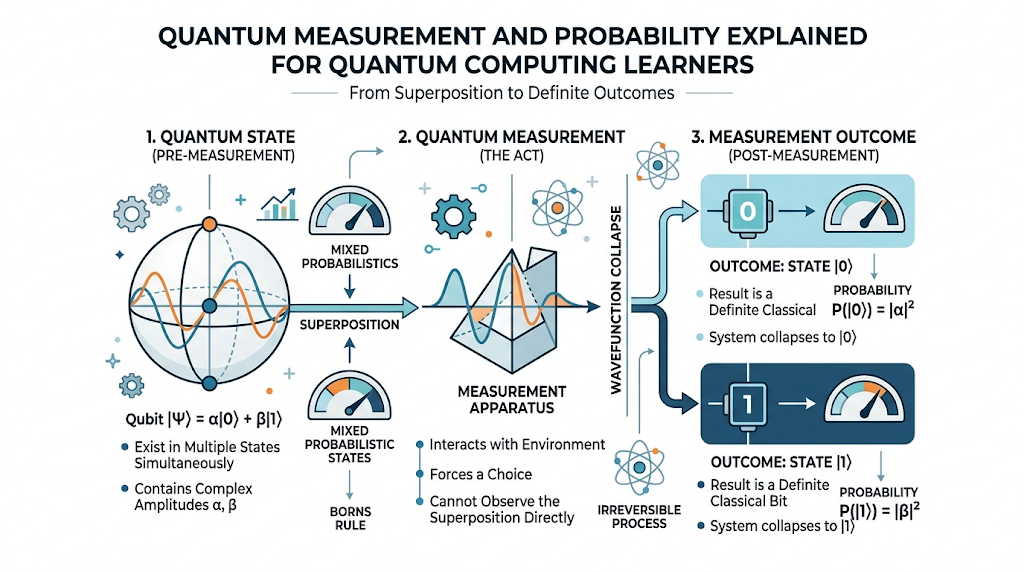
Quantum measurement is one of the most important ideas in quantum computing because it connects the strange world of quantum states with the real answers we can actually observe. A classical computer works with bits that are either 0 or 1. A quantum computer works with qubits, which can exist in a combination of possible states before measurement. But when we measure a qubit, we do not always get a fixed answer. Instead, the result depends on probability. This is why probability is not just a side topic in quantum computing. It is part of how quantum systems behave. In simple words, quantum measurement is the process of observing a quantum state and getting a classical result, such as 0 or 1. QuantumOpsSchool.com is an educational learning resource that helps learners build strong foundations in quantum computing concepts, including qubits, gates, circuits, probability, and measurement. You can explore more learning resources at QuantumOpsSchool.com.
3. What Is Quantum Measurement?
Quantum measurement is the process of checking a quantum system to obtain a definite classical result.
For example, when we measure a qubit, the result is usually either:
- 0
- 1
Before measurement, the qubit may be in a superposition. This means it can hold a combination of 0 and 1 possibilities.
After measurement, the qubit gives one result based on probability.
Simple Definition
Quantum measurement is the act of observing a quantum state and converting it into a definite classical outcome.
Why Measurement Matters
Measurement matters because quantum computers cannot directly show us superposition. They must finally return classical results that humans and classical computers can read.
Quantum circuits may use superposition, interference, and entanglement internally. But at the end, measurement is needed to extract the answer.
Without measurement, quantum information would remain hidden inside the quantum system.
Relationship Between Qubits and Measurement
A qubit is the basic unit of quantum information.
A classical bit has one fixed value:
- 0
- or 1
A qubit can exist in a combination of both before measurement:
- partly 0
- partly 1
When measured, the qubit gives one result.
The probability of getting 0 or 1 depends on the qubit’s quantum state before measurement.
Everyday Analogy
Imagine spinning a coin.
While the coin is spinning, it is not clearly heads or tails from your viewpoint. It has possible outcomes.
When the coin lands, you see one result: heads or tails.
A qubit is not exactly like a spinning coin, but this analogy helps beginners understand the idea of possible outcomes before observation.
The key difference is that quantum probability is not only due to lack of knowledge. It is built into the nature of quantum systems.
4. Understanding Quantum Probability
Quantum probability explains how likely each measurement outcome is when we observe a quantum system.
In classical life, probability often means uncertainty because we do not know enough information. In quantum computing, probability is deeper. Even if we know the complete quantum state, the measurement result may still be probabilistic.
Probability in Classical Computing
Classical computing is mostly deterministic.
If a bit is 0, reading it gives 0.
If a bit is 1, reading it gives 1.
For example:
Classical bit before reading: 0
Classical bit after reading:  0
There is no surprise. The value already exists.
Classical probability is usually used when there is incomplete information.
For example:
- We do not know which card is on top of a shuffled deck.
- We do not know whether it will rain.
- We do not know which number a dice will show.
The result exists or will happen based on physical conditions, but we may not know it in advance.
Probability in Quantum Computing
In quantum computing, probability is part of the system itself.
A qubit can be prepared so that measurement gives:
- 0 with some probability
- 1 with some probability
For example:
Qubit before measurement: possible 0 and possible 1
Measurement result: either 0 or 1
If a qubit has a 70% chance of giving 0 and a 30% chance of giving 1, one measurement gives only one answer.
To understand the full behavior, we often run the same quantum circuit many times.
Probability Amplitudes
Quantum states are described using probability amplitudes.
A probability amplitude is not the same as ordinary probability. It is a quantum value used to calculate the probability of each measurement result.
For beginners, you can think of amplitude as a hidden strength behind each possible outcome.
The probability is found from the amplitude.
In simple terms:
Quantum state → probability amplitudes → measurement probabilities → final resultProbability amplitudes are important because they allow quantum interference. This is one reason quantum algorithms can be powerful.
Measurement Outcomes
When we measure a qubit, we get a classical result.
For a single qubit, the most common outcomes are:
- 0
- 1
For multiple qubits, outcomes may be bit strings such as:
- 00
- 01
- 10
- 11
Each possible result has a probability.
For example, a two-qubit system may produce:
| Outcome | Probability |
|---|---|
| 00 | 50% |
| 01 | 25% |
| 10 | 15% |
| 11 | 10% |
After running the circuit many times, the results begin to show the probability pattern.
State Collapse
State collapse means that after measurement, the quantum state becomes the result that was observed.
Before measurement, a qubit may be in superposition.
After measurement, it becomes a definite state such as 0 or 1.
Example:
Before measurement: 0 and 1 possibilities
Measurement result: 1
After measurement:  state becomes 1
This is why measurement is powerful but also delicate. It gives information, but it also changes the quantum state.
5. How Quantum Measurement Works
Quantum measurement can be understood in stages.
These stages help beginners see what happens from preparing a qubit to getting a final answer.
Preparing a Quantum State
First, a quantum computer prepares a qubit.
A qubit may start in a simple state such as 0.
Initial qubit state: |0>This means the qubit is prepared in the 0 state.
Quantum gates can then change the qubit state.
For example, a Hadamard gate can place a qubit into superposition.
Superposition Before Measurement
Superposition means a qubit can hold a combination of possible states.
A simple superposition may give equal chance of 0 and 1.
Before measurement:
50% chance of 0
50% chance of 1
This does not mean the qubit is secretly 0 or secretly 1.
It means the quantum state contains both possibilities until measurement.
Measuring a Qubit
When we measure the qubit, the quantum computer returns one classical answer.
Example:
Run 1: result = 0
Run 2: result = 1
Run 3: result = 0
Run 4: result = 1
If the qubit was prepared with equal probability, many repeated runs may show results close to 50% 0 and 50% 1.
One measurement does not reveal the full probability distribution. Many measurements help us estimate it.
Collapse of the Quantum State
After measurement, the qubit collapses into the observed state.
If the result is 0, the qubit becomes 0.
If the result is 1, the qubit becomes 1.
Text-based diagram:
Quantum State Before Measurement
        |
        |  Measurement
        v
Classical Result: 0 or 1
        |
        v
State Collapses to Observed Result
This is why measurement is usually done at the end of a quantum circuit.
If we measure too early, we may destroy useful quantum behavior.
Repeating Measurements
Quantum computing often depends on repeated circuit runs.
A single run gives one result. Multiple runs show the probability pattern.
For example:
Circuit repeated 1000 times

Result 0: 498 times
Result 1: 502 times
This tells us that the qubit was likely close to an equal superposition.
Quantum algorithms are designed so that the correct or useful answer appears with high probability after measurement.
6. QuantumOpsSchool.com Guide to Understanding Quantum Measurement
Quantum measurement becomes easier when learners build the topic step by step. QuantumOpsSchool.com focuses on helping beginners understand the core behavior of qubits before moving into advanced quantum algorithms.
Learning Qubit Behavior
The first step is to understand how qubits differ from classical bits.
A beginner should learn:
- What a qubit is
- How a qubit stores quantum information
- How superposition works
- Why measurement returns classical output
Once qubit behavior is clear, quantum measurement feels less confusing.
Visualizing Probability Concepts
Probability in quantum computing becomes easier when learners use simple visual models.
For example, a learner can imagine a probability bar:
Outcome 0: ██████████ 50%
Outcome 1: ██████████ 50%
Or a biased quantum state:
Outcome 0: ████████████████ 80%
Outcome 1: ████ 20%
Visual learning helps beginners connect abstract quantum states with measurable outcomes.
Understanding State Collapse
State collapse is one of the most misunderstood topics in quantum mechanics for beginners.
A simple way to understand it is:
Before measurement: many possible outcomes
After measurement: one observed outcome
The quantum state changes because measurement interacts with the system.
This does not mean quantum computing is magic. It means quantum systems follow rules that are different from classical systems.
Practicing with Quantum Simulators
Quantum simulators are useful for learning measurement.
With a simulator, learners can:
- Prepare qubits
- Apply quantum gates
- Measure outcomes
- Repeat circuits many times
- Compare result probabilities
This practical approach helps students move from theory to experience.
Building Strong Quantum Foundations
Measurement and probability are foundation topics.
They support many advanced areas, including:
- Quantum algorithms
- Quantum cryptography
- Quantum error correction
- Quantum machine learning
- Quantum simulation
A learner who understands measurement clearly will find advanced quantum topics much easier.
7. Real-World Examples
Quantum measurement and probability are not only classroom concepts. They are used in real quantum technologies and research areas.
Quantum Random Number Generation
Quantum systems can produce true randomness because measurement outcomes can be intrinsically probabilistic.
A quantum random number generator may prepare a qubit in equal superposition and measure it.
Example:
Result 0 → random bit 0
Result 1 → random bit 1
Because the outcome is quantum-based, it can produce high-quality randomness for security and scientific use.
Secure Communication
Quantum measurement plays an important role in secure communication.
In quantum communication, measuring a quantum state can disturb it. This property can help detect unwanted observation.
If an attacker tries to measure certain quantum signals, the state may change, revealing possible interference.
Quantum Cryptography
Quantum cryptography uses quantum states and measurement rules to support secure key exchange.
The basic idea is that quantum information cannot always be copied or measured without disturbance.
This makes measurement a useful part of security design.
Scientific Simulation
Quantum systems are difficult for classical computers to simulate fully.
Quantum computers may help model molecules, materials, and physical systems.
Measurement is used to extract useful information from these simulations, such as energy levels or state behavior.
Quantum Algorithms
Quantum algorithms use probability carefully.
They do not simply guess answers. They shape probabilities so that useful answers become more likely.
For example, a quantum algorithm may use interference to reduce the probability of wrong answers and increase the probability of correct ones.
At the end, measurement gives the final output.
Optimization Problems
Optimization means finding the best solution among many possibilities.
Quantum approaches may explore solution spaces in new ways. Measurement helps identify likely good solutions after the quantum process runs.
The result may not always be perfect in one run, so repeated measurements help find strong candidate answers.
8. Classical Probability vs Quantum Probability
Classical probability and quantum probability may look similar from a beginner’s point of view, but they are not the same.
Classical probability often comes from missing information.
Quantum probability is built into the behavior of quantum systems.
| Feature | Classical Probability | Quantum Probability |
| Information Unit | Bit | Qubit |
| State Before Observation | Fixed | Superposition |
| Measurement | Reveals existing state | Produces a probabilistic outcome |
| Uncertainty | Based on incomplete information | Intrinsic to quantum systems |
| Repeated Results | Generally deterministic | Probability-driven outcomes |
Simple Explanation
In classical computing, reading a bit usually tells you what was already there.
In quantum computing, measuring a qubit produces an outcome based on the quantum state.
This difference is one of the main reasons quantum computing requires a new way of thinking.
9. Common Misconceptions
Beginners often face confusion when learning quantum measurement. These misconceptions are normal and can be corrected with clear explanations.
Measurement Reveals Every Hidden Quantum State
A common mistake is thinking that measurement simply reveals a hidden value.
In quantum computing, measurement does not always reveal something that was already fixed. It produces an outcome based on the quantum state and measurement probabilities.
The full quantum state cannot always be fully known from one measurement.
Quantum Probability Is Random Guessing
Quantum probability is not random guessing.
Quantum systems follow mathematical rules. The result may be probabilistic, but the probabilities are calculated from the quantum state.
Quantum algorithms use these rules carefully to guide outcomes.
Every Measurement Gives the Same Result
Not every measurement gives the same result.
If a qubit is in superposition, repeated measurements may produce different outcomes.
This is why quantum circuits are often run many times to collect meaningful results.
Probability Replaces Physics
Probability does not replace physics.
Quantum probability is part of quantum physics. It helps describe how quantum systems behave during measurement.
The results may look random, but they follow structured quantum rules.
Quantum Measurement Is Impossible to Understand
Quantum measurement can feel difficult at first, but beginners can understand it with the right approach.
Start with qubits, superposition, probability, and simple circuits.
Avoid jumping too quickly into advanced mathematics before the basic ideas are clear.
10. Benefits of Understanding Quantum Measurement
Learning quantum measurement gives beginners a strong advantage when studying quantum computing.
Better Understanding of Quantum Algorithms
Quantum algorithms depend on measurement.
Algorithms are designed to increase the probability of useful answers. Without understanding measurement, it is hard to understand why quantum algorithms work.
Easier Learning of Quantum Programming
Quantum programming involves building circuits, applying gates, and measuring qubits.
If you understand measurement, you can better interpret circuit outputs and simulator results.
Stronger Foundation for Quantum Computing
Measurement connects theory with real output.
It helps learners understand how quantum states become usable information.
Improved Conceptual Thinking
Quantum computing requires a different mindset from classical computing.
Understanding probability and measurement helps learners think in terms of possibilities, amplitudes, outcomes, and repeated experiments.
Preparation for Advanced Quantum Topics
Many advanced topics depend on measurement, including:
- Quantum error correction
- Quantum cryptography
- Quantum teleportation
- Quantum machine learning
- Quantum information theory
A strong foundation makes these topics easier to approach.
11. Challenges for Beginners
Quantum measurement can be challenging because it does not match everyday experience.
Understanding Superposition
Superposition is often the first difficult concept.
Beginners may think a qubit is simply both 0 and 1 like a normal mixture. But quantum superposition has special behavior that allows interference.
This makes it different from ordinary uncertainty.
Accepting Probabilistic Outcomes
In classical programming, beginners expect fixed outputs.
Quantum computing often gives probability-based results.
This can feel strange at first, but repeated practice with circuits makes it easier.
Visualizing Invisible Quantum States
Quantum states cannot be directly seen like physical objects.
Learners must use diagrams, probability charts, circuit models, and simulator results to understand them.
Distinguishing Classical and Quantum Thinking
Classical thinking says information is usually fixed.
Quantum thinking says information can exist in a state of possibility until measurement.
This shift is important for learning quantum computing properly.
12. Best Practices for Learning
Beginners can learn quantum measurement more effectively by following a structured path.
- Learn classical probability first
- Study qubits before algorithms
- Practice using quantum simulators
- Focus on concepts before mathematics
- Reinforce learning with visual examples and simple experiments
Practical Learning Path
A good beginner path looks like this:
Classical bits
      ↓
Qubits
      ↓
Superposition
      ↓
Quantum gates
      ↓
Measurement
      ↓
Probability results
      ↓
Simple quantum circuits
      ↓
Beginner quantum algorithms
Do not rush directly into complex algorithms.
Quantum measurement becomes much clearer when the learner first understands how a single qubit behaves.
13. Career Opportunities
Quantum computing is an emerging field with opportunities for learners from computer science, physics, mathematics, engineering, and software development backgrounds.
Understanding quantum measurement and probability helps prepare for roles such as:
Quantum Computing Engineer
A quantum computing engineer works with quantum hardware, circuits, systems, and tools. Measurement knowledge is important because hardware outputs are probability-based.
Quantum Software Developer
A quantum software developer writes quantum programs using quantum SDKs and simulators. They must understand how circuit measurement results are collected and interpreted.
Quantum Information Scientist
A quantum information scientist studies how quantum systems store, process, and transmit information. Measurement is a core part of quantum information theory.
Quantum Research Engineer
A quantum research engineer supports experiments, simulations, algorithms, and applied quantum research. Probability and measurement concepts are used regularly.
Quantum Algorithm Specialist
A quantum algorithm specialist designs or studies algorithms that use quantum behavior to solve computational problems. These algorithms depend heavily on probability, interference, and measurement.
14. Future of Quantum Measurement
Quantum measurement will continue to play an important role as quantum technology improves.
Fault-Tolerant Quantum Systems
Fault-tolerant quantum systems are designed to work reliably even when errors occur.
Measurement helps detect errors and support correction methods.
Quantum Error Correction
Quantum error correction uses measurement carefully to identify errors without destroying the main quantum information.
This is one of the most important areas in building reliable quantum computers.
Advanced Quantum Sensors
Quantum sensors use measurement to detect very small changes in physical systems.
These sensors may support applications in navigation, medicine, material science, and environmental monitoring.
Hybrid Quantum-Classical Computing
Many quantum applications use both quantum and classical computing.
A quantum processor may prepare and measure states, while a classical computer analyzes the results and decides the next steps.
Measurement acts as the bridge between the quantum and classical parts.
Enterprise Quantum Applications
Businesses exploring quantum computing need people who understand how quantum results work.
Since quantum outputs are often probabilistic, teams must know how to interpret measurements, validate results, and compare outcomes with classical methods.
15. FAQ Section
- What is quantum measurement in simple words?
Quantum measurement is the process of observing a quantum state and getting a definite result, usually 0 or 1 for a qubit. Before measurement, the qubit may have multiple possible outcomes. After measurement, only one result is seen. - Why is probability important in quantum computing?
Probability is important because quantum systems do not always produce fixed results. A qubit can give different outcomes depending on its state. Quantum algorithms use probability to make useful answers more likely. - What happens to a qubit after measurement?
After measurement, the qubit collapses into the result that was observed. If the result is 0, the qubit becomes 0. If the result is 1, the qubit becomes 1. - Is quantum measurement the same as reading a classical bit?
No. Reading a classical bit usually reveals a fixed value. Measuring a qubit produces a result based on quantum probability, especially when the qubit is in superposition. - What is state collapse?
State collapse means a quantum state changes into one definite outcome after measurement. Before measurement, several outcomes may be possible. After measurement, only the observed result remains. - Can we predict the exact result of quantum measurement?
In many cases, we cannot predict the exact single result. However, we can calculate the probability of each possible result and estimate outcomes by repeating the experiment many times. - Why do quantum circuits need repeated runs?
A single run gives only one measurement result. Repeated runs help show the probability distribution of outcomes. This allows learners and researchers to understand the behavior of the quantum circuit. - What is the difference between quantum probability and classical probability?
Classical probability often comes from missing information. Quantum probability is built into the nature of quantum systems. Even with complete knowledge of a quantum state, outcomes can still be probabilistic. - Is quantum probability just randomness?
No. Quantum probability follows clear rules. The result may be uncertain, but the probabilities are calculated from the quantum state. Quantum computing uses this structure to solve problems. - Should beginners learn measurement before quantum algorithms?
Yes. Measurement is essential for understanding quantum algorithms. Algorithms prepare quantum states, change probabilities, and finally use measurement to produce useful results.
16. Final Summary
Quantum measurement and probability are foundation concepts in quantum computing. A qubit can exist in a superposition before measurement. When measured, it gives a classical result such as 0 or 1. The result is not always fixed in advance. It is guided by quantum probability. This makes quantum computing different from classical computing. Classical computers usually work with definite bits. Quantum computers work with qubits, probability amplitudes, superposition, interference, and measurement outcomes.