Introduction
Computers have shaped the modern world, driving everything from global financial networks to the smartphones in our pockets. Yet, as our data needs grow exponentially, traditional computers are beginning to hit physical limits. This baseline bottleneck has sparked massive global interest in quantum computing, a revolutionary paradigm that processes information using entirely new physical concepts. Every piece of software, video game, or data file relies on fundamental units of data. By examining the structural contrast between traditional data units and their quantum counterparts, we can see exactly why this new frontier is so groundbreaking. In this beginner guide, we will break down the essential concepts of Quantum Bits vs Classical Bits. We will explore how traditional computers use binary states, how quantum systems leverage complex phenomena like superposition and entanglement, and what this means for the future of technology. If you are looking for structured learning paths to break into this exciting field, explore the comprehensive resources available at QuantumOpsSchool.com.
What Are Classical Bits?
A classical bit is the fundamental building block of traditional computing. Every email you send, video you stream, and application you run is ultimately broken down into millions of these tiny units of information.
The word “bit” stands for binary digit. It operates on a strict binary representation, meaning it can only exist in one of two distinct physical states at any given moment. These states are numerically represented as:
- 0 (off, low voltage, or false)
- 1 (on, high voltage, or true)
Traditional computers use bits by passing electrical currents through tiny switches called transistors. If the current flows, the state is a 1. If it stops, the state is a 0. By combining billions of these switches on a single microchip, modern processors perform sequential calculations to run complex software.
For example, when you press a key on your keyboard, your computer does not see a letter. It sees an 8-bit string of 0s and 1s, known as a byte. The letter “A”, for instance, is translated into the binary sequence 01000001. This deterministic system is highly reliable, predictable, and excellent for everyday tasks like web browsing, database management, and running office applications.
What Are Quantum Bits (Qubits)?
A quantum bit, or qubit, is the basic unit of quantum information. Unlike a classical bit that relies on macroscopic electrical currents, a qubit is built using subatomic particles, such as electrons or photons, controlled by advanced quantum technology. Because qubits operate under the laws of quantum mechanics, they use a highly advanced quantum representation. A qubit does not have to choose between being a 0 or a 1. Instead, it can exist in a state that combines both possibilities simultaneously until it is actively measured. This capacity to hold multiple potential values at once changes how we process information. Instead of analyzing data one line at a time, a quantum computer manipulates these fluid quantum states to evaluate massive numbers of possibilities all at once.
Quantum Bits vs Classical Bits: Quick Comparison
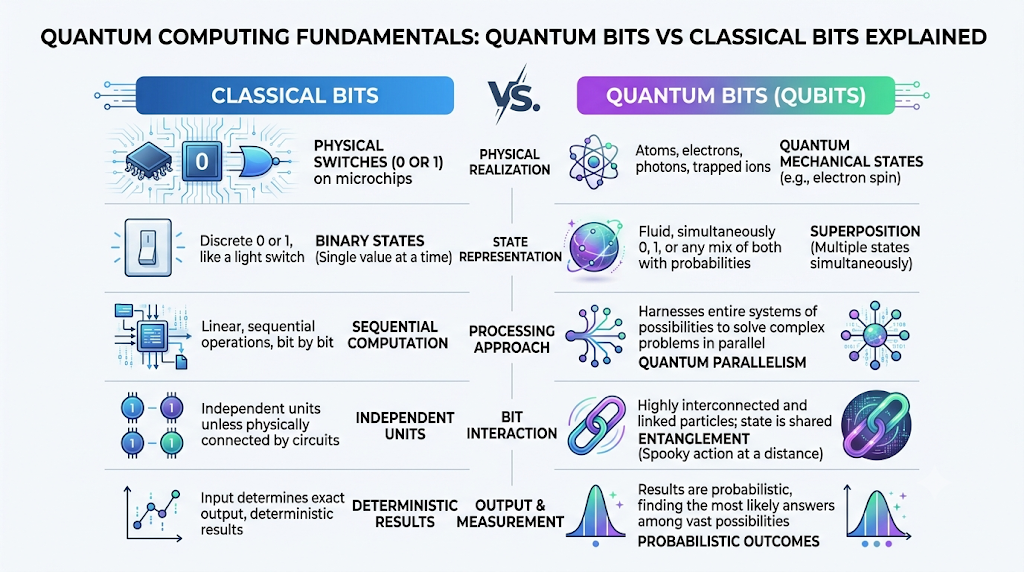
To help visualize how these two computational units stack up against each other, let’s look at a direct, side-by-side comparison across their primary functional traits.
| Feature | Classical Bits | Quantum Bits (Qubits) |
| State Representation | Strict binary (Either 0 or 1) | Fluid superposition (0, 1, or any blend of both) |
| Processing Capability | Linear, sequential processing | Exponential, simultaneous processing |
| Storage Approach | Holds a single data value per bit combination | Holds a vast web of potential values at the same time |
| Computation Model | Deterministic (predictable, fixed paths) | Probability-based (weights multiple options at once) |
| Scalability | Scale linearly by adding more transistors | Scales exponentially ($2^n$ states for $n$ qubits) |
| Real-World Applications | Word processing, web browsing, standard databases | Molecular modeling, encryption, advanced optimization |
Core Differences Between Quantum Bits and Classical Bits
Understanding Quantum Bits vs Classical Bits requires exploring the architectural differences that separate these two technologies. Let’s look closer at the specific mechanisms that give quantum computing its unique edge.
Binary States vs Superposition
As we have established, classical bits are locked into binary states. They are like a light switch that must be either completely flipped up (1) or completely flipped down (0).
Qubits, however, take advantage of superposition. Think of a spinning coin. While it is spinning on a table, it isn’t strictly heads or tails; it is a fluid blur of both possibilities at once. Only when you catch the coin and slap it flat on the table does it collapse into a definite heads or tails. Qubits compute while the coin is spinning, allowing them to manage vastly more data throughout the calculation process.
Deterministic Processing vs Probability-Based Processing
Classical systems use deterministic processing. If you feed a classical computer the exact same input through the same logic gates, you will get the exact same output every single time. It follows a rigid, unyielding line of logic.
Quantum computing operates on a system of probability-based processing. Because qubits exist in a fluid state, a quantum algorithm does not look for a single, straight path. Instead, it adjusts the mathematical probabilities of different outcomes. As the calculation runs, the wrong answers cancel each other out, while the correct answers amplify, guiding the system toward the most accurate solution.
Independent Bits vs Entangled Qubits
In a traditional computer chip, classical bits are entirely independent. Changing the state of a transistor on one side of a processor has zero physical effect on a transistor located elsewhere on the chip.
Qubits can undergo a phenomenon known as entanglement. When qubits become entangled, they form an unbreakable, interconnected link. If you change the state of one entangled qubit, its partner reacts instantly, no matter how far apart they are. This unified connection allows qubits to share information across a system instantly, massively accelerating computational speeds.
Sequential Computation vs Parallel Quantum Possibilities
A standard computer handles complex tasks through sequential computation. If it needs to find a path out of a maze, it tries the first path, hits a dead end, backs up, and tries the second path. It works quickly, but it is still working one step at a time.
A quantum system utilizes parallel quantum possibilities. By putting its qubits into superposition and entangling them, the system tests every single path through the maze at the exact same time. It evaluates the entire problem space in one unified step, rendering it incredibly efficient at scanning vast sets of possibilities.
Traditional Logic vs Quantum Logic
Classical computers rely on traditional logic gates like AND, OR, NOT, and XOR. These gates take in standard bits, apply fixed rules, and spit out a definitive 0 or 1.
Quantum logic relies on specialized quantum gates that physically manipulate the probabilities, phases, and alignments of qubits. These gates can rotate quantum states, create superposition, and link qubits together through entanglement. This allows for a completely different language of programming that classical hardware simply cannot replicate.
Understanding Superposition
Superposition is the foundational pillar of quantum computing basics. Without it, a quantum computer would function exactly like a traditional machine.
To understand how it differs from binary states, consider a dimmer switch on a wall. A standard bit can only turn the lights completely off or completely on. A qubit in superposition can be set to any precise brightness level between those two extremes, holding a complex mix of both properties at once.
Let’s use a real-world map analogy. If you are trying to find a hidden treasure in a massive forest, a classical bit can only look at one coordinate at a time. It checks the first spot, then the second, then the third. A qubit in superposition allows you to look at every single coordinate on the map simultaneously.
This has an unbelievable impact on computing power. Every time you add a classical bit to a computer, its processing power grows by a predictable, steady amount (+1). But every time you add a qubit to a quantum system, its capacity to hold information doubles.
With just 300 perfectly stable qubits, a quantum computer could hold more simultaneous values than there are atoms in the observable universe.
Understanding Entanglement
Albert Einstein famously referred to quantum entanglement as “spooky action at a distance” because it challenged traditional views of physics. Today, it serves as a core engine driving quantum information science.
Entanglement is unique because it creates a deeply unified system out of separate components. Imagine buying a pair of shoes, separating them into two identical boxes, and giving one box to a friend who travels to the opposite side of the world. The moment you open your box and see a left shoe, you instantly know your friend has the right shoe, even though you are miles apart.
In quantum systems, this connection is active and dynamic. The qubits do not have set identities until they are checked. Changing the state of qubit “A” instantly alters the behavior of qubit “B”.
This shared relationship is incredibly important for scalability. It allows a quantum computer to orchestrate massive networks of qubits that work in perfect harmony. This collective processing capability is what allows quantum computers to crack incredibly dense data problems that paralyze traditional microchips.
How Quantum Computing Uses Qubits
Now that we understand how individual qubits behave, let’s look at how a quantum computer coordinates them to do meaningful work.
Quantum systems organize qubits into structures called quantum circuits. While these sound similar to classical circuits, they are built to preserve and manipulate delicate quantum states rather than handling raw electrical currents.
Instead of traditional copper pathways, these circuits use quantum gates. These gates do not alter physical voltages. Instead, they use precise pulses of lasers or microwaves to rotate a qubit’s state, put it into superposition, or entangle it with another particle.
[ Input Qubits ] ---> [ Quantum Gates (Superposition) ] ---> [ Entanglement Stage ] ---> [ Measurement ]
When a quantum algorithm runs, information processing occurs through the controlled interference of these quantum waves. Think of it like ripples in a pond. When waves hit each other correctly, they can grow taller (constructive interference) or flatten each other out (destructive interference).
Quantum algorithms are designed so that the paths leading to incorrect answers experience destructive interference and vanish. Meanwhile, the paths leading to the correct answers experience constructive interference, highlighting the solution clearly when the final measurement is taken.
Advantages of Quantum Bits
The unique physical properties of qubits offer massive advantages over traditional silicon chips. Here are the core areas where quantum systems truly shine:
- Increased Computational Potential: Because processing power scales exponentially with each added qubit, these machines can handle data loads that are mathematically impossible for classical architectures to manage.
- Optimization Capabilities: Whether it is finding the most efficient delivery routes for a global logistics network or balancing a volatile financial portfolio, qubits can scan millions of combinations instantly to pinpoint the ideal option.
- Scientific Simulations: Traditional computers struggle to simulate individual molecules because the atomic interactions are too complex. Qubits can mimic quantum mechanics naturally, allowing scientists to simulate molecular behavior with perfect precision.
- Complex Problem Solving: From analyzing deep climate change variables to processing massive streams of astrophysical data, quantum computing handles multi-variable problems effortlessly.
- Advanced Cryptography: Qubits can quickly factor massive prime numbers, which forms the basis of modern data encryption. This capability is driving the development of next-generation, unhackable quantum communication networks.
Limitations and Challenges of Qubits
While the potential of quantum technology is incredible, building and maintaining these systems is one of the toughest engineering challenges in human history. Qubits are highly sensitive and face several major hurdles:
- Noise: Qubits are highly vulnerable to environmental interference. Minor temperature shifts, stray electromagnetic waves, or even tiny physical vibrations can disrupt a calculation completely.
- Decoherence: This occurs when a qubit loses its delicate quantum state and slips back into a standard classical bit. Currently, qubits can only sustain superposition for fractions of a second before decohering.
- Error Rates: Because qubits are so unstable, their calculation error rates are significantly higher than classical transistors. Researchers must use massive numbers of “physical” qubits just to correct the errors of a single “logical” qubit.
- Hardware Complexity: To keep qubits stable, most quantum computers must be housed in specialized dilution refrigerators that cool the system to near absolute zero—colder than deep space.
- Scalability Challenges: Engineering a system that keeps thousands of qubits entangled and error-free simultaneously requires unprecedented manufacturing precision.
Real-World Applications of Quantum Computing
Quantum computing is transitioning from theoretical physics labs into practical, industry-shaping tools. Here is where quantum information will make the biggest real-world impacts:
Drug Discovery
Developing a new medication currently takes over a decade of trial-and-error laboratory testing. Quantum computers can simulate molecular interactions at an atomic level, allowing researchers to discover life-saving medications and vaccines in days rather than years.
Financial Modeling
Global markets generate massive amounts of chaotic data. Quantum algorithms can analyze complex risk profiles, optimize high-frequency trading paths, and detect fraudulent activity much faster and more accurately than current banking software.
Logistics Optimization
Managing international shipping lanes, fleet distribution, and supply chains involves balancing millions of shifting variables. Qubits can instantly process these patterns to reduce fuel consumption, eliminate transit delays, and optimize global delivery networks.
Artificial Intelligence
AI models require massive amounts of data processing and complex pattern recognition. Quantum computing can train machine learning algorithms much faster, leading to more responsive, accurate, and capable AI systems.
Materials Science
By modeling atomic structures accurately, quantum systems can help engineers design completely new materials. This includes creating lighter, stronger metals for aerospace, ultra-low-loss power grids, and hyper-efficient solar panels.
Common Misconceptions About Quantum Bits
Because quantum technology is frequently featured in science fiction, several myths have caused some beginner confusion. Let’s clarify the reality behind these common misconceptions.
The Myth: Quantum computers will completely replace standard laptops and smartphones.
The Reality: Quantum computers are not designed for everyday tasks. They will not make your web browsing faster or improve your gaming performance. Classical computers will always be better for word processing, streaming, and running everyday apps. Quantum systems will be accessed via the cloud to solve highly specific, hyper-complex math challenges.
The Myth: Qubits are simply faster classical bits.
The Reality: Qubits do not just run classical code at higher speeds. They use entirely different logic and physical principles. A quantum computer solves problems using a completely unique approach that classical hardware cannot execute, regardless of how fast it runs.
The Myth: Quantum computers are completely ready for global enterprise deployment today.
The Reality: We are currently in the NISQ era (Noisy Intermediate-Scale Quantum). While today’s quantum processors are impressive achievements, they still require significant error correction and structural scaling before they can handle massive corporate applications without interruption.
Future of Quantum Computing
The horizon for quantum technology is incredibly bright. Over the next decade, we will see major advancements in qubit design, transitioning from fragile physical components to highly stable, error-corrected systems.
As these systems mature, quantum infrastructure growth will accelerate globally. We will see cloud-based quantum computing services become a standard part of corporate technology stacks, letting developers run quantum algorithms directly from their standard workstations.
Enterprise adoption will likely explode across fields like pharmaceuticals, aerospace, and global finance. Organizations that prepare for this shift today will have a massive competitive advantage, driving continuous research developments that will redefine what is technologically possible.
Career Opportunities in Quantum Technologies
The rapid expansion of this industry has created a surge in demand for qualified talent. Computer science learners and quantum computing aspirants can explore several rewarding career paths:
- Quantum Engineer: Focuses on designing, building, and maintaining the physical hardware, cryogenic cooling units, and control systems that keep qubits stable.
- Quantum Software Developer: Writes quantum algorithms, builds cloud-integrated platforms, and translates complex business problems into functional quantum circuits.
- Quantum Research Scientist: Investigates new quantum states, explores novel materials for qubit creation, and advances the core mathematics of quantum information science.
- Quantum Systems Analyst: Bridges the gap between business and technology, helping companies figure out how to integrate quantum computing solutions into their existing workflows.
- Quantum Operations Specialist: Manages deployment strategies, handles infrastructure logistics, and ensures quantum systems interface smoothly with classical cloud environments.
Best Practices for Learning Quantum Computing
If you are a beginner looking to break into this field, trying to digest everything at once can feel overwhelming. Here is a step-by-step roadmap to guide your learning path smoothly:
- Start with Computing Fundamentals: Make sure you have a solid grasp of basic classical computing concepts, binary notation, and linear algebra before diving into quantum topics.
- Learn Qubit Concepts Gradually: Focus heavily on conceptual understanding. Master superposition and entanglement thoroughly before worrying about complex mathematics or algorithms.
- Study Quantum Circuits: Learn how quantum gates operate visually by studying simple circuit diagrams to see how data flows through a quantum system.
- Practice with Simulators: You don’t need access to a multi-million dollar quantum computer to start coding. Use open-source development kits to run your programs on classical simulators.
- Follow Structured Learning Paths: Avoid fragmented tutorials. Use comprehensive, organized training programs like those at QuantumOpsSchool.com to build clean, professional skills from the ground up.
FAQ Section
- What is the main difference between a qubit and a classical bit?
A classical bit can only exist in one of two definite states (0 or 1) at any given moment. A qubit can exist in a state of superposition, meaning it can represent a 0, a 1, or any combined blend of both states simultaneously.
- Do quantum computers use binary code?
No, quantum computers do not use traditional binary code. While they can read binary inputs and output binary answers after a measurement is taken, they process information internally using fluid quantum states and probabilities.
- Why do qubits need to be kept so cold?
Qubits are incredibly sensitive to environmental noise, heat, and electromagnetic interference. Cooling the hardware to near absolute zero reduces atomic vibrations, helping the qubits maintain their delicate quantum states and avoid computation errors.
- Can I write software for a quantum computer today?
Yes, you can. There are several open-source software development frameworks that allow you to write quantum code using accessible programming languages like Python, which you can test directly on classical computer simulators.
- Is quantum computing going to make my personal computer obsolete?
Not at all. Quantum computers are specialized machines designed for massive, highly complex optimization and simulation problems. For standard tasks like playing videos, editing documents, or running standard software, classical computers are much more efficient.
- What is quantum decoherence?
Quantum decoherence is the process where a qubit loses its quantum properties (like superposition or entanglement) due to environmental disruption. When this happens, the qubit drops back into a standard, classical state, halting the quantum calculation.
- How does entanglement help a quantum computer compute faster?
Entanglement links qubits together dynamically. This connection allows the system to share information across qubits instantly, letting the computer process a massive network of interconnected possibilities all at once rather than evaluating them one by one.
- Do I need a PhD in physics to learn quantum computing?
No, you do not. While advanced research positions require deep academic backgrounds, there is a rapidly growing need for software developers, systems analysts, and operations specialists who understand the core concepts and know how to apply them practically.
- What industries will be impacted first by quantum technology?
Pharmaceuticals (drug discovery), finance (portfolio risk analysis), logistics (route optimization), and materials science (developing advanced clean energy materials) are poised to see the earliest breakthroughs.
- Where can a complete beginner go to learn these skills structurally?
Beginners should look for structured, comprehensive programs that explain concepts without burying students in dense math. Structured platforms like QuantumOpsSchool.com offer excellent, beginner-friendly resources to help you build a solid foundation.
Final Summary
When we look at Quantum Bits vs Classical Bits, we are looking at two completely different approaches to processing information. Classical bits are the reliable, binary workhorses that power our everyday digital world. Qubits are the fluid, probability-driven powerhouses designed to tackle the world’s most complex computational challenges by leveraging the strange laws of quantum mechanics. Understanding the difference between these two systems is the vital first step to navigating the next major evolution in technology. As quantum hardware scales and businesses integrate these systems into their tech stacks, the demand for professionals who understand quantum computing fundamentals will continue to grow exponentially.