Introduction
Modern software teams are expected to release applications faster while keeping infrastructure stable, systems observable, and security controls consistent. Cloud platforms, containers, automated pipelines, Infrastructure as Code, and distributed systems have changed the skills engineers need in their daily work. As technology environments become broader, organizations cannot always depend on informal learning or occasional tool demonstrations to develop these capabilities. This is where structured DevOps training can be useful. A capable DevOps Trainer can help learners understand not only individual technologies but also how development, infrastructure, security, and operations fit together. For organizations, training can provide a common foundation across teams and highlight areas where additional practical experience is needed. However, choosing a training program should involve more than looking at the number of technologies included in a syllabus.
What Does a DevOps Trainer Actually Do?
A DevOps Trainer is responsible for turning complex engineering concepts into understandable and practical learning experiences. The role can involve teaching CI/CD, cloud infrastructure, containers, Infrastructure as Code, automation, monitoring, source control, and production operations.
Good training normally combines several methods. An instructor may first explain a concept, demonstrate how it works, allow learners to complete a lab, and then introduce a troubleshooting scenario. This approach helps learners move from understanding an idea to applying it.
For example, instead of simply explaining CI/CD, a practical session might involve creating a pipeline, adding automated testing, deploying an application, checking the deployment, and investigating a failed stage.
The difference between theoretical and practical training becomes particularly clear when something goes wrong. Production-oriented learning should expose participants to configuration errors, failed builds, connectivity problems, deployment issues, or unexpected application behavior.
A trainer should also explain technical decisions rather than presenting a particular tool as the universal answer. Different teams have different architectures, budgets, security requirements, cloud platforms, and operational constraints.
Why DevOps Training Is Important for Engineering Teams
The technology landscape changes continuously. Organizations adopting cloud services often need new infrastructure and automation skills. Teams introducing Kubernetes may need container orchestration knowledge. Companies improving delivery processes may need stronger CI/CD capabilities.
These changes can create gaps even inside experienced engineering organizations.
A software developer may understand application architecture but have limited exposure to infrastructure automation. A system administrator may have strong operational experience but need more knowledge of containers and cloud-native delivery. A security engineer may understand security controls but need deeper insight into how those controls fit into development pipelines.
Structured learning can help bring these different perspectives together.
Training can also create consistency. When teams understand common concepts such as automated deployment, version-controlled infrastructure, observability, and security integration, collaboration can become easier.
That does not mean training replaces production experience. Real engineering work involves incidents, legacy systems, changing requirements, technical debt, and unexpected failures. Training provides a controlled environment where learners can build foundational knowledge and practice techniques before applying them to real systems.
Understanding Corporate DevOps Training
Corporate DevOps Training is different from a general course designed for individual learners because the focus is usually on a specific team’s requirements.
An organization may already use particular cloud platforms, CI/CD systems, container technologies, monitoring solutions, or Infrastructure as Code tools. Teaching an unrelated collection of products may create unnecessary complexity.
A customized program can instead focus on the company’s existing environment and areas that need improvement.
For example, one engineering team may need a workshop on CI/CD pipeline design, while another may need Kubernetes troubleshooting or infrastructure automation. A company beginning its cloud transformation may require foundational training before moving into advanced topics.
Corporate programs can include:
- Team workshops
- Instructor-led sessions
- Virtual classrooms
- Practical labs
- Assessments
- Architecture exercises
- Troubleshooting scenarios
- Internal use cases
- Knowledge-transfer sessions
The best curriculum is usually determined by learner experience, technology requirements, business objectives, and the team’s current maturity rather than by a fixed list of tools.
Learning With an Online DevOps Trainer
An Online DevOps Trainer can provide live instruction without requiring participants to be physically present in the same location. This can be useful for distributed teams and organizations with employees working from multiple cities or countries.
Online programs can use video sessions, screen sharing, demonstrations, remote lab environments, exercises, documentation, and recordings.
The flexibility is useful, but online delivery has its own challenges. A participant may become passive during long lectures, technical issues can interrupt sessions, and inadequate lab environments can reduce hands-on practice.
For this reason, effective online training should be interactive. Learners should have regular opportunities to perform tasks, ask questions, solve problems, and discuss technical decisions.
Online delivery should not simply reproduce a classroom lecture through a video call. The learning format should be designed around remote participation.
How to Evaluate a DevOps Trainer in India
When organizations or professionals search for a DevOps Trainer in India, technical knowledge should be only one part of the evaluation.
A trainer may know many tools but still struggle to teach them clearly. Conversely, someone with strong teaching skills but limited practical exposure may not be able to explain production problems effectively.
Consider the following areas:
Practical engineering experience: Look for familiarity with automation, cloud platforms, CI/CD, containers, infrastructure management, monitoring, and troubleshooting.
Teaching ability: Complex concepts should be explained in a way that matches the learner’s experience.
Hands-on methodology: Labs should require participants to perform meaningful tasks rather than simply watch demonstrations.
Technology relevance: The curriculum should reflect the technologies and practices relevant to the learners.
Problem-solving: Training should include failure scenarios and troubleshooting, not only successful deployments.
Communication: Clear explanations and useful responses to learner questions are essential.
Curriculum structure: Topics should build logically rather than appearing as an unrelated collection of tools.
A strong trainer understands that technical expertise and teaching expertise are related but different skills.
What Should a Kubernetes Trainer Teach?
Kubernetes training should move beyond memorizing commands. Learners need to understand how Kubernetes components work together and how containerized applications are operated.
A practical Kubernetes Trainer may cover:
- Cluster architecture
- Pods
- Deployments
- Services
- ConfigMaps
- Secrets
- Networking
- Storage
- Scaling
- Helm
- Monitoring
- Security
- Cluster administration
- Troubleshooting
- Production operations
Hands-on exercises can involve deploying an application, changing configuration, scaling workloads, inspecting resources, troubleshooting failed Pods, and investigating service connectivity.
Managed Kubernetes services can provide additional cloud context. These include AWS EKS, Azure AKS, and Google GKE.
The important point is not to teach every platform feature. Learners should understand the operational principles that allow them to work confidently with Kubernetes-based environments.
What an AWS DevOps Trainer Should Cover
An AWS DevOps Trainer should help learners understand how cloud services can support software delivery and infrastructure automation.
Relevant subjects can include:
- EC2
- EKS
- ECS
- Lambda
- Terraform
- CloudFormation
- CI/CD
- Monitoring
- Infrastructure automation
- Deployment strategies
The most useful learning connects these components into workflows.
For instance, learners could create an automated process that validates source changes, builds an application, provisions or updates infrastructure, deploys the workload, and checks its operational state.
AWS training should also explain that architecture decisions depend on workload requirements. Different applications may have different needs for compute, networking, storage, deployment methods, security, and operational management.
The goal should be understanding AWS-based DevOps practices rather than memorizing service descriptions.
What an Azure DevOps Trainer Should Cover
An Azure DevOps Trainer can help teams understand software delivery within Microsoft Azure environments.
Training may include Azure Pipelines, AKS, Azure infrastructure, Infrastructure as Code, release automation, monitoring, CI/CD, and production deployment workflows.
Practical exercises can demonstrate how source-code changes move through validation, build, testing, and deployment stages. Learners can also examine configuration management, deployment failures, monitoring, and rollback considerations.
Azure-focused training becomes more useful when learners understand the complete workflow rather than learning individual services independently.
As with other cloud platforms, there is no single architecture suitable for every organization. The training should help participants evaluate options based on technical requirements and operational constraints.
Why DevSecOps Training Matters
Security is increasingly expected to be part of the software delivery process rather than a final checkpoint.
A DevSecOps Trainer can introduce learners to practices such as:
- Secure CI/CD
- SAST
- DAST
- Dependency scanning
- Container security
- Secrets management
- Vulnerability management
- Security automation
- Compliance automation
A practical exercise could demonstrate how a vulnerable dependency is detected during a pipeline or how sensitive credentials can be handled without storing them directly in source code.
The purpose is not to add security tools simply for the sake of having more pipeline stages. Teams should understand why a control exists, what risk it addresses, and how it fits into the development workflow.
The appropriate security approach depends on the application, environment, organizational risk, and applicable requirements.
What SRE Training Should Teach
An SRE Trainer focuses on the engineering practices used to improve service reliability.
Important topics include:
- Service Level Indicators
- Service Level Objectives
- Service Level Agreements
- Error budgets
- Observability
- Incident management
- Root-cause analysis
- Capacity planning
- Performance engineering
- Reliability automation
SRE learning becomes more meaningful when participants work through realistic situations.
For example, an exercise could involve defining an SLO for a service, examining monitoring information during an incident, identifying possible causes, and deciding what actions should follow.
SRE is broader than monitoring. It introduces a way of thinking about reliability using measurable objectives, engineering practices, and operational feedback.
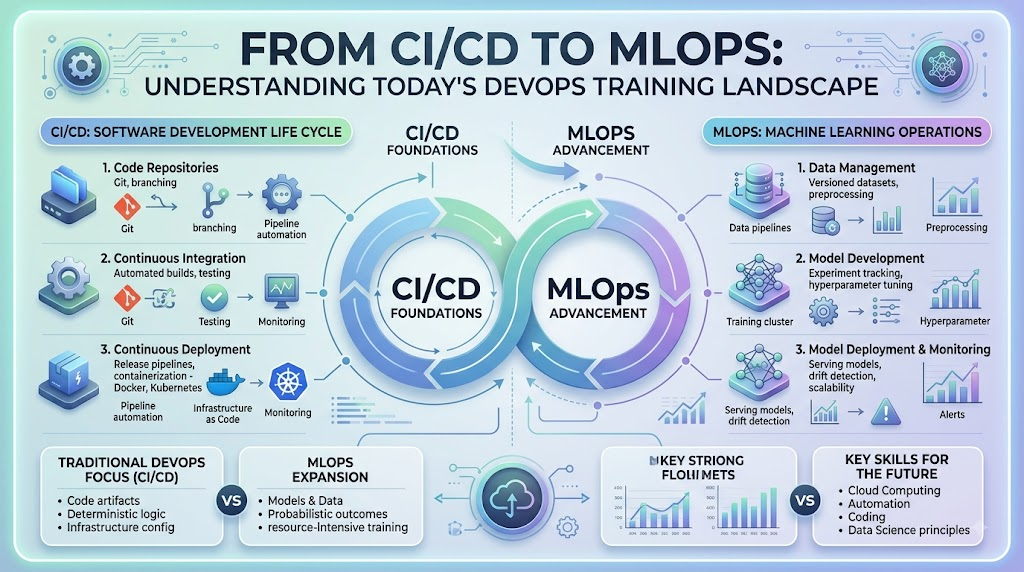
Why MLOps Training Is Becoming Relevant
Machine-learning applications introduce operational challenges that traditional application development may not fully address. Models need to be managed, deployed, monitored, versioned, and updated as part of a controlled production process.
An MLOps Trainer can cover:
- ML pipelines
- Model deployment
- Model monitoring
- Version management
- Automation
- ML infrastructure
- Cloud environments
- Production operations
- Scalability
The objective is to connect machine-learning development with reliable operational processes.
Different ML workloads require different approaches. Model type, data pipelines, infrastructure requirements, deployment patterns, monitoring needs, and organizational processes all influence the appropriate MLOps architecture.
Key Technology Areas in DevOps Training
| Training Area | Common Technologies / Practices | Main Learning Focus |
|---|---|---|
| CI/CD | Jenkins, GitHub Actions, GitLab CI/CD, Azure Pipelines | Automated software delivery |
| Cloud | AWS, Azure, Google Cloud | Cloud operations |
| Containers | Docker, Kubernetes | Containerized applications |
| Infrastructure as Code | Terraform, CloudFormation | Repeatable infrastructure |
| Security | SAST, DAST, secrets management | Secure delivery |
| Monitoring | Metrics, logs, traces | Observability |
| SRE | SLI, SLO, error budgets | Reliability engineering |
| MLOps | ML pipelines, model monitoring | Production machine learning |
These technologies are examples rather than a mandatory technology stack. Training should reflect actual learning objectives.
Benefits of Hands-On DevOps Training
Practical training gives learners an opportunity to apply concepts instead of only reading or listening about them.
Potential benefits include:
- Stronger understanding of DevOps workflows
- Better automation knowledge
- Greater cloud familiarity
- Improved CI/CD understanding
- Better troubleshooting practice
- Stronger Infrastructure as Code skills
- Greater security awareness
- Improved understanding of reliability
- Better collaboration between technical functions
Hands-on learning can also reveal gaps that are difficult to identify during theoretical study. A learner may understand how a deployment should work but discover new challenges when configuration, permissions, networking, or dependencies cause it to fail.
For this reason, labs should include both successful workflows and controlled failure scenarios.
Common Mistakes in DevOps Training
1. Teaching only theory
Concepts matter, but learners need practice to understand how systems behave.
2. Covering too many tools
A large technology list does not automatically produce useful knowledge.
3. Providing weak labs
Labs should require meaningful technical work rather than simple copy-and-paste exercises.
4. Using outdated examples
DevOps practices change, so examples should remain relevant to current engineering environments.
5. Ignoring different skill levels
Beginners require foundational explanations, while experienced engineers may need architecture and troubleshooting challenges.
6. Leaving out cloud concepts
Many modern delivery environments depend heavily on cloud infrastructure.
7. Treating security as a separate subject
Security should be connected to source code, pipelines, infrastructure, containers, and operations.
8. Skipping troubleshooting
Engineers need to know how to investigate failures, not just create successful deployments.
9. Avoiding realistic scenarios
Practical context helps learners understand where a technique fits.
10. Overloading learners
Depth in relevant areas is generally more useful than shallow exposure to a large number of technologies.
How Organizations Can Evaluate a DevOps Training Program
Before selecting a program, organizations should define what they want participants to learn.
A useful evaluation framework can include:
- Trainer’s practical experience
- Teaching approach
- Technical depth
- Lab quality
- Course structure
- Technology relevance
- Cloud coverage
- Kubernetes coverage
- CI/CD coverage
- Security coverage
- SRE concepts
- MLOps awareness
- Troubleshooting exercises
- Documentation
- Learning resources
- Assessments
- Post-training support
Organizations should also consider whether the program fits the team’s current maturity.
For example, a team that has never automated infrastructure may need foundational Infrastructure as Code training before moving into advanced platform engineering topics. Similarly, a team already operating Kubernetes may benefit more from production troubleshooting and observability than from basic container definitions.
Training Area and Typical Learning Need
| Training Area | Typical Learning Need |
| DevOps Training | Understand automation and delivery practices |
| Corporate DevOps Training | Develop shared team capabilities |
| Online DevOps Training | Learn remotely through flexible instruction |
| Kubernetes Training | Operate container orchestration environments |
| AWS DevOps Training | Understand AWS-based delivery workflows |
| Azure DevOps Training | Learn Azure automation and delivery practices |
| DevSecOps Training | Integrate security into software delivery |
| SRE Training | Apply reliability engineering principles |
| MLOps Training | Operate machine-learning workloads in production |
FAQ
What does a DevOps Trainer normally teach?
A DevOps Trainer can teach CI/CD, automation, cloud, containers, Infrastructure as Code, monitoring, troubleshooting, and DevOps operating practices.
What makes Corporate DevOps Training different?
Corporate programs are usually adapted to a company’s technology stack, team experience, internal processes, and learning objectives rather than following a completely generic curriculum.
How should I evaluate a DevOps Trainer in India?
Consider practical experience, teaching ability, communication, lab quality, curriculum structure, technical coverage, and the trainer’s ability to adapt to different learner levels.
Can an Online DevOps Trainer work with corporate teams?
Yes. Online training can work well for distributed teams when it includes live interaction, practical labs, demonstrations, exercises, and sufficient opportunities for questions.
What should a Kubernetes training program cover?
A practical program should include Kubernetes architecture, Pods, Deployments, Services, configuration, networking, storage, security, scaling, Helm, monitoring, administration, and troubleshooting.
What topics are usually covered by an AWS DevOps Trainer?
Training can include AWS compute services, EKS, ECS, Lambda, CI/CD, Terraform, CloudFormation, monitoring, infrastructure automation, and deployment practices.
Why should security be included in DevOps training?
Integrating security into development and delivery workflows helps teams understand how security testing, vulnerability management, secrets handling, and other controls fit into normal engineering processes.
How are DevOps, SRE, and MLOps training different?
DevOps generally focuses on software delivery and operations, SRE concentrates on reliability engineering, and MLOps applies operational and automation practices to machine-learning systems.
Conclusion
Choosing a DevOps training program should start with the learning problem rather than the technology list. A course that includes dozens of tools may appear comprehensive, but its real value depends on whether learners understand the concepts and can apply them to realistic engineering situations. Modern training may need to cover multiple connected areas, including cloud platforms, CI/CD, Kubernetes, Infrastructure as Code, security, observability, SRE, and MLOps. Not every learner or organization needs the same depth in every area. The appropriate curriculum depends on experience, architecture, technology choices, team maturity, and business requirements.