Introduction
Think about how much computers have changed our lives. From the smartphones in our pockets to the massive servers that run the internet, standard computers are amazing tools. However, as human problems get bigger and more complicated, our standard computers are starting to reach their physical limits. We are entering a brand new era called quantum computing. While people often talk about the software and the code that runs on these futuristic machines, the physical hardware is the real engineering miracle being built by companies like Google and IBM today.
To really understand how these amazing machines work, you have to look closely at the hardware itself. Learning how the physical pieces fit together is the most exciting part of the journey. If you want to master how these physical systems are built and managed, visiting Quantumopsschool.com is a great place to start your education. It provides the foundation you need to understand the nuts and bolts of quantum hardware operations.
Why Normal Computer Chips Aren’t Enough
Think about the laptop or tablet you are using right now. Inside that device, there is a tiny, flat chip filled with billions of tiny electrical switches. These switches can only be in one of two positions: on or off. We call these positions 1 and 0. This simple system, called standard or classical computing, is wonderful for everyday tasks. It is perfect for watching videos, typing emails, listening to music, and playing video games.
However, standard computer chips have a very big limit when it comes to solving massive puzzles. When a problem gets very complex, like finding the perfect chemical formula for a new medicine or cracking a highly secure secret code, normal computer bits struggle. They have to guess the answer one by one, checking every single possible path. Imagine trying to find your way out of a giant maze by walking down every single hallway, one at a time, until you find the exit. If there are millions of possible paths, it could take a normal computer thousands of years to find the correct answer.
Scientists realized they needed a completely new type of physical hardware to solve these impossible problems. They needed a computer bit that could explore many different paths at the exact same time, rather than just guessing one by one. This magical ability to be in multiple states at once is called “superposition.” To make this quantum magic happen in real life, the standard silicon chips used in your laptop simply do not work. Scientists had to invent something entirely different from scratch: the superconducting qubit.
The Magic of Superconductors and Extreme Cold
To build a quantum bit, or qubit, scientists turned to some of the most amazing tricks in the physical world. They had to use special materials and temperatures that do not exist naturally anywhere on our planet.
What is Superconductivity?
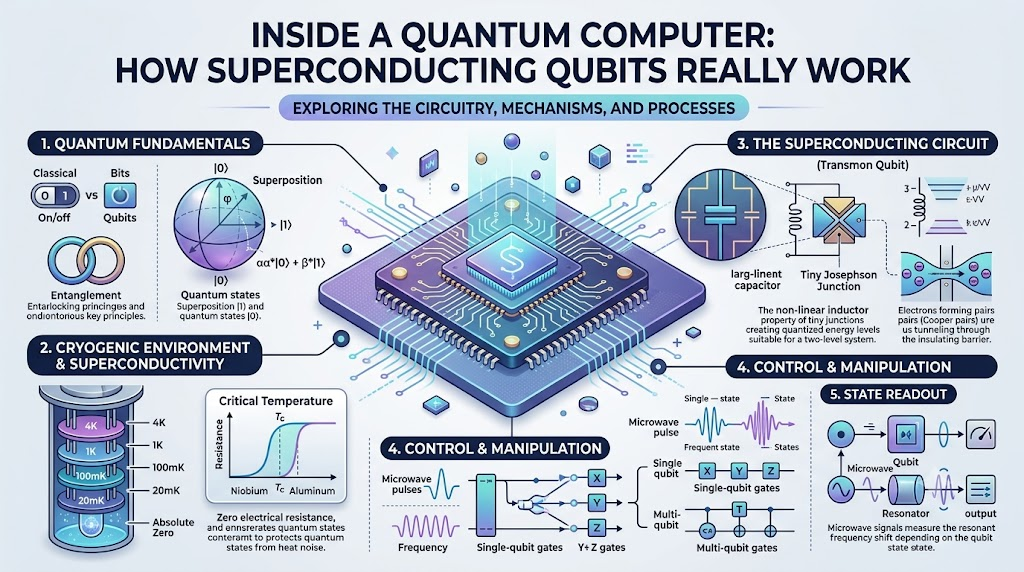
Normally, when electricity flows through a regular wire, the wire gets warm. Think about the glowing wires inside a toaster or a space heater. This heat happens because the wire pushes back against the electricity, which scientists call resistance. But researchers discovered something amazing: if you freeze certain special metals to extremely low temperatures, this resistance completely disappears. The electricity can flow forever and ever without losing any energy or creating any heat. This perfect, frictionless flow of electricity is called “superconductivity,” and it is the main secret ingredient for making quantum bits work.
Colder Than Deep Space
To make these special metals work properly, you have to get them unbelievably cold. We are talking about temperatures near “absolute zero.” Absolute zero is the coldest temperature possible in the entire universe, where everything completely stops moving. In fact, the chips inside a quantum computer are kept much colder than the dark, empty space between the stars! If the chips get even a tiny bit warm, they lose their perfect electrical flow, and their delicate quantum state disappears instantly.
The Golden Chandelier
So, how do you keep something colder than deep space right here on Earth? Scientists use a massive, amazing machine called a dilution refrigerator. If you walk into a quantum lab, you will see a giant, shiny device that looks just like a beautiful golden chandelier hanging from the heavy ceiling. This golden machine has many different layers stacked on top of each other. As you go down each layer, the machine removes more and more heat. It gets colder and colder, until you reach the very bottom point where the tiny quantum chip sits safely in a deep freeze.
Comparing Standard Bits vs. Superconducting Qubits
| Feature | Standard Silicon Bit | Superconducting Qubit |
| Materials Used | Silicon (made from sand) and copper wires | Special metals like Aluminum or Niobium |
| Operating Temperature | Normal room temperature (can get quite warm) | Near absolute zero (colder than deep space) |
| How It Is Controlled | Normal electricity flowing through standard wires | Gentle microwave pulses sent down special cables |
As you can see in the simple table above, normal bits and superconducting qubits are completely different types of machines. Your everyday laptop uses silicon, which is basically made from melted sand, along with regular copper wires. It runs happily on your messy desk, it gets warm when it works hard, and you control it using normal electricity from a wall plug. It is simple, cheap, and very easy for factories to build by the millions.
On the other hand, the superconducting qubit is a very sensitive, delicate, and special device. It uses rare metals like niobium or pure aluminum. Because it needs to stay near absolute zero, you can never put one in your pocket or carry it around in a backpack. It must stay locked safely inside its giant golden cooling fridge at all times, closely watched by teams of scientists.
The way we talk to these quantum devices is also completely different. Instead of sending normal electrical power through wires, scientists have to use careful bursts of energy to make the qubits do their math. This requires a whole new way of thinking about how we build computer parts, control signals, and read information.
How We Actually Control These Tiny Qubits
You might be wondering, if the chip is locked away at the bottom of a freezing golden chandelier, how do scientists actually tell it what to do? You cannot simply plug a regular keyboard into it. The answer lies in microwaves. These are very similar to the invisible energy waves that heat up your leftover food in the kitchen, but scientists use very precise, very gentle microwave pulses to talk to the chip.
Special cables are wired all the way from the top of the giant fridge down to the freezing bottom layer. Scientists send these microwave signals down the wires. When the microwave hits the qubit, it gently nudges it. Depending on the exact shape and timing of the microwave pulse, the qubit can flip from a 0 to a 1, or it can be put into that special, magical state of being both 0 and 1 at the same exact time.
The real star of this hardware show is a tiny part inside the qubit called a “Josephson junction.” You can think of a Josephson junction as a tiny, magical gate for electrical particles. It is made of two superconducting metals with a very, very thin solid wall sitting between them. According to normal rules, the electricity should not be able to get past the wall. But because of quantum magic, the electrical particles can actually jump right through this solid wall! This jumping action is what gives the qubit its power, allowing the microwave pulses to control it perfectly and perform complex math.
The Biggest Challenges Ahead: Heat and Noise
While all of this sounds amazing and sounds like a science fiction movie, building a working quantum computer is incredibly difficult. The biggest problem scientists face right now is something called “noise.” In the quantum hardware world, noise does not just mean a loud sound like a dog barking. It means any outside interference at all. A tiny change in temperature, a stray magnetic wave, or even a tiny vibration from a truck driving on a road outside the building can ruin the whole quantum system.
When this outside interference hits the delicate chip, the qubit loses its special quantum magic. Scientists call this sad event “decoherence.” Think of decoherence like a beautiful house of cards falling over because someone breathed on it too hard. When decoherence happens, the qubit stops being a super-powerful quantum bit and turns back into a normal, boring bit. The mathematical calculation is instantly destroyed, and the computer gives the completely wrong answer.
Because they are so sensitive to noise, it is very hard to pack many qubits onto a single chip. A normal laptop chip has billions of standard bits packed tightly together like a crowded city. But if you put too many superconducting qubits too close together, their microwave signals start bothering each other and creating their own noise. Figuring out how to safely put millions of qubits together without them ruining each other’s delicate states is the biggest challenge for the future of quantum computing.
FAQs
Q1: What exactly is a qubit?
A1: A qubit is the basic building block of a quantum computer. Unlike a normal computer bit that can only be a 0 or a 1, a qubit can be both a 0 and a 1 at the exact same time, which makes it incredibly powerful.
Q2: Why do quantum computers look like giant gold chandeliers?
A2: The beautiful golden chandelier is actually a giant, multi-layered cooling machine. It is designed to freeze the tiny quantum chip at the bottom to extremely low temperatures so the chip can work properly.
Q3: What does the word superconductivity mean?
A3: Superconductivity is a special state that happens when certain metals are made extremely cold. In this state, electricity can flow perfectly through the metal without losing any energy or creating any heat.
Q4: Exactly how cold is a quantum computer?
A4: The hardware chips inside are kept near absolute zero. This is actually much colder than the dark, empty space between stars in our universe!
Q5: Can I buy a quantum computer to use in my house?
A5: No, not right now. Because they need massive cooling machines, perfect laboratory conditions, and protection from all noise and vibrations, they cannot fit in a normal house or sit on a desk.
Q6: How do scientists control the qubits if they are frozen?
A6: Scientists control them by sending very precise, gentle microwave pulses down special wires into the freezing cold machine. These gentle waves nudge the qubits to perform math.
Q7: What is a Josephson junction?
A7: A Josephson junction is a tiny, magical gate inside the qubit. It has a tiny solid wall that electrical particles can jump right through, which is what gives the quantum computer its special power.
Q8: What happens if a quantum computer gets warm?
A8: If it gets even a tiny bit warm, the qubits instantly lose their special quantum power. This ruins the ongoing calculation, and the computer will give the completely wrong answer.
Q9: What do scientists mean when they talk about quantum noise?
A9: Quantum noise is any outside interference that messes up the sensitive qubits. This can include heat, stray magnetic fields, or even tiny vibrations from the environment.
Q10: Why are normal computer chips not enough for the future?
A10: Normal chips solve massive problems by guessing one answer at a time. For super complex problems, this guessing process would take thousands of years, so we need the extreme speed of a quantum computer.
Conclusion
Superconducting qubits are truly one of the greatest inventions in human history. By combining the strange rules of tiny quantum particles with extreme freezing technology, scientists are building machines that could soon solve the world’s hardest problems. They represent a massive leap forward from the everyday laptops and phones we are used to.
The journey from standard silicon chips to freezing golden chandeliers shows just how far human engineering has come. While we still have to beat major hardware challenges like heat, noise, and decoherence, the progress being made by brilliant engineers is happening faster than ever before. We are standing at the starting line and watching the birth of a completely new era of computers, and the physical hardware is the magic making it all possible.