You might feel tired of waking up late at night to fix simple server alerts. A system administrator named Mark spent most of his week typing the same setup commands over and over. He wanted a way to let machines handle routine fixes so he could focus on building new features. That desire for less manual work led him to explore modern cloud automation methods. He needed a place that offered clear training without any confusing jargon. That is where platforms like NoOpsSchool step in to help technical folks learn smart automation.
Overview of NoOpsSchool
NoOpsSchool is a specialized IT education, certification, and consulting platform focused on NoOps, cloud infrastructure automation, and modern software delivery practices. It serves DevOps engineers, cloud architects, platform engineers, software developers, system administrators, IT managers, and organizations that want to reduce manual operational work through automation. Its main offering combines training courses, professional certification programs, educational resources, and practical guidance for adopting automated IT operations. The platform is based in India and serves an international English-speaking technical audience through online training and professional services. It offers separate learning programs for NoOps Engineers, NoOps Architects, NoOps Managers, and NoOps Professionals, along with matching certification tracks. The site also advertises consulting services and access to specialized freelance professionals to help teams build better cloud systems.
At a Glance: Learners vs. Organizations
| Area | For Learners and Professionals | For Organizations |
| Main purpose | Build automation skills and earn certificates | Reduce manual work and adopt cloud systems |
| What the site offers | Training courses and certification tracks | Consulting services and freelance access |
| Skills and topics | Code infrastructure, containers, and pipelines | Operational reviews and automation strategy |
| Practical focus | Hands-on labs and real-world scenarios | Cloud-native updates and security setup |
| Next step | Pick a role track and start learning | Confirm service details with the site |
This table shows how the platform supports both individual learners and growing teams. Professionals can pick structured study tracks to grow their technical skills. At the same time, companies can find expert help to streamline their daily tech work. Both sides benefit from a shared focus on smart cloud automation.
Part One: Learning NoOps, From the Basics to Certification
What is NoOps? A plain-language explanation
People often ask what is NoOps when they want to make server management easier. NoOps is a setup where teams use code and smart tools to handle routine server tasks automatically. This approach aims to automate operational work so teams spend less time on manual tasks. It lets software run smoothly without constant human setup for every small change. You can think of it as setting up a smart thermostat for your entire computer network.
NoOps vs DevOps: one way to look at the difference
It helps to understand how NoOps vs DevOps compare in everyday tech work. DevOps is a set of practices that brings development and operations teams together to build and ship code faster. NoOps takes those ideas a step further by automating routine maintenance tasks so ops teams do not have to touch every server manually. One way to look at it is that DevOps builds the bridge, while NoOps lets the traffic flow on autopilot. Human oversight and accountability remain key parts of the process.
Who NoOpsSchool is for: engineers, architects, administrators, developers, and IT managers
Different job roles need different kinds of technical knowledge. The platform serves DevOps engineers, cloud architects, platform engineers, software developers, system administrators, and IT managers. Each group faces unique daily challenges with server maintenance and software delivery. Tailored programs help every professional find relevant study materials for their specific daily duties. A good tip is to choose the learning path that matches your current job responsibilities.
NoOps training courses and what they cover
Learning new skills requires structured lessons and clear topics. The site offers a NoOps training course setup that covers many vital cloud subjects. Course content covers infrastructure as code, which means writing setup files to build servers automatically. It also covers cloud-native computing, which is building software designed to run on modern cloud setups. Other topics include serverless architecture, which lets you run code without managing underlying servers, and observability, which means tracking how well your apps work. A helpful tip is to take notes on each topic before moving on to the next lesson.
Hands-on labs, real-world scenarios, and self-healing infrastructure
Reading about cloud tools is not enough to build real skills. Training materials stress hands-on labs, real-world automation scenarios, self-healing infrastructure, automated incident response, and practical platform engineering concepts. Self-healing infrastructure means systems can fix themselves when a small error happens. Automated incident response sends quick alerts and fixes problems before users notice them. A practical tip is to test your lab scripts in a safe sandbox environment first.
NoOps automation tools and technologies you will meet
Modern cloud systems rely on specific software tools to stay organized. Learners will study NoOps automation tools like Kubernetes, which helps manage container apps across many servers. They will also look at Docker, a tool used to pack apps into neat containers. Another key tool is Terraform, which helps build server infrastructure using code files. Students also review GitOps, a way to manage system updates using code repositories, and CI/CD, which automates building and testing software updates. A useful tip is to practice using one tool at a time rather than learning them all at once.
NoOps certification tracks
Proving your knowledge can help you grow in your tech career. The platform offers a NoOps certification path that matches its learning programs. These tracks help you test your understanding of automated cloud systems and modern workflows. A smart tip is to review all course notes before you sit for any certification exam.
The NoOps Engineer track
Engineers need deep technical skills to build and maintain cloud systems. The NoOps engineer certification path focuses on practical setup and daily automation tasks. It helps technical staff learn how to write reliable setup scripts and manage cloud tools. A helpful tip is to build small test scripts while working through this track.
The NoOps Architect track
Big cloud systems need careful planning and smart design choices. The NoOps architect training path helps senior staff design large, automated environments. It covers high-level system layouts and secure cloud workflows. A practical tip is to draw out your system designs on paper before writing any code.
The NoOps Manager track
Leaders need to understand automation to guide their teams well. The NoOps manager certification track helps supervisors learn how modern cloud workflows operate. It gives managers the knowledge to support automation projects across their departments. A useful tip is to talk with your engineering team about daily bottlenecks as you study.
The NoOps Professional track
Some roles require a broad understanding of all cloud automation concepts. The NoOps Professional track covers general practices for modern software delivery. It helps workers gain a well-rounded view of automated operations. A good tip is to apply what you learn in this track to your current workplace projects.
Which Offering Is for You? A Quick Guide
| Offering | What It Covers | Who It Helps |
| Training courses | Infrastructure, containers, and pipelines | Learners building new cloud skills |
| Certification tracks | Verified knowledge of automated systems | Professionals proving their expertise |
| Educational resources | Guides on NoOps and automation tools | Anyone studying modern cloud topics |
| Consulting services | Operational reviews and strategy help | Organizations reducing manual work |
| Freelance professionals | Expert help with cloud platforms | Teams needing specialized skills |
This guide helps you see which part of the platform fits your current needs. Individuals can focus on learning courses and exams. Companies can look into consulting help or expert freelance support. Remember to confirm current details on the site before making any final choices.
Part One: For Organizations, From Assessment to Execution
NoOps consulting services: what the site advertises
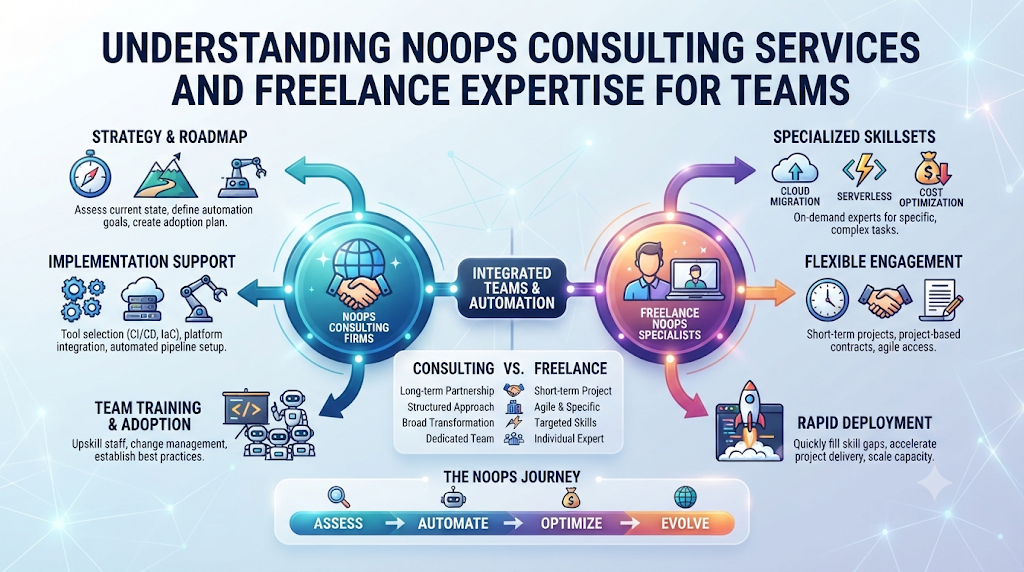
Companies often need outside help to update their old tech systems. The site advertises NoOps consulting services to assist teams with digital upgrades. These services give organizations expert advice on how to improve their daily tech workflows. Always confirm service details and availability directly with the site before starting a project. A helpful tip is to list your team’s main operational bottlenecks before you request a consultation.
Assessments and automation strategy
Before changing how your servers work, you need a clear view of your current setup. Consulting services cover operational assessments and automation strategy planning. An operational assessment looks at how much time your team spends on manual fixes. An automation strategy helps you map out a clear path toward smoother cloud operations. A practical tip is to involve both developers and system administrators in your initial assessment talks.
Cloud-native modernization and infrastructure provisioning
Older software often struggles to run on modern cloud platforms. The consulting portfolio covers cloud-native modernization and infrastructure provisioning. Cloud-native modernization means updating old apps so they run better in the cloud. Infrastructure provisioning involves setting up new servers and networks using automated code. A useful tip is to modernize your apps in small batches rather than all at once.
CI/CD implementation, AIOps integration, and security automation
Advanced automation requires smart tools to handle testing and security checks. Services cover CI/CD implementation, which sets up automated pipelines to build and test code safely. They also cover AIOps integration, which uses machine learning to spot and fix server problems early. Security automation means setting up automatic checks to keep your cloud data safe from threats. A smart tip is to test your security rules in a staging environment before turning them on for live users.
Access to freelance professionals: what the site advertises
Finding skilled cloud experts for short projects can be tough. The site advertises access to specialized freelance professionals to help teams fill skill gaps. The freelancer section focuses on connecting organizations with expertise in Terraform, Kubernetes, cloud platforms, automated monitoring, and self-healing systems. Always confirm contract terms and project details directly with the site. A practical tip is to write a clear project brief before you look for freelance help.
Realistic Expectations: What NoOps Does and Does Not Do
Automating your computer systems can change how your team works every day. NoOps reduces operational workload by letting machines handle routine maintenance tasks. It does not remove accountability or human oversight from the process. People still need to write the automation code, review system alerts, and make important business choices. Setting realistic expectations helps teams avoid common mistakes when adopting new cloud tools. You should view automation as a helpful assistant rather than a magic fix for every IT challenge. Keep your goals simple and focus on steady improvements over time.
Tips for Learners and Organizations
For learners and professionals:
- Start with the basic concepts before moving on to advanced container tools.
- Pick the role track that matches your daily job duties and career goals.
- Practice your skills regularly in hands-on labs and safe sandbox environments.
- Learn one new cloud topic at a time to keep your study sessions clear.
For organizations:
- Assess your current manual operational work before planning any big changes.
- Set realistic goals for your team and focus on steady automation steps.
- Keep humans in the loop to oversee automated alerts and system updates.
- Confirm service details directly with the site before you make a decision.
A Hypothetical Scenario
Imagine a mid-sized software company whose team spends hours every week restarting stuck servers. The IT manager wants to cut down this manual work so developers can ship features faster. First, the manager reviews educational resources on the platform to understand how automation works. Next, the team explores advertised consulting services to get expert advice on setting up automated pipelines. They also look at training courses to help their system administrators learn new cloud tools. By combining expert guidance with team training, the company builds a smoother, more automated workflow.
Frequently Asked Questions About NoOpsSchool
What is the platform and who does it serve? It is a specialized IT education, certification, and consulting platform. It serves engineers, architects, developers, IT managers, and organizations.
What does NoOps mean in plain words? It is a setup where teams use code and smart tools to handle routine server tasks automatically. This reduces the time spent on manual fixes.
How do NoOps and DevOps relate to each other? DevOps brings development and operations teams together. NoOps takes those practices further by automating routine maintenance tasks.
Does NoOps remove the need for human staff? No, oversight and accountability remain essential. People still write code, review alerts, and make key decisions.
Which job roles have dedicated learning programs? The platform offers separate programs for NoOps Engineers, NoOps Architects, NoOps Managers, and NoOps Professionals.
What subjects do the training courses cover? Courses cover infrastructure as code, cloud-native computing, serverless architecture, and observability.
What happens during hands-on labs and real-world scenarios? Learners practice building automated workflows and testing real-world cloud setups in safe environments.
Which specific tools and technologies appear in the lessons? The study materials cover Kubernetes, Docker, Terraform, GitOps, and CI/CD automation.
What do self-healing infrastructure and automated incident response mean? They are systems that can automatically detect errors, fix minor issues, and alert teams before major problems happen.
How do the certification tracks match the learning programs? The platform offers matching certification exams for each of its four main professional learning tracks.
Final Thoughts
Adopting modern cloud automation can make daily IT work much smoother for everyone involved. Clear training helps technical staff build strong skills without getting lost in confusing terms. At the same time, expert guidance gives growing organizations a reliable way to reduce manual tasks. Taking a steady, practical approach is the best way to succeed with cloud systems. Every small step toward automation brings your team closer to a calmer workday.