Introduction
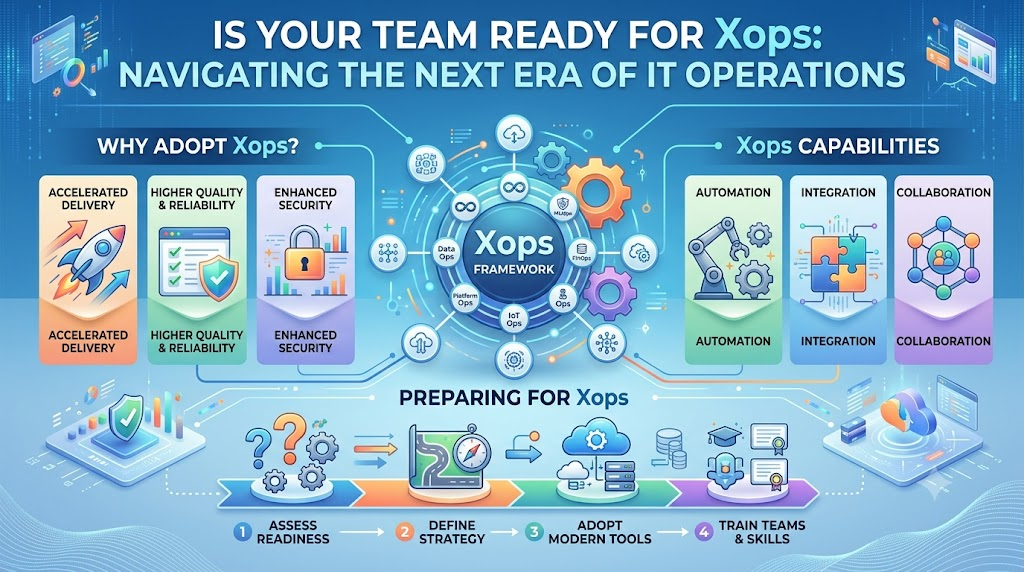
Modern technology organizations no longer struggle with writing software; they struggle with the fragmentation of operating it. As engineering organizations embraced specialized operational disciplines over the past decade—DevOps for software delivery, DataOps for analytical pipelines, MLOps for machine learning models, SecOps for threat detection, and FinOps for cloud spend—they unintentionally recreated the very silos they sought to eliminate. Each functional team adopted separate pipelines, isolated telemetry stacks, disjointed policy engines, and misaligned delivery cadences. XOps (Everything Operations) is the umbrella operational paradigm designed to address this fragmentation. Rather than serving as yet another standalone framework or a replacement for existing disciplines, XOps establishes a unified baseline of automation, governance, observability, and continuous integration across all operational practices. Platforms like XOpsSchool emphasize this integrated view, helping engineers see how modern delivery practices share common foundational architectures. Understanding what XOps represents—and how to apply its principles—enables organizations to convert isolated operational teams into a cohesive, scalable delivery platform.
The Core Problem: The Proliferation of Operational Silos
Over the last decade, technical teams discovered that applying general-purpose DevOps pipelines directly to machine learning, data engineering, or cloud financial management resulted in friction:
- DataOps teams struggled because database migrations, schema drift, and data quality validation operate on different lifecycles than stateless application code.
- MLOps practitioners encountered challenges tracking model drift, experiment lineage, training datasets, and non-deterministic model inference inside standard CI/CD tooling.
- SecOps engineers found themselves bypassed when automated pipelines prioritized deployment velocity over dependency scanning, image signing, and runtime compliance.
- FinOps practitioners operated retrospectively, reviewing cloud bills weeks after dynamic auto-scaling clusters or unoptimized query models caused budget overruns.
While these domain-specific “Ops” practices solved immediate local challenges, they caused cross-functional friction. A single enterprise product might require a microservice change (DevOps), an updated feature store schema (DataOps), a newly retrained recommendation model (MLOps), compliance verification (SecOps), and cost-allocation tagging (FinOps). When these teams work across completely disjointed tools and governance models, operational overhead compounds quickly.
What Is XOps?
At its core, XOps is an architectural and organizational approach that standardizes operational fundamentals—continuous integration, continuous deployment, automated testing, real-time observability, and policy-as-code—across disparate technology operations.
The term treats the variable “X” as a placeholder for any technical discipline that must run reliably in a production environment:
$$\text{XOps} = \{\text{DevOps}, \text{DataOps}, \text{MLOps}, \text{SecOps}, \text{FinOps}, \text{CloudOps}, \text{GitOps}\}$$
Rather than forcing data scientists to become Kubernetes specialists or requiring security engineers to write frontend integration tests, XOps promotes common control planes, unified metadata standards, and shared delivery pipelines.
                                +-----------------------------------+
                                |            XOps Layer             |
                                | (Shared Governance, Control Plane |
                                |   & Cross-Discipline Telemetry)   |
                                +-----------------+-----------------+
                                                  |
         +-----------------+----------------------+---------------------+-----------------+
         |                 |                      |                     |                 |
         v                 v                      v                     v                 v
   +------------+    +------------+        +--------------+       +-----------+     +------------+
   |   DevOps   |    |  DataOps   |        |    MLOps     |       |  SecOps   |     |   FinOps   |
   | (Delivery) |    | (Pipelines)|        | (Lifecycle)  |       | (Security)|     |   (Cost)   |
   +------------+    +------------+        +--------------+       +-----------+     +------------+
How the Core XOps Disciplines Interconnect
To implement XOps effectively, it helps to see how the primary sub-disciplines intersect in real production workflows:
1. DevOps (The Baseline)
Focuses on iterative code development, containerized builds, automated testing, and predictable releases. In an XOps model, DevOps provides the underlying CI/CD patterns and infrastructure-as-code foundations that other disciplines inherit.
2. DataOps (The Information Pipeline)
Adapts Agile and DevOps practices to data management. It automates data integration, pipeline orchestration, schema change testing, and data quality checks to supply dependable datasets for downstream consumers.
3. MLOps (The Intelligence Layer)
Extends continuous delivery to machine learning workflows. It manages continuous training (CT), model registry maintenance, feature stores, and automated model evaluation before traffic routing.
4. SecOps & DevSecOps (The Trust Layer)
Embeds automated policy enforcement directly into deployment pipelines. This includes software supply chain security, Software Bill of Materials (SBOM) generation, container vulnerability scanning, and real-time identity validation.
5. FinOps (The Value & Efficiency Layer)
Integrates unit economics into engineering workflows. By embedding cost metrics alongside performance indicators, teams can automatically detect resource over-provisioning and trace cloud spending back to specific code commits or microservices.
Architectural Comparison: Operational Disciplines
The table below illustrates how different operational paradigms approach key lifecycle phases, highlighting why a unifying XOps architecture is valuable:
| Operational Discipline | Primary Asset Under Management | Trigger for Execution | Primary Quality / Success Metric | Critical Tooling Categories |
| DevOps | Application source code, config files | Code commit / Pull Request merge | Deployment frequency, Mean Time to Recovery (MTTR) | GitHub Actions, GitLab CI, ArgoCD, Kubernetes |
| DataOps | Structured/unstructured data, SQL, pipelines | Scheduled ingestion, streaming events, schema updates | Data freshness, pipeline uptime, schema validity | Apache Airflow, dbt, Great Expectations, Kafka |
| MLOps | Model weights, feature stores, hyperparameters | Concept drift detection, new dataset availability | Precision, recall, inference latency, drift tolerance | MLflow, Kubeflow, Feast, Weights & Biases |
| SecOps | Identities, policies, access keys, images | Configuration changes, runtime threat anomalies | Vulnerability remediation time, zero-day exposure | Trivy, Falco, HashiCorp Vault, Open Policy Agent |
| FinOps | Cloud budgets, compute/storage reservations | Resource provisioning events, billing threshold alerts | Unit cost per transaction, budget vs. actual spend | Kubecost, Infracost, AWS Cost Explorer |
Practical Implementation: A Real-World XOps Workflow
To see XOps in action, consider an enterprise deploying an automated fraud-detection service for an e-commerce platform.
Instead of five disconnected handoffs, a unified XOps workflow proceeds systematically:
- Continuous Data Validation (DataOps): Apache Airflow coordinates streaming ingestion via Apache Kafka into a cloud data lake. A Great Expectations validation check runs automatically; if schema drift or null-value rates exceed baseline thresholds, the pipeline halts and alerts the team before corrupting the analytical warehouse.
- Automated Retraining & Evaluation (MLOps): With validated data ready, an automated Kubeflow pipeline runs model training. The resulting model artifacts are logged in an MLflow registry. A validation gate evaluates model precision against a live baseline; if accuracy benchmarks pass, the candidate artifact is marked for staging.
- Automated Cost Projection (FinOps): During the Pull Request step for deploying the new inference service, an Infracost check evaluates the Terraform configuration. It verifies that running the inference service on target GPU instances stays within the allocated budget before the pull request can be merged.
- Supply Chain Security & Compliance (SecOps): As container images are built, Trivy scans all operating system packages and application dependencies. Concurrently, Open Policy Agent (OPA) validates that the container runs with a non-root user and specifies strict network policies.
- GitOps-Driven Deployment (DevOps/CloudOps): ArgoCD detects the approved pull request and synchronizes the desired state into the production Kubernetes cluster using a progressive canary strategy.
- Cross-Discipline Observability: Prometheus and OpenTelemetry capture standard HTTP latency, while Evidentiary/Whylabs monitors prediction drift and Kubecost attributes live compute expenses to the fraud-detection cost center.
Core Pillars of an XOps Framework
A successful XOps implementation relies on four shared pillars across all operational teams:
+-----------------------------------------------------------------------+
|                              XOPS PILLARS                             |
+-------------------+--------------------+--------------------+---------+
| Continuous        | Unified            | Policy &           | Common  |
| Automation        | Telemetry          | Governance as Code | Culture |
+-------------------+--------------------+--------------------+---------+
1. Continuous Automation (CI/CD Everywhere)
Every production asset—whether an application binary, a PyTorch model, a Snowflake database migration, or an IAM role definition—must be versioned in Git and delivered through declarative automated pipelines.
2. Unified Telemetry and Observability
Operations cannot scale when DevOps monitors CPU usage in Datadog, DataOps checks job failures in an Airflow dashboard, and MLOps monitors drift in custom Jupyter notebooks. An XOps approach standardizes tracing and telemetry on vendor-neutral protocols like OpenTelemetry, centralizing system performance, data health, model drift, and cost metrics within a shared pane of glass.
3. Policy and Governance as Code
Regulatory requirements, identity frameworks, and resource allocations should be enforced programmatically rather than through manual gatekeeping. Tools like Open Policy Agent (OPA) or Kyverno ensure consistent security, compliance, and tagging rules across environments.
4. Common Cultural Foundations
XOps requires breaking down the tribalism between disciplines. Software engineers, data engineers, and data scientists collaborate using shared terminologies, shared service level agreements (SLAs), and joint incident response practices.
Practical Benefits of Adopting XOps
- Reduced Operational Drag: Shared deployment patterns and reusable pipeline templates eliminate the need to reinvent CI/CD for every new data science or infrastructure project.
- Faster Root-Cause Analysis: When a machine learning service fails, unified observability quickly isolates whether the root cause is a container crash (DevOps), bad input features (DataOps), concept drift (MLOps), or an expired token (SecOps).
- Predictable Delivery Velocity: Standardized release gates reduce deployment anxiety across data and machine learning workloads, bringing their delivery cadence closer to agile software practices.
- Automated Governance and Auditability: Using Git as the single source of truth for both code and operational changes provides a complete, auditable record for regulatory compliance.
Common Challenges and How to Avoid Them
1. The “One Tool to Rule Them All” Fallacy
Teams often fail when attempting to force a single application deployment tool (like standard Jenkins or GitHub Actions runners) to manage complex distributed data pipelines or model training jobs natively.
- Remedy: Do not standardize on a single monolithic execution tool. Instead, standardize on the integration layer—using APIs, webhooks, and orchestrators that connect specialized tools (e.g., dbt for transformation, ArgoCD for Kubernetes workloads) into a coherent control plane.
2. Tool Sprawl Without Shared Standards
The opposite error occurs when every engineering sub-team adopts separate cloud accounts, specialized SaaS tools, and distinct logging agents with zero interoperability.
- Remedy: Establish a centralized Platform Engineering group. The platform team builds internal developer platforms (IDPs) that offer self-service templates for infrastructure, pipelines, and observability, making the supported path the easiest path.
3. Neglecting People and Process
Adopting the term XOps without addressing functional silos produces little real change.
- Remedy: Align metrics around shared end-to-end business outcomes rather than isolated functional milestones. For instance, tie team goals to the end-to-end latency of shipping a verified, secure data product to end users, rather than solely focusing on model training time or raw deployment volume.
Frequently Asked Questions
What does the “X” in XOps stand for?
The “X” represents a variable placeholder for any technical operational discipline, including DevOps, DataOps, MLOps, SecOps, FinOps, CloudOps, and GitOps. It signifies the unification of these distinct practices into a cohesive operational framework.
How does XOps differ from traditional DevOps?
DevOps focuses primarily on the lifecycle of traditional software applications, prioritizing code integration, testing, and infrastructure provisioning. XOps expands these principles to handle assets with distinct lifecycles, such as machine learning models, distributed data pipelines, financial metadata, and security governance.
Is XOps a specific software tool or platform?
No. XOps is an architectural strategy, operational methodology, and organizational approach. It is implemented using an ecosystem of tools—such as Kubernetes, OpenTelemetry, ArgoCD, and policy engines—rather than a single commercial product.
What is the relationship between XOps and Platform Engineering?
Platform engineering is frequently the delivery mechanism for XOps. A platform engineering team builds and maintains the internal developer platforms, self-service portals, and reusable pipelines that allow cross-discipline teams to execute XOps principles efficiently.
Why did specialized Ops disciplines emerge before XOps?
Specialized disciplines emerged because standard software engineering tools could not natively address the unique challenges of machine learning (model drift, experiment tracking) or big data (schema evolution, high-throughput pipeline monitoring). Once these specialized disciplines matured independently, XOps emerged to reconnect them.
Can small teams or startups benefit from XOps?
Yes, though smaller teams should adopt it pragmatically. Startups rarely need dedicated sub-teams for MLOps or FinOps, but building on shared infrastructure-as-code and unified logging early on prevents painful refactoring as the team and system footprint grow.
How does XOps improve system security?
XOps integrates SecOps mechanisms—such as vulnerability scanning, secret management, identity verification, and policy-as-code—into every stage of software, data, and machine learning pipelines, preventing security from becoming an isolated checkpoint.
What role does OpenTelemetry play in an XOps framework?
OpenTelemetry provides a vendor-neutral standard for generating and collecting metrics, traces, and logs. It serves as a foundational component in XOps by allowing infrastructure, application, and data pipeline telemetry to be processed through a unified observability layer.
Does implementing XOps require restructuring existing engineering teams?
Not necessarily. Rather than forcing immediate organizational changes, companies often begin by standardizing cross-discipline control planes, establishing shared service-level metrics, and creating cross-functional working groups to unify delivery practices.
What skills should engineers learn to prepare for an XOps-oriented environment?
Engineers should build a solid foundation in containerization and orchestration (Docker, Kubernetes), declarative Infrastructure as Code (Terraform), pipeline automation (CI/CD tools), distributed observability standards (OpenTelemetry), and modern configuration practices such as GitOps.
Conclusion
The rapid growth of specialized technical fields—from cloud-native computing and enterprise data platforms to predictive machine learning—has made operating modern software systems increasingly multifaceted. While specialized disciplines like DataOps, MLOps, and SecOps solved important domain-specific operational challenges, running them as disconnected functions reintroduces friction, operational blind spots, and deployment delays. XOps offers a practical way forward by applying unified standards for automation, observability, continuous delivery, and policy enforcement across every operational layer. By building common operational baselines, organizations break down technical silos and build engineering systems that are stable, secure, cost-conscious, and scalable.