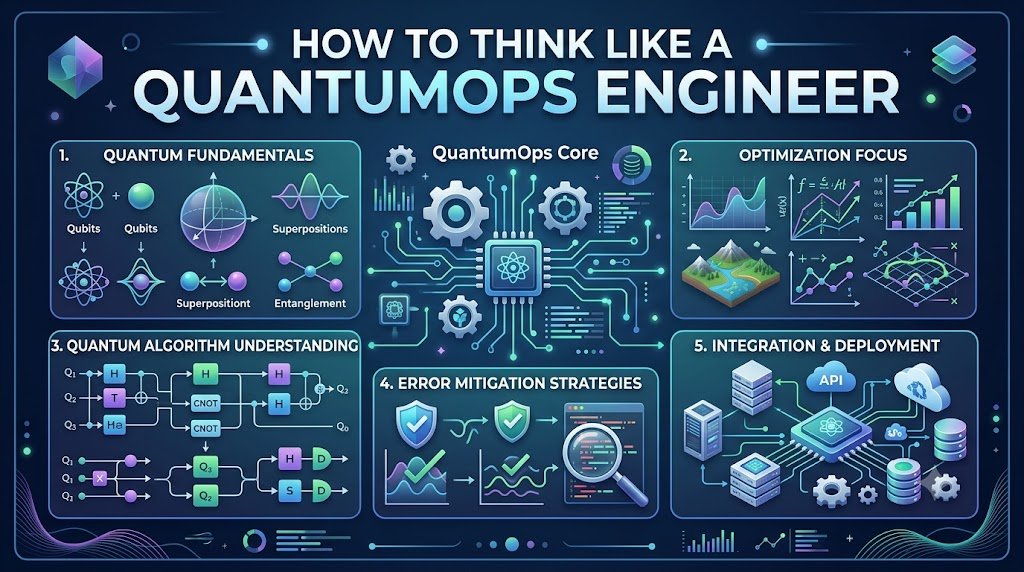
Introduction
Quantum computing is creating new opportunities for technology professionals. It combines computer science, physics, and advanced hardware. As quantum systems grow, teams need people who can manage their daily operations. This is where QuantumOps becomes useful. QuantumOps engineers help monitor, test, and support quantum computing systems. They also work with software, cloud services, and research teams. To succeed in this field, you need more than technical tools. You need a mindset that accepts uncertainty, repeated testing, and constant learning.
Understanding QuantumOps
What Is QuantumOps?
QuantumOps is the practice of operating and supporting quantum computing systems. It includes monitoring, testing, automation, troubleshooting, and workflow management.
A QuantumOps engineer helps teams run quantum workloads in a controlled and reliable way. The work may involve quantum hardware, software, and classical computing systems.
How Is QuantumOps Similar to DevOps?
DevOps combines software development and IT operations. It helps teams build, test, release, and maintain software.
QuantumOps uses many of the same ideas. These include automation, monitoring, testing, and teamwork.
The main difference is the system being managed.
| DevOps | QuantumOps |
|---|---|
| Focuses on software and IT systems | Focuses on quantum systems and workloads |
| Tests software behavior | Tests circuits and repeated results |
| Monitors servers and applications | Monitors hardware and quantum workloads |
| Handles software failures | Handles software, hardware, and noise-related issues |
| Uses automation for delivery | Uses automation for experiments and operations |
QuantumOps does not replace DevOps. Instead, it uses DevOps skills in quantum computing environments.
How Is QuantumOps Different From AIOps?
AIOps uses artificial intelligence to support IT operations. It can help teams study alerts, events, and system behavior.
QuantumOps focuses on quantum computing operations. It may use AI tools, but AI is not required for every QuantumOps task.
Both fields need monitoring and careful troubleshooting. However, quantum systems introduce special hardware and measurement challenges.
Why Does QuantumOps Need a Different Mindset?
Quantum systems do not always produce the same result. Their behavior can change because of noise and hardware conditions.
This means you cannot depend only on fixed answers.
You must also study:
- Probability.
- Repeated results.
- Hardware performance.
- Error patterns.
- System changes.
- Experimental conditions.
A QuantumOps engineer asks questions before making assumptions. This habit helps them understand problems more clearly.
Classical Thinking vs Quantum Thinking
The biggest mindset change involves learning to work with uncertainty.
Classical IT Systems
Many classical IT systems aim for predictable results.
For example, a calculator returns the same answer for the same input. A software function may also return a fixed result.
These systems can still fail. Network issues, bugs, and hardware problems can affect their behavior.
However, many classical tasks follow clear and repeatable rules.
Quantum Systems
Quantum computing uses qubits, which are units of quantum information.
A normal computer bit usually represents zero or one. A qubit uses quantum properties that allow different possible states.
When you measure a qubit, you receive a result. Repeated measurements can produce different outcomes.
This makes probability an important part of quantum operations.
Understanding Noise
Noise means unwanted disturbance in a system. Quantum hardware can be affected by its environment and operating conditions.
Noise may change the results of quantum operations.
For example, a quantum circuit may produce a different result than expected. The cause may involve noise, calibration, or circuit design.
A QuantumOps engineer investigates these possibilities instead of guessing.
Why One Successful Run Is Not Enough
Imagine you run a quantum circuit once. It produces the result you expected.
Does that prove the circuit will always work?
No. One run provides limited information.
You should run the circuit many times. Then, study how often each result appears.
This gives you a better view of the system’s behavior.
Learn to Think in Probabilities
You may not always receive one fixed answer.
Instead, you may see several possible outcomes.
Ask yourself:
- Which result appears most often?
- How much do results vary?
- Is the variation expected?
- Did hardware conditions change?
- Can you repeat the experiment?
This way of thinking helps you make better operational decisions.
Core Habits of a QuantumOps Engineer
1. Think in Probabilities
Probability describes how likely an event is to happen. It helps you understand repeated quantum measurements.
Example: A circuit produces the expected result in 80 out of 100 runs.
You should study the full result pattern. Do not judge the circuit from one measurement alone.
The expected result may depend on the circuit and experiment.
2. Expect Noise and Errors
Errors are an important part of quantum computing.
Quantum hardware can experience different error sources. These may affect measurements and circuit operations.
Example: An experiment shows more errors than earlier runs.
You check the available calibration information and compare recent results. This helps you investigate possible causes.
Do not assume that every error comes from your code.
3. Test and Re-Test Experiments
Repeated testing helps you understand result patterns.
Run experiments several times under suitable conditions. Record the settings and results for later comparison.
Example: You test a circuit on different days. The results change slightly between sessions.
You compare the results and review the system conditions. This helps you identify possible changes.
4. Watch Hardware Health
Quantum hardware needs careful monitoring.
Depending on the platform, useful information may include:
- Qubit performance.
- Calibration results.
- Error measurements.
- Hardware availability.
- Job execution status.
- System temperature information.
Not every platform exposes the same information.
Example: A quantum job produces unusual results. You check the available hardware data before changing the circuit.
5. Balance Classical and Quantum Systems
Many quantum workflows use classical computing systems too.
A classical computer may prepare data and control the workflow. The quantum processor handles a specific quantum task.
Example:
- A classical system prepares input data.
- A quantum circuit runs the required operations.
- The system collects the measurement results.
- Classical software analyzes the output.
This is called a hybrid quantum-classical workflow.
You need to understand both sides of this process.
6. Accept Useful Results Within Limits
Perfect results are not always possible.
Some experiments allow a certain amount of error. The acceptable level depends on the task and its goals.
Example: A team defines an acceptable error range for an experiment.
The results fall within that range after repeated testing. The team reviews the findings against its requirements.
Do not accept results without checking the agreed limits.
Key Skills to Develop
A strong QuantumOps career requires skills from several areas. You can develop these skills step by step.
Basic Quantum Computing Knowledge
Start with the main ideas of quantum computing.
Learn about:
- Qubits.
- Quantum gates.
- Quantum circuits.
- Measurements.
- Quantum states.
- Basic quantum algorithms.
A quantum gate is an operation that changes a qubit’s state. A quantum circuit combines several gates into a sequence.
You do not need advanced physics at the beginning. Focus on understanding the basic concepts first.
Monitoring and Observability
Observability means understanding a system through its available signals.
These signals may include logs, metrics, events, and performance data.
In QuantumOps, you may monitor:
- Quantum job status.
- Execution time.
- Error rates.
- Calibration information.
- Queue delays.
- Experiment results.
Learn how to read these signals and identify unusual changes.
Scripting and Automation
Python is a useful language for many quantum workflows.
You can use Python to run circuits, collect results, and process data.
Frameworks such as Qiskit and Cirq support quantum programming tasks.
Example: You create a script that runs a circuit 100 times. The script then counts the different results.
Automation saves time during repeated experiments.
Statistics and Probability
Statistics helps you understand data from repeated runs.
Learn these basic concepts:
- Average.
- Variation.
- Probability.
- Distribution.
- Sampling.
- Error rate.
You do not need complex equations at first. Focus on understanding what the results mean.
Collaboration Skills
QuantumOps connects several technical teams.
You may work with:
- Quantum researchers.
- Physicists.
- Software developers.
- Cloud engineers.
- DevOps teams.
- Data scientists.
Clear communication helps teams solve problems together.
Patience and Continuous Learning
Quantum computing is still developing.
Tools, hardware, and operating methods may change over time.
You should build a habit of learning and testing new ideas. Keep notes about your progress and practical work.
How a QuantumOps Engineer Approaches Problems
A QuantumOps engineer follows a structured troubleshooting process.
Understand the system → Expect variability → Run experiments → Monitor results → Analyze data → Adjust or calibrate → Document → Repeat
Step 1: Understand the System
First, learn what the system should do.
Check the quantum circuit, workload, hardware, and recent changes.
You should know the expected behavior before investigating a problem.
Step 2: Expect Variability
Quantum results may change between runs.
Do not assume that every difference represents a software bug.
Understand the expected result range for your experiment.
Step 3: Run and Monitor Experiments
Run the circuit several times.
Collect measurement results and available system information.
Monitor the workload and relevant hardware signals.
Step 4: Analyze Results
Study the results as a group.
Look for changes in error rates and result patterns.
Compare current results with earlier experiments.
Step 5: Adjust or Calibrate
If the results change, investigate possible causes.
The team may need to review circuit design, hardware conditions, or calibration information.
Do not make changes without understanding the problem.
Step 6: Document and Repeat
Record the experiment details and results.
Document what you changed and what happened afterward.
This helps other team members repeat the experiment.
Simple Example
A quantum job gives different results during repeated runs.
Instead of assuming a bug, the engineer checks the experiment settings and hardware information.
The available calibration data shows that the qubits have changed from their earlier condition.
The engineer reviews the findings and repeats the experiment.
Lesson: Different results do not always mean that the code is broken.
Where QuantumOps Fits in a Team
QuantumOps can support several teams within a quantum computing project.
Working With Quantum Hardware Providers
QuantumOps engineers may work with teams that provide quantum hardware access.
They need to understand system availability, hardware limits, and job execution processes.
Some work may involve cloud-based quantum platforms.
Working With Software Teams
Software teams build applications and quantum circuits.
QuantumOps engineers help support the workflows that run those applications.
They may investigate job failures, queue delays, and system changes.
Supporting Research Teams
Research teams often run experiments to test new ideas.
QuantumOps helps them manage repeated runs and record results.
Good documentation can make experiments easier to repeat.
Supporting Production Workloads
Some organizations explore quantum computing for specific business or technical tasks.
Production-style workflows need clear processes for monitoring and support.
The exact operational needs depend on the workload and hardware platform.
Connecting Physics and Operations
QuantumOps connects physical systems with software operations.
You may need to explain hardware conditions to software teams.
You may also need to explain job failures to research teams.
This makes communication an important part of the role.
Common Use Cases and Daily Tasks
QuantumOps work can include technical, operational, and documentation tasks.
Monitoring Qubit Performance
Qubits may show changes in performance over time.
Engineers review available system information and study unusual behavior.
The exact monitoring data depends on the quantum hardware.
Managing Quantum Job Queues
Quantum processors have limited processing capacity.
Jobs may wait before execution.
Engineers can track queue times and job status when the platform provides this information.
This helps teams understand workload delays.
Tracking Error Rates
Error rates help teams understand the performance of quantum operations.
Engineers compare measurements over time.
Changes may require further investigation.
Supporting Hybrid Workflows
Quantum workloads often use classical systems.
Engineers help manage data preparation, job submission, and result processing.
They may also troubleshoot communication between system components.
Documenting Experiments
Documentation helps teams understand earlier work.
Record details such as:
- Circuit version.
- Hardware platform.
- Run date.
- Number of repetitions.
- Available calibration data.
- Observed results.
- Problems found.
Good records support repeatable experiments.
Benefits and Challenges of This Mindset
Benefits
A QuantumOps mindset can help you:
- Make better decisions with uncertain results.
- Investigate problems more carefully.
- Reduce incorrect assumptions.
- Improve experiment repeatability.
- Understand hardware and software together.
- Communicate with different technical teams.
These benefits depend on good processes and practical experience.
Challenges
QuantumOps also has several challenges.
New field: Many job roles and practices are still developing.
Changing tools: Quantum platforms may change their features and workflows.
Limited hardware access: Physical quantum systems may not be available to every learner.
Learning curve: You need knowledge from software, operations, and quantum computing.
Limited established practices: Teams may need to develop and test their own methods.
These challenges make continuous learning important.
Best Practices for Building a QuantumOps Mindset
Start With Basic Quantum Courses
Learn quantum computing fundamentals before studying advanced operations.
Understand qubits, gates, circuits, and measurements.
This knowledge will help you understand operational problems later.
Practice With Simulators
Simulators allow you to practice quantum circuits without physical hardware.
You can learn how circuits work and how measurements behave.
Then, compare your experience with real hardware when access becomes available.
Study Statistical Results
Practice reading repeated measurement results.
Look at the complete distribution instead of one output.
Ask whether the results match the expected behavior.
Join Quantum Communities
Quantum communities can help you learn from other people.
Follow technical discussions, learning groups, and forums.
Ask questions and share your practical experience.
Document Your Experiments
Keep notes about successful and failed experiments.
Record the settings and results.
This helps you learn from your own work.
Keep Learning Regularly
Quantum computing is changing over time.
Follow updates in tools, hardware, and research.
Focus on learning useful concepts instead of chasing every new trend.
Common Mistakes Beginners Make
Mistake 1: Treating Every Different Result as a Bug
Quantum measurements can vary between runs.
Study the result pattern before changing your code.
Mistake 2: Running a Circuit Only Once
One run provides limited information.
Repeat important experiments and compare the results.
Mistake 3: Ignoring Hardware Conditions
Quantum hardware can affect workload results.
Review available calibration and system information during troubleshooting.
Mistake 4: Focusing Only on Quantum Code
Many quantum workflows depend on classical systems.
Understand the complete workflow from input to output.
Mistake 5: Avoiding Statistics
Probability is important in quantum computing.
Learn basic statistics early and practice reading measurement results.
Mistake 6: Expecting Perfect Results
Real quantum systems have limitations.
Understand acceptable error ranges for your experiments.
Mistake 7: Skipping Documentation
Poor documentation makes experiments harder to repeat.
Record important settings and observations.
Mistake 8: Trying to Learn Everything Together
Quantum computing covers many subjects.
Start with the basics and build your skills over time.
Tools and Platforms Used in QuantumOps
Several tools and platforms support quantum programming and experimentation. Their features and access options may vary.
| Tool or Platform | What It Is Known For |
|---|---|
| Qiskit | A framework for creating and working with quantum circuits. |
| IBM Quantum | Quantum computing tools and access to IBM quantum systems. |
| Amazon Braket | A cloud service for working with quantum computing technologies. |
| Google Quantum AI | Quantum computing research, hardware, and software development. |
| PennyLane | A framework for quantum machine learning and hybrid workflows. |
| Cirq | A Python framework for creating and testing quantum circuits. |
Future Trends in QuantumOps
Growing Interest in QuantumOps Roles
As quantum computing develops, teams may need more operational support.
The exact role of QuantumOps is still taking shape.
Job responsibilities may differ between research teams, cloud providers, and other organizations.
Better Monitoring and Automation
Quantum systems need tools that support monitoring and repeated experiments.
Future improvements may make it easier to track hardware conditions and workload results.
Automation may also reduce repeated manual tasks.
More Hybrid Quantum-Classical Workloads
Quantum systems often work alongside classical computers.
As these workflows develop, teams may need better integration and monitoring.
Engineers with skills in both areas may support these workflows.
Frequently Asked Questions
1. What Is QuantumOps?
QuantumOps focuses on operating, monitoring, testing, and supporting quantum computing systems. It combines quantum computing knowledge with software and operations practices.
2. How Is QuantumOps Different From DevOps or AIOps?
DevOps focuses on software delivery and IT operations. AIOps uses AI methods in IT operations, while QuantumOps focuses on quantum systems and their operational needs.
3. Do I Need a Physics Degree to Work in QuantumOps?
A physics degree is not required for every QuantumOps role. Software, cloud, automation, and operations skills can provide a useful starting point.
4. What Programming Skills Are Most Useful?
Python is a useful starting language for many quantum workflows. You can then learn frameworks such as Qiskit, Cirq, or PennyLane.
5. Why Do Quantum Systems Give Different Results Each Time?
Quantum measurements can produce different results across repeated runs. Noise, calibration conditions, and circuit design may affect the observed results.
6. Can I Practice QuantumOps Without Real Quantum Hardware?
Yes, you can begin with quantum simulators. You can practice circuits, automation, testing, and result analysis before using physical hardware.
7. What Does a Typical Day Look Like for a QuantumOps Engineer?
Daily tasks may include checking workloads, reviewing system information, and analyzing results. Engineers may also work on automation, documentation, and troubleshooting.
8. Is QuantumOps a Good Career Choice Right Now?
QuantumOps is an emerging field with developing roles and practices. If you enjoy operations and quantum computing, you can explore the field through learning and practical projects.
9. Which Skills Should I Learn First?
Start with quantum computing basics, Python, statistics, and DevOps concepts. Then learn quantum frameworks, monitoring, automation, and experiment management.
10. Where Can I Learn More or Start Practicing?
Start with beginner quantum courses and official platform documentation. Practice with simulators and explore cloud quantum systems when you are ready.
Conclusion
Thinking like a QuantumOps engineer means learning to work with uncertainty. You need basic quantum knowledge, operations skills, and a habit of repeated testing. Monitor system conditions, study statistical results, and document your experiments. Start with simulators and simple Python projects. Then build your knowledge through practical learning. QuantumOps is an evolving field, so curiosity and continuous improvement matter.