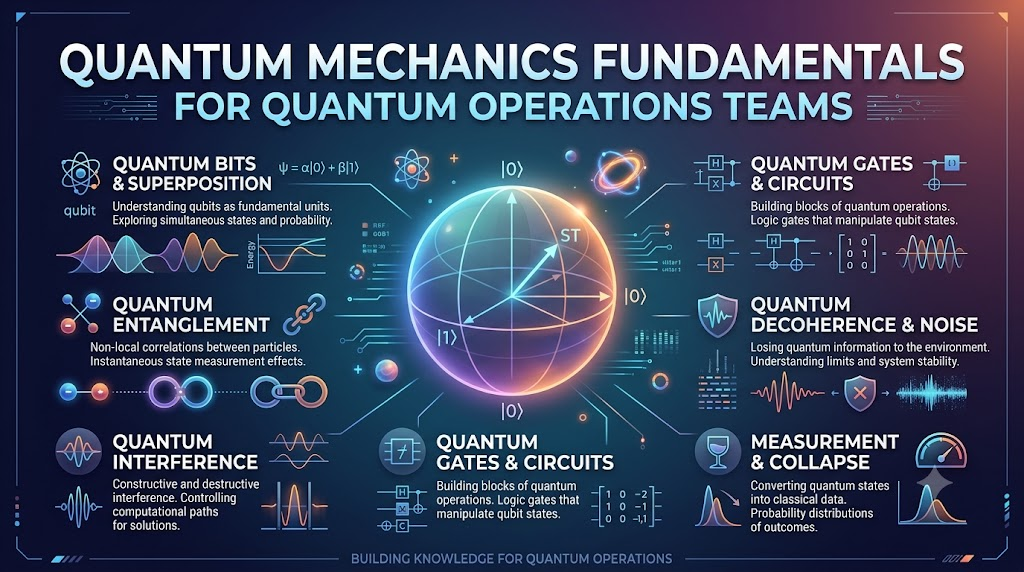
A normal server gives a predictable result. Run the same code twice, and you get the same answer both times. A quantum processor works differently. Its output can depend on probability, noise, measurement, and the exact state of its qubits.
This difference isn’t just interesting trivia. It directly shapes how QuantumOps teams do their job. If you don’t understand why a quantum job behaves the way it does, you can’t monitor it, test it, or troubleshoot it properly.
This guide covers the small set of quantum mechanics ideas that every QuantumOps beginner actually needs, without turning into a physics course.
Why Quantum Mechanics Matters in QuantumOps
QuantumOps is the operational layer that connects quantum software, hardware, classical infrastructure, and workflows. To manage this layer well, you need to understand a few core physics ideas.
Here’s why this matters in practice:
- Qubit states affect quantum jobs – What state a qubit starts in changes what a circuit does.
- Measurement produces probabilistic results – The same job can give different answers on different runs.
- Noise can affect results – Real hardware isn’t perfect, and that shows up in your output.
- Hardware conditions can affect execution – A poorly calibrated system can produce weaker results.
- Quantum circuits need special handling – They don’t behave like normal classical code.
- Quantum workloads often work with classical systems – Most real quantum jobs are part of a larger hybrid process.
QuantumOpsSchool describes QuantumOps as the layer that connects quantum software, hardware, classical infrastructure, and workflows across their full lifecycle. Understanding the physics behind this layer makes every operational decision easier.
Classical Computing vs Quantum Computing
Classical and quantum computers process information in fundamentally different ways.
Classical Computing:
- Uses bits
- Each bit is 0 or 1
- Operations are deterministic, meaning the same input always gives the same output
Quantum Computing:
- Uses qubits
- Qubits are described using quantum states
- Involves superposition
- Requires measurement
- Involves probability
It’s easy to think of quantum computers as just “faster computers.” That’s not accurate. They process information in a fundamentally different way, and that difference is exactly what QuantumOps teams need to manage.
What Is a Qubit?
A qubit is the basic unit of quantum information, similar to how a bit is the basic unit of classical information.
A qubit has two basis states, written as |0⟩ and |1⟩. Before measurement, a qubit’s state can be described as a combination of these two basis states.
It’s a common shortcut to say a qubit is “both 0 and 1 at the same time.” This isn’t quite accurate. The real idea, called superposition, is more specific, and we’ll explain it properly next.
What Is Superposition?
Superposition means a qubit’s state can be described as a combination of its basis states, before it gets measured.
Simple example: A qubit prepared in an equal superposition has a real chance of giving either 0 or 1 when measured, roughly 50% each.
For QuantumOps, this matters a lot. A quantum job doesn’t behave like a normal binary process that always gives the same answer. Teams need to expect and plan for this kind of variation.
What Is Entanglement?
Entanglement is a special kind of connection between qubits.
When two or more qubits are entangled, their combined state can’t be described as separate, independent states for each qubit. The qubits behave as a linked system instead.
Simple example: If two qubits are entangled, measuring one qubit can tell you something about the other qubit’s result, even though you haven’t measured it yet.
This isn’t some form of instant communication between the qubits. It’s a property of their shared quantum state. For QuantumOps, entanglement matters because multi-qubit circuits often depend on it working correctly to produce useful results.
What Is Quantum Measurement?
Measurement is the step where a quantum state turns into a classical result, either 0 or 1.
Here’s what matters for QuantumOps:
- Measurement produces classical results, not quantum ones.
- For many quantum states, results are probabilistic, not fixed.
- Running the same circuit many times produces a distribution of results, not one fixed answer.
- In the standard measurement picture, measuring a qubit changes its state.
Because results can vary, engineers often need many circuit runs, called shots, to understand the real output distribution. QuantumOpsSchool also highlights this probabilistic nature of measurement as a reason operational workflows need repeated runs, not single-shot testing.
What Is a Quantum State?
A quantum state describes the condition of a qubit or a group of qubits at a given moment.
A few basic ideas connect here:
- State vectors – A mathematical way to describe a quantum state.
- Probability amplitudes – Numbers that determine the likelihood of each possible measurement result.
- Basis states – The basic building blocks, like |0⟩ and |1⟩, that make up a state.
Simple example: A qubit’s state tells you the chance of getting 0 versus 1 when you measure it. You don’t need the full math to understand this at a beginner level, just the general idea.
What Are Quantum Gates?
Quantum gates are operations that change a qubit’s state, similar to how logic gates work in classical computing.
Some common gates include:
- X gate – Works similar to a bit flip, turning |0⟩ into |1⟩ and back.
- Y gate – Another type of single-qubit flip, involving phase changes.
- Z gate – Changes the phase of a qubit’s state without flipping it like the X gate.
- H gate (Hadamard) – Can create an equal superposition from a basic state.
- CNOT gate – Can create correlations between two qubits, often used to build entanglement.
You don’t need to understand the matrix math behind these gates to work in QuantumOps. Knowing what each gate generally does is enough for most operational tasks.
What Is a Quantum Circuit?
A quantum circuit is a sequence of quantum operations applied to one or more qubits.
The basic flow looks like this:
Qubits → Gates → Measurement → Classical Result
Circuits have a property called depth, which roughly means how many operations happen in sequence. A deeper circuit has more steps.
This matters for QuantumOps because deeper circuits are harder to run reliably on noisy hardware. More steps mean more chances for errors to build up before you even reach measurement.
What Is Quantum Interference?
Interference is a property that quantum algorithms can use to their advantage.
In simple terms, quantum algorithms can be designed so that useful outcomes become more likely, while unwanted outcomes become less likely. This happens through the way quantum states combine during a computation.
You don’t need wave equations to understand this at a beginner level. Just know that well-designed circuits use interference to steer results toward useful answers.
What Is Quantum Noise?
Quantum noise refers to unwanted changes in a quantum system, caused by outside factors.
Common sources include:
- Environmental effects – Heat, vibration, or electromagnetic interference.
- Hardware imperfections – No physical qubit is perfectly isolated or stable.
- Unwanted changes – Small shifts in a qubit’s state that shouldn’t happen.
- Measurement errors – Mistakes in reading out the final result.
- Gate errors – Imperfect execution of a quantum gate’s intended operation.
QuantumOpsSchool highlights that physical quantum systems are sensitive to noise, and operational teams need to track error behavior and hardware conditions closely as a result.
What Is Decoherence?
Decoherence happens when a qubit loses its useful quantum behavior because of interactions with its surrounding environment.
In simple terms, a qubit can only stay in a useful quantum state for a limited amount of time before outside noise disrupts it.
This connects directly to QuantumOps in a few ways:
- Qubit stability – Decoherence limits how long a qubit stays useful.
- Execution time – Circuits need to run within this limited window.
- Hardware monitoring – Teams track how stable qubits are over time.
- Circuit design – Shorter circuits are often more resistant to decoherence issues.
Quantum Errors
Quantum systems face a few common types of errors.
- Bit-flip errors – A qubit’s value flips unexpectedly, similar to a classical bit error.
- Phase-flip errors – The phase of a qubit’s state changes unexpectedly.
- Measurement errors – The readout doesn’t match the qubit’s actual state.
- Gate errors – A gate doesn’t perform its intended operation perfectly.
We won’t go deep into quantum error-correcting codes here. What matters for QuantumOps is knowing that these errors exist and need active monitoring and testing.
NISQ and Noisy Quantum Hardware
NISQ stands for Noisy Intermediate-Scale Quantum systems. This term describes the quantum hardware most teams work with today.
In simple terms, current quantum systems have real noise, and they don’t yet have full error correction built in.
This connects to several operational concerns:
- Hardware selection
- Circuit depth planning
- Error rate tracking
- Calibration schedules
- Job scheduling
- Result quality review
Understanding that today’s hardware is inherently noisy helps set realistic expectations for QuantumOps work.
Quantum Hardware and QPUs
A QPU, or Quantum Processing Unit, is the physical hardware that runs quantum circuits.
Here’s a simple comparison:
- CPU – Handles general classical computing tasks.
- GPU – Handles tasks that benefit from many parallel classical operations.
- QPU – Handles quantum operations on qubits.
A QPU doesn’t replace a CPU or GPU. Quantum systems almost always work alongside classical systems, not instead of them.
Why QuantumOps Uses Hybrid Computing
Most real quantum workloads follow a hybrid pattern, combining classical and quantum systems.
A typical flow looks like this:
Classical System → Prepare Data → Build Circuit → Submit Job → QPU Executes → Measure → Classical System Processes Results
QuantumOpsSchool describes quantum computing as a hybrid environment, where classical systems support and coordinate quantum workloads at nearly every step. This is why QuantumOps needs strong practices on both the classical and quantum sides.
Quantum Mechanics Concepts and Their QuantumOps Impact
| Quantum Concept | Simple Meaning | Why It Matters in QuantumOps |
|---|---|---|
| Qubit | Basic quantum information unit | Helps understand quantum workloads |
| Superposition | Combination of basis states | Affects circuit behavior |
| Entanglement | Strong quantum correlation | Matters in multi-qubit circuits |
| Measurement | Converts quantum information into classical results | Affects result collection |
| Noise | Unwanted changes in quantum systems | Affects reliability |
| Decoherence | Loss of useful quantum behavior | Limits execution time |
| Quantum Gates | Operations that change quantum states | Define circuit operations |
| Quantum Circuit | Sequence of quantum operations | Defines a quantum job |
Simple QuantumOps Example
Here’s how these ideas show up in a real workflow.
A QuantumOps team receives a quantum circuit from a developer. The team must:
- Check the circuit for issues.
- Select a suitable QPU.
- Check hardware status and calibration.
- Submit the job.
- Run enough shots to get a useful result distribution.
- Collect measurement results.
- Review error data from the run.
- Store the results for future comparison.
- Compare results with earlier runs.
Understanding superposition helps the team expect varied results. Understanding noise helps them judge whether the results look reasonable. Understanding measurement helps them know why multiple shots are needed in the first place.
Why Noise and Measurement Matter to Operations
A quantum job can produce different results across repeated runs, even with the exact same circuit.
Example (illustrative only):
Run 1: 48% result A, 52% result B
Run 2: 51% result A, 49% result B
These numbers aren’t real hardware data. They simply show the kind of variation teams should expect. Because of this, operations teams need to look at result distributions across many runs, rather than expecting one run to give a fixed, final answer.
Quantum Mechanics and Quantum Monitoring
QuantumOps teams typically monitor several things tied directly to the physics involved:
- Qubit availability
- Error rates
- Calibration status
- Circuit depth
- Job success rate
- Queue time
- Execution time
- Measurement results
- Hardware health
- Noise levels
Exact metrics vary by platform and hardware provider, but these categories cover most of what teams track day to day.
Quantum Mechanics and Quantum Testing
Testing quantum systems looks different from testing a normal classical application.
Key differences include:
- Probabilistic results – The same test can give different outputs across runs.
- Repeated circuit runs – Testing usually needs many shots, not just one.
- Expected output distributions – Success often means matching an expected pattern, not one fixed value.
- Noise – Real hardware results include noise that simulators may not fully capture.
- Hardware differences – Different QPUs can behave differently, even for the same circuit.
- Simulator vs real hardware – Both have a role, but they don’t always agree.
Because of this, QuantumOps teams often test on simulators first, then validate on real physical QPUs.
Common Beginner Mistakes
- Thinking quantum computers are just faster classical computers – They process information differently, not just faster.
- Thinking qubits are simply 0 and 1 at the same time – The real concept, superposition, is more specific than this.
- Confusing probability with probability amplitude – Amplitudes must be squared to get actual probabilities.
- Assuming every quantum result is deterministic – Many results are probabilistic by nature.
- Thinking every superposition is entanglement – These are related but different ideas.
- Ignoring noise – Noise is a real, ongoing operational concern, not a minor detail.
- Ignoring measurement – Measurement fundamentally shapes what results you get.
- Expecting simulator results to always match hardware results – Real hardware includes noise that simulators may not fully reflect.
What a QuantumOps Beginner Should Learn First
Building this knowledge works best step by step.
Step 1: Learn bits and basic computing.
Step 2: Learn what qubits are.
Step 3: Learn quantum states.
Step 4: Learn superposition.
Step 5: Learn measurement.
Step 6: Learn entanglement.
Step 7: Learn quantum gates.
Step 8: Learn quantum circuits.
Step 9: Learn noise and errors.
Step 10: Connect these ideas to QuantumOps monitoring, testing, scheduling, and automation.
QuantumOpsSchool’s own learning guidance also places these basic quantum computing concepts before deeper operational skills, since the operational side depends heavily on understanding the physics first.
FAQs
1. Why does QuantumOps require an understanding of quantum mechanics?
Because quantum hardware behaves differently from classical systems, and understanding why helps teams manage, monitor, and troubleshoot quantum workloads properly.
2. What quantum concepts should a QuantumOps beginner learn first?
Start with qubits, quantum states, superposition, measurement, and entanglement, then move to gates, circuits, and noise.
3. What is a qubit in simple terms?
A qubit is the basic unit of quantum information, described using basis states like |0⟩ and |1⟩.
4. Why is superposition important for QuantumOps?
It explains why a quantum job’s results can vary across runs, instead of always giving the same fixed answer.
5. Why does entanglement matter in quantum operations?
Many multi-qubit circuits rely on entanglement to work correctly, so understanding it helps teams judge circuit behavior.
6. How does measurement affect quantum jobs?
Measurement turns a quantum state into a classical result, and results can be probabilistic, often requiring many runs to understand.
7. What is quantum noise, and why does it matter?
Quantum noise is unwanted change in a quantum system, caused by hardware imperfections or environment effects, and it directly affects result reliability.
8. Why does decoherence matter for QuantumOps?
Decoherence limits how long a qubit stays useful, which affects circuit execution time and hardware monitoring practices.
9. How does quantum mechanics affect quantum testing?
Because results are probabilistic, testing often needs repeated circuit runs and comparisons against expected output distributions, not single fixed answers.
10. How does quantum mechanics affect QuantumOps monitoring?
It shapes what teams monitor, including qubit stability, error rates, calibration status, and noise levels across the hardware.
Conclusion
QuantumOps doesn’t require a physics degree, but it does require a solid grasp of a few key ideas. Qubits, superposition, entanglement, measurement, and noise all shape how quantum jobs actually behave in the real world.
Once these basics feel familiar, monitoring, testing, and managing quantum workloads starts to make a lot more sense. The physics isn’t separate from the operations work, it’s the foundation that explains why quantum systems need a different kind of care than classical ones.