Have you ever wondered how supercomputers solve giant math problems in seconds? Even the fastest machine you use today would take thousands of years to solve certain heavy tasks. This roadblock is why scientists built quantum computers. To prove these new machines work, researchers run special tests. These tests are known as quantum supremacy experiments.
If you want to master these concepts and learn how advanced computing works from industry pros, you can check out QuantumOpsSchool for clear guides and tutorials. These tests show a clear finish line where a quantum machine beats the best normal computer on earth.
Scientists use these tests to mark a huge milestone in tech history. They prove that quantum physics can do real work in the real world. You do not need a degree in physics to understand this. We will break down how these experiments work, why they matter, and what they mean for your digital future.
What Is a Quantum Computer
A regular computer uses tiny switches called bits. A bit can only be a zero or a one. Think of it like a light switch that is either turned on or turned off.
A quantum computer uses qubits instead of normal bits. Qubits can be both zero and one at the same time. This trick is called superposition.
Because of superposition, a quantum computer can look at millions of choices at once. Normal computers have to check options one by one. This is why quantum machines can think so much faster.
The Core Idea Behind Supremacy
The word supremacy simply means being the best or having the highest power. In science, quantum supremacy means a quantum computer finishes a task that a normal computer cannot finish in a reasonable time.
Researchers pick a very specific, hard math problem. It is usually a problem that has no practical use outside of testing speed. They give this problem to the biggest supercomputer available.
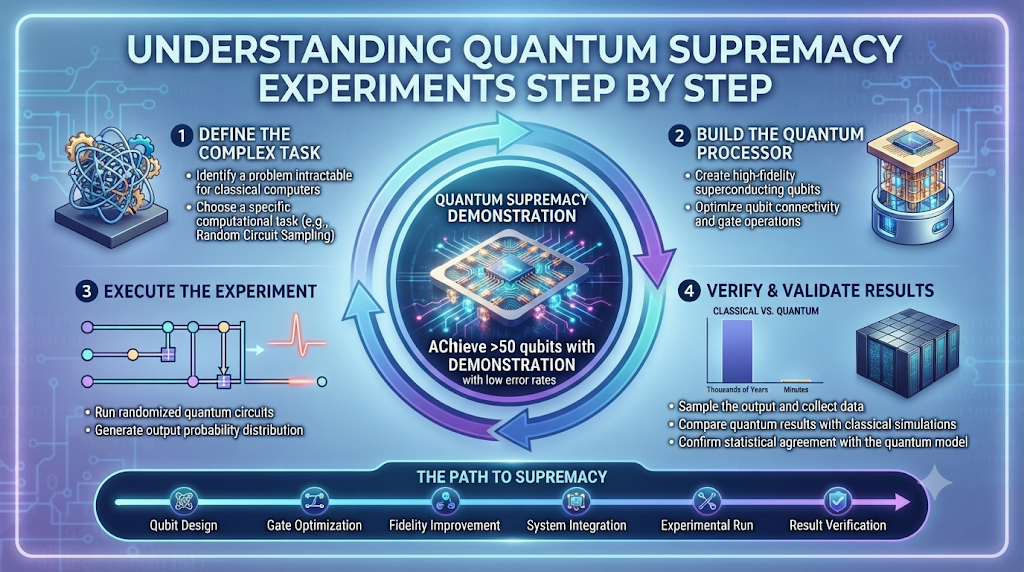
Then, they give the same problem to the quantum machine. If the quantum machine finishes in minutes while the supercomputer takes ten thousand years, the test wins. That is the entire goal of the experiment.
Why Normal Computers Fall Behind
Your laptop or phone is great for browsing the web and playing games. Big data centers are even stronger. But they all think in a straight line.
When a math problem grows very large, the number of choices grows too fast for normal chips. A supercomputer runs out of memory and time.
Quantum chips use the weird rules of subatomic particles to skip the line. They test all paths at once. This lets them solve complex puzzles without breaking a sweat.
How Researchers Run the Test
Running these tests is not easy. Quantum machines are very fragile. They need special fridges that are colder than outer space to run properly.
First, scientists write a special code that uses random numbers. They send this code into the quantum processor.
Next, the processor runs the code millions of times. It creates a complex pattern of outputs.
Finally, scientists check if the pattern matches what the math predicts. If it does, the test is a success.
Real-World Stories and Case Studies
- The First Big Win: A famous team used a 53-qubit processor to solve a random sampling puzzle in two hundred seconds, while a top supercomputer would have needed ten thousand years.
- The Cooling Crisis: One early test failed for three days straight because a tiny pipe in the ultra-cold fridge had a microscopic leak that let warm air in.
- The Power Grid Test: Engineers tried to map power grid failures using early qubits, but background noise ruined the data until they added better shielding to the lab.
- The Supercomputer Push: After a quantum win, rival engineers updated their supercomputer code and cut the estimated ten-year task time down to just a few days.
- The Noise Problem: A lab ran a supremacy test, but stray Wi-Fi signals in the building flipped the fragile qubits until the team moved the machine to a steel box.
- The Algorithm Rewrite: Programmers spent six months rewriting the test code to use fewer steps, which cut the error rate in half and proved the hardware was stable.
- The Global Race: Two different labs claimed supremacy in the same year using different methods, which led to a healthy debate over what counts as a fair test.
- The Cloud Access Milestone: A university team ran a quantum test from thousands of miles away using a web browser, proving these machines can work over the cloud.
- The Battery Simulation: Researchers used a mini supremacy test to simulate a new battery chemical structure, solving a puzzle normal laptops could not touch.
- The Student Project: A group of grad students built a small simulator on a desktop to mimic a supremacy test, helping them spot flaws in the main lab design.
Quantum vs Traditional Computing
| Feature | Traditional Computer | Quantum Computer |
| Basic Unit | Bit (Zero or One) | Qubit (Zero, One, or Both) |
| Processing Style | One step at a time | All steps at once |
| Temperature | Room temperature | Near absolute zero |
| Best Use Case | Everyday apps, web browsing | Complex math, simulations |
| Error Rate | Very low and stable | High, needs constant fixing |
Common Mistakes and Pitfalls
- Mistake: Expecting quantum computers to replace your home laptop. Solution: Understand that quantum machines are only meant for heavy math tasks, not daily web browsing.
- Mistake: Ignoring background heat and noise. Solution: Always use heavy shielding and ultra-cold fridges to keep qubits stable during tests.
- Mistake: Choosing the wrong math problem for the test. Solution: Pick random sampling problems that specifically highlight quantum speed advantages.
- Mistake: Forgetting to account for hardware errors. Solution: Build error-correcting steps into your code to catch flipped qubits early.
- Mistake: Believing supremacy means all problems are solved. Solution: Remember that supremacy is just a milestone, not an end to all tech limits.
- Mistake: Using normal coding habits for quantum systems. Solution: Learn quantum logic gates and think in terms of probabilities instead of direct answers.
- Mistake: Relying on unverified claims without peer review. Solution: Wait for independent labs to replicate the test results before celebrating.
- Mistake: Underestimating the power of updated supercomputers. Solution: Keep tracking traditional computer upgrades because they keep getting faster too.
- Mistake: Skipping basic safety steps in cryogenic labs. Solution: Follow strict liquid helium handling rules to prevent frostbite and pressure buildup.
- Mistake: Treating the test as a commercial product too soon. Solution: View supremacy tests as pure research tools while hardware matures.
Step-by-Step Implementation Roadmap
- Set Up the Lab Environment: Build a vibration-free room with strict climate controls to house the delicate hardware.
- Install Cooling Systems: Hook up dilution refrigerators to cool the processor down to near absolute zero temperatures.
- Calibrate the Qubits: Run diagnostic pulses to make sure every single qubit responds accurately to control signals.
- Write the Test Code: Draft a random circuit sampling algorithm designed to push the processor to its limits.
- Run the Initial Test: Execute the code on the quantum processor and record the raw output data patterns.
- Capture Baseline Data: Run the exact same problem on a high-end classical supercomputer to get a time baseline.
- Filter Out Noise: Apply error mitigation software to clean up stray signals and fix flipped qubit values.
- Compare the Results: Measure how long the quantum machine took versus the estimated time for the supercomputer.
- Verify the Output: Check the mathematical probability distribution to prove the quantum results are correct.
- Publish and Review: Share the data with independent peers to confirm the milestone and document the findings.
Frequently Asked Questions
1. What does quantum supremacy actually mean?
It means a quantum computer has solved a complex problem faster than any normal supercomputer ever could.
2. Can I buy a quantum computer for my home?
No, these machines require giant cooling tanks and cost millions of dollars to build and run.
3. Are normal computers going away soon?
No, normal computers are still the best tools for everyday tasks like writing, gaming, and web browsing.
4. Why do quantum computers need to be so cold?
Heat causes tiny vibrations that make qubits lose their data, so they must be kept near absolute zero.
5. Do these experiments have real-world uses?
The specific test problems are chosen just for speed, but the technology behind them helps build better medicines and secure codes.
6. Who won the first quantum supremacy race?
A team of corporate researchers announced the first major verified win using a 53-qubit processor.
7. What is a qubit?
A qubit is the basic unit of quantum information that can exist in multiple states at the same time.
8. How long do these supremacy tests take?
The actual quantum calculation often takes just a few minutes or even seconds to finish.
9. Can anyone run a quantum test online?
Yes, many cloud platforms let developers send small code tasks to real quantum processors over the web.
10. What is the next big goal after supremacy?
The next goal is building fault-tolerant systems that can run useful business and science programs without errors.
Final Recommendation
Quantum supremacy experiments are much more than just a race for bragging rights. They mark the exact moment humanity proved that a new kind of computing is possible. While these machines are still growing up, understanding how they work gives you a front-row seat to the future of technology.
Your best next step is to explore basic quantum logic tutorials online or read up on how qubits use superposition. Keep testing your knowledge and stay curious as this amazing field continues to grow.