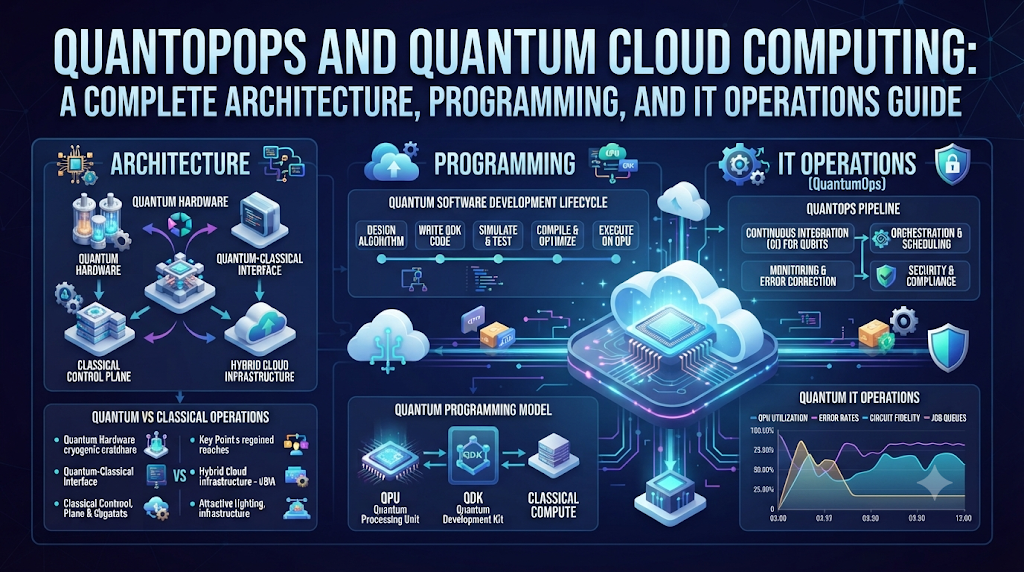
How do software engineers, cloud architects, and IT managers run workloads on quantum processors without owning a cryogenic dilution refrigerator? The answer lies in quantum cloud computing and the emerging discipline of QuantumOps—the operational, architectural, and software practices required to build, deploy, and manage quantum-classical applications in production-like cloud environments.
For decades, quantum computing remained confined to physics laboratories. Today, cloud platforms allow any developer with a Python environment and an internet connection to design quantum circuits, run noise-modeled simulations, and execute workloads on real quantum processing units (QPUs). However, connecting quantum hardware to enterprise IT systems introduces unfamiliar challenges: probabilistic outputs, hardware noise, specialized transpilation pipelines, and tight hybrid loops with classical compute clusters.
This guide explores the complete landscape of quantum cloud architecture, hybrid quantum-classical workflows, programming frameworks, and operational governance. Whether you are a classical software engineer writing your first circuit or an IT manager evaluating quantum readiness, you will learn how quantum systems work from the ground up and how to integrate them into modern cloud operations.
Quantum Computing Fundamentals: Explaining the Technology from Scratch
Before provisioning cloud quantum resources or writing code, technology professionals need a clear mental model of how quantum computers process information differently from classical servers.
Classical Bits vs. Qubits
A classical computer—from a smartphone to a hyperscale data center—stores and processes data using bits. A bit is binary: it exists strictly in one of two states, 0 or 1, represented physically by high or low electrical voltage across transistors.
A quantum computer uses quantum bits, or qubits. Instead of relying solely on binary voltage levels, qubits use quantum mechanical properties—such as the spin of an electron, the polarization of a photon, or energy states in superconducting circuits—to represent information.
Superposition and Entanglement
Two core quantum phenomena give qubits their distinct computational behavior:
- Superposition: While a classical bit must be either
0or1, a qubit can exist in a linear combination (superposition) of both0and1simultaneously until it is measured. Mathematically, a qubit state ∣ψ⟩ is written as ∣ψ⟩=α∣0⟩+β∣1⟩, where α and β are complex probability amplitudes such that ∣α∣2+∣β∣2=1. When you measure the qubit, superposition collapses, returning a classical0with probability ∣α∣2 or a classical1with probability ∣β∣2. - Entanglement: Entanglement links two or more qubits so tightly that the state of one qubit cannot be described independently of the others, even when separated physically. Measuring one entangled qubit immediately determines the measurement outcome of its partner. Algorithms use entanglement alongside interference to amplify the probability of correct answers and cancel out incorrect ones.
Quantum Gates, Circuits, and Simulators
In classical computing, logic gates (AND, OR, NOT) manipulate bits. In quantum computing, quantum gates (such as the Hadamard gate H, Pauli-X gate X, and Controlled-NOT gate CNOT) are reversible linear transformations applied to qubits to alter their probability amplitudes and create entanglement.
- Quantum Circuit: A sequence of quantum gates applied to a register of qubits over time, ending with measurement operations that convert quantum states back into classical bits.
- Quantum Simulator: Classical software running on CPUs or GPUs that mathematically models how a quantum circuit behaves. Simulators are essential for debugging algorithms before paying for or queuing on real quantum hardware, though they become exponentially slower as qubit counts grow beyond roughly 30 to 40 qubits.
- Quantum Hardware (QPU): The physical processor—built using modalities like superconducting transmons, trapped ions, or neutral atoms—that executes quantum gates on physical qubits.
Why Quantum Cloud Computing and QuantumOps Matter Today
Quantum computers are not general-purpose replacements for classical CPUs or GPUs. They will not run your relational databases, host web servers, or render video games faster. Instead, quantum processors act as specialized co-processors designed for specific mathematical structures where classical algorithms scale poorly.
Organizations and researchers are actively exploring quantum cloud environments across several high-impact domains:
- Optimization Problems: Logistics routing, airline crew scheduling, energy grid balancing, and portfolio allocation involve combinatorial optimization. Algorithms such as the Quantum Approximate Optimization Algorithm (QAOA) explore large solution spaces alongside classical optimizers.
- Molecular and Material Simulation: Simulating chemical reactions, battery electrolytes, catalysts, and pharmaceutical compounds requires modeling quantum mechanics directly—a task that overwhelms classical supercomputers as molecules grow complex.
- Financial Modeling: Risk analysis, derivative pricing, and Monte Carlo simulations are active research areas where quantum amplitude estimation may eventually offer asymptotic speedups.
- Cryptography and Quantum Security: While large-scale fault-tolerant quantum computers capable of breaking RSA or ECC encryption do not yet exist, organizations must prepare now by adopting Post-Quantum Cryptography (PQC) and exploring Quantum Key Distribution (QKD).
Distinguishing Current Reality from Future Potential: Today’s hardware belongs to the Noisy Intermediate-Scale Quantum (NISQ) and early utility era. Physical qubits are sensitive to environmental interference (thermal noise, electromagnetic fluctuations), causing errors before long computations finish. Consequently, current enterprise adoption focuses on cloud experimentation, algorithm benchmarking, hybrid workflow design, and workforce readiness rather than immediate production replacement of classical workloads.
How a Cloud Quantum Workload Works: Step-by-Step
Running a quantum workload in the cloud involves an end-to-end pipeline that bridges classical software engineering with physical hardware constraints.
[1. Problem Formulation] ──▶ [2. Circuit Design (SDK)] ──▶ [3. Local Simulation]
                                                                    │
[6. Classical Post-Processing] ◀── [5. QPU Execution] ◀── [4. Transpilation & Routing]
- Identify and Map the Problem: Determine whether the problem maps cleanly to a quantum formulation (such as an Ising Hamiltonian or quadratic unconstrained binary optimization model). Classical baselines are established first.
- Select a Programming Framework: Choose a Python-based SDK such as Qiskit, Cirq, Amazon Braket SDK, or the Microsoft Quantum Development Kit (QDK).
- Construct the Quantum Circuit: Define the qubit register, apply gates to prepare states and entangle qubits, and specify measurement bases.
- Test on a Quantum Simulator: Execute the circuit locally on a state-vector or density-matrix simulator to verify logical correctness without hardware noise.
- Transpile for Target Hardware: Real QPUs only support specific native gate sets and have limited physical connectivity between qubits. A transpiler rewrites your abstract circuit into native gates and inserts
SWAPgates so connected qubits can interact. - Submit the Job to the Cloud Queue: Authenticate via cloud Identity and Access Management (IAM), package the circuit, and submit it to a remote QPU or cloud simulator with a specified number of shots (repetitions, typically 1,000 to 10,000, needed to build a statistical probability distribution).
- Apply Error Mitigation and Post-Process: Retrieve the bitstring counts, apply noise-mitigation techniques, and feed the classical results back into your application or classical optimizer.
Tools, Frameworks, and Quantum Cloud Platforms
Navigating the quantum ecosystem requires understanding how open-source SDKs interact with managed cloud providers. Professionals enrolling in a Qiskit programming course or AWS Braket training typically work across several of these platforms.
| Platform / Tool | Type | Primary Languages | Accessible Hardware Modalities | Key Operational Strength |
|---|---|---|---|---|
| Qiskit & IBM Quantum | Open-source SDK + Cloud Platform | Python (C interfaces available) | Superconducting QPUs (IBM Eagle, Heron) + Simulators | Mature transpiler, Qiskit Runtime primitives, Qiskit Functions |
| Amazon Braket | Managed AWS Cloud Service | Python (Braket SDK, PennyLane, OpenQASM 3.0) | Superconducting (Rigetti, IQM), Trapped Ion (IonQ), Neutral Atom (QuEra) | Multi-vendor QPU access, AWS IAM/S3 integration, Hybrid Jobs |
| Microsoft Azure Quantum | Managed Azure Cloud Service | Q#, Python, OpenQASM, Qiskit, Cirq | Trapped Ion (Quantinuum, IonQ), Neutral Atom (Atom Computing) | Azure Quantum Resource Estimator, tight Microsoft Entra ID integration |
| Google Cirq | Open-source Framework | Python | Google Quantum AI processors (via authorized access) + qsim | Hardware-aware circuit control, gate timing, and noise modeling |
Qiskit and IBM Quantum
Qiskit is an open-source software development kit used globally to build, transpile, and execute quantum circuits. Paired with IBM Quantum Platform, developers use standardized primitives—specifically Sampler (for retrieving bitstring probability distributions) and Estimator (for calculating expectation values of quantum observables). Qiskit Runtime manages execution inside containerized environments close to the quantum hardware, reducing latency for iterative workflows.
Amazon Braket
Amazon Braket is a fully managed AWS service that provides a single API and development environment to test circuits on simulators and run them across diverse hardware providers—including IonQ, Rigetti, IQM, and QuEra. Because Braket sits inside the standard AWS ecosystem, cloud engineers can govern quantum tasks using AWS IAM policies, store output artifacts in Amazon S3, monitor execution via Amazon CloudWatch, and orchestrate variational loops using Amazon Braket Hybrid Jobs.
Microsoft Quantum Development Kit (QDK) and Azure Quantum
The Microsoft Quantum Development Kit supports Q#, a standalone quantum programming language designed around classical control flow and hardware-agnostic abstractions, alongside Python interoperability. Azure Quantum connects workspaces to third-party QPUs (such as Quantinuum and IonQ) and includes the Azure Quantum Resource Estimator, which calculates how many logical and physical qubits a future fault-tolerant algorithm would require.
Google Cirq
Cirq is a Python framework tailored for NISQ architectures where low-level hardware details—such as qubit grid coordinates, native gate sets, and gate durations—directly impact circuit fidelity. Cirq pairs with qsim, a high-performance state-vector simulator, and Virtual Machine tools that mimic real hardware noise profiles.
Practical Example: Building and Simulating a Bell State in Qiskit
To see how quantum programming works in practice, let us build a Bell state—the foundational two-qubit entangled state—using Python and Qiskit.
Prerequisites
- Python 3.10 or higher
- Qiskit SDK installed (
pip install qiskit)
Step-by-Step Python Code
Python
from qiskit import QuantumCircuit
from qiskit.primitives import StatevectorSampler

# 1. Initialize a quantum circuit with 2 qubits and 2 classical bits
qc = QuantumCircuit(2, 2)

# 2. Place qubit 0 into an equal superposition using a Hadamard gate
qc.h(0)

# 3. Entangle qubit 0 (control) and qubit 1 (target) using a CNOT gate
qc.cx(0, 1)

# 4. Measure both qubits into the classical register
qc.measure([0, 1], [0, 1])

# 5. Run the circuit on a local reference simulator for 1,000 shots
sampler = StatevectorSampler()
job = sampler.run([qc], shots=1000)
result = job.result()[0]

# 6. Retrieve and display measurement counts
counts = result.data.c.get_counts()
print("Measurement outcomes:", counts)
How This Code Works
QuantumCircuit(2, 2)allocates two qubits (initialized to ∣00⟩) and two classical bits to store measurement outcomes.qc.h(0)applies a Hadamard gate to the first qubit, putting it into a 50/50 superposition of ∣0⟩ and ∣1⟩.qc.cx(0, 1)applies a Controlled-NOT (CNOT) gate. If qubit 0 is1, it flips qubit 1; if qubit 0 is0, it leaves qubit 1 unchanged. This creates the entangled state 21(∣00⟩+∣11⟩).
qc.measure([0, 1], [0, 1])collapses both qubits into classical bits.StatevectorSampler()simulates an ideal, noise-free quantum processor across 1,000 shots.
Expected Output: Because the two qubits are entangled, you will observe approximately 500 counts of '00' and 500 counts of '11' (for example, {'00': 508, '11': 492}), and zero counts of '01' or '10'. When executed on a real cloud QPU rather than an ideal simulator, hardware noise will introduce a small percentage of '01' and '10' errors.
Quantum Computing Architecture and Cloud Infrastructure
From an infrastructure and DevOps perspective, a quantum computer is not a standalone server—it is a tightly integrated stack of classical control electronics, cryogenic physics hardware, and cloud orchestration layers.
- Quantum Processing Unit (QPU): The physical chip housing the qubits. Superconducting QPUs operate inside dilution refrigerators cooled to roughly 10–15 millikelvin (colder than outer space) to preserve fragile quantum states.
- Quantum Control and Readout Electronics: Room-temperature classical FPGA (Field-Programmable Gate Array) systems and microwave pulse generators that translate digital gate instructions into precise analog control pulses and read back analog measurement signals.
- Compilation and Transpilation Layer: Software services that map logical qubits to physical QPU topologies, optimize gate depth to minimize decoherence, and calibrate pulse schedules.
- Cloud Runtime and API Gateway: REST APIs, container runtimes, job schedulers, and queueing systems that handle multi-tenant access, authentication, billing, and telemetry.
- Security and Governance Layer: Role-based access control (RBAC), encryption in transit (including emerging hybrid TLS with post-quantum key encapsulation), audit logging, and network isolation (such as AWS PrivateLink or Azure Private Endpoints).
Hybrid Quantum-Classical Computing
Because current QPUs have limited coherence times and cannot easily perform classical tasks like file I/O, branching logic, or large-scale data preprocessing, nearly all practical quantum applications use hybrid quantum-classical computing.
In a hybrid architecture, classical CPUs/GPUs and QPUs divide the workload based on what each does best:
- Classical Computer Role: Preprocesses input data, initializes circuit parameters, evaluates cost functions, runs gradient-free or gradient-based optimization algorithms (such as COBYLA or Adam), and stores final outputs.
- Quantum Computer Role: Executes a parameterized quantum circuit (ansatz) to prepare complex quantum states and measures expectation values that are intractable to compute classically.
Example Hybrid Loop (Variational Quantum Eigensolver – VQE):
- A classical orchestrator selects initial rotation angles θ for gates in a quantum circuit.
- The cloud runtime submits the parameterized circuit to a QPU.
- The QPU executes the circuit thousands of times and returns energy expectation values to the classical node.
- The classical optimizer updates θ to lower the energy and repeats the loop until convergence.
Without low-latency cloud orchestration—such as Qiskit Runtime sessions or Amazon Braket Hybrid Jobs—network queuing delays between every iteration would make hybrid algorithms impractical.
Benefits, Limitations, and Operational Challenges
Technology leaders evaluating quantum computing for IT managers must weigh genuine architectural capabilities against current physical constraints.
Potential Benefits
- On-Demand Hardware Diversity: Cloud platforms eliminate the multi-million-dollar capital expense of purchasing, housing, and maintaining physical quantum hardware, allowing teams to benchmark superconducting, trapped-ion, and neutral-atom QPUs through a single cloud bill.
- Seamless DevOps Integration: Quantum workloads can be version-controlled in Git, tested via automated CI/CD pipelines using simulators, and monitored through existing cloud observability tools.
- Algorithmic Exploration: Organizations gain early intellectual property and domain intuition by mapping high-value optimization and simulation problems onto quantum workflows before fault-tolerant hardware arrives.
Limitations and Challenges
- Hardware Noise and Decoherence: Qubits lose their quantum state within microseconds to milliseconds. Deep circuits accumulate too much error to yield meaningful results without heavy error mitigation.
- Scalability and Error Correction Overhead: Achieving fault-tolerant quantum computing requires Quantum Error Correction (QEC), which encodes a single reliable logical qubit across dozens or hundreds of noisy physical qubits.
- Queue Times and Execution Costs: Dedicated QPU reservations and per-shot cloud execution fees can accumulate rapidly during iterative hybrid training runs if workloads are not validated on simulators first.
- Skills Shortage: Few professionals combine classical cloud architecture, Python software engineering, and quantum information fundamentals.
Skills, Training, and Career Development
Transitioning into quantum computing does not require a PhD in theoretical physics. Depending on your current background, you can build practical capability step by step:
- Core Foundations: Proficiency in Python, basic linear algebra (vectors, matrices, tensor products, eigenvalues), and probability distributions.
- Quantum Programming: Understanding quantum gates, circuit construction, transpilation, and SDKs like Qiskit or Cirq.
- Cloud & QuantumOps: Managing cloud IAM, containerized runtimes, hybrid job orchestration, cost controls, and post-quantum security policies.
Professionals looking for structured upskilling often pursue quantum cloud computing training, a quantum computing certification course, or a specialized quantum computing architecture course. At QuantumOps School, the advertised curriculum aligns with four distinct enterprise roles:
- QuantumOps Architect: Focuses on end-to-end system architecture, hardware selection, hybrid quantum-classical integration, and cloud infrastructure design.
- QuantumOps Engineer: Focuses on hands-on circuit programming, Qiskit and cloud SDK development, transpilation optimization, and CI/CD automation.
- QuantumOps Manager: Designed for IT leaders overseeing quantum readiness assessments, vendor governance, budget planning, and cross-functional teams.
- QuantumOps Professional: Builds foundational fluency across qubits, quantum algorithms, simulators, and cloud execution workflows.
Pursuing a QuantumOps certification helps validate practical familiarity with bridging quantum frameworks and cloud operations, though candidates should always pair credentials with a public GitHub portfolio of working circuits and hybrid benchmarks.
Business Applications and IT Operations Governance
When enterprises launch quantum initiatives, success depends on disciplined IT governance rather than ad-hoc experimentation:
- Conduct a Quantum Readiness Assessment: Inventory existing cryptographic dependencies (to prepare for post-quantum cryptography transitions) and identify NP-hard optimization or molecular simulation bottlenecks.
- Establish Cloud Governance and FinOps: Set strict spending alerts and shot quotas on cloud quantum workspaces. Enforce a policy requiring developers to validate circuits on local simulators before submitting jobs to paid QPUs.
- Standardize Security Controls: Integrate quantum cloud access with corporate Single Sign-On (SSO) and role-based access control, ensuring proprietary problem formulations and molecular datasets remain encrypted and compliant.
- Build Cross-Functional Pods: Pair domain experts (chemists, supply-chain analysts, quantitative researchers) with classical software engineers and cloud architects so quantum prototypes connect cleanly to enterprise data pipelines.
Common Mistakes to Avoid
- Assuming Quantum Is Faster for Everything: Using a quantum circuit to sort a list or query a database is slower and vastly more expensive than classical code. Always benchmark against optimized classical solvers.
- Treating Ideal Simulator Results as Hardware Guarantees: A circuit that produces 100% accurate results on a noise-free state-vector simulator may degrade into random noise on a real QPU due to gate depth and qubit connectivity limits.
- Skipping Transpilation Awareness: Ignoring how a transpiler maps virtual qubits onto physical hardware topology can insert excessive
SWAPgates, destroying circuit fidelity. - Neglecting Classical Infrastructure Bottlenecks: In hybrid workflows, slow classical data serialization or poor cloud region placement between your classical compute instance and the QPU creates severe latency bottlenecks.
Best Practices and Actionable Recommendations
- Start Local, Scale to Cloud: Write and unit-test circuits using local simulators first, move to cloud-hosted noisy simulators second, and reserve real QPU runs for final validation and hardware benchmarking.
- Keep Circuits Shallow: Minimize two-qubit gate counts (
CNOT,CZ), as two-qubit gates typically have significantly higher error rates than single-qubit rotations. - Use Hardware-Agnostic Abstractions Where Possible: Leverage OpenQASM 3.0 or multi-backend SDKs so your team can benchmark the same algorithm across superconducting and trapped-ion architectures without rewriting core logic.
- Invest in Quantum-Safe Security Now: Begin cryptographic inventory and TLS 1.3 migrations today so your classical cloud infrastructure is ready for NIST-standardized post-quantum algorithms (such as ML-KEM and ML-DSA).
Future Trends in Quantum Cloud and QuantumOps
Over the next several years, several technical shifts will reshape how IT teams operate quantum systems:
- Early Fault-Tolerant Architectures: Hardware providers are transitioning from raw physical qubit scaling toward demonstrated logical qubits with real-time error detection and correction.
- HPC-Quantum Supercomputing Integration: Major supercomputing centers and cloud providers are tightly coupling QPUs with GPU clusters using standardized resource management interfaces (such as Slurm plugins and Qiskit Runtime) to accelerate hybrid scientific computing.
- Higher-Level Application Functions: Rather than forcing every developer to design low-level quantum gates, cloud platforms are introducing domain-specific quantum functions where enterprise developers pass classical graphs or Hamiltonians and receive optimized results.
- Mandatory Post-Quantum Cryptography (PQC) Migration: Regulatory frameworks and cloud security standards are accelerating enterprise migration toward quantum-resistant encryption across APIs, key management services, and network layers.
How QuantumOps School Supports Your Learning Journey
For developers, cloud engineers, and technology leaders seeking structured guidance, QuantumOps School bridges quantum computing theory with practical cloud and IT operations. Its advertised learning tracks—covering Architect, Engineer, Manager, and Professional pathways—combine instructor-led sessions, hands-on laboratory exercises, quantum circuit simulations, technical case studies, and capstone projects across frameworks such as Qiskit, Cirq, AWS Braket, IBM Quantum, and Azure Quantum.
For organizations seeking external guidance, QuantumOps School also offers quantum computing consulting services covering quantum cloud integration, hybrid quantum-classical system design, algorithm exploration, workload optimization, and quantum security strategy. Exploring structured quantum computing for software engineers and operations teams can help demystify complex quantum mechanics and turn them into repeatable engineering workflows.
Conclusion
Quantum cloud computing has transformed quantum processors from isolated physics experiments into programmable cloud resources accessible to any engineering team. By mastering the fundamentals of qubits, superposition, entanglement, and transpilation—and combining them with disciplined cloud governance and hybrid quantum classical computing training—technology professionals can build realistic, high-value proof-of-concept applications today while preparing their organizations for fault-tolerant architectures tomorrow.
Your most practical next step is hands-on experimentation: install Qiskit or the Amazon Braket SDK in a local Python environment, build and simulate a simple entangled circuit, and explore how noise models affect your measurement distributions.
Frequently Asked Questions (FAQs)
1. What is QuantumOps in cloud computing?
QuantumOps is the set of architectural, software engineering, and IT operations practices used to develop, test, deploy, monitor, and govern quantum and hybrid quantum-classical workloads in cloud environments.
2. Do I need a physics degree to learn quantum programming?
No. While understanding quantum mechanics helps at the research level, software engineers can write and run quantum circuits using Python frameworks like Qiskit and Cirq with a basic grasp of linear algebra, probability, and logic gates.
3. How does quantum cloud computing work?
Quantum cloud platforms host physical quantum processing units (QPUs) and high-performance classical simulators in specialized data centers, exposing them via REST APIs and Python SDKs so developers can submit circuits remotely and retrieve measurement results.
4. What is the difference between a quantum simulator and a real QPU?
A quantum simulator is software running on classical CPUs or GPUs that mathematically calculates how a quantum circuit behaves. A QPU is physical quantum hardware that manipulates real qubits, introducing physical hardware noise and decoherence not present in ideal simulators.
5. Why are hybrid quantum-classical systems used instead of pure quantum programs?
Current quantum processors have limited qubit counts and short coherence times, making them unsuitable for data storage, I/O, or classical optimization loops. Hybrid systems let classical servers handle data preprocessing and parameter optimization while QPUs execute targeted quantum circuits.
6. Which programming language is most widely used for quantum computing?
Python is the dominant language across the quantum ecosystem, serving as the primary interface for Qiskit, Cirq, Amazon Braket SDK, and PennyLane, while Microsoft Azure Quantum also supports Q# alongside Python.
7. What is transpilation in a quantum computing workflow?
Transpilation is the compilation step that translates an abstract, hardware-independent quantum circuit into the specific native gate set and physical qubit connectivity topology of a target QPU, optimizing gate count to reduce errors.
8. How can IT managers evaluate if their organization needs quantum computing?
IT managers should start with a quantum readiness assessment: first auditing cryptographic systems for post-quantum security compliance, and second identifying high-value combinatorial optimization or molecular simulation problems suitable for low-cost cloud proof-of-concept testing.
9. What does a Qiskit programming course cover?
A comprehensive Qiskit programming course typically covers qubit states, quantum gates, circuit construction, local state-vector and noisy simulation, circuit transpilation, Qiskit Runtime primitives (Sampler and Estimator), and executing jobs on IBM Quantum cloud backends.
10. How does AWS Braket training help cloud engineers?
AWS Braket training teaches cloud engineers how to build circuits with the Braket SDK, test on managed simulators (SV1 and DM1), execute workloads across multi-vendor QPUs, and manage security, storage, and hybrid jobs using IAM, S3, and CloudWatch.
11. What is the difference between a QuantumOps Architect and a QuantumOps Engineer?
A QuantumOps Engineer focuses on coding quantum circuits, running simulations, optimizing transpilation, and automating CI/CD workflows, whereas a QuantumOps Architect designs end-to-end hybrid cloud infrastructure, selects hardware modalities, and establishes security and governance frameworks.
12. Are current quantum computers ready for production enterprise workloads?
Most current quantum hardware is best suited for research, algorithm benchmarking, hybrid experimentation, and workforce skill development rather than replacing production classical systems, due to hardware noise and qubit scale limitations.